Showing posts with label Black Swallowtail. Show all posts

Sunday, 29 October 2023

Random seasonal highlights, late larvae, etc.

 With the seasonal ups and downs, it must have some of the butterflies confused. I don't recall ever seeing Black Swallowtail caterpillars so abundant so late in the season, but just in the last couple of days before the temperature took a significant drop (Oct 25), we came across three caterpillars out feeding on some carrots that are still in the garden.

They were all fairly well developed, so if they hurried, they may have been able to complete this stage and form a pupa for the over winter period.

Good luck to them!

The Keith McLean Conservation Lands have been an ongoing place of interest. One never knows what to expect, except that it seems to attract Nelson's Sparrows fairly regularly in October. I have been there a couple of times, and have seen them both times, but they are often elusive and do not cooperate for the camera. Some folks have gotten some quite good photos during their visits, but so far I have only gotten one poor record shot, as shown next.

This is one of my best shots, from a couple of years ago. There is still time for more attempts this year, but depending on the weather, opportunities will be dwindling.

White-crowned Sparrows were a little more accommodating.

There have been lots of Green-winged Teal, and other ducks. This next photo shows some of these teal, and in their midst are some Dunlin and a single Killdeer. Dunlin have been quite abundant, with sometimes more than 100 noted.


Dunlin in flight
Occasionally another lingering shorebird can be found, such as this Greater Yellowlegs I photographed there a couple of days ago.
One or two Great Blue Herons sometimes provide a photo op.

I missed out on the Cattle Egret that was seen on one occasion, but it may still be around somewhere in Chatham-Kent. I will keep looking!

At Rondeau, there is an abundance of berries on some but not all, of the Red Cedars, especially in the campground, and if one can find the right tree that the birds have also found, it can be rewarding. Light is important, but the birds are not considering that in their quest for nourishment. 

Robins, of course....

....and it is nice to see a group of Cedar Waxwings, both adults....
...and young of the year. I kept an eye open for the very rare Bohemian Waxwing, but did not see any. No one else has reported them lately either, but it is not impossible.

Pileated Woodpeckers are year-round residents of Rondeau, but not commonly seen. Decent photo ops are always fun.

It wasn't all that long ago that the forest looked typically like this, still fairly green and luxuriant.

These next few are from one of my 'go-to' spots to show the changes. It is at the corner of Rondeau Road and Gardiner Ave.
October 19

Oct 23

October 27

There is more and more sky showing, but by moving a bit and using a longer focal lens, I can get the colourful tunnel look.

This next photo is at another one of my 'go-to' spots to show the colour. It is along Bennett Ave.

Elsewhere not far from home, I have been up along the Lake St. Clair wetlands. There have been a few of the usual things of interest, including a few Midland Painted Turtles soaking up some late season sunshine.

Sandhill Cranes continue to be seen.....

Duck diversity is increasing, such as these three Northern Pintail in amongst Canada Geese and other ducks.
A highlight was to see this single Snow Goose, not all that surprising given the time of year. More are likely soon, along with things like Ross's Goose and Greater White-fronted Goose. I will be on the lookout for them soon!

If you would like to subscribe, or unsubscribe, to Nature Nuggets, send an email to: prairietramper@gmail.com


Wednesday, 12 July 2023

Rondeau Butterfly Count

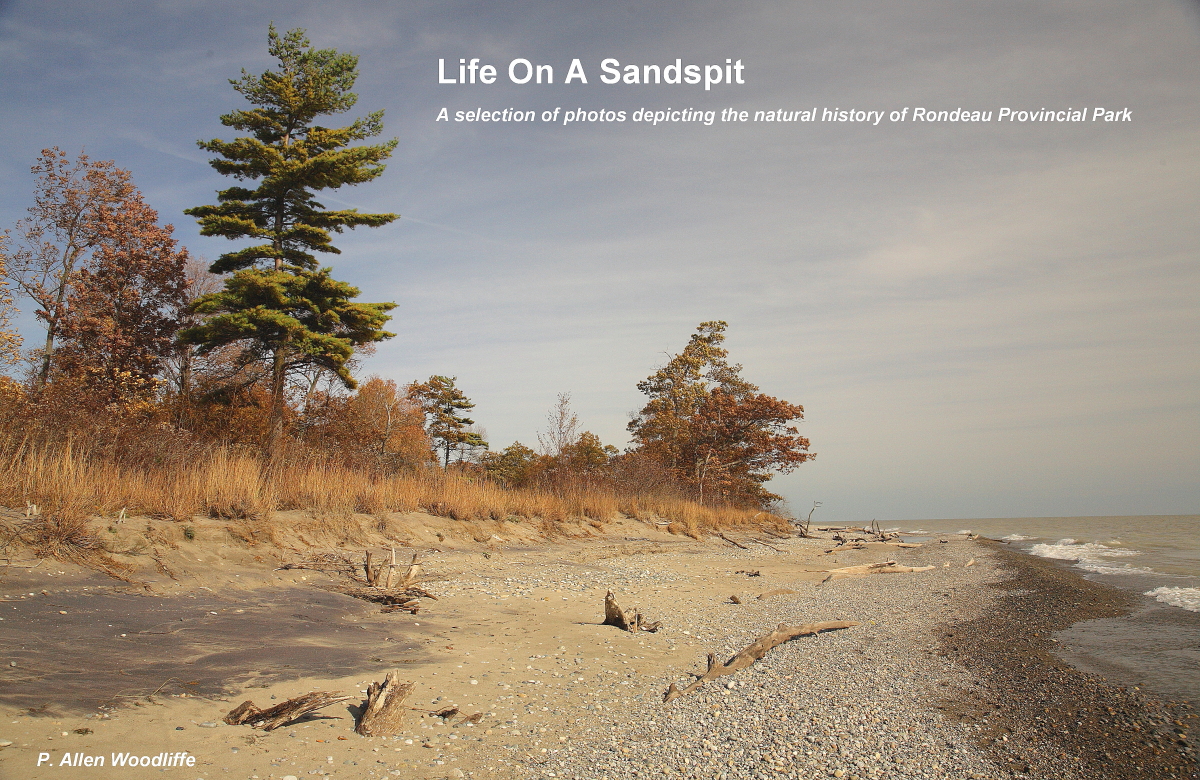
Just a brief note regarding Life on a Sandspit: it seems to have garnered a lot of interest and is doing well.

It is currently available at the Friends of Rondeau store (inside the Rondeau Visitor Centre), as well as the Bayview Market, just outside the Rondeau PP gates. It is also available via the Sydenham Field Naturalists, and you can see it, along with other nature publications on their web site here. I am slowly finding other local sites where it may be available, and will provide updates on those as they occur.

On to the butterfly count post.

Just a few days ago, on July 9, was the annual butterfly count, for the Rondeau area. Over the past 22 years, it has ranged from 35 to 47 species, averaging about 41 species. I don't have the final tally for this year, but based on the area that I and my colleagues did for this one, I think we will definitely be below average both for total species and individuals. I usually get about 18 species, but this year I got only 15. Of course weather is always a factor, and the cool, cloudy, misty weather this year did not bode well. And a downpour of heavy precipitation in the afternoon for some, did not help at all. Nonetheless, it can always be worthwhile to get out and see what is around. The following photos are ones I took while meandering through the several spots I normally cover. I didn't get photos of all the species I recorded, and the results vary.

This first one is the only swallowtail species I encountered, and just one individual!

Black Swallowtail
Bronze Coppers, next, are not a guarantee, and I only saw this one. Fortunately it cooperated to get the kind of photos that allowed me to separate it from the American Copper.

If this count was taken a few years ago, I would have no problem identifying this next one as a Summer Azure. However the lepidopterist taxonomists have examined the Celastrina genus a little differently, and it apparently is not quite so easy, so this one could be as Summer Azure, but I left it as Celastrina sp.

Common Wood-nymph

Eastern Comma

Eastern-tailed Blue

Little Wood-satyr
Monarchs, shown next, got off to a slow start in the count, but as the day wore on, I came across several areas where Common Milkweed was present in the hundreds of plants. One area could have even had more than a thousand plants, so getting several dozen Monarchs was not hard. If I had been able to carefully survey this largest milkweed site, I could have easily doubled the number of Monarchs, but by that time I was losing energy so I did most of my surveying via scanning the large field with binoculars.
Crescent butterflies are normally fairly common, but for some reason, that wasn't the case on this day. I had just this one Northern Crescent.
Although the ? on this next butterfly isn't all that visible, it was indeed a Question Mark.
Red Admirals, at 57 individuals, were by far the most common of the butterflies, other than Cabbage Whites at about 70.

Of course anytime one is out in such habitat, there are always other things to see, so I took advantage of the photo ops I was given. This Eastern Gartersnake was quietly sitting along the edge of one of the first trails I took. I presume it was trying to soak up some of the non-existent sunshine, as it never moved even a bit, although I got quite close.


Along the Erieau Marsh Trail there were the usual things like Great Blue Heron.....
...and even a Trumpeter Swan.
Song Sparrows were common in most areas.....
...as were Red-winged Blackbirds.
Along one area, which follows an old Railway Track, I saw three Wild Turkeys, but true to their character, did not allow me to get very close. This next photo is highly cropped.
Along this same part of the area I covered, I noted several clusters of a Species At Risk, known as Prairie Rose.
And I even saw the occasional day-flying moth that enabled me to shoot it: the Eight-spotted Forester.

Once all the results are tabulated, I will update the results for this count, but as far as I can tell in talking with several other counters, it will not be one of the better ones. Every year is different! Update: there was a total of 1777 individuals of 36 species recorded on this day, so definitely on the low end of average.


If you would like to subscribe, or unsubscribe, to Nature Nuggets, send an email to: prairietramper@gmail.com


Sunday, 9 October 2022

More migrants, some late leps, a cactus conundrum and a house of yesteryear

 Autumn is unfolding as it should, and that means there are lots of things to photograph. A few days ago I was out in the Erieau area. I took time to check the main pier, as the uncommon Purple Sandpiper could appear any day. I walked all the way to the end, flushing a multitude of the usual gulls along the way, but only came up with a single Sanderling right at the end.

Maybe next time there will be a Purple Sandpiper to greet me.

A walk along the Erieau Marsh Trail and McGeachy Pond Trail is often worthwhile, so I included it in my itinerary. There was a nice mix of passerines, including:

Eastern Phoebe

Northern Parula

There were several others, but due to the very contrasty light, were hard to photograph.

Butterflies, on the other hand, were typically out in the open where they could benefit from the sunlight energy while nectaring on the flowers. The deep purple of New England Aster seemed to be the main flower attraction.

Orange Sulphur

Clouded Sulphur
The first two are pretty common, but these next ones are much less common. In fact the Fiery Skippers, of which there were several, were the first ones I had photographed this year.

Bronze Coppers, shown next, are to be expected at some point and usually much more common than the Fiery Skippers.
Female

Male

I also spent a bit of time up along some accessible areas along Lake St. Clair. There were some migrants, not surprisingly, including a good number of Blue Jays on the wing....


 ...and some even landed for another shot.


There were a lot of Yellow-rumped Warblers, by far the most abundant warbler almost everywhere you go these days.

And since it is still relatively early in the season, a few Great Egrets are to be found, and occasionally are in an excellent spot to be photographed.

On another outing, I photographed this Prickly Pear Cactus. Cacti of this type are popular, and always fun to be found. But they present a problem, mainly in the taxonomy. What species is it? For many years, the cacti known in southern Ontario were called Eastern Prickly Pear (Opuntia humifusa). A bit later, taxonomists changed the name to Opuntia cespitosa, and most of the ones are still known as that. However this first one apparently is a different species, known as Grassland Prickly Pear (Opuntia cymochila). It is more of a western species, but due to the arrangement and angle of the spines, is believed by Opuntia experts to be this species. This makes for an interesting element to Ontario's Opuntia, as this particular population in the former Howard Township was quite abundant back in the 1940s. A former co-worker of mine, when I was at Rondeau back in the late 1970s, told me of this population which occurred in a large sandy area almost right across the road from where he and his wife lived. His wife was a teacher at the schoolhouse just down the road, and walked by this population almost every day. That was back in the mid 1940s. However as time went on, the sandy area was converted to agriculture, and it eliminated most of the cactus. Now only a couple of dozen plants persist in the road allowance.

Another population of cactus occurs at Rondeau, in the southeast beach dunes. They do not occur there naturally, as some unknown persons transplanted them there in about 1994. They have done fairly well there since. This population has been determined to be genetically similar to the naturally occurring population on Pelee Island. Therefore the species is legally endangered under the province's Endangered Species Act. The conundrum is: what to do with these plants? They are endangered, sort of, but it is debatable whether transplants are covered under the Act. Or should they be removed, since they may end up being a problem species in an otherwise highly significant natural habitat in one of the most significant provincial parks in Ontario? At the moment, park staff are reluctant to remove them, so they continue where they are.

On quite a different topic than the ones above, here is one of the most photographed abandoned houses in southwestern Ontario, perhaps in all of Canada if you believe some reports. It is known as the Guyitt House, and if you google that name, you can find out lots more information about this house. Regardless, it is along the former Hwy 3, now the Talbot Trail, in eastern Chatham-Kent a short distance east of Palmyra and few kilometers before you get to the Elgin Co border. It was built in the 1840s and was occupied up until about the mid-1980s. I took these photos at various times in about 2010-2011. It has continued to deteriorate, but does so 'gracefully' and it is interesting to see the process.

I took these next two and processed them to reflect an earlier age

This next one was taken during a full moon, with a long exposure of slightly more than 300 seconds using the moon as the sole source of light. You can tell it was a long exposure by seeing the white streak just to the left of the chimney on the right hand side, which is how far a star 'moved' in those 300+seconds.

In recent weeks, an unknown person has complained about its condition, and asked the municipality to enforce a by-law forcing the owner to either repair it or remove it. This has caused a great deal of angst for the landowner, who would like to keep it as is, since it is such a popular photographic subject. The landowner gets nothing for it, just the satisfaction of having a popular photographic subject. There has been a lot of support to leave it as is. At this point nothing has been decided, so stay tuned.

Back on the lep theme, here is what Marie and I call our October Cat. It is a fairly well developed caterpillar of a Black Swallowtail. Interestingly although Black Swallowtail butterflies have been in our garden area periodically all season, it wasn't until the last couple of weeks where we could find any caterpillars.


We have seen about 7 in the last couple of weeks. Today we couldn't find any, so it is possible that the remaining ones have gone off to change over to a pupal form, in which it will overwinter.

And finally, a Magnificent Frigatebird appeared near the mouth of the Thames River yesterday. It was initially seen by some fishermen but word didn't get out until late in the day. It was believed to not be in good health. Several keen birders were there first thing this morning, and one group saw it tumble from its overnight roost and fall into the water, barely able to struggle to a log on the bank of the river. Clearly it was not likely to survive. A few people reported seeing it in the morning, and one or more believed a rehabber was tracking it down and taking it in to see if it could be saved.

Marie and I went for a drive out that way in the early afternoon. I had mixed feelings, as I don't chase as many rarities as I used to, and chasing a bird that was almost dead was not all that appealing. We didn't see it, so perhaps it has been rescued by a rehabber. I haven't heard any more on that. Update: it may have been euthanized due to its poor condition.

I wasn't too concerned about not getting to add it to my Chatham-Kent list, as I had the opportunity to see and photograph a quite healthy one off the south beach of Rondeau, back in early July of 2012.


If you would like to subscribe, or unsubscribe, to Nature Nuggets, send an email to: prairietramper@gmail.com