
It isn't National Forest Week. That comes in September. But anytime is a good time to take note of a character of forest known as Old Growth, especially as more and more of what is left, is disappearing.
It may be coincidental that today I received an advance copy of Trees of Ontario, a book that the Royal Ontario Museum has just produced. It has been in the works for several years, and has had an enormous amount of work put into it by quite a lot of people. Yours truly was one of many folks working on it in various capacities, in that I provided well over two hundred photos. That was the relatively easy part! I expect that it will be on bookshelves very shortly.

And no, this announcement is not the one I referred to in a previous post. That announcement will be forthcoming in about a week or so.
On to the topic of Old Growth Forest.
Old Growth Forest (OGF) is not just something that occurs in the magnificent groves of Giant Sequoia or Western Red Cedar that you read about in some of the western parts of this continent. There is no question that they are impressive. In our family's travels over the years, we have seen some of them up close, and one feels very small and humble traveling through those behemoths. But OGF also occurs in parts of southern Ontario, albeit on a very limited basis and in a much smaller scale. Most forests have been severely altered through harvesting. I have heard on more than one occasion, a forestry specialist commenting on a woodlot that they are evaluating and stating something like 'this forest needs to be managed (i.e. selective logging) in order for it to stay healthy.' Knowing that most forestry workers are focusing on commercial production in their schooling, I am not surprised with a comment like this. However that begs the question: who was looking after the forest and maintaining it in its magnificence before forester types came along to 'manage' them?
I would like to go back in time, to when people like Anna Jameson wrote about her travels through the southern Ontario forests in the 1830s. It almost makes me drool with envy experiencing vicariously what she saw and felt.
Nonetheless, there are some woodland remnants that are probably at least somewhat close to what untouched forests might have looked like two hundred or more years ago. They can be found in places like Rondeau and Clear Creek Forest provincial parks in Chatham-Kent. Or maybe in parts of McKerrall Woods a bit northeast of Chatham. Or traveling east, exploring Backus Woods, or the Jackson Gunn Tract, both of which are in Norfolk County. Even parts of the Skunk's Misery forest complex in Middlesex County. But if you are exploring them, it might help to have some blinders on so as to not get distracted by signs of forest loss and destruction that may be close by.
 |
| Jackson Gunn |
 |
| Skunk's Misery |
 |
| McKerrall Woods |
 |
| McKerrall Woods |
 |
| Clear Creek Forest PP |
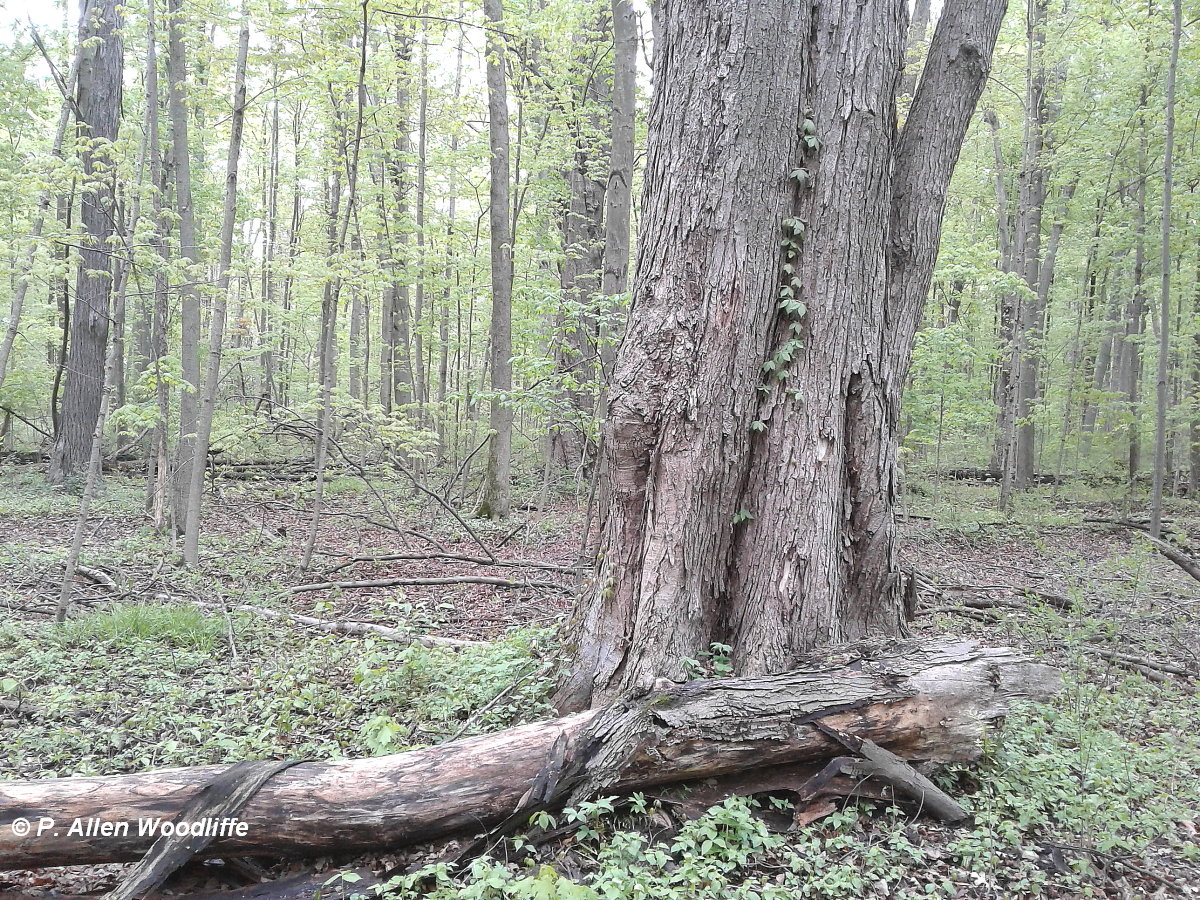
This extremely large American Beech at Clear Creek Forest is now gone, having succumbed to age and wind several years ago. It measured about 94cm in diameter, and was one of the largest ones in Ontario.
More recently I came across a slightly larger one at McKerrall Woods, which I measured at 96 cm diameter. It may not look quite as large in diameter, but that would be due to the way the photo was taken. This one is still standing, at least as of last autumn and was actually taken in March of 2016.

Big trees are always fun to find and see. But there is a lot more to OGF than big trees, and many of the next photos showing those other features were taken at Rondeau. For example:
-there is usually a lot of large fallen mossy logs. In reality, a fallen and decomposing log often supports a greater diversity of life than when it is in its prime.


-the understorey, if it is damp, should support a good diversity and abundance of ferns, indicating a lack of disturbance and therefore a better quality soil.


-if it is not damp, it may be covered with small seedlings of, for example, Sugar Maple. This following photo reminds me of an excellent and popular film we used to show to students at the Visitor Centre, called 'Life in a Woodlot'. One of the statements that the narrator said referred to the seedlings being 'Countless as stars, short-lived as snowflakes.' This refers to the thousands of seedlings trying to grow up to be a mature tree, but in an area covering the size represented by this photo, only a very few will survive to maturity and even then, after many decades of struggle against competing stems.

-some trees may show 'balding' at the base, such as this Tuliptree is showing.


In most cases when a tree and root fall over, there is a lot of sand that goes with it. As the root decomposes, the sand remains, and may create a small mound where the root once was. As an aside, there have been efforts to re-establish tree plantations with a 'pit-and-mound' effect, and while it was an interesting concept, I have yet to see any such projects that were done correctly at the outset. I believe there is a way to make it happen a bit more successfully, but a somewhat different and more patient approach is necessary.
-this next photo shows the root of a tree that went down in the big storm just before Christmas. There is a lot of sand still clinging to the root mass. It is still dry in the pit as it was on a slightly higher ridge....


These are some of the things that characterize a healthy, Old Growth Forest. But certainly forest landscapes with lots of, or even a few, large diameter trees and undisturbed ground layers are good starting points to look for when evaluating a forest for its old growth character.
 | ||
| Tuliptree, 125 cm diameter |
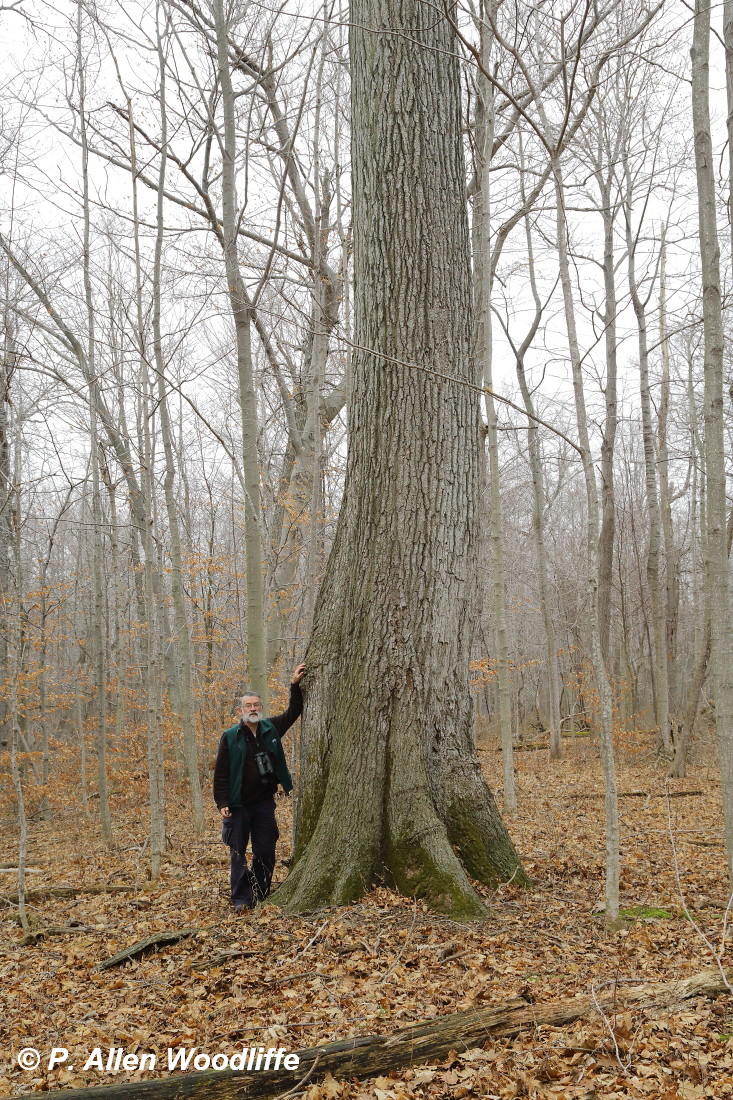 |
| Red Oak, 135 cm diameter |
 |
| Eastern Cottonwood, 158 cm diameter |
 |
| Red Oak, 190 cm diameter, Keith McLean CL |
Here's to Old Growth!
If you would like to subscribe, or unsubscribe, to Nature Nuggets, send an email to: prairietramper@gmail.com


