Showing posts with label House Finch. Show all posts

Monday, 29 December 2025

"Only" birds here and there

 In spite of the winter, there have been opportunities to get out, go for a long walk, explore and even get a few photos to feature the season.

A recent eBird post indicated a Snowy Owl had been seen not far from St. Clair NWA. Since I was heading out somewhere anyway, I decided to swing that way since it was only a couple of hours later. Unfortunately, even with slow and careful viewing, the owl was not to be seen. It wasn't reported by anyone else either. But I did get photographs of a few other things while I was in that vicinity.

Sub-adult Bald Eagle

As I crossed over a wide creek, I noticed this Great Blue Heron standing on the ice, waiting for....something. Maybe spring????

A little further down the channel, was another one. At least it was standing in some water. I am amazed that in spite of standing in almost freezing water, on ice, it apparently doesn't seem to bother them. And even farther down the channel was a third heron.
In a field nearby, were 7 Sandhill Cranes.....
...and a few Tundra Swans flew overhead.
But no Snowy Owl to be seen.

An outing at Rondeau and area didn't produce a lot to photograph, but there always seems to be something. 

White-throated Sparrow
It was bright/heavy overcast, which didn't produce great lighting for a mostly dark House Finch perched on a branch against the sky. It seemed to be busy feeding on the numerous berries of some of the Red Cedars in the campground.
A Hairy Woodpecker was busy searching for insects.
American Tree Sparrows are relatively common, or at least somewhat regular at the moment. They often travel in small flocks.
A single photo gives a good view....

In other odds and ends, there are often Canada Geese somewhere around...

...or a Ruddy Duck...

...or even a Red-tailed Hawk.
No butterflies, insects, or plants to photograph these days, but at least there are a few birds!


If you would like to subscribe to Nature Nuggets, send an email to: prairietramper@gmail.com 

Saturday, 25 November 2023

Some late season shorebirds, a few very late moths, and a rare goose

 Persistence paid off. Some readers may recall me lamenting about stopping by the Keith McLean Conservation Lands on several occasions, trying to find and photograph a Hudsonian Godwit that had been seen by quite a few others, but without success. It got to the point of me thinking HUGO (the four-letter birding code for this species), where did YUGO? And even on this day, the 15th, I again stopped in mid-morning and spent well over an hour searching every possible wet spot within sight, hoping to track it down. I gave up, thinking it was finally gone, but planned to stop in a few hours later, before returning home. 

And there it was! I concluded by checking other reports, that it was an afternoon bird. I have no idea where it and the other shorebirds spent the earlier part of the day.


 There were some Dunlin around as well.


For a size comparison, here are both HUGO and DUNL.

 This individual was distinct due to some malformation at the tip of the bill. It didn't seem to interfere with its feeding, at least to the eyes of human observers, although the actual bird may have felt a little less efficient at feeding. But it had adapted.

 A Black-bellied Plover was also with them, not a common species at this time of year...

....and was quite cooperative for the camera. These photos were barely cropped.

On my earlier visit that day, I had to satisfy my photographer's urge with a cooperative Great Blue Heron. Not quite the same satisfaction as a HUGO, but....

In between visits to this site, I spent a few hours at Rondeau, not surprisingly, and had the satisfaction of seeing and photographing a few birds. Robins were widespread....

....Northern Cardinals were scattered, but seldom cooperative for a good photo.
Pileated Woodpeckers are more often heard than seen, at least not seen in a position for other than a record photo.
Yellow-bellied Sapsuckers were around here and there, but for the most part seem to have moved on.
A few Yellow-rumped Warblers can still be found, with a little persistence.

On a day with promising WNW type winds, I spent a bit of time in a good location to watch for late season raptors carrying on with their migration. I got a distant Bald Eagle...

....and several Red-tailed Hawks, among other things.

At Erieau, I photographed one of the dozens of Red-breasted Mergansers in the slip...

...as well as a Bonaparte's Gull, of which there were several hundred. I was hoping to see a Little Gull, but it was not to be on this day, or at least not while I was there.

A bit more recently when I was out at Rondeau on a quiet, cool and overcast day, I encountered several late moths fluttering about and coming to rest on some leaf litter. They were Bruce Spanworms.....


A White-breasted Nuthatch came to investigate me, pausing long enough for a photo.
I had been on the lookout for White, or Paper Birch at the park. Someone had inquired about where to find one in the park, and although I knew I had seen a few over the years, I was hard-pressed to find one on the spot. They are much more visible when the leaves are off the trees, as they are not abundant. They have somewhat specific soil requirements, so are best found between Harrison Trail and Lakeshore Road. On my travels along these two roads, I have located more than a dozen individuals, although most are fairly small diameter trees. These next two individuals were about 25-30 cm in diameter.

On yet another short term visit to the park, I spent some time in both the campground as well as the east South Point Trail and photographed a few things I encountered. European Starlings, shown first, are not very popular with anyone, but they are somewhat attractive in the seasonal speckled plumage. This one, along with a dozen others, were feeding on bittersweet fruit.
A couple of House Finches, year-round residents, were noted feeding on red cedar berries.
A close relative, the Purple Finch, is migrating through as of late, and I managed to capture a few photos of this female.....
...and this Ruby-crowned Kinglet flitted about almost non-stop, as they typically do, so getting even one shot like this is tricky and infrequent.
White-throated Sparrow, shown next, is one of the commonest sparrow species around these days.

Just a short time before I was getting ready to post this blog today, a friend and former co-worker alerted me to the presence of a Greater White-fronted Goose along Mud Creek here in Chatham. 

Thanks, Fred!

 I had been on the lookout for this species at various locations where there were concentrations of Canada Geese, as the occasional Greater White-front will show up with them, so I wasn't going to pass up this opportunity so close to home. And there it was, showing its 'speckle' belly, pinkish/orange bill and white frontal area of the head.


If you would like to subscribe, or unsubscribe, to Nature Nuggets, send an email to: prairietramper@gmail.com


Saturday, 13 March 2021

Bird Action Increases!

We've had some very nice late winter weather, making it feel more like spring every day. But the forecasts look like things will slow up a bit, which is likely a good thing. Nonetheless, with some warm weather, brisk southerly type winds and lots of sunshine, it has spurred more activity amongst our feathered friends.

It was only a few days ago (March 2) when I took this photo of the piles of ice along the Rondeau shoreline.

In a matter of just a few days, that ice had all but disappeared. 

Waterfowl continued to pour in to the open waters of Rondeau Bay and even the local sewage lagoons. The warm, southerly winds caused most of the Tundra Swans to depart, although some continue to linger. The Greater White-fronted Geese that showed up periodically at Ridgetown over the last week or so seem to have left, but up to 15 Snow Geese were still there earlier this week. Snow Geese are much more of a novelty here than in extreme eastern Ontario, where tens of thousands of them pass through both spring and fall. This first photo shows all Snow Geese, including a single blue colour phase individual, and a single Tundra Swan.

This close-up shows a difference in size between two individuals. I had hoped the smaller one might have popped its head up, to see if it showed any characteristics of a slightly smaller Ross's Goose, but it remained in this sleeping pose. Then, as I was photographing something else, all of the Snow Geese took flight, although I don't think I 'shot' the smaller one in any of the several photos I got. It may have been a hybrid between the two species, which is known to happen with some regularity.


Rondeau Bay attracts thousands of waterfowl. In the last few weeks, Tundra Swans have been in impressive numbers, but most have left and it is dominated now by ducks. They are often too far to photograph, let alone get a good view of, but as was the case yesterday, several rafts of both Canvasback, shown next, and Redhead, were close enough to make the attempt. Note that there is a single American Coot at the far right of this photo.

Since several pairs of Bald Eagles have been observed at the early stages of nesting, with an adult sitting on the nest presumably incubating one or more eggs, I went part way down the west branch of Rondeau's South Point Trail to check out the nest there. It is barely visible from a limited part of the trail, and a 'scope is really useful. This next photo shows a white head sitting above the nest, so it would appear that this pair is also into the nesting cycle. This photo was taken and cropped to about 45X, so not easy to see or photograph.

While I was there, I had three cyclists stop by and I gave them a view through the 'scope, and as they were leaving three young fellows came by and also got a look. None of them had seen an eagle's nest in the park before.

The sunshine has definitely triggered some increase in activity amongst the smaller land birds, and yesterday I was treated to a fair bit of activity in the campground area. I got several firsts of the year, including Tufted Titmouse (they are year round residents, but not always easy to find)...

...a couple of Yellow-bellied Sapsuckers......
..and two Yellow-rumped Warblers. It is likely they were over wintering individuals, although there had not been any reports of them in the Rondeau area for several weeks.

I also had a single Evening Grosbeak perched at the top of a cottonwood tree, but it was seen from a distance and before I could get even a distant photo, it flew north. They were quite frequently seen in mid to late autumn last year, and presumably this is one that was on its return to the boreal forest region.

Other, regular winter residents cooperated nicely for the camera.

White-breasted Nuthatch

Northern Cardinal

House Finch

Golden-crowned Kinglet

Black-capped Chickadee

Red-bellied Woodpecker

Downy Woodpecker, male

Downy Woodpecker, female

Elsewhere in the park, I came across several Turkey Vultures. They will be a regular occurrence from now on....

....and three Killdeer.
This Eastern Screech Owl is showing up in its usual beech tree a bit more regularly.
I came across this Virginia Opossum along the Tuliptree Trail.
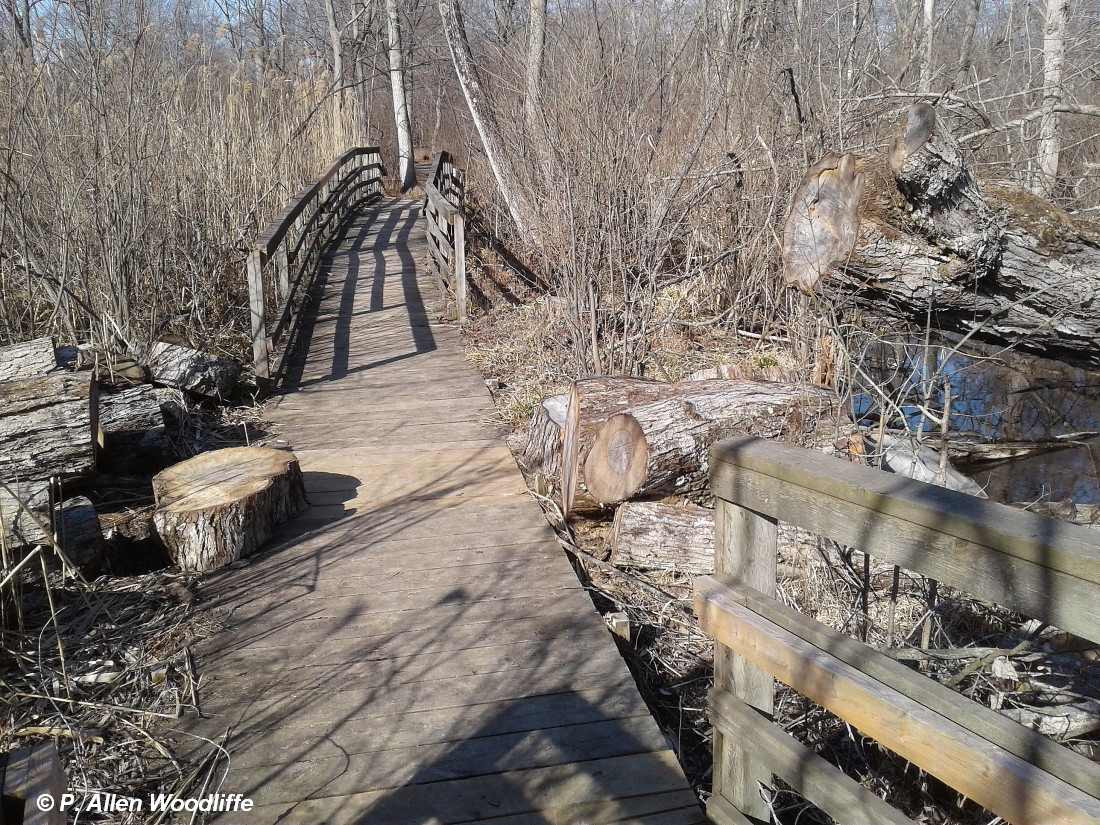
The Spicebush Trail did not have much birdy action, partly because the brisk westerly winds had them hunkered down, or elsewhere. I hadn't been around this trail for several weeks, and noted that since my last time around, a large Silver Maple had come crashing down across the boardwalk, likely due to one of the strong easterly wind events.

On one occasion while returning home, I saw this Striped Skunk scampering along the edge of a field. Normally you don't see skunks out in broad daylight and so far from any cover, although as they emerge in the warming days of spring, they may forage farther afield. A closer look at this individual, however, shows a diseased or damaged left eye. I did use a telephoto lens, but still got fairly close to get these photos. I made sure that the wind was blowing in the skunk's direction, just in case!