Now that we have entered the middle third of May, birders expect lots of bird action. While it seldom is as active as most birders would like, there has been a steady stream of birds arriving.
I have been to Rondeau a couple of times lately, of course. The lake effect of the wind off the water keeps things cooler than inland, and so the leaves on the trees have not developed as far along as trees inland. Therefore the birds even high in the trees are a little more visible.
Almost all of the expected warblers, vireos and flycatchers have been recorded, although not in very great abundance. Here are some of the ones I've been able to capture on digital film so far.
While looking for a reported Kirtland's Warbler, along with several dozen other birders, this Cape May Warbler obliged at the top of a low red cedar. The Kirtland's never did show up again.
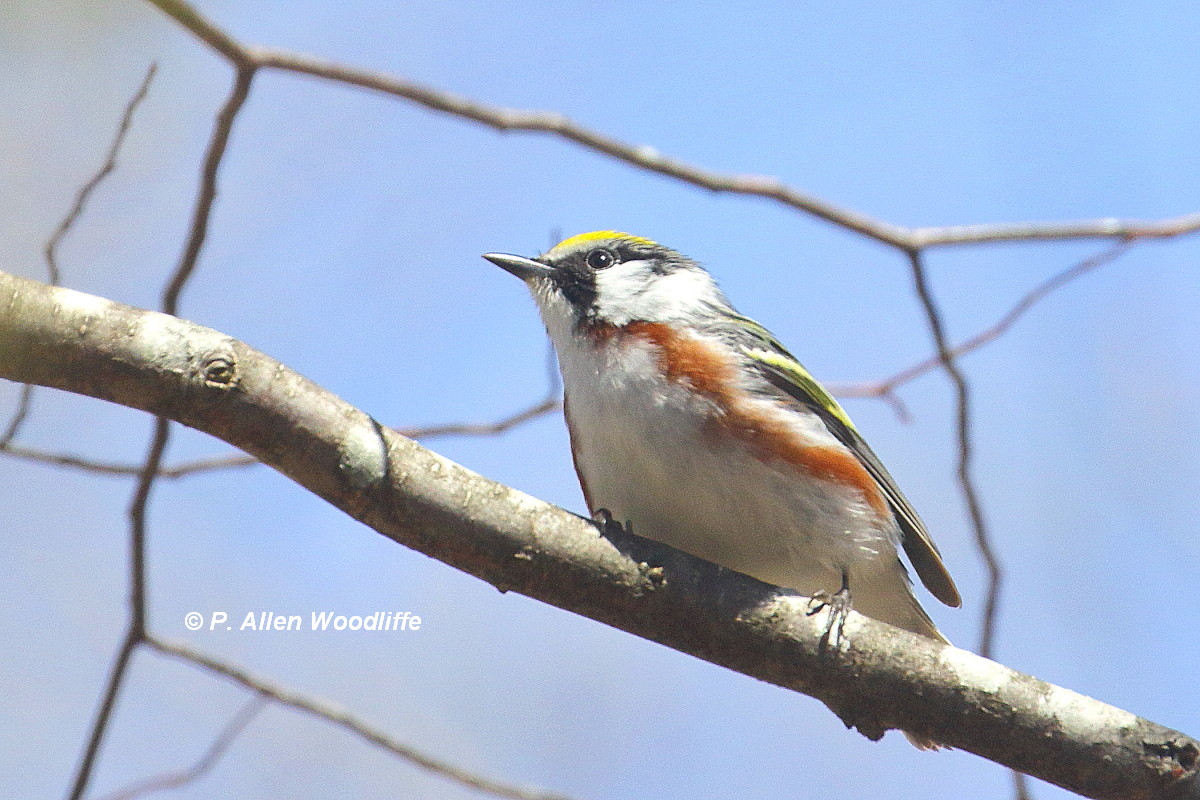
Chestnut-sided Warblers were one of the more common warblers in the last few days.
Magnolia Warblers are beginning to increase in numbers.
 |
Nashville Warbler
|
One of the warbler highlights of spring, and throughout the summer breeding period, is to see a Prothonotary Warbler. They never cease to draw oohhs and aahhs from any birder observing one.
Only the males have shown up so far, although the females will be arriving soon if they haven't already. Rondeau happens to be the first location in Canada where this species was discovered nesting, and it has remained the main stronghold for this very rare species.
Aside from warblers, things like Blue-gray Gnatcatchers are widely scattered. They are constantly on the move, and get into a variety of postures as they attempt to glean insects from the twigs, etc.
Great-crested Flycatcher is a breeding flycatcher at Rondeau.
Lincoln's Sparrow, on the other hand, is not a breeding species, and they are typically quite furtive along trails and forest edges.
Northern Cardinals are not uncommon, but when one pops up for a photo, I will take it. They are heard regularly throughout the park.
White-throated Sparrows were around by the dozens, even the hundreds, for a few days. Their numbers seem to be dropping now, as they have moved on to their more northern breeding locales. This one was enjoying some morning sun on an otherwise cool morning, and allowed me to approach fairly closely.
Wood Thrush is not a common species, and due to its overall decline in Ontario, is considered a species at risk. Their flute-like calls are always nice to hear in the quiet of evening.
On one occasion, I was heading down a trail to get GPS coordinates of a rare orchid that I had discovered a new location for a few days earlier. I noticed this Turkey Vulture preening and soaking up some early morning sunshine.
On another trail, I heard the distinctive churring of a Red-headed Woodpecker, and located it on a dead tree not far away. It seemed to be staking out its territory, checking out some holes in the tree, and otherwise looking quite at home. While this species is on the decline, the numbers reported at Rondeau this year seem to be a bit higher than the past few years, so hopefully it is a good sign.
American Woodcocks have been back for several weeks, and are well underway in the nesting process. They rely on the cryptic coloration, and so allow quite a close approach.
On sunnier days, one has to be vigilant regarding where one is walking. This Ribbon Snake was on Harrison Trail, and I could have easily missed it.
It is a species at risk, and although it looks generally similar to the much more common Eastern Gartersnake, can be told via its more distinctive yellow lines, and the small white patch in front of the eye.
Red Trilliums are starting to be in good bloom these last few days. They are typically in flower a bit earlier than White Trillium, shown following, and are also starting to appear rapidly in the considerably warmer temperatures of late.
I made a brief stop at Bannerstone Conservation Area, just north of Rondeau. I saw a Bay-breasted Warbler, normally a species that shows in the latter part of the warbler migration...
....and the Tree Swallow boxes look like they have been claimed by some for this season.
I got wind of a pair of Black-necked Stilts being at the Blenheim Sewage Lagoons yesterday, so of course I decided to stop in and look. Sure enough, along with numerous Dunlin, Lesser Yellowlegs and a single Wilson's Phalarope and such, there were the two stilts.
Quite a few birders had already seen them during the day, but they still allowed a couple of distant photos. These are cropped quite a bit. This is a species that normally will be found in the mid-west, but occasionally show up here in southern Ontario on migration, much to the delight of birders.
The male has a completely black back....
...whereas the female has a brownish back.
I've also spent a bit of time at St. Clair NWA where the large managed wetland complex is a wonderful and accessible spot for finding marsh birds.
Common Yellowthroats are, rather common, although one is more likely to hear them than see them. On occasion a male will sit up in an open spot at the top of the cattails, or in this case the invasive Phragmites, and belt out its call.
Black Terns are a somewhat declining species. On this day, I saw about 18, with many of them flying north along the lake shore so were likely continuing their travels to their breeding grounds. A few will likely remain. They fly a bit erratically, so getting photos is not an easy thing to do!
Eastern Kingbirds like the openness along the wetland complex edges.
Blue-headed Vireos were using the shrubby edges to rest and forage before moving northwards.....
....an Eastern Wood-pewee was also there, but just using the shrubby edges for resting and feeding as well.
Warbling Vireos, on the other hand, like the openness of the cottonwood edges and at least a few will likely stay to nest.
The next few days look quite promising for bird migration, so I plan to be out a few times putting my camera to good use!
If you would like to subscribe, or unsubscribe, to Nature Nuggets, send an email to prairietramper@gmail.com