Showing posts with label Red-necked Phalarope. Show all posts

Sunday, 4 October 2026

Fall Fungal Foray, etc.

 Late summer through early autumn is a great time of year to be searching for mushrooms, a.k.a. fungi. Being the 'fun guy' that I am (joke :-), I spend a fair bit of time looking for ones to photograph. Recent moisture can have a big effect on fungi. What one sees attached to a log or growing out of the ground, is really just the fruiting body of the fungus, where spores are released and carried by slight breezes to another spot at which it can grow. Important as these above ground features are, they are only a very small part of this plant. The immense part of it is underground, in the form of tiny but very extensive threads of mycelia that collectively are absolutely enormous! A rich forest ground cover is jam-packed full of mycelia, which connect many other plants, including trees root systems, and are one of the main forms of energy that allows the richness of the forest to flourish. And they just keep expanding every year!

By comparison, a corn or soybean field growing next to a woodland is so depauperate.  The destruction of the forest which once was there, as well as the annual plowing/cultivation, has destroyed the beneficial mycelia, and the only way those crops can produce is if the farmer pours on extensive amounts of man-made fertilizers, a lot of which will end up in the local creek systems, eventually ending up in the local rivers/lakes, and be the main source of our drinking water. Yuk! And that is an important, but unfortunate topic for another blog post.

In the meantime, I want to focus on some of the fungi I have recently noted and photographed. Here are a few, all of which have been found locally, mostly at Rondeau.

One of the most impressive ones I have found quite recently is one called Chicken-of-the-woods. I have seen this species annually, and it is always worthy of note, but on this occasion about a month ago, I came across by far the most impressive example of it. I took this photo with my phone as it was raining, and did not enhance this image a bit, other than to slightly crop it. 

Some others, in no particular order are:

Conifer Mazegill
Next is one somewhat similar to the first one, and it is called Conifer Chicken-of-the-woods. It is not common in this area, but can be found on a decomposing conifer log. This one was on a rotting log of White Pine.

Clustered Bonnet
One thing that is helpful in determining what species a fungus is, is to examine the underside. Some fungi have small holes, such as this next one....

Chicken Fat Mushroom
....while others have gills. Since it is just the fruiting part of the fungus, breaking a piece off and examining the underside will have very minimal effect on the fungus.

Burnt Sugar Milky

Crown-tipped Coral Fungus
Next is one that is seldom seen, and that is just as well. It is called Golden Oyster Mushroom, native to Europe and Asia. However it has been cultivated in North America due to its apparent edibility, and no doubt spores of it have been distributed throughout much of at least eastern North America. It decomposes the wood of many native tree species, and apparently has displaced some of the naturally occurring fungal species. I have only seen it on one occasions, about a year ago.

Northern Honey Fungus

Orange Earthtongue
One of the very first species of mushroom I photographed decades ago is this next one: Orange Mycena. I see it annually now, and this was photographed in September.
Next is a type of bracket fungus, called Orange Polypore

Oyster Mushroom
Again, looking at the underside to determine whether there are gills or holes is beneficial.
Next are a couple of examples of a Pear-shaped Puffball, some of which are opening up to allow the spored to disperse.


Earthball
Next is a type of the Amanita family, a family known for its harmful, even deadly, qualities. I should add that as interested in mushrooms as I am, there are only a couple of types that I have ever eaten from the wild: Giant Puffball and one of the Morels. Even though I took a course on Mycology at University and have a couple of excellent books to help identify them, there are too many things to consider before even thinking of eating them.
Small Funnel-veil Amanita

Trooping Crumble Cap
Next is a type of slime mould known as Tubifera magna

Vermilion Cap
The next two show a variation in the one called White Jelly Fungus

And lastly, one called Witch's Cap. Not sure who comes up with the names......

In other news, just because it is of interest to many birder readers, I managed to catch up with a Red-necked Phalarope at the Blenheim Sewage Lagoons...


 ...and just a day or two ago, that of a young Purple Gallinule which had been found at the Keith McLean Conservation Lands just outside of Rondeau. At times it was out in the open and relatively close at hand.


However when I first saw it, it was tucked back behind some vegetation, still identifiable, but not what I had hoped to work with. Fortunately for me, and many others who were out looking for it, it did eventually come out in the open and was busily nipping of bits of something on the underside of the lotus leaves!

 On another note, some of the long-time readers of Nature Nuggets will have realized that I don't produce as many as I used to. Of course when my dear wife Marie passed away, that was a significant adjustment and I cut back on blog posts as well as other things. However in early June of 2025, some friends suggested I start an additional blog, sharing some of the life-changing things I had experienced and learned from, especially in the previous few years. And so my new blog, entitled Life Is A Journey, began. I now have 47 posts on that blog sharing the many ups and downs of life, some of which were devastating, and others resulting in some significant blessings. Nature continues to be part of the story in some of them. If you are interested in some of my background that makes me who I am, check it out if you like. The first post can be found at this link: and progresses in bits and pieces through the decades of my (and Marie's) lives. It is also mentioned on the lower right-hand-side of this blog, in the category of Blogs I Follow. As I continue through some of the ups and downs of life, nature will likely be still an important part of it, and one I have in mind for a post in the near future is about spiders!


If you would like to subscribe to Nature Nuggets, send me an email to: prairietramper@gmail.com 


Wednesday, 25 September 2024

On the hunt for Marsh Tickseed, and lots to see in other open wetland areas

 Readers of my last post will note that Marsh Tickseed, a species at risk was something I found at St. Clair NWA, and since there were a couple of older records for this species at Rondeau, I tried diligently to find it there. The search got me out to places I hadn't been for awhile, at least not at this time of year, so I was hopeful. The south beach, along the edges of the marsh, was the place to search. Unfortunately the habitat has changed due to variable water levels as well as the onslaught of the non-native Phragmites.

This is the plant that I was looking for. A sort of typical looking sunflower type....

...but with very distinctive finely cut leaves.

I did find a few other things to aim the camera at, however, including this adult Bald Eagle, which did not like me getting any more than about 300 metres away before it left its perch....

...a moth, this Rubbed Dart, feeding on a relative of the Marsh Tickseed (I looked at a lot of tickseed types!)
And this small but colourful plant, the Trailing Fuzzy-Bean, a member of the legume family.

I saw a number of Double-crested Cormorants, as usual but for some reason this one was quite tolerant of my presence.


Elsewhere, while checking out some of the multitude of goldenrods, I came across a Northern Paper Wasp....

....a type of cluster fly...
....and this Bald-faced Hornet.

While some of these critters are capable of giving a painful sting, I have never been stung yet, as they are much too busy feeding on the nectar. I leave them alone as much as possible, but sometimes I use a macro lens and flash, and may only be inches away from them.

On my way to and from the park, I sometimes stop at the Blenheim Sewage Lagoons, as there is always a good variety of birds to view. On occasion they even are close enough to photograph! Bonaparte's Gulls can be fairly plentiful and sometimes quite close to the edge of the cells.

My target species for this visit to the lagoons, however, was to find one of the Red-necked Phalaropes that have been there lately. It is very much an irregular migrant, and one doesn't see them every year. Unfortunately it is often well out in the middle of the lagoon, making a decent photo hard to come by. This was taken at a magnification of about 22X, and then cropped considerably to more like about 80X.

One of the intriguing birds recently reported in southern Ontario, was a Cinnamon Teal, near Grimsby. It is quite the rarity at any time of year. Apparently hundreds of birders flocked to see it, but I wasn't one of them. I have seen it in Ontario before, as a fairly brightly plumaged spring male was at Rondeau for a brief period back in May of 1994. It was well out along the Marsh Trail and I, along with a good number of others, managed to see it. I didn't get a photo of it, but I do have a photo of one that I took out in southern Saskatchewan in July of 2018, where it was hanging out in a prairie pothole area along with numerous shorebirds, especially Wilson's Phalaropes, shown next. Not a brightly plumaged male.

A trip to St. Clair NWA is almost always worthwhile, and not just to see the Marsh Tickseed. Waterfowl are building in numbers, with Canada Geese numbering in the several hundreds by now.

Tucked well out of the way along the shrubby shoreline of the wetland, was this immature Green Heron. It was likely about 300 metres away, and when I first saw it through binoculars, I thought it might be an immature Black-crowned Night-Heron, but when I got a distant photo and highly cropped it, also to about the equivalent of about 80X, I could see the darker crown and the slightly dull green back. An immature BCNH would show a more evenly coloured brownish back. This bird is a little more fluffed up to make its body look a little more BCNH like, adding to the challenge of identification, especially in poor light and at a considerable distance.
Mallard are in the area, also by the hundreds.
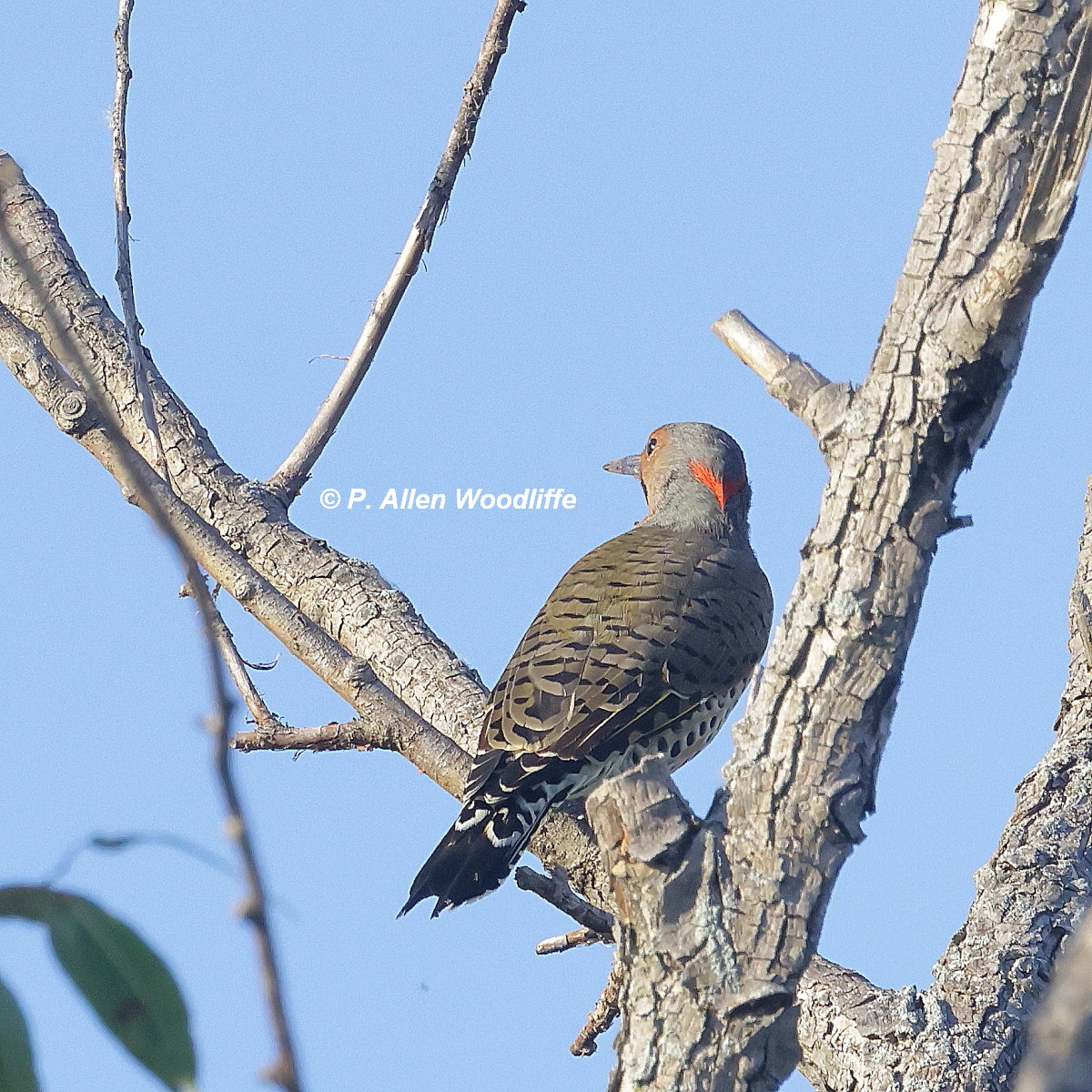
This Northern Flicker was in one of the few trees along the dyke trail.
Sandhill Cranes can often be heard, and occasionally seen and even photographed on their flights to and from the NWA.
Sometimes they will be feeding in a field immediately adjacent to the NWA.
Along the far woodland shore, there often are a few Wood Ducks tucked away, giving only distant views and photos. Sometimes up to 20 can be seen in one or two places....
....and on occasion, a brightly coloured male, shown next, will even linger in the channel adjacent to the trail, and a cautious approach might result in a photo such as this next one.

Northern Harriers are periodically seen, although usually in flight mode, and often heading away, giving a rear view only.

I typically add visiting the Mitchell's Bay North Shore Trail to one of my more northern forays in Chatham-Kent. The openness means there is often a comfortable breeze. As I have mentioned before, it is a great spot to see a few Great Egrets with typically at least half a dozen seen on each visit. On a cloudy day when they are sitting up in a tree, they may be a bit more challenging to get a good photo, but it is always worth a try.

There is enough shallow water or muddy shoreline along the edge to attract a few shorebirds, such as this Lesser Yellowlegs....
...and a Wilson's Snipe.

This adult Red-tailed Hawk was keeping an eye on me from a safe distance.

My next post may finally get me to do the one I had in mind awhile ago, featuring a variety of late summer orchids, including the endangered Nodding Pogonia, a.k.a. Three-bird's Orchid (Triphora trianthophoros). Stay tuned!


If you would like to subscribe, or unsubscribe, to Nature Nuggets, send an email to: prairietramper@gmail.com