Showing posts with label cluster fly. Show all posts

Monday, 9 December 2024

Late November, early December highlights

 In spite of the warmer than normal weather in late November, one doesn't expect to see swallows still around. However Cave Swallows, if they are going to show up in southwestern Ontario, have a habit of showing up after the majority of the others in that family have gone south. Such was the case when I got a text message saying that a Cave Swallow was at the Erieau pier. Since I was almost ready to head out somewhere anyway, it made the decision of where to go very easy. 

As I got to the main channel, just as I was getting parked, I saw this swallow scoot by, heading for the pier that juts out into the lake. Bingo! And as I glanced towards the base of the pier a minute or so later, I saw 4 people looking intently at something, so with camera in hand, out I went. 

And there it was, resting at the edge of the lower section of the pier, trying to keep out of the brisk wind. You can tell by its posture and fluffed up feathers it wasn't really enjoying the cool wind.

It seemed quite tolerant of us. Every few minutes it would get up and fly around, and sometimes flew by almost within arms reach, before returning to the edge of the pier.

However after awhile, it got up and flew east towards Rondeau, and we never saw it again. What a great sighting in late November! This swallow species seems to show up quite regularly in small numbers. I have had one to five of them at Erieau on at least 3 occasions, and along the east beach of Rondeau.

I've been able to find, and photograph, other species which, although they are much more common, are always a delight to see as well. Here are some of the highlights.

Bald Eagles always get ones attention, especially a fully adult bird with its distinctive white head and tail, and its fierce look if one gets a close enough look.


The above bird was in a tree right along the roadside near St. Clair NWA and it didn't seem to be concerned when I got out and aimed my camera at it. The next photo is of a bird that was well out from the trail at Keith McLean Conservation Area, and it flew off as I got within several hundred metres of it.

On one of my several visits to Rondeau, I photographed some smaller, land birds. A Hermit Thrush, not all that common this time of year but usually there is the occasional one lingering, was feeding on some berries at the side of the trail.

Its spotted upper chest area and the rusty tail are good indicators to separate this species from others in its genus.
Northern Cardinals are year-round residents, and the males really show up well with their bright red plumage.
Less brightly coloured but perhaps even more attractive with a more subtle, warm brown plumage, is the female cardinal.
Not a small bird, of course, but Wild Turkeys are regularly seen in their family groups. There were four others in this group, but I just zeroed in on this one for a full frame photo.

Elsewhere on my Rondeau travels, I photographed some Cluster Flies even though the temperature was barely above freezing...

..and I noted this White Pine seedling also along the trail. White Pines are an important element of Rondeau's vegetation, and while they are often eaten by White-tailed Deer, hopefully some will survive to maturity. This past weekend the park was closed to the public, as a deer hunt/cull was in progress. In the absence of natural predators at the park, periodic culls are important to keep the population of both the deer, and the vegetation, in a healthy condition. At one point in the mid 1980s or so, and in the absence of any kind of cull for a decade or so, the winter population of deer approached 600! The vegetation was in horrible shape, and one winter there were about 20 deer that died of starvation and severe cold. Deer biologists that specialize in herbivory determined that the population in winter should not exceed about 125 animals.

In other travels, I have often been near wetland areas which have not been iced over. Not sure how long that will last, as it isn't officially winter for a few days yet. Waterfowl are always fun to focus on. This first photo is of a female Bufflehead at the lower left, and a female Hooded Merganser on the right.


Female Hooded Merganser
As is the case with some mergansers species, the females have a tufted head, as the hoodie shows. The next photo is of a female Red-breasted Merganser which is much larger than the hoodie.
I photographed these Ruddy Ducks at Erieau, which were taking advantage of the quiet water in the harbour area. This first one is of a male...
...and next is a female.
This next one is of a female Ruddy Duck that was not resting, but quite alert.

Typically in the St. Clair NWA vicinity at this time of year, there are lots of swans. Mute Swans, shown first, are not present in large numbers, but as long as there is any open water, are present throughout the year .

But what gets more attention due to their seasonal variation, and huge numbers are Tundra Swans. It is not uncommon to see upwards of 10000 birds in scattered flocks, especially if there is an unplowed field to feed in....
....or a wetland area to take refuge in.
Small groups are frequently seen flying from one field to another, or back to the NWA.

There are still some flocks of Sandhill Cranes reluctant to leave the area. I came across over 150 only a few days ago, in two separate areas. They were quite a way off in a field, so not easy to get the kind of photos that I was hoping for, but this is what it is.


Sometimes they are on the move as well, to a quieter or better feeding area.

And even though the main raptor migration is over for the autumn period, some raptors will be content to stick around. I was out looking and hoping for Snowy Owls, but didn't see any. However there are a few Northern Harriers, a.k.a. Marsh Hawks, around hunting in open fields or in wetland areas.


And Red-tailed Hawks, such as this immature one, are regularly seen along woodland edges and even on power line poles.
Not the greatest shot of this bird on a power line pole, but you do what you can to capture the setting!

If you would like to subscribe, or unsubscribe, to Nature Nuggets, send an email to: prairietramper@gmail.com

Saturday, 23 November 2024

Autumn's final warm fling?

 Butterflies in late November? Yes, and a few other warmish season creatures have been out and about. Eastern Comma, first, is a species that will overwinter as an adult, so when the weather is warm, they can be out basking as this one was.

Common Buckeye does not overwinter in southwestern Ontario, but there has been a good number of them this late summer and fall, so it isn't all that surprising to see the occasional one stick around in this unseasonably warm weather.


  There have been a few Autumn Meadowhawks flitting around in sunny, sheltered places.

Next is a Black Blow Fly.

...followed by a Common Drone Fly.

There were a few of this next one around. It is a possibly a Tufted Clusterfly, although the exact type of clusterfly has not yet been determined.
Woolly Bear Caterpillars are often seen, even in winter. It is the larval stage of the Isabella Tiger Moth, and this first image shows the typical coloration.
According to a specialist on iNat, this next one is a Tiger Moth of the Phragmatobia species.

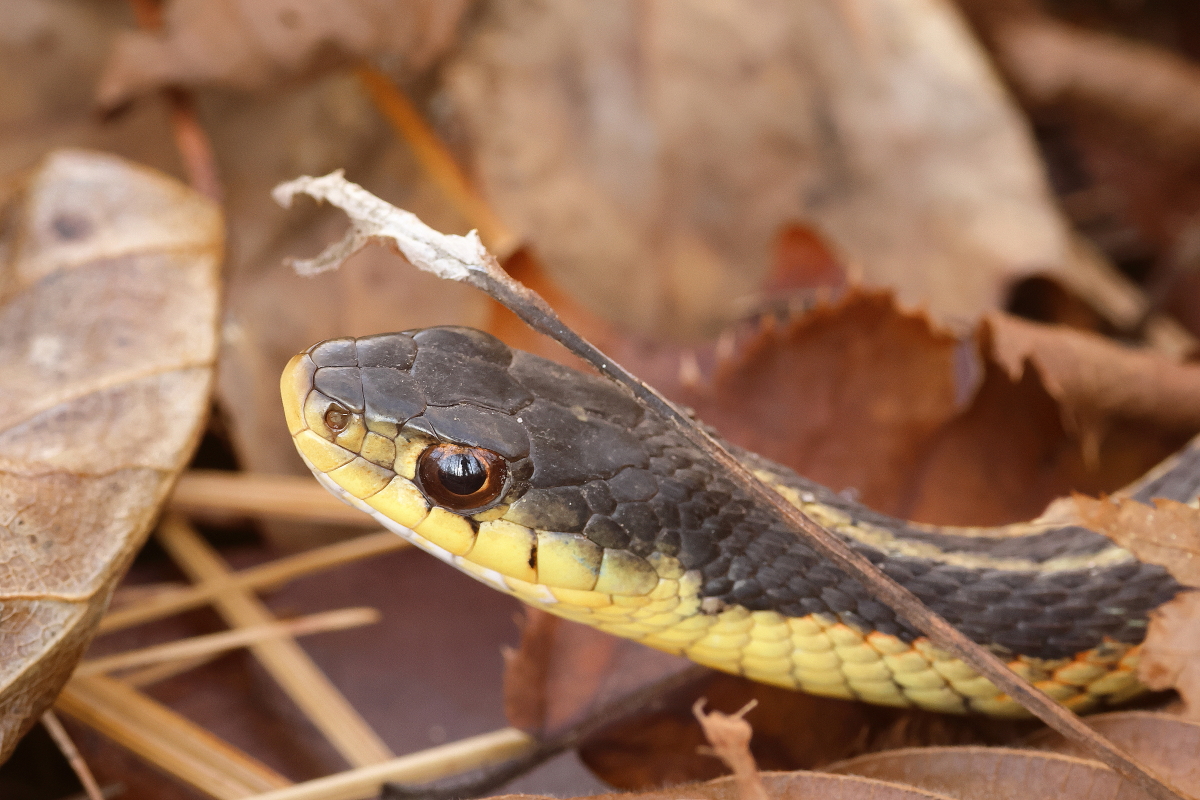
Reptiles are cold-blooded, and are not often seen this late in the season. However due to the warmer than normal temperatures, a few Eastern Garter Snakes were out....

.....as were a few Midland Painted Turtles.

I even heard several Spring Peepers on more than one occasion! I'm sure all these reptiles and amphibians are now safely in their winter quarters!

On one of my outings to Rondeau, I spent a bit of time scanning the lake from the east beach. I was hoping for a few loons, especially a Red-throated Loon or even a Pacific Loon. Both have been seen on occasion in the last week or so. I did see up to a couple of dozen Common Loons.....


....and there was at least one Red-throated Loon mixed in from a distance, but I didn't get any photos of it. As for a Pacific Loon, I struck out on that one so far, but I have seen them in Ontario in the past. When I was involved with some wildlife surveys at Polar Bear Provincial Park in about 1990, we came across a nest, and one of the adults was cooperative enough to allow me this photo. The fall plumage is considerably more drab than this photo, however.
While looking for loons, there was a massive movement of Red-breasted Mergansers flying by. I think they had been stirred up by a passing ship, so there were probably 3-4000 of them in flight that stretched like this photo, for at least a kilometre with smaller groups going by as well.

I spent a bit of time up along the Mitchell's Bay North Lakeshore Trail, and while I didn't see any shorebirds on this occasion in spite of the extensive mud flats, there were some raptors in the area keeping an eye on waterfowl and other things. There were probably three adult Bald Eagles in the area, although they were sometimes on the move for a short distance and maybe there were only two.


This Merlin, next, was initially seen hopping around in some shallow water. Not sure what it was trying to do, maybe wash something before eating? It wasn't clear, but after a few moments it got up and left....
....and this next photo is likely of the same bird, on the top of a pole a short distance away, surveying its domain.

I also spent a bit of time along the Erieau Marsh Trail. There wasn't a huge diversity of birds, but a few things caught my eye and gave me some photo ops. I was a little surprised to see at least a couple of dozen American Pipits flying around in a loose group and landing near the tree tops. I usually see them in much fewer numbers, and typically on the ground, but these were migrating so were behaving a little differently.


American Tree Sparrows are one of the more common sparrows this time of year. This one was busily tearing into some goldenrod seedheads.
A Downy Woodpecker was digging into a tree trunk....
...and this is a Rusty Blackbird, one of a small flock of a dozen or so on the move.
This Great Blue Heron was first noticed when I heard its loud 'croak' that indicated where it was, so enabled me to get this rather distant and cropped photo.


If you want to subscribe, or unsubscribe, to Nature Nuggets, send an email to: prairietramper@gmail.com