Showing posts with label Five-lined Skink. Show all posts

Monday, 1 June 2026

So much flora and fauna!

 What a dilemma...so much to see in nature this time of year, as well as so much to keep up-to-date with at home. What makes this time of year especially challenging is that on May 26, it was the two year anniversary of my wife/best friend's passing. For anyone not aware of a post I did shortly after she passed, here is the link to that.

Also, about a year ago I started a new blog called Life Is A Journey, which gives some insight on who I am featuring so many challenges and blessings. I have over 35 posts on it, so far. If you are interested, here is the link to the first post. It starts early in life, as it is a journey.

But on to Nature Nuggets and some of the things I have noted over the last little while. I will refrain from birds, since on the last post I featured just birds, and neglected so many other things. Much of my time has been at Rondeau, of course. The Common Five-lined Skink is one of my favourite things to see this time of year, as they are found on fallen logs connected to a tree root and with at least part of it well exposed to the sun. They are a cold-blooded reptile, so the sun is beneficial. They are also a species at risk, and Ontario's only lizard. The male, at this time of year, has an orangey face.


The female is almost the same size, but with no orange on the face.
A real treat was to photograph a pair of them, which I call Love Skinks!


A young one has a blue tail, and is why they are sometimes called Blue-tailed Skinks.

A distinctive emerging item is called American Cancer Root, looking like a pale yellowish pine cone emerging. 

On a visit to the Erieau Marsh Trail, I watched a couple of large, female Common Snapping Turtles, vying for territory as they thrashed about the shallow water. Males are much smaller.


Continuing with another reptile, Eastern Garter Snakes are regularly seen....


.....unlike the very similar Northern Ribbon Snake, next. They are quite similar, although the ribbon snake prefers wetter sites, is usually more distinctly lined and perhaps one of the easier features if you can get a look, is that there is a small white spot immediately in front of the eye, as the next photo shows.

Changing up a bit, I was out last evening along the east beach of Rondeau. I noted yet another reptile. This little guy was right on the path, and due to its very small size, is undoubtedly a hatchling this year.

I also came across something that is very hard to capture photographically. It may not be immediately apparent of what it is, but just at dusk, millions....no make that billions....of insects start to swarm in very large mass groups. They are constantly on the move as they swirl around, and along the lake shore one can see numerous swarms. It was really hard to keep the camera's focus on them!


 A bit later in the evening, I got a photo of the second full moon of May, a.k.a. a Blue Moon, being the second one in the month.

 After I got home, I also noticed my first tick of the season! It was just crawling up my leg, so hadn't dug into me yet. I picked it off and photographed it on the back of my hand. The month of May is Lyme Disease Awareness Month, which is sort of suitable that I got my first tick of the year in May. Hopefully it is the last one, and I am glad it wasn't a Black-legged Tick, a.k.a Deer Tick which is the transmitter of Lyme Disease. I have had LD at least 5 times, and while I haven't been as seriously affected as some, I do have a long-term/ongoing issue of fatigue ever since my first encounter with LD back in September of 1976!

American Dog Tick
 A few of the wildflowers that have recently made an appearance include:

Wild Geranium

Golden Ragwort close-up

Golden Ragwort 
A rare plant, which may not even be present at Rondeau naturally, but that is another story, is a species at risk called Goldenseal, shown in the next two photos.


Long-spurred Violet

Canadian Lousewort, yellow

Canadian Lousewort, purplish

Wild Columbine
Next, what is initially perceived as a flower, is actually the emerging leaves of Shagbark Hickory.

Starry False Solomon's Seal

Mayapple

Next is not a flower, but a plant, known as Sap Yeast which often occurs in the spring oozing from a damaged part of a tree trunk.

Wood Anemone
Next is an orchid that one doesn't normally associate with Rondeau. It is Large Yellow Ladies'-slipper. I rarely come across them unless I am looking specifically for them, as I have only known them to occur at three spots in the park. One spot no longer supports them, a second spot only has one or two if any, and the third spot supports a dozen or so but is a long way from any trail.

 A couple of other critters:
Bronze Jumping Spider

Spicebush Swallowtail
And lastly, just a view along the west South Point Trail, one of my favourite places to meander in Rondeau especially once the crowds of May have subsided.


 If you would like to subscribe to Nature Nuggets, send an email to: prairietramper@gmail.com


Saturday, 21 June 2025

Lots of colours and diversity!

 First of all, I need to apologize for not responding to the many comments readers have shared with me over the past few months. I used to get immediate notifications when a comment was made, but something changed, and so comments that were made since the beginning of 2025 seemed to be tucked away in a different manner, and I only came across them today. I have tried to respond to all of those that were made since then!

June is the prime month for Tulip Trees to show off their impressive flowers. 


 The Tulip Tree Trail is one of my favourite trails at Rondeau for various reasons that I might explain in my other post. At any rate, there are lots of Tulip Trees, but unfortunately for the normal hiker, the flowers are hard to see as the flowers like lots of sunlight so are most abundant near the uppermost parts of the tree. A telephoto lens was necessary to get this next photo.

At ground level, fortunately, there are lots to see at this stage of the season. It is always nice to lock eyes on a butterfly!

Northern Crescent
Wildflowers are more apt to stay put for the camera. This next flower is a Narrow-leaved Blue-eyed Grass.

Another critter came into view: it is a Morbid Owlet, a moth, which was not very active and preferred the shadier parts along the trail. Not sure who comes up with these names, as I don't see anything morbid about it.
Butterflies are fairly active especially on sunnier days. If it doesn't get too hot, I expect they will really like the next few days as it becomes the warmest of the year so far!
Little Wood-satyr
A colourful wildflower that likes open grassy areas, such as at the edge of a prairie/savannah with lots of sun is this next one: Hairy Beardtongue, a native species.


 Purple-flowered Raspberry is starting to be more noticeable at the woodlot edges, as the deep red flower appear. Although it is a member of the raspberry family, the fruits are not edible.

And in a few places, one might encounter the Endangered, Red Mulberry. There are a few places scattered around Rondeau where this species can be found, and it is in flower right now.

 In some of the wetter areas, one will come across this next wildflower, Tufted Loosestrife.

Also along trail edges, but not a native species, is Common Mouse-ear Chickweed, named because the 5 petals are partially split, looking like a pair of ears.

And then another moth comes into view. It is known as a Black-bit Moth.

 An even smaller creature resting on a leaf was this Basal Click Beetle, barely a centimetre in total length.

Not a flower in the normal sense of what one might expect, is this next one: American Cancer-root, formerly known as Squawroot. It is parasitic on the roots of various trees, mainly oaks and beech trees, although this particular one was part of a clump at the base of a White Pine. But since the roots of trees intermingle underground, it could easily have been connected to an oak, which was nearby. It doesn't have leaves and flowers like most flowering plants, and what is seen above ground is really just the flowering/fruiting body.

One can come across Ontario's only lizard at Rondeau, the Common Five-line Skink. I know I have featured them in recent posts, but I thought this one was worth showing. I refer to these particular ones  as 'Love Skinks'. The male has the orange facial area. I have never seen a pair of them this close, and with the male having his right front arm over the back of the female!
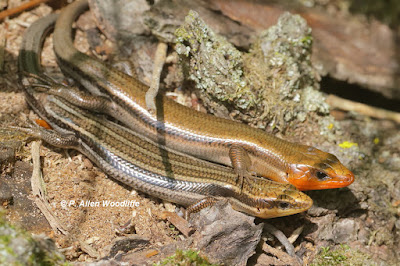

While we were watching this pair, we had what we determined was likely a Short-tailed Weasel pop up on the boardwalk less than two metres of my feet, grab something and disappear. I suspect that as we had slowly walked along the boardwalk approaching this spot, the weasel dropped what it had in its mouth, and scampered away, but was reluctant to give up its meal and so returned. It all happened so fast I was unable to get a photo of the weasel. I didn't get a solid look at what it came back for, but the person I was with said it looked like a small skink, perhaps part of the extended family of the pair we were watching. I had seen young skinks in this immediate vicinity on previous visits, so it was entirely likely. Certainly an interesting time watching nature in action, much to the chagrin of the little skink.
 

Visitors to Rondeau earlier this season likely would have noticed where the park's prescribed burn efforts were this year. Several areas looked like this:


In only a short period of time, the grasses responded well, and even now, several weeks later, the growth has been quite lush, as expected. The burn keeps the numerous shrubs, some of which are not native and aggressive, in check, so that the native grasses and wildflowers continue to represent an important part of the park's vegetation mix.
I was going to feature some more early season orchids, but that may be in the next blog. And check out my new-themed blog, Life Is A Journey, at this link. I plan to post my next one on this blog very soon.

If you would like to subscribe, or unsubscribe, to Nature Nuggets, send an email to: prairietramper@gmail.com