Showing posts with label black lighting. Show all posts

Monday, 13 July 2026

Creatures that saw the light

 Black lighting for moths has been a lot of fun over the years, although since Marie's significant decline in her health and eventual passing, I haven't done any black lighting for the past two plus years. But in looking at various file folders with numerous moths shown, I have gotten back into it. So far I have been out to Rondeau, the only place I have done any black lighting in this current year, on five occasions, at three different locations. With the shorter nights, I usually put the lights on at about 9:30 p.m. and stayed until after midnight. On a couple of occasions I stayed out until about 2 a.m., and was tempted to stay until daylight, having an occasional nap in the vehicle if necessary. However the ongoing presence of mosquitoes was just enough to prevent any naps, so packed it in no later than 2. 

Each time I was out, I took anywhere from 125-200 photos, many of which were duplicates, but could easily be deleted once I got a closer look at them on the computer. Nevertheless, to date I have probably photographed about 150 species of moths, plus a couple of dozen other creatures that came to the light.

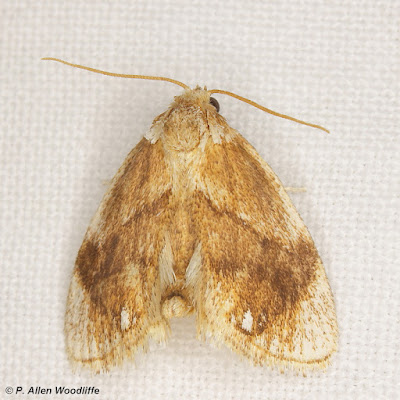
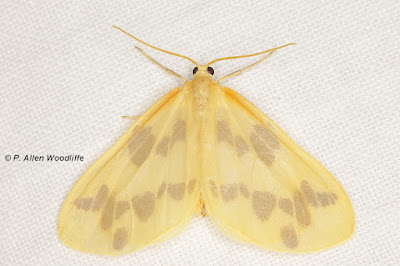
Here are some of the more colourful, even rare, moths that I got photos of. You can get a relative size of each one, based on the size of the weave on the sheet it was photographed on.

Abbreviated Button Slug Moth

Angle-lined Prominent

Angus Datana

Baltimore Snout

Basswood Leafroller

Bent-lined Carpet

Bicolored Pyrausta

Common Spring Moth
This next one is a member of the Crocus Geometer complex, and often cannot be identified to species based on a photo.

Dark-spotted Palthis
Dimorphic Tosale Moth
Next is an Elm Sphinx. Large moths such as sphinx and silk moths are always a highlight.

At the opposite end of the size scale is this next one, a Goldenrod Gall moth.

Green Leuconycta 

Next is one of the smaller silk moth types. It is a Pink-striped Oakworm Moth, and I am fortunate if I see even one every year, so it is definitely a highlight of the black lighting season.
 

Pink-shaded Fern Moth

Muzaria Euchlaena Moth

Lettered Sphinx Moth

Leafy Spurge Hawkmoth

Hickory Tussock Moth

Spotted Apatelodes Moth

Scarlet-winged Lichen Moth
Another medium sized silk moth, is the Rosy Maple Moth, shown next. This is more commonly seen than the Pink-striped Oakworm moth above, and I often see 4-5 of these in a season.

Purple-crested Slug Moth
Another highlight is to photograph a large member of the silk moth group. This one, a Polyphemus Moth, came in very briefly at first and never stopped fluttering on the sheet. This next photo of it is the best I could get at first, and is not entirely in focus, nor is it entirely in the photo. It left after a few brief moments, and then returned about an hour later, and even landed on my hat, my shirt and arm, kept moving and I couldn't get a photo of it.
It left again, and then an hour later it came back and landed quietly on the sheet, and remained until I was done for the night. 

Yellow Slant-line

White-dotted Prominent

Tulip-tree Beauty

Three-spotted Fillip
And finally, The Badwing.

Taking so many photos and having to process them is definitely time-consuming. I still have lots more already processed, and lots I haven't even started on yet. As the third week of July is considered National Moth Week, I may post some more, or at least feature some of the non-moth creatures that stopped by for a photo shoot.


If you would like to subscribe to Nature Nuggets, send me an email at: prairietramper@gmail.com 


Friday, 21 July 2023

National Moth Week just around the corner

July 22 begins National Moth Week for 2023. I haven't been giving moths their due so far this year, but it is time! I have been out on occasion, but not as often as in the past few years. A couple of recent black lighting visits to Rondeau have been quite productive. Some of the highlights, and more colourful individuals of the approximate 100 species from those visits, are shown here.

American Idia, shown first, is pretty regular, but not always in as good a shape as this one.


Arched Hooktip
Next, slightly worse for wear but still in pretty good shape is the Beautiful Wood-nymph.
Here is one I have rarely seen, let along photographed. It is the Black Bit Moth, and fairly large as most moths go.
I'm not entirely sure about this next one. It might be a Fragile White Carpet.

Delightful Donacula

Early Button Slug Moth
For moth-ers, having Sphinx moths come to the light is always a highlight. This next one is a large Sphinx moth known as an Elm Sphinx.

Next is one with rather limited Ontario distribution, and is on the list of rare species of Ontario. It is a Faint-spotted Palthis.
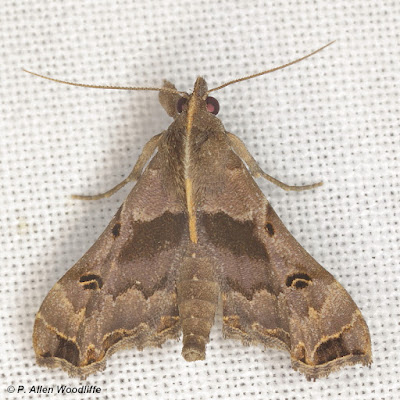
Fall Webworm

Frosted Tan Wave
Another highlight is this large moth, which I have only photographed a couple of times. It is a Giant Leopard Moth.
Another rare species in Ontario is this Gold-lined Melanomma.
Quite a common species, but rarely have I seen it looking so greenish, is this Green Pug.

Guenee's Pearl
These next two are fairly regular, and quite interestingly patterned.
Hickory Tussock Moth

Jewel-tailed Slug Moth

This next one is extremely small, only about 5 mm long, and rarely photographed in Ontario. It is the Linden Bark Borer and is not native.

There are several Callus Borers, but only this Maple Callus Borer comes to a light. Of the Callus Borer group, it is easily told by the reddish/orange tip of its abdomen.

Pale-winged Crocidophora
A quite colourful and vividly patterned moth is this Pink-shaded Fern Moth, shown next. I had 8" x 12" canvas prints made of these next two due to their impressive colours and patterns.
One of my all-time favourites, seen primarily in mid to late June and sometimes early July is this Rosy Maple Moth.

Showy Emerald
This next one is new for the Rondeau checklist, and in Ontario, is only found widely scattered across the southern part of the province.
Sooty-winged Chalcoela


Another one in the slug moth group is this Spiny Oak-slug Moth.

A larger moth looking somewhat like the sphinx moths is this Spotted Apatelodes.

The Bad-wing

Beggar Moth
This next one is rather worn and torn, but it is a rare species in Ontario. Not surprisingly it is fairly regular at Rondeau as it is a Tulip-tree Beauty, where Tulip-trees are rather common.
There are several similar looking moths, but I am fairly certain this is a Virginian Tiger Moth.
Another large Sphinx moth is this next one, the Walnut Sphinx.
At the other end of the size spectrum is another slug moth, the Yellow-collared Slug Moth.

Depending on the weather and my energy levels, I expect to be out with the black lights again on several occasions over the next few nights during National Moth Week. It is about the peak time for moths, although there will be lots more to photograph and document until October!


If you would like to subscribe, or unsubscribe, to Nature Nuggets, send an email to: prairietramper@gmail.com