Showing posts with label Cattle Egret. Show all posts

Thursday, 14 November 2024

A mix of rarities and more common things to enjoy!

 One of the birding highlights in recent days was to hear about a Western Cattle Egret hanging out with a few black angus cattle a bit north of Erieau. I had been out at Keith McLean Conservation Area on the lookout for migrating raptors with the favourable winds, when I got the word, so I headed over to look. Sure enough, there it was, but it was flighty, moving from one group of cattle to another before it finally got up in the air a little higher and headed towards Rondeau Bay.


A few days later, this past Tuesday to be exact, an even rarer bird got the attention of many, many birders, at the KMCL, a Mountain Bluebird. More on that a little later.

In between these bird highlights, I was out and about looking for whatever I could find. The sometimes breezy winds from a northerly direction was promising for raptors, and I spent a bit of time at the Morpeth Cliffs area. There were a few raptors on the move, but most were very high up and difficult to see against the almost entirely blue sky. My hope was to see a Golden Eagle or two, as this is prime time for their migration, and several of the hawkwatch sites had reported then regularly. Even though I had been on the lookout for them at other times over the past few weeks, today was to be the day. I had two fly over, way up high. This photo of one of them was the lowest. Fortunately my camera/lens combination latched onto it with good focus, and this is what I ended up with.


Both birds were almost impossible to see with the naked eye, up against the brilliant blue sky. Binoculars were a necessity. After I got the photos processed, and greatly cropped, these were the best of the bunch, and after all was said and done, they are shown here at the equivalent of about 100X magnification!

There were some sunny warmish days to go out wandering around Rondeau on occasion, so out I went. Birds were not always that plentiful, but there are always other things to see and photograph.

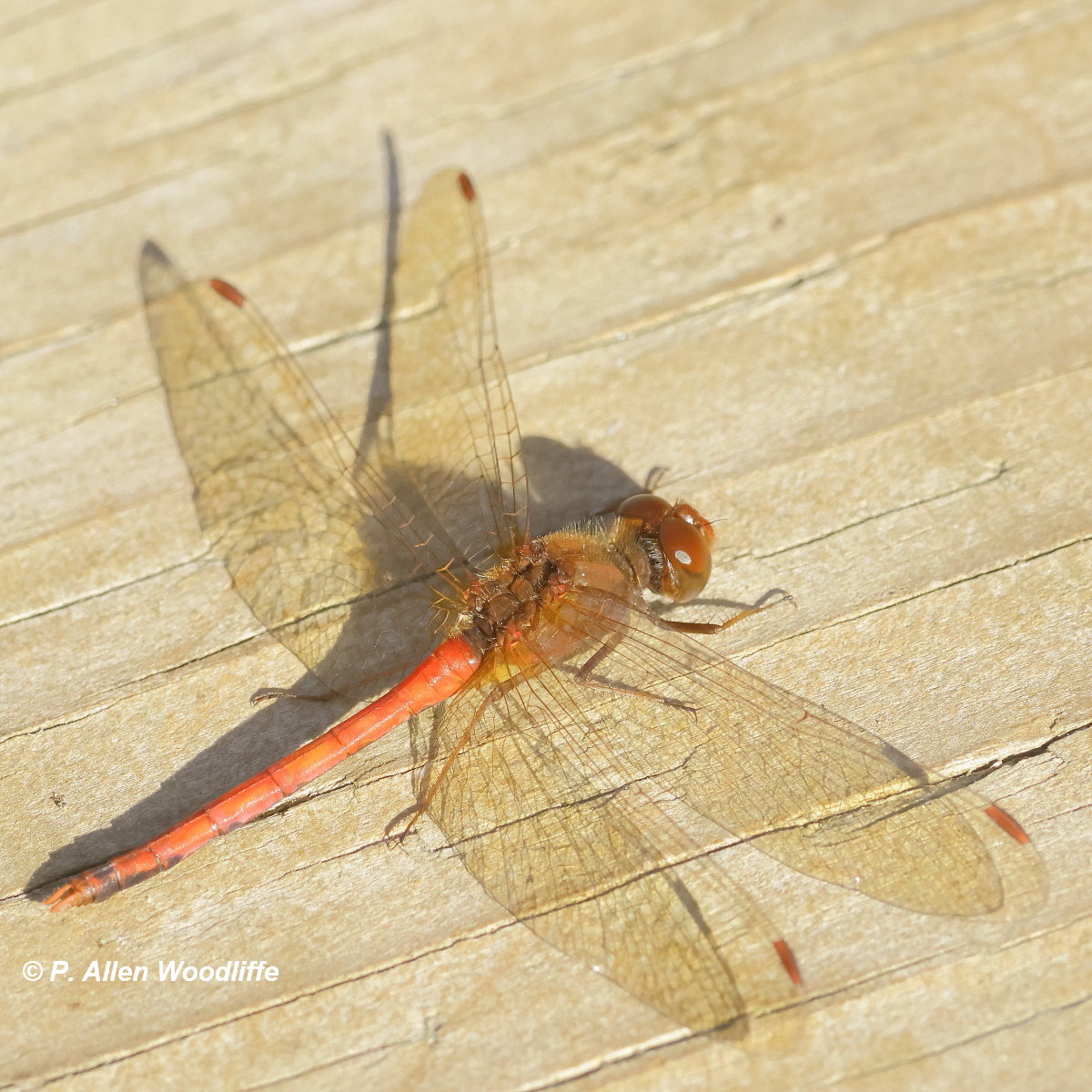
During the sunniest period and sheltered from the wind, there were often a lot of dragonflies flitting about. They were all of the Autumn Meadowhawk species as near as I could determine, and their pale/yellow legs were telltale. It used to be called the Yellow-legged Meadowhawk, and perhaps is still referred to as such.
Common Buckeyes were still around, and sometimes paused long enough for a close approach with the camera.
As there were still the occasional dandelion flowers quite visible, they attracted several of this next critter, the Common Drone Fly. It is not a native species, but has become quite abundant at times.
Eastern Black Squirrels are quite common, as usual, especially where there were a few oak trees around, as they were searching for acorns.
Another butterfly is this next one, a Fiery Skipper. It is typically more of a southern species, and arrives in Ontario in the later summer. Some will stick around for quite awhile!
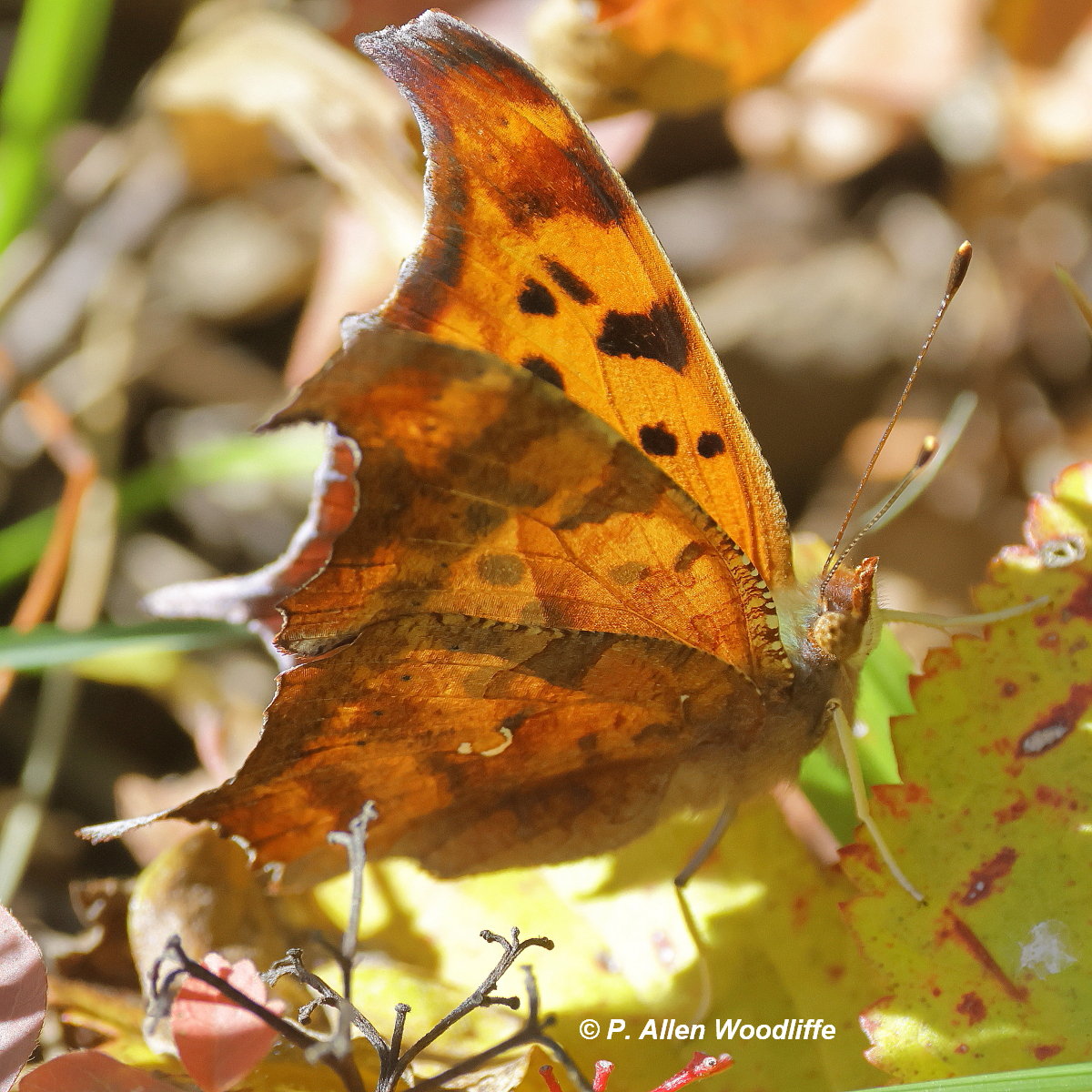
Another butterfly I caught up with is this Question Mark.

There were a few birds to be found, and some allowed me to get some worthwhile photos. Blue Jays are migrating through in good numbers, with some searching for sustenance to carry them on their journey.

No doubt some will stick around all winter, as usual.
Dark-eyed Juncos are fairly common. Here are a few having a bath in a shallow puddle.
Red-bellied Woodpeckers are permanent residents now. They were extremely rare up until the 1980s or so, and have since became well established here in southwestern Ontario.
Rusty Blackbirds are not as plentiful as they used to be, but still migrate through in decent numbers. This one was feeding on a seed of some sort on the ground.

Mushrooms have not been plentiful compared to some years. The quite dry spell we have experienced over the last few months made all the difference. But a few have appeared. This first one is a type of puffball, and may be the Pear-shaped Puffball.

Next is the Orange Jelly Fungus...
...followed by Shaggy Mane.

Some days have had some quite brisk east winds. This first image is of the waves along the east beach of Rondeau.

I went over to Erieau hoping for some impressive wave action hitting the pier and splashing over. This next one is one of the better ones, but overall it wasn't as impressive as I was hoping. Maybe a different day...

This next photo shows one of the better ones I took in late October of 2021. Some of the waves and spray almost obscured the lighthouse!

Getting back to the Mountain Bluebird. It was first seen this past Tuesday, and I got word from Steve Charbonneau who was the one who found it, in the very early afternoon. I am not on Discord, the birding app that keen birders who like to chase the latest notable birds are on, and since Steve is aware of that, informed me directly (thanks, Steve!). However it just didn't work out for me to scoot out to the Keith McLean area to catch up to it that afternoon. It was apparently feeding quite readily in a good spot, and since this species is fairly hardy even in poor weather conditions, I thought it might still be around on Wednesday. A lot of others were hoping for that outcome as well. There were lots of people who saw it on Tuesday, and even when I went out on Wednesday, I could barely find a spot in the parking lot. Unfortunately no one reported seeing it at any time on Wednesday. Perhaps the strong wind forced it to take shelter, and it might have been around and was even amused by the number of people roaming around with 'scopes, binoculars and camera gear. However it was not reported. Hopefully it might still be around at an accessible location not far away. This species has been considered long overdue for the Rondeau checklist area. But so far I cannot add it to my Rondeau list. I have seen it on two occasions in southern Ontario in the past, as well as on a few trips to the western part of the country. The first time in Ontario was one I saw on a Christmas Bird Count on Pelee Island, back in the '90s. The second one was one I heard about in southeastern Lambton, so Marie and I went searching. We successfully tracked it down and photographed it, just a short distance from Chatham-Kent. We caught up to it on January 20, 2012.

January 2012 provided another good photo op for an uncommon species, this time for White-winged Crossbill. There have been a few migrating through so far this autumn, and on one occasion I thought I heard one or two, giving their high-pitched rattle calls, but could not find it perched anywhere. It was probably passing through quickly and vocalizing. At any rate, here is a photo I took of one at Rondeau on January 25, 2012. It was part of a flock of a couple of dozen feeding in this spruce tree.


If you would like to subscribe, or unsubscribe, to Nature Nuggets, send an email to: prairietramper@gmail.com


Monday, 6 November 2023

Cattle Egret, Purple Sandpiper and more common birds to enjoy

 Undoubtedly the highlight bird for me in recent days, is the presence of a Cattle Egret. There has been the occasional report of one somewhere in southern Chatham-Kent over the last couple of weeks, but this one stuck around for at least a few days, giving many birders a successful outing.

It wasn't always easy to find, and usually it was patience that made it successful. The bird could be quite well hidden for great lengths of time, and then all of a sudden be seen in flight heading to one of its preferred feeding areas. As far as I know, it was either at the edge of a pasture with cattle, or more likely to be in a hay field with rather short vegetation, or on occasion, even on a lawn nearby. On more than one occasion, a Northern Harrier that was hunting close by gave the egret cause for alarm, and it would fly off to another spot, but given that the hay field was large enough, would stay within sight of the road side where birders congregated.


I saw this egret on several occasions as I was going back and forth from home to either Rondeau or Erieau, and came across several birders while doing so, all of which happily saw this bird.

At Rondeau, there was always something to see and photograph, although at times one had to be at the right spot at the right time, or cover a lot of area. I did not go after the very distant Western Grebe that was present off the east beach on the weekend. I have seen this species at a much closer range, several years ago, and got some satisfying photos at that time. I haven't caught up to a Red-throated Loon this fall yet either. Maybe on one of the coming days. But the influx of one of my favourite sparrows, the Fox Sparrow, has been fun to see. It seems they often travel in small bunches, and this is prime time to see them. I counted approximately 15 in a couple of bunches along the Black Oak Trail a few days ago. I find that they often respond well to 'spishing', and come in quite a bit closer to investigate.


Cedar Waxwings continue to be fairly common, at least where there are berries of Red Cedar to be had.
On one sunny and not too cool day, a couple of Eastern Commas were still flitting around along the more sheltered part of a trail.....

.....and it seems the local Eastern Screech Owl has returned to one of its regular tree cavities. It is the first time I have seen it there in several months.

At Erieau a few days ago, the highlight was a Purple Sandpiper. As many as three had been seen a couple of days earlier, but when I checked out the end of the pier, there was only one that I could find. The bird was back lit, so it required a bit more processing to get it to this condition.


It is a fairly regular occurring shorebird in very small numbers, but not always easy to catch up to. Depending on the year, one may even overwinter in some relatively out-of-the way location, such as the far reaches of the south beach of Rondeau. They are discovered fairly regularly on the Christmas Bird Count if there is adequate coverage of such area.

There are some good mud flats at the Keith McLean Conservation Lands, which has attracted large numbers of some species of shorebird. Dunlin is the most abundant by far at this time of year, with sometimes several hundred birds being reported.

Much less common is Semipalmated Sandpiper, a little smaller and with a shorter and straighter bill.
Here is a side-by-side view of those two shorebird species.

A stop at St. Clair NWA can be rewarding for bird photos. The Tundra Swans are on the way back, and will number in the hundreds or even thousands in the near future. Some will likely even stay the winter, depending on the open water and field conditions. They are often seen at a distance.....

....but some may fly right overhead!
There are lots of ducks at the NWA, including Ruddy Duck, shown next..
...and Northern Shoveler, the less colourful female of the pair which is next.
American Coots are plentiful.
Again, the presence of many Fox Sparrows were indicative of the time of year....
...as were American Tree Sparrows.
An American Goldfinch decided to check me out from this grass stem, rather than fly away like its fellow goldfinches did. It is clearly in its non-breeding plumage.

The Mitchell's Bay North Shore Trail can be worth checking out, depending on the light and the wind. Here, as in many lake shore areas, are exposed mudflats, and with the above freezing temperatures, are popular with shorebirds. As is often the case, Dunlin is by far the most abundant shorebird. There were well over 100 of them on my most recent visit, often seen in flight....

...and occasionally landing fairly close by.
This next one was not part of the larger group. It seemed to prefer hanging out by itself, although it didn't look quite the same as the others, and may have suffered a slight injury.
A single Greater Yellowlegs was in the same area....
...as were several Killdeer.
This adult Bald Eagle was noted at the lake edge, surveying the lake itself.

A visit down the Thames River towards Jeanette's Creek turned up several Great Blue Herons....

....and Great Egrets. Will some stay for at least the early part of the coming winter and be counted on the upcoming Christmas Bird Count? It has happened before, so stay tuned!


If you would like to subscribe, or unsubscribe, to Nature Nuggets, send an email to: prairietramper@gmail.com