Showing posts with label Pied-billed Grebe. Show all posts

Friday, 21 April 2023

(Mostly) Wetland Wanderings

 Birds returning, wildflowers blooming, turtles sunning, butterflies flitting....there is lots to take in as spring develops! 

I recently stopped in at the Blenheim Sewage Lagoons to see what was happening. There was a good variety of waterfowl, as expected, with Ruddy Duck taking top honours in terms of numbers. There were anywhere from 800 to 1000 or more scattered across the various cells. Many were in fine breeding plumage. Perhaps they have memories of the last hunting season, however, as they were not eager to be within good camera range.

The water in all of the ponds was about as high as I have ever seen it. Even two of the sprinkler cells had lots of water, which bodes well for the upcoming shorebird season if those sprinkler cell levels remain. On this day, however, I only saw Lesser Yellowlegs and Killdeer, but it is a bit early.
There were many hundreds of swallows, mainly Tree Swallows, and due to the cool temperatures, some were low down or even on the ground.
A small number of Purple Martins, like the female shown next, were mixed in on the wires and on the wing....
...I only saw a single Barn Swallow.
A couple of Savannah Sparrows were skulking around.

I next went to the Erieau Marsh Trail. It can be quite birdy, and due to the narrowness of the trail, at least some of the birds are not far off. Ducks are becoming fewer, although there are still many out on the bay but well beyond camera range. Close by the trail are the usual Canada Geese and Mute Swans nesting. This pair of Blue-winged Teal was scrounging around....

...and nearby were up to 9 Dunlin. This one is a long way from full breeding plumage, but getting there.
Blackbirds of various types are typically plentiful, and occasionally a Common Grackle was busy enough with something else that it let me get this photo. I love the iridescence of its plumage in good light.
Along the trail was this Groundhog. At first I wasn't sure what it was up to. But watching for a few minutes indicated it was on the prowl for something to line its burrow with.
It scampered back and forth several times while I watched. After it went down into its burrow, I kept moving along, and when I got to its burrow entrance just a metre or so off the trail, I could see its head at the top keeping an eye on me, to make sure I moved along.
Just as I left the trail, I noted this Osprey perched on a pole. It was apparently quite comfortable and secure, as it let me turn the vehicle around and pull into a driveway to get this photo. There are very few places to pull off along this stretch of road, so I was glad it was close by one of them.

I have been to Rondeau a couple of times lately, although the birding has been erratic. I always find other things to enjoy if the birds aren't plentiful, but I have to decide what camera/lens combination to take on my route. On one of the days, I had a wide-angle zoom intending to photograph some of the emerging wildflowers, so it was a bit of a challenge to get this Azure species. Not so many years ago, most butterfly people would be content to call this a Spring Azure but in recent years the butterfly specialists have re-configured the Celastrus genus and some of them get quite indignant if one puts a species name to the genus. I just call this an Azure species.

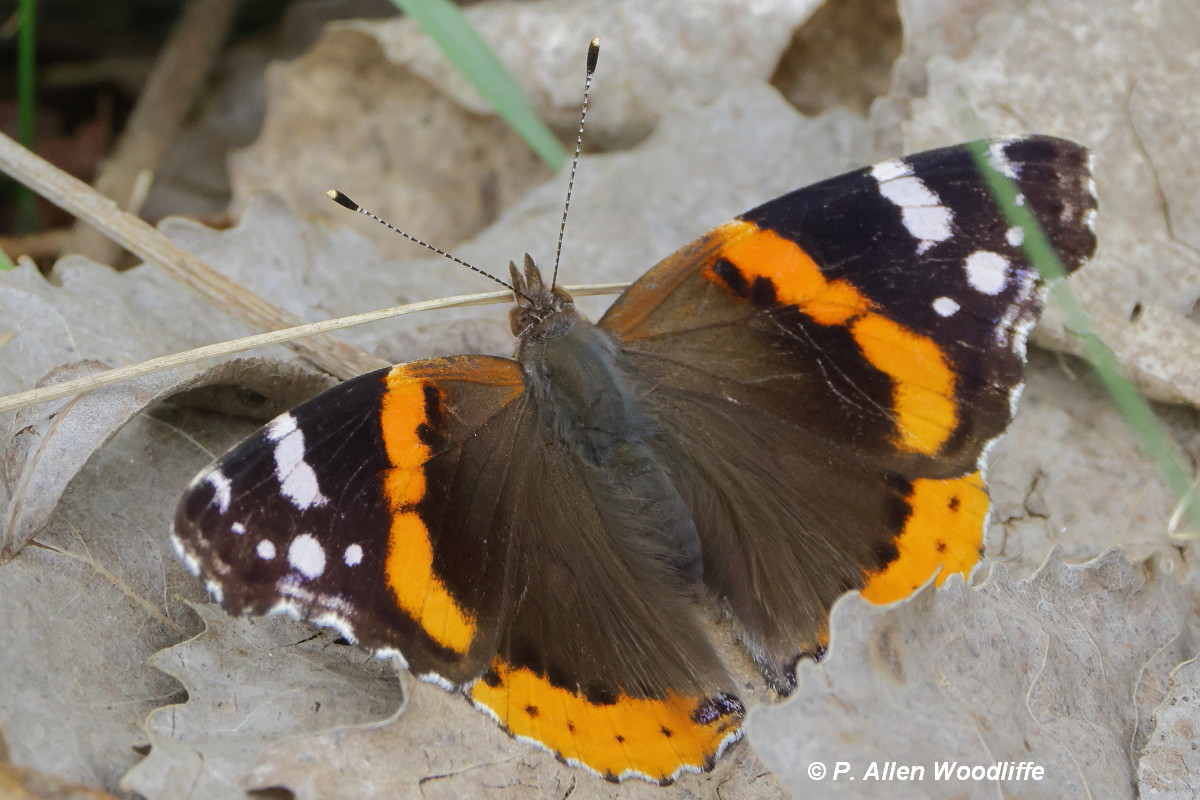
I also had several Red Admirals go by.
The resident Eastern Screech Owl shows up in its usual spot on occasion, but is not predictable. It was quite visible on this day.

I've also spent time at some of the wetland areas along the Lake St. Clair shoreline, and for good reason: there is always a variety of things to see there as well! At the NWA, I had this American Kestrel perched on a branch well away from the trail, but at least it stayed long enough for a distant and heavily cropped photo.

There were many dragonflies flitting about, including this pair of Green Darners 'in wheel'.
A young Painted Turtle was along the road side, but clearly it was dead.
More Red Admirals were around.
Up in the Mitchell's Bay area, I had several Forster's Terns, but most were well out over the lake. I got a single photo of one perched on a rail, just as it was getting ready to take off.
Great Egrets are often within camera range. I had about 11 on this most recent visit, and a couple were within shooting range.

There were numerous turtles out, with about 95% of them being Painted Turtles. I saw 5 of these Northern Map Turtles, the first ones I have seen this year.
Pied-billed Grebes can be heard hooting and hollering out in the marsh. I had a pair of them swim by fairly close, before they realized I was not a tree or something, whereupon they quickly made their way elsewhere.

One of my target birds for this outing was to see a Yellow-headed Blackbird, which are known for nesting in the cattail islands close by Mitchell's Bay. I did get a couple of quick glimpses of one, but it was very skittish and did not allow me to photograph it. So I include a photo of yesteryear.


If you want to subscribe, or unsubscribe, to Nature Nuggets, send an email to: prairietramper@gmail.com


Friday, 25 February 2022

Late winter explorations and hints of spring

 Spring is teasing us a bit more lately. I've been out exploring a few places around Chatham-Kent, intermixed with things going on at the home front.

I often have stopped in at the warm water outlet along the Thames River right at the downstream side of Chatham. The cold weather had kept the opening in the ice quite small up until a few days ago. There has been a periodic change of water bird species, but not a lot of diversity this late in the season. One of the things I always look forward to in a cold winter is the great photo ops of even some of the more regular species.

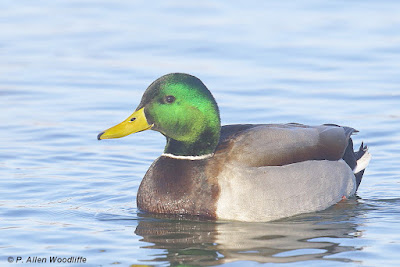
Of course the ubiquitous Mallard is the most abundant....

...and the female Bufflehead continued for awhile.
The numbers of Redhead has varied from 1-10.
Canada Geese are always somewhere around Chatham in winter, numbering in the several hundreds. There seems to be a constant movement of small groups from one location to another, and this provides some great photo ops.


Pied-billed Grebes are seldom very common in winter, but this one has persisted for weeks now.

With the recent warm spell and moderate rainfall, the Thames River drainage has resulted in a significant change. The once frozen over Thames River is completely open, with only a few scattered bits of ice clinging to the shoreline. Therefore waterbirds are widely scattered, and unless there is a prolonged cold spell (I hope not!!) that will put an end to photography at this location.

Hints of spring are showing up on the landscape. Killdeer have been reported in various locations over the past week or two. Red-winged Blackbirds are always a good sign, although given their general abundance over the next few weeks, will cease to be as much of a novelty as they are now. I saw more than a dozen along a shrubby corridor not far from one of the larger marshes in Chatham-Kent a few days ago.

American Goldfinches were frolicking in a nearby cedar hedge. Some of them were looking a bit more colourful than they were a few weeks ago. They are a far cry from their vivid breeding plumage, but any change is a nice hint of what is to come.

A quick check of a Wood Duck box at St. Clair NWA resulted in seeing the resident Eastern Screech Owl show itself.


 Horned Larks are fairly abundant, scattered far and wide along roadsides and fields.

I stopped in at the cemetery along Owen Road, where there are numerous cedars amongst the hardwoods. A Red-breasted Nuthatch, not an abundant species this winter, was there to greet me and posed politely for me.
I've only been to Rondeau on a couple of occasions lately. House Finches are fairly common in certain localities.

But the birds can be quite few and far between at this stage of the winter. On my most recent visit, yesterday, I wanted to take advantage of trekking along the west South Point Trail. Trails in general have been tricky lately, as the snow packed surfaces have turned into very uneven ice, making hiking a bit of a challenge. So with the recent mild weather and rain, a lot of the ice was gone, and the walk to the south end of the park was quite enjoyable, although the birds were few. The ice formations along the lake can be interesting and photogenic.


A bit of milder weather and the brisk winds that March is known for will spell the end of these types of features in fairly short order. There were a few open water spots barely visible with the binoculars, and a few rafts of waterfowl were scattered about, mostly scaup and Redhead, along with some Common Mergansers. But the bird highlight was to see at least 6 Bald Eagles perched on some of the ice mounds well out in the lake, while two more, both adults, soared overhead.


FYI, I am planning a short series featuring some changes in the birds of Chatham-Kent over the last century or more. I have an unpublished manuscript by A. A. Wood, entitled The Birds of Kent County, Ontario, which he prepared back in the 1940s. It was based on his research of notes and articles from birders over the previous 75 years. In reading some of the descriptions, I found it interesting to compare with today. So stay tuned!


If you want to subscribe, or unsubscribe, to Nature Nuggets, send an email to me at prairietramper@gmail.com


Saturday, 12 February 2022

Water Birds and a Beaver

 Certainly with the limited amount of open water available this time of year, any of it is a major drawing card for birds. Waterfowl in particular, not surprisingly. So I keep checking places like the small patches of open water at water treatment plants and the like.

The warm water outlet for the Chatham water treatment plant, as it enters the Thames River, consistently has several dozen to a couple of hundred water fowl in the immediate area, but they come and go.

A female Bufflehead has been around for several weeks....

...as has at least one, and sometimes two, Common Goldeneye.

Up to 9 Redheads have been present, mostly males, 

but a female or two have been there a bit longer.

Snow Geese are not often seen there, but on one occasion recently there were 14 of them, and showed various plumages varying from pure white, to partial 'blue' phase, to a good solid blue phase.


Mallards are by far the most common, and while they certainly are not rare, they are quite an impressive duck nonetheless. In fact a colleague of mine, who had a Ph. D. and specialized in waterfowl biology mentioned that he thought they were a very strikingly marked duck that never got the adulation they deserved. I agree, and while I like to photograph rare or less common birds, if a common species gives me a good photo op, I will take it.
Even the females are quite attractive in their own way.
A single Pied-billed Grebe continues to hang in there as well.

There are always a few gulls looking for something to snatch away from anyone else.
 

 At the Ridgetown Sewage Lagoons, the open patch of water is getting smaller. But a few ducks are continuing to spend time in the water or on the ice immediately surrounding it. A couple of male Northern Pintail were present for several days....

...but most of the ducks were skittish. As long as you stayed in the vehicle, they were fairly tolerant, but any move to step outside caused most of them to take to the air.
A couple of male Redheads were also there....
...but also decided any movement outside the vehicle was reason to take flight.
Most Mallards were more likely to stay put....

....although a few got up for a little flight once in awhile.

a Mallard returns
 I've been out roaming around the former Dover Twp on several occasions. There is still an occasional Snowy Owl, but most seem to have moved on. Of course with the snowy farm fields, they are definitely a lot harder to spot!

There are still several thousand geese as well as a few swans, especially in the vicinity of St. Clair NWA. Mixed in with the Canada Geese have been a few Greater White-fronted Geese, but I haven't managed to get any photos of them lately. I did get this photo of a single blue phase Snow Goose

.....and snapped a few of the Tundra Swans.
I went to the west end of Rivard Line, just north of St. Clair NWA, where a large-scale water pump continues to keep a bit of water open even in the coldest weather. As is sometimes the case, a Belted Kingfisher can be found, waiting to snatch a minnow from the water. This bird looks to be in fairly good condition, so must have had some success in minnow-catching over the last few weeks.

Oh, and regarding a beaver, I came across this critter one time in late afternoon at the warm water outlet along the Thames. I managed to capture a couple of quick photos before it disappeared under the ice.


Seeing beaver out in broad daylight at any time of year is unusual. Seeing one in winter in broad daylight, and along a stretch of the river within the city limits was a lot more than just unusual, in my opinion. I think this is the first one I have seen anywhere near this location. The population has been expanding in southern Ontario for a few years now.


If anyone wants to subscribe, or unsubscribe, to Nature Nuggets, email me at prairietramper@gmail.com