Showing posts with label Common Checkered-Skipper. Show all posts

Thursday, 28 September 2017

Butterfly Bonanza

One doesn't normally consider September, and late September at that, to be a prime time for finding butterflies. But then the extended mid-summer weather isn't exactly normal, either.

It had been a little more than two weeks since I had last been to the McGeachy Pond trail and checked on the butterfly bush by the west end parking lot, so I decided it was time again. I went out this past Tuesday morning....another hot sunny day.

The butterfly bush still had numerous flower clusters, with lots of butterflies vying for a spot from which to sip the nectar. It was hard to decide which butterfly to photograph first! The west end of the trail also had numerous butterflies, and overall I ended up with well over 150 butterflies of a dozen species! This area had been mine to cover during the butterfly count back in July, a time when butterfly diversity is usually at its peak, but on that occasion I got only half a dozen species and only a few dozen individuals at the most.

The following photos were taken on this visit. I didn't attempt photos of Cabbage White or Red Admiral.

It has been an excellent late season for Painted Lady. On this occasion I saw at least 30, and most looking quite fresh.

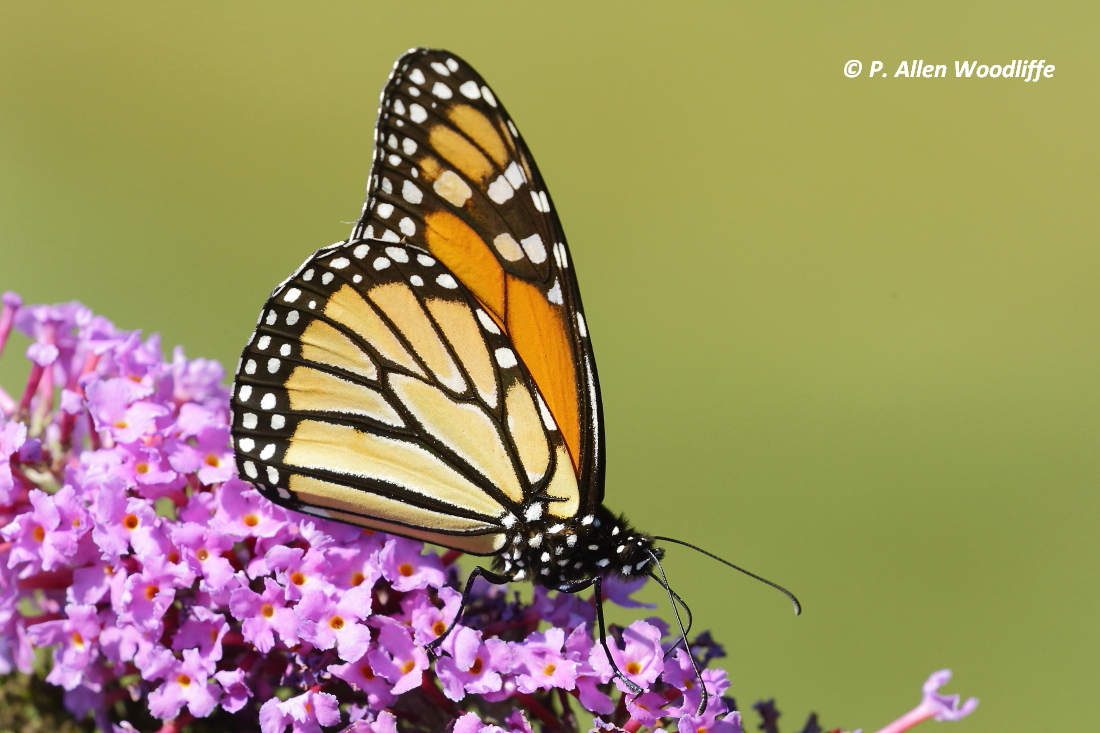
 Monarchs were not surprising at all, as they are well into their southwestern migration. There were at least 22 of them.
 Silver-spotted Skippers were few....no more than 5.
 I didn't bother counting Orange Sulphurs, although there were at least a dozen.
 One which I was hoping for was Fiery Skipper. If it shows up in southwestern Ontario, it is usually late in the season, so not a total surprise but nice to finally see one for the year. There were actually two individuals.
 Gray Hairstreak is also more likely to be seen later in the season, and this single individual was my first of the year, and one of the few I've photographed in recent years.


Along the trail was a profusion of goldenrod and New England Aster, among others, but it was clear that New England Aster was the favoured plant.

There were a few Clouded Sulphurs, another quite expected species.

Common Buckeye is another late season species. The one individual I observed wasn't my first of the year, but I've seen no more than half a dozen so far.
 Certainly one of the highlights was to see a super abundance of Bronze Coppers. I had a couple on the early July Butterfly Count, a little early for them, but only one or two since. It is a species that is often associated with wetlands, so the adjacent McGeachy Pond wetland was undoubtedly a factor. I was quite surprised to count at least 55 individuals along the trail, certainly more than I usually see in an entire season!
 It wasn't uncommon to see three or more in close proximity to each other......
 .....or even 7! There are 6 visible (one only partially) in this tight shot.
 Another first of year for me was this Common Checkered-skipper. It had been reported in other areas, but for some reason has not been common in Chatham-Kent. It is very tiny...about the same as the width of the aster flower head.
While the temperatures are dropping a bit for a few days, getting to be about normal, a slight warming trend early next week will likely continue the butterfly action, so at least one more visit will be attempted then to see what differences there might be. Stay tuned!


Thursday, 13 October 2016

Birds and other critters on some warm days of October

As is often the case, there have been a few warmer than normal days in October. It is almost summer-like, and lots of sun. It isn't really Indian Summer....that is a few weeks away, hopefully.

Yesterday I checked out the Erieau waterfront, hoping to catch up with a Hudsonian Godwit that Steve Charbonneau had seen the day before. The water levels and weed mats in Rondeau bay are such that they provide excellent habitat for ducks, shorebirds and herons. Unfortunately they are a long way from shore, so that even with the 'scope cranked up to 50-60 power, viewing especially during a breezy day can be challenging.

I didn't see the godwit. I didn't see the Eurasian Wigeon that Steve had seen either, but with the 5000+ ducks scattered as far as the eye could see, the wigeon was probably there somewhere. As for the godwit: there were shorebirds, including Pectoral Sandpiper, both yellowlegs and both American and Black-bellied Plover, plus a few peeps that went unidentified due to the distance and haze. Who knows where the godwit is by now.

I headed over to Rondeau next, going to the east branch of the South Point Trail. Birds weren't especially plentiful, but I did see a few warblers skulking in the wind-blown shrubbery. The most notable avian species was an abundance of Rusty Blackbirds (it was being considered as a Species At Risk recently, although it hasn't happened yet).....there must have been upwards of 1000 in several flocks. It was really hard to tell the number, as they kept emerging from the wetland shrubbery only to stream by to the other side of the trail. They were constantly on the move, and difficult to get a photo of.

Even though it was windy, where the sun was hitting the trail in some sheltered areas, it was good for butterflies. I saw at least 8 Eastern Commas.

There are a few Monarchs still passing through.

A small number of Pearl Crescents are still around.

 A single Common Buckeye was fighting the wind looking for shelter.

The sunny pavement also attracts snakes trying to soak up a bit more warmth before going underground for the next few months. I noted several Eastern Gartersnakes, as well as this Northern Brown Snake.
The park roads open to vehicular traffic showed evidence of slow moving snakes, unfortunately, with several Eastern Gartersnakes in various states of wreckage.


When one got to the southeast corner, it was easy to see the results of the early autumn storms of the last couple of weeks. This remnant from the old south campground camp office was exposed during the major east wind storms of 2015, but then got mostly covered up again for most of the next few months....such is the norm for dynamic shorelines. But now, once again, the strong winds from the east and southeast have brought it back into view.

Along the sandy trail to the shoreline, I noted a small, orange ball on the move, struggling to escape a shallow sandy pit. It turned out to be a Marbled Orb Weaver, a colourful spider that is fairly common in late summer.


The Blenheim Sewage Lagoons can be a worthwhile stop. On this day a male Lesser Scaup was the first bird I saw.

There were almost 150 Ruddy Ducks in various sized groups in each of the ponds.

One of the Long-billed Dowitchers was still around. This one has a shorter bill than some of the others of a week or so ago.
LBDO, October 12, 2016

LBDO October 1, 2016

This next photo shows a Greater Yellowlegs on the left, a Lesser Yellowlegs on the right with the dowitcher busily feeding in the middle.

Savannah Sparrows are widely scattered and plentiful.

And there has been a recent influx of American Pipits. I observed more than two dozen flying over the sprinkler cells and dropping into the drier, weedy portions.


Butterflies are still around, with the only unusual ones noted at the lagoons being two Common Checkered Skippers. They were on the move and this photo is from a previous visit.




Friday, 7 October 2016

Late season prairie veg and leps

This early autumn splurge of warmer weather has benefited some lingering tallgrass prairie vegetation as well as the persistence of butterflies. A good spot to see this in Chatham-Kent is the Mitchell's Bay North Shore Nature Trail. Butterfly diversity is diminishing, and with the forecast cooler trend beginning this weekend it will likely continue to diminish. But the ones that are around do provide some good photo ops.

Cabbage Whites continue to be super abundant. Clouded Sulphur and Orange Sulphur are also fairly abundant.

Cabbage White

Clouded Sulphur

Orange Sulphur

An occasional Red Admiral, here sipping nectar on a Spotted Joe-pye-weed, may still be around.
Red Admiral

Monarchs are on the move, heading southwest towards their overwintering site in the Mexican highlands..

Common Checkered-Skippers, those diminutive and attractive little later season visitors, are still around. Some of the later blooming asters are good spots to check for them.
Common Checkered-Skipper

While the dominant colour of flowering plants in early autumn is the yellow of various goldenrod species, there are a few others tucked away. Surprisingly this Gray-headed Coneflower (Ratibida pinnata) was seen in good flower recently.


One that does not occur very commonly anywhere in Ontario is Biennial Gaura (Gaura biennis). It blooms early on a sunny day, and typically closes up by late morning.


A relatively rare autumn orchid is Great Plain's Ladies'-tresses (Spiranthes magnicamporum) occurs. There are several Spiranthes in the area in the late summer and early autumn, but even though this is S3 and therefore ranked as reasonably rare, it is by far the most common Spiranthes located here at this time of year here in the southwest.

Not restricted to prairies by any means, is this Pokeweed (Phytolacca americana). It has attractive white flowers that develop into succulent looking bluish-purple berries. Birds love them! But don't you try eating them....all parts of the plant are quite toxic to humans and other mammals.


This next species, the brilliant Cardinal Flower (Lobelia cardinalis), normally is in flower in early to mid-August. For some reason this one decided to extend the season.

If you have been paying attention to non-raptors passing by the various hawk watches in southern Ontario recently, you may have noticed tens of thousands of Blue Jays passing by, heading southwest. Are they all heading to Texas in support of their American League namesake???


Go Blue Jays!!!!

Sunday, 2 October 2016

Raptors, shorebirds and butterflies

Over the last couple of days I have spent time at Erieau and the Blenheim Sewage Lagoons. I've continued to hope that a good gull or two, or a jaeger might show up at Erieau.

It hasn't happened so far.

But yesterday when I was scanning the several thousand gulls resting on the western tip of the Rondeau peninsula or on the adjacent Lake Erie, something put the gulls up in a frenzy. I searched the air hoping for that jaeger, but no, it was a raptor. A Peregrine Falcon in fact. It never came all that close to me, so even with the equivalent of 22X lens and heavy cropping, this is the best I could get. It was my first Peregrine of the year.
 And this next one shows a head-on view. Note the distinctive wing profile.

Minutes later I saw another raptor, but this fish-eating species did not stir up the gulls like the Peregrine did. I guess the gulls can tell the difference fairly readily.

The black-and-white raptor against a white sky made getting the photo a little challenging.
Osprey


The Blenheim Sewage Lagoons are conveniently located on my most direct route between home and Erieau, so a stop there happens pretty regularly. Especially since Steve C had been there earlier and seen 5 Long-billed Dowitchers. When I got there on Saturday afternoon, there was one still hanging around.

There were also a couple of White-rumped Sandpipers. This one doesn't show the white rump, obviously, but it was in flight a couple of times and the white rump really stood out.

I noted a fair number of sparrows, and with hopes of discovering a Nelson's Sparrow, a rarity to be sure, but which has recently been recorded farther east and north in the last few days, I looked at a lot of the sparrows I could get the binos on.

All I saw were about 15 Savannah Sparrows and a couple of Song Sparrows.
Savannah Sparrow

I got my first of the fall season Rusty Blackbird....4 of them were in a group in the shrubby willows along one of the ponds.
Rusty Blackbird


Today I went to the Blenheim lagoons for a different target species. What does the bird in this next photo remind you of?


If you said 'phalarope', good answer. And in this case it was one of the two Red-necked Phalaropes that showed up earlier today. At first they were always on the far side of the pond, but persistence paid off and eventually they decided that I and the 3 other folks nearby were not a threat so they came reasonably close.


With the still relatively warm weather, butterflies are making the best of it. I noted about 10 species in the last couple of visits, including the following:
One of at least 5 Common Buckeye

One of 6 Common Checkered-Skippers

Fiery Skipper
One of the local groundhogs was out keeping an eye on things as well.


So no jaegers or rare gulls....maybe on the next time out!