Showing posts with label endangered species. Show all posts

Tuesday, 10 December 2019

A Significant Decision to be made regarding Rondeau Provincial Park

It is no secret that Rondeau Provincial Park is one of my favourite places. It is a favourite place of a lot of people, and for many reasons.

Rondeau has been a provincial park since 1894 and in fact is the oldest park to have that designation. While Algonquin lays claim to that title, for its first few years it was legislatively identified as a national park, as per the Algonquin National Park Act of 1893.

Rondeau hosts a huge biodiversity, and has the greatest number of Species At Risk of any Ontario provincial park. The diversity of habitat, including beach dune, oak savanna, pine-oak forest, beech-maple forest, slough, cattail marsh and the bay is nothing short of amazing, and they all contribute immensely to the park's biodiversity. Some of the main habitats themselves are provincially significant, especially the oak savanna and Great Lakes beach dune. It is one of the best examples of a cuspate sand spit in the world, according to my geomorphology professor. Add the old growth forest and there truly is no other place remotely like it in all of Canada.

Here are just a few representative photos as well as some of the species at risk.
Carolinian hardwood forest
 The cuspate sand spit is formed by wave action, bringing currents together.

Oak Savanna
Oak Savanna
Rich hardwood forest

400 ha marsh


Birds are a well-known feature at Rondeau, with over 360 species recorded for the area, and more than a few species at risk (SAR) that breed here.

The Prothonotary Warbler is Rondeau's flagship bird, as it has been the stronghold for the species in Ontario since it was first discovered nesting here in the early 1930s.
 More breeding SAR include the following.
Red-headed Woodpecker
King Rail
Bald Eagle
Hooded Warbler.....maybe has nested
Wood Thrush
Lots of non-SAR species occur as well. During the first Ontario Breeding Bird Atlas, Rondeau had the highest number of species recorded with at least some breeding evidence.
Scarlet Tanager
Pileated Woodpecker
Orchard Oriole
Eastern Bluebird
American Redstart
Gray Catbird
Great Egret; not nesting but regularly seen feeding


 Numerous species migrate through, or spend a lot of time in the area in both spring and fall, but have never been found nesting.
Blackburnian Warbler
 
Golden-winged Warbler   


The ground cover is rich and luxuriant, with many ferns, indicating a high quality forest.
Cinnamon Fern
 Red Mulberry is an endangered species, and Rondeau has one of the highest quality populations in Ontario. Hybridization with the non-native White Mulberry is rampant in some of the other populations.
 Tuliptree, the unofficial flagship tree of Rondeau and indeed, the Carolinian Forest Zone.
Old growth forest is currently very difficult to find anywhere in Ontario due to the impact of harvesting in so many forests, not to mention outright clearing. Rondeau has some good examples of old growth forest.
158cm diameter Eastern Cottonwood
135 cm diameter Red Oak
Three-bird's Orchid is endangered, and is the only place in Canada where it has been confirmed in the last 25+ years. The only other location where it has been found has not been seen since the late 1980s.

Showy Orchid...has been considered as a SAR but not formally designated yet
Ragged-fringed Orchid
There are many other SAR, including several species of reptiles (e.g. Eastern Fox Snake, Ribbon Snake, Eastern Spiny Softshell Turtle, Spotted Turtle) and amphibians (e. g. Fowler's Toad).

There are countless invertebrates. For example it is quite likely that 1500-2000 species of moths occur here, as much smaller sites elsewhere and with considerably less diversity have documented over 1000 species.
Chestnut-marked Pondweed Moth
One would think that with the provincial, even national, significance that Rondeau has, the provincial government would give the park the highest level of protection. And while it does to some extent, the bigger picture shows that there is clearly an attempt to ignore this responsibility, at least in part.

Today I received an email message that explains this concern, and you can read about it at this link.

Read it, if you will, and make your thoughts known to the provincial government. The deadline for comment is December 18, so there is no time to waste!


Friday, 17 May 2019

Black-necked Stilt, Summer Tanager, Endangered Species Act at Risk, Other bird highlights, Part II

I will get to the Warbler Parade eventually, but in the meantime, there are too many other things to post about!

The Keith McLean Conservation Lands continues to be a draw for so many birds. There are currently at least 207 species of birds recorded for this relatively small site, which has only been accessible for the last 5 years!

Just a few days ago a Glossy Ibis appeared. And yesterday came the report of a pair of Black-necked Stilts. Of course the very high water that has flooded some of the fields along the creek system has created super habitat for such birds. In fact there are typically more shorebirds in both numbers and diversity in these flooded fields than there has been at local sewage lagoons, which are traditionally a hot spot. Once the field dry up, that will change.

Needless to say, the presence of these stilts, normally a mid-western species, caused a lot of interest amongst the throngs of birders in the area. They weren't always close by, or in the best light, so in order to capture the photos below, I and several other photographers had to approach very slowly and carefully along the edge of the creek system in the opposite direction of the road.
 This is a pair, as the male has the darker, black back and the female has a slightly browner back.

This is as close to the boundary of Rondeau that I am aware this species has come. I have seen them twice before within the park's checklist area, but one of those times was at the Ridgetown Sewage Lagoons and the other time, just last year, was at the Blenheim lagoons. If the birds like this spot, it is always possible, but not terribly likely, that they may even attempt to nest!

Not nearly as rare as the stilts, but just a 'regular rarity' is Summer Tanager. One or more occurs almost annually any more, but still draws a lot of attention. Just this last week or so, a young male has been seen in the vicinity of a very active cottage feeding area in the park. There are several hummingbird feeders as well as various suet, niger, sunflower and mixed seed feeders spread out along the Lakeshore Road side of the cottage, so there is a lot to attract birds. Baltimore Orioles and Rose-breasted Grosbeaks are common, as are numerous grackles and other blackbirds. The tanager has to be persistent to get anything it seems, but it does manage to get sustenance from both the suet and one of the sunflower feeders.


Endangered Species Act: At Risk
On another topic, and a very important one, it is interesting to know that today, May 17th, is Endangered Species Day, at least in the USA. It is ironic that here in Ontario where we have a relatively recently produced Endangered Species Act, 2007, it is undergoing a major revision. Not that it couldn't have undergone some tweaking to make a few improvements. But if a casual reader reads the general statements by politicians within the conservative government currently in power, one might think the proposed changes are an improvement. I will not refer to them as progressive conservative, the official name of the party, since at least based on environmental issues it is anything but progressive. In fact in spite of the wording of the proposed revisions it is a very poor attempt to make one think the gov't knows what it is doing to benefit the endangered species. In reality it is making the current Act virtually meaningless, giving politicians almost carte blanche authority to remove any protections of legislated endangered species and their habitat.

If you are interested to see the list, along with photos, of the current species that are Endangered, Threatened or Special Concern under the Act, check out this site. Over the years when I was working within MNR on behalf of such species at risk, I contributed many photos. I think at last count I had over 40 photos of these species on this link, a few of which follow here.

Cucumber Magnolia
Red Mulberry
Drooping Trillium
Nodding Pogonia
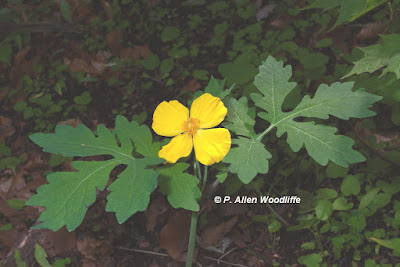
Wood Poppy
Eastern Hog-nosed Snake


If you are concerned about the future of Ontario species at risk, contact your MPP and strongly contest what the conservative gov't is trying to do by essentially gutting the current Endangered Species Act. One way to make your voice heard is through this link.

Lyme Disease Awareness Month
And finally, better late than never, May is Lyme Disease Awareness month. Ticks that are carriers of Lyme Disease are out in full force in many areas of Ontario and beyond. I have written several blog posts on the topic, since I have contracted Lyme Disease 6 times over the past 42+ years. The most extensive post can be found here. If you want more information, check it out, or one of the seven other posts (just go to the right hand side of the post page and under the heading 'Labels', scroll down and look for Lyme Disease). If you or your pets spend any time out doors, especially in the April-November period, please ensure you take extra precautions to reduce the likelihood of contracting this disease.

It is the Black-legged Tick, a.k.a. Deer Tick that is believed to be the primary carrier of Lyme Disease. It is about one-quarter to one-half the size of the more common American Dog Tick, a.k.a. Wood Tick.
Black-legged Tick
American DogTick
Be safe!


Friday, 18 August 2017

Phalaropes and Orchids

I realize that Phalaropes and Orchids may seem like an odd combination, but sometimes the events just go that way.

Some readers may recall an earlier blog post, describing an unsuccessful attempt in predicting the appearance of one of Canada's rarest orchids, Nodding Pogonia, to be in flower at Rondeau Provincial Park. I was determined to see this species in flower, and on August 13, the overnight temperature dipped lower than it had been for several days, down to about 11C. With that bit of information in mind, I figured that August 15 might be the day to see these amazing little flowers fully open.

It so happened that at about the same time, there was an appearance of up to 8 Wilson's Phalaropes at the Blenheim Sewage Lagoons. This species has nested at the lagoons on very rare occasion, but in recent years even seeing them on migration has been a challenge. So on my way to Rondeau to check out the orchids, I made a stop at the sewage lagoons.

There was, as expected, a lot of shorebirds scattered along the gradually expanding muddy edges of the ponds. And there in one corner, were three of the aforementioned phalaropes, spinning around as phalaropes do.


 On occasion, one or two would come up to the very muddy edge and preen.

After viewing these phalaropes, I continued to Rondeau. Putting on my boots and gathering my equipment, I struck off, hoping that this would be the day. Some years I don't ever see them in flower. The mosquitoes were present but tolerable. Sometimes they are a formidable presence, making this foray very uncomfortable. On this occasion, putting up with the mosquitoes was worth the effort, as I came across a few orchids in flower!


 At best, these little plants are small, typically no more than 12-15 cm in height. However some are extremely diminutive, as the one in this last image was no more than about 5 cm!
Since I might not have a chance to see them in flower again this year, and who knows what the next year or so might result in, I took lots of photos. This declining orchid, in Canada, grows only at a remote place or two at Rondeau, and some years not a single plant will flower.