Showing posts with label Pelee Island. Show all posts

Wednesday, 16 March 2016

Endangered species habitat

Several weeks ago, I posted a few blogs about Pelee Island, including one post that dealt specifically with some of the endangered snakes. You can read about it here. 

With all of the development that has taken place on Pelee Island and is proposed to take place, some of the critical habitat elements that snakes require are at risk, placing these already endangered snakes at further risk. There are options, however, which may reduce further risk:
  • one option is to buy up the island and convert it back to its natural habitat (believe it or not, that was an option that was bandied about several decades ago! It didn't get too far, not surprisingly);
  • another option is to acquire some of the best remaining pieces of natural area and if possible, connect the pieces so that the snakes have a safe travel corridor along which to go to and fro; 
While acquisition of habitat, or creation of habitat might be done specifically for the benefit of these endangered snakes, in the bigger picture there may be lots of other species, some rare and some not so rare, which will be much better off as well.

If habitat is to be protected, it may be necessary to create features on it that would serve the snakes well for some critical aspects of their life cycle. There have been various efforts to create what I refer to as Critical Habitat Element Clusters (CHEC) on Pelee Island, and include:
  • Hibernacula
  • Egg-laying sites
  • Basking hot rocks
  • Brush piles
Ideally, if these CHEC are available in such proximity so that the snakes don't have to travel a long way and risk their lives crossing roads, it will save their energy and keep a lot more of them alive.

Hibernacula
Snakes are cold-blooded, and spend a good part of their lives underground, below the frost line. There are various ways to create hibernacula, but here are the basics of how we did it on Pelee Island.

A backhoe was used to dig a hole almost two metres deep.
We got large rocks to put at the bottom of the pit....the larger the better.
 The intent was that the rocks are large enough so that there would be numerous cavities at the bottom. We then placed 3 or 4 long plastic pipes (about 4"-6" diameter) leading to various cavities.
 Progressively smaller sized rock was placed on top, being careful not to damage the pipes. The smaller and smaller rock will prevent the uppermost layers of material from falling through, leaving the largest cavities at the bottom.

Fibre cloth matting was placed on top.
The top layer was fine gravel screenings.
The fine screenings at the top will become quite hard, and limit the amount of vegetative growth on the top. This exposed surface serves as a basking site when the snakes are just about to go underground in the fall, or when they begin to emerge during the first warm days of spring.
 Having several access points allows for safety: if for some reason one pipe gets plugged or collapses, there are still others to enter or emerge through.


Basking Hot Rocks
Being cold-blooded, snakes rely on the warmth of sunlight to maintain or increase their physiological activity. For females that are developing eggs inside of them, proper physiological processes are critical for them to be able to lay their eggs early enough, so the young will develop in enough time so that they can hatch early enough in the summer to be able to grow a bit before finding a place to hibernate for the winter. Timing is everything!

The top of the hibernacula can be useful for basking, as mentioned, but one can create other basking sites as well. It is important to have the basking surfaces in layers. And being elevated, it increases the time that the sun is available for basking.

First, place some blocks on the ground in an open area with lots of sun.

In our case, we had pieces of an old concrete slab available, which were perfect for our needs. By creating layers, it gives a basking snake options to choose the right exposure and temperature to its liking. If it feels threatened, it can quickly escape to a more protected part of the hot rock cluster.

Another version of basking hot rocks

Egg-laying site
Both the endangered Blue Racer and Eastern Fox Snake lay eggs. They seek out a pile of decomposing material that they consider to have the right sunlight exposure and moisture so that the eggs, once laid, will have the benefit of warmth and humidity to maximize the chances of the young being able to hatch successfully. In a totally natural setting, this could be an opening in a decomposing log. But where logs are unavailable, snakes have been known to use piles of straw, manure, or wood chips. Creating a suitable egg-laying site is really quite simple: find an open sunny area and dump a large pile of wood chips!


 Such a pile may not be suitable right at the outset, but it will gradually decompose, holding moisture and the snakes can use these piles for several years.

Brush Piles
Snakes shed their skin several times a year. During this period, their eyes cloud over as they "go into the blind". They are much more vulnerable at this time, so they seek out areas where they can hide safely for several days, until the skin is shed. Suitable sites for this period could include a brush pile. Since Pelee Island has a lot of grape growing operations, there are lots of old grape stalks being culled from the vineyards. They are robust, and should last for many years. The material was free for the asking.
 Of course one can just use good old brush and branches as well.
These brush piles may also serve as communal gathering places, where courtship and mating will take place.

As mentioned earlier, having these CHEC in close proximity will minimize the need for the snakes to travel far and wide to seek the habitat they require. This next image shows a brush pile, egg-laying pile and a hibernaculum all within sight. The basking hot rocks are just around the corner. All four of these Critical Habitat Elements are important. Just as a chain is only as strong as its weakest link, if any one of these CHE are not available, the survival of the population of Blue Racer and Eastern Fox Snake on Pelee Island is at risk.
We were able to create 7 of these CHEC all strategically placed in some moderate habitat that wasn't available to these endangered species before. Now this moderate habitat has become excellent habitat!


Friday, 29 January 2016

Challenges: snakes vs development

The previous post introduced some of the better known reptilian members of the Pelee Island community: Blue Racer, Lake Erie Water Snake and Eastern Fox Snake. All are legislated Species At Risk (SAR), protected under both provincial and federal legislation. This creates challenges for landowners, for the municipality and for those who want, or are tasked with, their protection.
Blue Racer
Lake Erie Water Snake
Eastern Fox Snake
Now if these SAR were restricted to one location and didn't move, it might be less challenging. There are numerous plant species which are also at risk, but they can be a little easier to deal with. A single plant and its immediate habitat can be protected. A large population is a little more difficult, however. Or if it is a breeding bird, it only spends a few short weeks in its breeding habitat, and the rest of the time it is involved with other aspects of its life cycle: busy getting ready for migration, or actually on migration to points which may be hundreds or thousands of kilometres south in the tropics. However snakes represent different challenges:
-they aren't generally appreciated in quite the same way as plants or birds;
-their entire life cycle may occur over as much as 200 hectares, although often less;
-some spend a fair bit of their entire life cycle within a 100 metres or so of the shoreline;
-they sometimes will use anthropogenic features, such as buildings or wells;
-when they are active, they are often hard to find;
-when they are hibernating for 6 months of the year or more, they are a lot harder to find.

By now you will be aware of some of the appealing aspects of Pelee Island to human visitors. Waterfront property is highly sought after, and therein lies the conflict. Some waterfront properties really are right on the water front. The property shown in the image below, has very little stable land base. There is barely enough room to get a vehicle off the road before you are on a dynamic beach! And anyone who has had experience with waterfront property on Lake Erie is well aware of the effects of wave action, changing water levels and such.

 Typically these shoreline properties, in their natural state, are great habitat for these endangered reptiles, whether it is sandy shoreline or rocky shoreline. A vegetated rocky shoreline is even more ideal for these snakes.

 Even rocky shorelines that have been left to mature for a few years can be quite useful to some species.

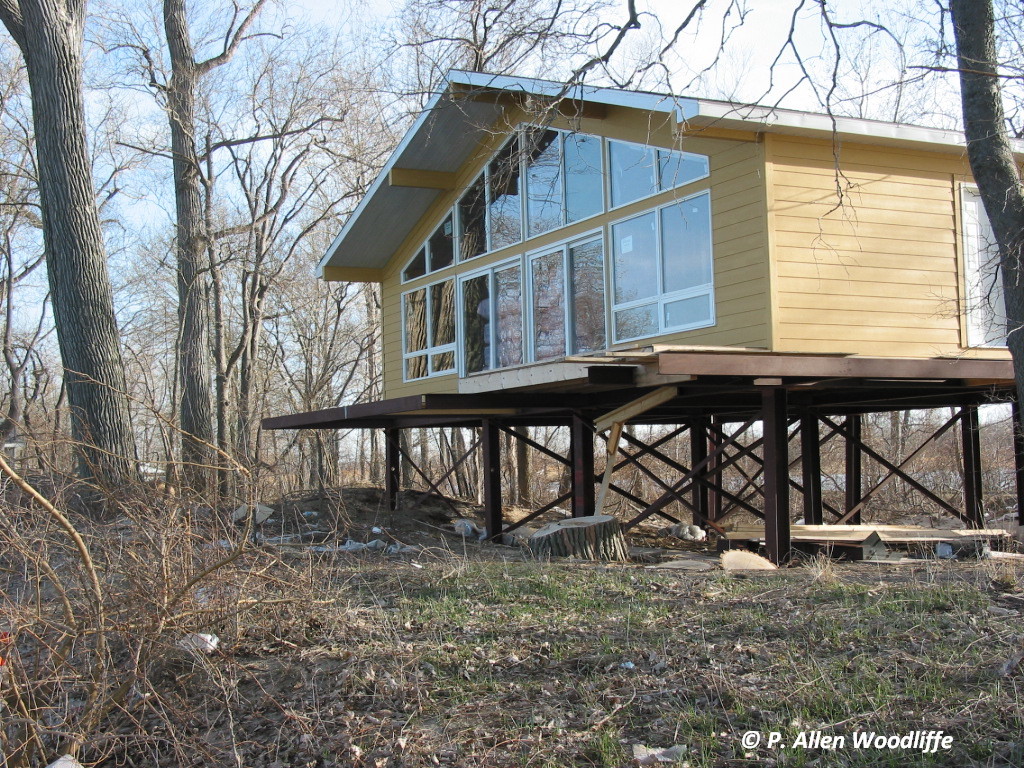
Nonetheless, people are attracted to a spot, and proceed to build sometimes a substantial property in a rather exposed location. So they adapt. Some will build on stilts, so that they can get a better view of the water, but also so that severe wave action can go under the building.

Other people will go to the expense of having huge chunks of armour stone placed in front of the building, to break the wave action. Of course any of this alteration usually results in a significant loss of habitat for endangered species. If it is left alone for long enough after it has been altered, it might revert to some type of habitat, but what are the species supposed to do for the years it takes to develop?

In the past couple of decades while I was with OMNR, my colleagues and I were frequently asked to evaluate a property with respect to endangered species habitat. We sometimes found the snakes themselves, but not that often due to their shy and retiring nature, or if it was the time of the season when they wouldn't be out. So we had to think like a snake, and look for features that they would likely use. Sometimes it was a hole in the ground...is it an access point to a hibernation site?
 Sometimes it was the structure of the vegetation, which would be useful for healthy populations of small mammals which would be, in the case of Blue Racer and Eastern Fox Snake, their main food source.
We had to look at everything that a reptile might need over the course of the season. Just as a chain is only as strong as its weakest link, any significant need of their life cycle that was missing, would be potentially deadly for the population.

Sometimes we found other Species At Risk in the course of our site visit.
Common Hop-tree
Common Hop-tree (Ptelea trifoliata) is a Threatened species also protected by legislation, and is restricted in Canada to places like Rondeau, Point Pelee and Pelee Island. As it turns out, it is very common on Pelee Island, so when it shows up on a property that is being evaluated, it may add to the development limitations that can occur.

There were a lot of properties where some development was allowed, although with limitations. There were other properties that had so much critical habitat on it for SAR, that there were very few if any development options. And of course that led to the inevitable question of fairness. Should a landowner have the right to develop what ever s/he wants on property that they own? That question can lead to some very lively and passionate debates...trust me!! But the bottom line is that part of the reason there are so many species at risk in southwestern Ontario is because so much of it has been developed. The municipality of Chatham-Kent and Essex County have the dubious distinction of having only 4%-5% natural area remaining at best, and even that is under threat from so many outside influences, including invasive species, fragmentation, air quality, water quality, loss of hydrological function, etc. So as a 'progressive and responsible' society, can we not protect even 5% of our natural area and the species that require it?

There are sometimes some alternatives, and I will be dealing with that in a future post where a highly contentious development led to an interesting resolution.
Jimaan at rest


Tuesday, 26 January 2016

Goodness Snakes Alive!!

Pelee Island is famous, or perhaps infamous depending on ones view point, for its snakes. Some of the islanders cringe when this is mentioned, however, and are quick to point out many other more endearing aspects of this fair isle. Somehow myriad large and small slithering creatures aren't appreciated by everyone!

Nonetheless snakes have survived fairly well, although two species of rattlesnakes have not been seen for decades.The big three are: Blue Racer, Lake Erie Water Snake and Eastern Fox Snake. All three are Endangered in Ontario.

A smaller but also interesting snake is the melanistic colour form of the Eastern or Common Gartersnake. It is almost entirely black, and is fairly abundant on Pelee Island. It also occurs on the Lake Erie Sand Spits of Point Pelee, Rondeau and Long Point. Presumably the dark colour enables it to warm up a bit more quickly on these areas that are typically influenced by the cooling action of the lake.
Melanistic Eastern Gartersnake
Blue Racers used to occur on the Ontario mainland, but have not been conclusively documented here for several decades. so as far as anyone knows, the only Ontario location for them is on Pelee Island. It is a beautiful species, if I can use that term. Their bluish gray colour in combination with the black mask is really quite attractive. They can grow to almost two metres in length.

Blue Racer
They are elusive at the best of times; if they sense impending danger, they will move very quickly. During the hot part of the season, they will spend their time underneath the dense thatch on the ground, or be up in the trees! So little was known about them even on Pelee Island that no one was able to undertake any meaningful research on them to determine what the population might be, where they spent their time above ground or where they hibernated. That began to change when during a Life Science Inventory I coordinated back in 1988, we narrowed some possible hibernation sites down. Fast forward to late April of 1989 when a biologist colleague of mine went over to the island with me, and the weather seemed about perfect for snakes to be out. I suggested that we check out one of the most likely spots, and in a matter of an hour, saw 14 large adults, and heard a few others rustling away in the brush and debris. Bingo! And with that, a keen snake researcher was able to capture enough individuals to put radio transmitters in them and follow them around for three seasons, documenting their daily and seasonal movements. So much was learned (he got a M.Sc. out of it too). For example, on average a male Blue Racer had the largest home range of any snake in North America. Most of their preferred habitat looked something like this.
 Or this.

Their territory averaged approximately 202 hectares. And some actual hibernacula entrances were discovered.
Hibernaculum entrance of Blue Racer
The entrance isn't much to look at from the surface, but led to an underground cavity which met their winter requirements, and that is what counted. The entrance could be just a hole in the ground or a hole in the rock.

Hibernaculum entrance of Blue Racer
Eastern Fox Snakes are one of the other big three, although they are fairly common on parts of the mainland. They occur even up along the east side of Georgian Bay, but that population is isolated from the southwestern Ontario ones. The species' entire world range is situated around the lower Great Lakes.
Eastern Fox Snake
It is distinctive and attractive in its own right. They are often heavier bodied than Blue Racers, and generally don't move as quickly. They do occupy some of the same types of habitat, although will be more often found in wetland habitat than racers. Both species lay eggs in rotting material, such as a hollow rotting tree trunk or a pile of rotting straw.

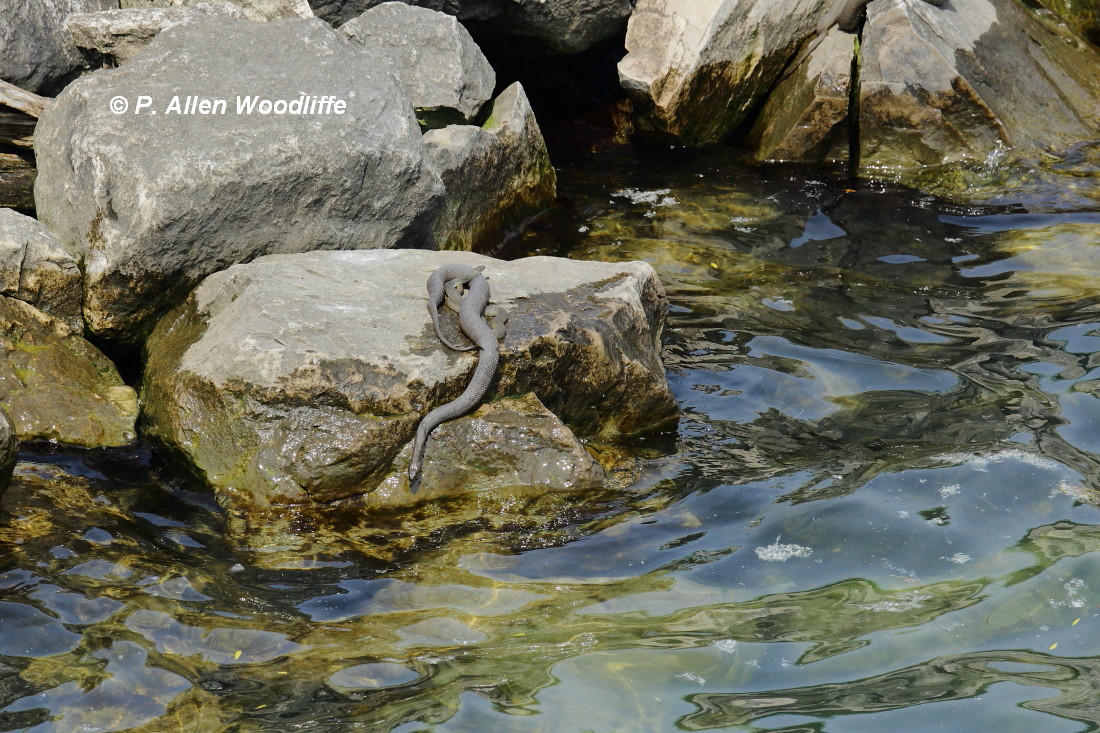
The other one of the big three is the Lake Erie Water Snake (LEWS). It isn't a true species in itself, as it is a subspecies/colour morph of the much more common Northern Water Snake. But the LEWS is different because it seldom is as dark brown and usually has less distinct cross banding. This is highly advantageous for them as they spend a lot of their time on the dark gray limestone shorelines of the Erie Island, and blend in better. When they are at the more vulnerable youngster stage, this is definitely an advantage so they don't get picked off by hungry gulls or herons. They are restricted to some of the Erie Islands and the Catawba/Marblehead Peninsula of Ohio.
They spend most of their time close to water, often basking on the rocks that line the shore. If danger comes by, they can make a quick exit into the water, where they are expert swimmers and one of the only snakes that can swim underwater.

Even their hibernacula are seldom more than 100 metres from shore. They often hibernate communally, and when they emerge in spring, can sometimes be found in numbers, such as this next image shows. This was taken at the edge of an abandoned quarry very close to the lake, and provided a perfect location for them for many of their seasonal requirements.
As is the case for many Species At Risk, there often are some restrictions to developers and the like, when an area is proposed for development. So just like the research with the Blue Racer, a colleague of mine decided she wanted to do some radio-telemetry with the LEWS to determine some of the life cycle activities of this species, including where they were hibernating. Since LEWS spends most of their time within a 100 metres of the shoreline, and that is exactly where a lot of the development on Pelee Island was focussed, this would be valuable information indeed. This first image shows Deb Jacobs, the researcher, inserting a small chip about the size of a grain of rice, subcutaneously into the snake. Each chip has its own number, so when this snake is caught again, a chip reader can tell exactly which individual it is. Another colleague, Ron Gould, is holding the snake during this brief operation.


A few LEWS had radio-transmitters implanted surgically, so they could be followed without actually seeing the snake. The transmitter would give off its own signal so even if it was underground, its location could be determined. This next image shows Deb with the receiver and antenna in hand, tracking one of 'her' snakes.
There were other activities focussing on snakes, including LEWS. There were summer students getting a first hand look at some of these endangered reptiles, and seeing a dedicated researcher in action. Admittedly some of it was grunt work, as the next image shows, but they didn't seem to mind. Here they are lifting heavy limestone slabs in case a LEWS was hunkered underneath.
Occasionally one would find a dead LEWS washed ashore. This one may have been hit by a boat propeller. They will venture out into the water quite freely. In fact one snake that had been marked on Pelee Island was found later on an island about 11 km away! This one below had been dead for a little while, but the Giant Swallowtail and Azure butterflies seemed to be enjoying the decomposition juices.

If you were to have visited Pelee Island at the time of settlement, you would have noticed that it is actually a collection of several rocky outcrops connected by a lower lying interior, which depending on the lake levels of the day, would likely have been wetland. But eventually settlers dug a canal system and drained the interior wetland, giving Pelee its present day look. Pumping stations on all four sides of the island, such as the one shown in the next image, are connected to an interior canal system which keep the island from flooding.
These stations pump the water into the lake. Since the interior is below lake level, large chunks of armour stone are situated around much of the periphery to protect the interior from wave action and flooding.


Also around the periphery of the island is a ring road system. You can see a bit of it in the background to the right of the image above. Being so close to wildlife habitat, it is not surprising that there are a lot of road-killed critters, such as this Snapping Turtle.....
.....and this Eastern Fox Squirrel. Fox Squirrels are presumably native to Pelee Island, but that is likely the only place in Canada where they are native. They are large and attractive squirrels, but are slow moving. In spite of the low posted speed limits on the island they misjudge traffic with surprising regularity.

Of course with the roads being so close to the water where LEWS occur, there are far too many of them that meet their demise as well. This is particularly the case in the relative coolness of spring and fall when the sluggish snakes are crossing the roads while going to or from their hibernacula. If the pavement is nice and toasty, they may linger for awhile thinking it is a nice place to bask. Unfortunately that might be one of their last thoughts.....
Here is a road-killed Blue Racer, below. At first glance it doesn't look dead....there is no obvious injury....but live ones don't normally stick around, and in the case of this one, its head is flat on the ground, not up and alert, keeping an eye on all that is going on around it.

It is not surprising that cottage owners want a view of the water. Hence that is where most of the development is, and is the greatest threat to habitat such as this, where a seemingly insignificant hole might be the deciding factor on whether one or more snakes lives or dies.


That presented us with enormous challenges in determining the potential impacts on one or more legislated Species At Risk. It is a delicate issue, trying to balance the needs and expectations of prospective landowners and the municipality expecting an increase in the tax base against the needs and survival of Species At Risk. As a result, I spent a lot of time on Pelee Island trying to sort things out!