Showing posts with label Smoky Rubyspot. Show all posts

Saturday, 24 August 2024

An endangered orchid, and lots of odes

 Sometimes the days go slowly, and other times the days go more quickly. Some of it is weather dependent, and at other times, it is in dealing with some of the other major issues in the aftermath of Marie's passing. I have been out roaming around locally as time, weather and energy permits.

One of the priorities in the world of nature during August, is to do some monitoring of an endangered orchid, and specifically the Nodding Pogonia (Triphora trianthophoros), which is only known in Canada to occur at Rondeau. Its location is for the most part, being kept a secret by park staff due to its small nature and endangered status.

 I have been following this special orchid for about 50 years. Given that the individual flowers only remain open for a day, there have been some good days this year, and other days not so good. I expect to devote an entire blog post about this species and my 2024 experience with it, so keep an eye out for it.

This is also a good time to try and track down various species of odonates or odes (damselflies and dragonflies), and I have had some moderate success in this. They are best found near water, of course, and my 'go to' places include a few spots along both the Thames River and Sydenham River, as well as Clear Creek Forest Provincial Park, St. Clair NWA and Rondeau.

On one occasion as I was heading to Clear Creek Forest, I came across an unfortunate scene.

This large adult Eastern Fox Snake, which is a Species At Risk and with its main population primarily limited in Canada to southwestern Ontario, had been crossing Talbot Trail when a vehicle ran over it.

At Clear Creek Forest, things were a bit more positive, and I have been there on more than one occasion to photograph odes and a few other things that provided an opportunity.

Blue Dasher

Blue Dasher

Calico Pennant

Double-striped Bluet

Eastern Amberwing

Eastern Pondhawk female

Eastern Pondhawk male

Variable Dancer

Widow Skimmer

None of the aforementioned odes are particularly unusual, although the Double-striped Bluet is probably the most uncommon of the ones shown. I particularly liked the Variable Dancer, the only damselfly where the male is an obvious pink/purple colour. I did see the rarer Comet Darner on a couple of occasions, but very briefly and there was no opportunity for a photo.

There are typically a few other invertebrates that get my attention here, such as:

Bronzed Tiger Beetle

Great Spangled Fritillary

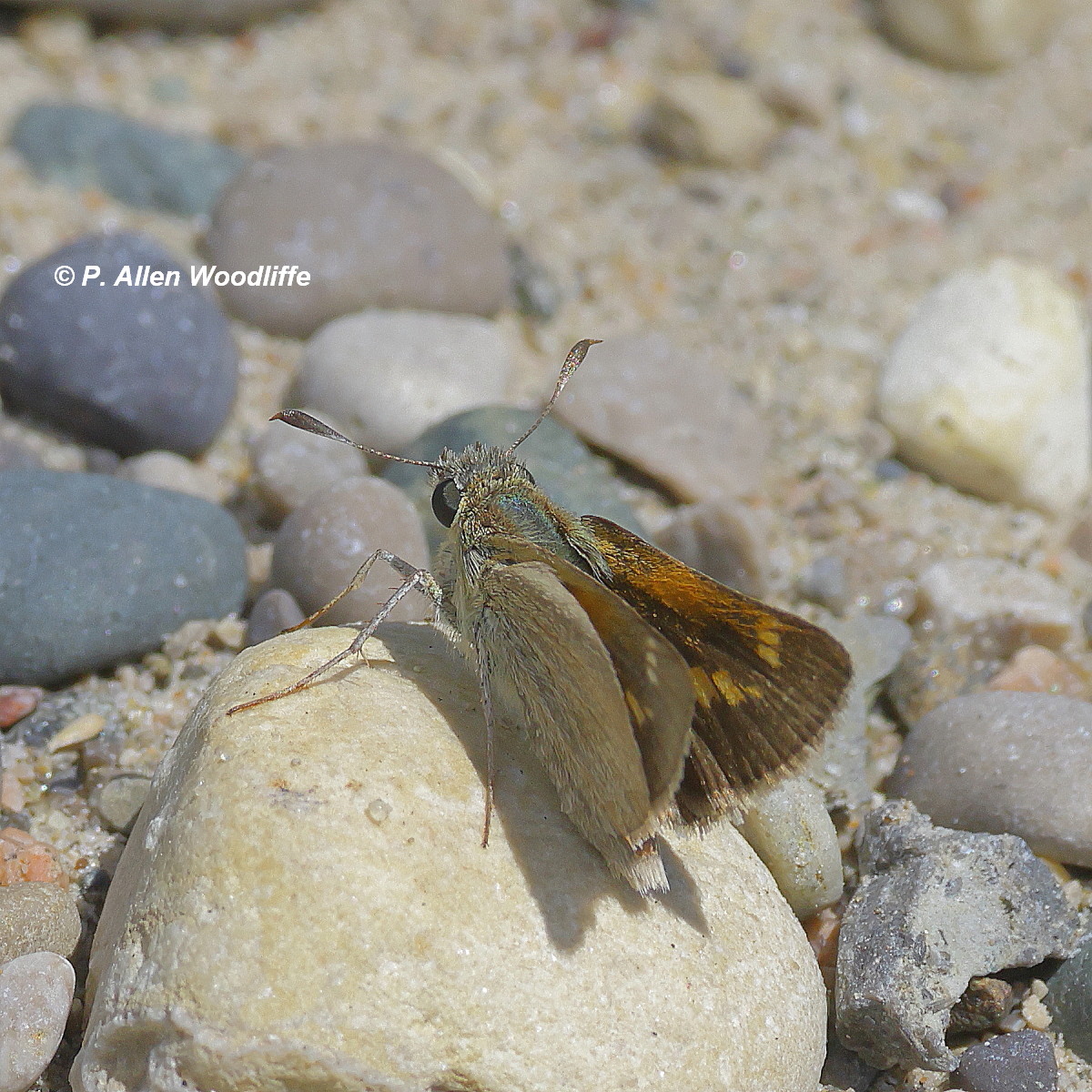
Tawny-edged Skipper

Viceroy

The local rivers are definitely worth checking out, as they feature some of the more challenging damselflies to see and photograph. With all of the rain over these past several months in their overall watersheds, however, the water levels continue to be a bit high, and the banks are a bit muddy and therefore slippery. Caution to gain access to even the limited places must be adhered to! Nonetheless, with care and a bit of time, there are a few that make it worthwhile. These include:

American Rubyspot

Blue-fronted Dancer

Ebony Jewelwing female
This next one is very rare, even considered endangered in Canada. It is the Smoky Rubyspot and for the most part, is very limited to the rivers of southwestern Ontario.

While on the prowl for odes, I came across this American Snout butterfly busily feeding on some goldenrod. It is not a common species, and I hadn't seen one for quite awhile so was glad to get a few photos.

At other places, such as Rondeau and SCNWA, there are various odes as well, although none that I came across were particularly uncommon.

Halloween Pennant
There were lots of Ruby Meadowhawks, shown next, flitting around.
I only got a frontal photo of this one, and it is likely a Ruby Meadowhawk as well, although there are at least a couple of others that look similar and a careful look at some more obscure feature is required to make definite call on it.

While I was busily focussing on the meadowhawks, I saw this caterpillar roaming around. It is the larval form of the American Dagger Moth.

And on various milkweed pods, I came across clusters of the Large Milkweed Bug.

Monday, 12 September 2022

Late Orchids and other rare to endangered species

 As promised in my previous post, this one will focus primarily on orchids, some of them quite rare, that occur in the August/September time frame.

As is featured in the current header, Nodding Pogonia (Triphora trianthophoros) is one of the rarest in Canada. While I have seen it in flower in very late July and as late as mid-September, typically about the third week in August is when it is at its peak.The following photos of this orchid were taken on August 25. It is legally Endangered, as the only known location for it in Canada is at Rondeau Provincial Park.

 It is very small, as you can probably tell from the first photo. They rarely exceed 12 cm in total height.

The flowers, all of which are developed to a certain point, will open simultaneously for a single day, can be slightly more than 1 cm in height. Singles are the norm, and it is always nice to see them with lots of magenta.
Doubles on the same flower seem to be plentiful at times.....
....while three flowers on the same plant, open all at the same time, is more unusual. In checking on this rare orchid annually since the early 1970s, I don't see a triple flowered one every year.

As tiny as Nodding Pogonia is, here is one that is even less conspicuous. It is Autumn Coralroot (Corallorhiza odontorhiza) and is also quite rare, although not as rare as the first one. It is a bit taller on average, but the flowers are much less showy. There are two varieties of this orchid. The one shown here is var. pringlei, and this is the 'open-flowered' variety. Even though the drooping flowers are open, the seed capsules are already well-developed. The form with flowers that never really open is even less obvious. In both cases, self-pollination occurs. To give you an idea of how small this is, it was taken with a 100mm macro lens plus 68mm of extension tubes, and then cropped some more.


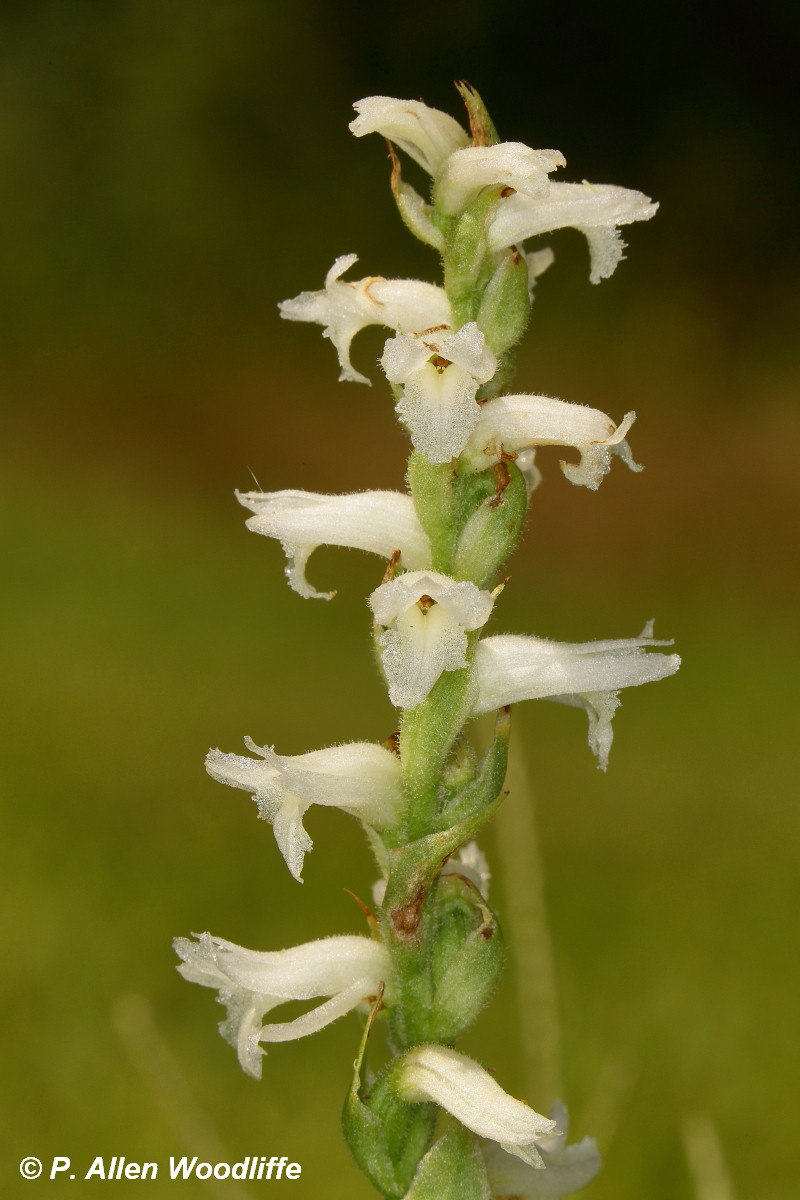
Sticking with orchids a bit longer, there is an interesting group of them in the Ladies'-tresses genus, and some can be challenging to tell apart. A previous post featured the most common one at this time of year, the Sphinx Ladies'-tresses (Spiranthes incurva). I photographed it at Rondeau a few weeks ago. While looking for an endangered gentian in eastern Chatham-Kent, I photographed this same species.

Its flowers are almost entirely white, with little or no fragrance. The brownish spots appearing are an indication that it is past its best. It was photographed on Sept 1, and normally would have been in its peak condition around the third week of August
It has small leaves at the base.

A similar looking one is this next one: Southern Slender Ladies'-tresses (Spiranthes lacera var. gracilis). It is quite dainty, and not easily seen amongst the fairly dense prairie vegetation.

A closer look reveals one of the key characteristics of its spiral flowers: the distinctly green centres of each flower.

Sometimes the spiraling of the flowers takes on a slightly different look with a more drawn out spiral.

It is an extremely rare species, with only this one population showing up in the iNaturalist database. There are older records that I am aware of, but they have not been seen for several decades, primarily due to a change in the overall vegetation.

I have been out to check on another extremely rare orchid of this group: Yellow Ladies'-tresses (Spiranthes ochroleuca), but it was not visible on this date. It occurs on a normally fairly dry sandy site, and it is possible that the extremely dry late June through early August period may be the reason it hasn't appeared. Or maybe I was a few days too early, so I will be out checking for it again soon.

Another one in that genus, while considered rare in Ontario but is relatively common at Rondeau, is Great Plain's Ladies'-tresses (Spiranthes magnicamporum). It is a bit early for it at the moment, but should be showing up in the next week. It is a more robust looking species, with a slightly creamy centre as well as a spicy vanilla scent, and no basal leaves. It grows in grassy areas.


Not an orchid, but an Endangered gentian, is the White Prairie Gentian (Gentiana alba). It grows in the same vicinity as the Southern Slender Ladies'-tresses, and so I combined the time out to photograph them both. There are three sub-populations of this gentian, and at the moment, are the only ones known for Canada. Key characteristics are the creamy white flowers, most of which are fairly closed but not always tightly closed. The flowers also have slight ridges, typically with greenish lines. The plant grows best in high quality tallgrass prairie/savanna vegetation communities.

They can sometimes be confused with another gentian, commonly known as Bottle Gentian (Gentiana andrewsii), which is fairly widespread in a broader vegetation community. Normally they are quite a deep blue, but on occasion they can be white. Such was the case where I was investigating a reported occurrence of the White Prairie Gentian (WPG) in eastern Chatham-Kent. We didn't find any WPG, but did see this white colour form of the Bottle Gentian. The flowers are more tightly closed, and doesn't have the more obvious ridges with greenish edges.

Just to add a little non-botanical information to this post, while I was in eastern Chatham-Kent on the hunt for some of the species above, I stopped by a couple of spots along the Thames River to look for some rare, and very rare, damselflies. The first one is much more common than the second species: American Rubyspot. It has a partially reddish area near the base of the wings, and their abdomen shows definitive brighter rings. They don't always sit in an ideal place to photograph them, but when they do, the patience required is worth it. In Ontario, it is found in many scattered locations west of the Toronto to Barrie area.


Much rarer is the Smoky Rubyspot, next, which shows a bit of red near the base of the wings, and a smoky tip of the wings. Also the abdomen is only faintly ringed, if at all. In Ontario and Canada, it is found primarily along the Sydenham River, the lower reaches of the Thames River and in a couple of places along the Ausable River.

I also managed to check on a couple of rare plants I knew about in the area, both of which are ranked as Endangered. The first one is Eastern Flowering Dogwood (Cornus florida), and while it is not in flower now, it is still quite distinctive. It has a small cluster of red berries.....

...and the large buds of next year's flowers are quite prominent.
In the same general area is a remnant of a population of Eastern Prickly Pear Cactus (Opuntia cespitosa), also Endangered. It was once part of a large population that was widespread across a sandy hillside back in the 1940s, according to a former co-worker of mine who lived across from the site. But eventually the hillside was converted to agriculture, and only a small remnant persists along the roadside.


If you would like to subscribe, or unsubscribe, to Nature Nuggets, send an email to: prairietramper@gmail.com


Monday, 6 September 2021

Late summer botanizing, birding, chasing damsels and checking out a toppled tractor

 In between some of the hot August nights that I blogged about recently, I have been out doing a bit of botanizing and birding on a casual scale.

The woodlands aren't ablaze with wildflowers like they are in the spring, but there is a steady stream of plants to seek out. For example, along the trails of Rondeau one can find some of the following without too much effort.

Beechdrops are not very colourful, and as a parasitic species, it doesn't need chlorophyll to get its energy as it feeds off the roots of other plants. It can thrive in the shaded understorey of the hardwood forest.

A common plant that doesn't get a lot of attention is Jumpseed. It has tiny flowers arranged tightly on its stem....
...which upon a closer look, can be rather colourful.
This next one is one of the Skullcaps. This one has a pair of flowers only on the one side of the stem.

Another flower of the same colour is Hog Peanut, a member of the Legume family.


 Poke Milkweed has completed its flowering and one can find a few seedpods of this uncommon milkweed along the edges of roads and trails through the forest.

 Also along the edges and more open areas within the forest, are large numbers of this Pale-leaved Sunflower....

...with maybe a Northern Crescent resting on it.
 There are lots of ferns. A healthy diversity and abundance of ferns is an indication of a healthy forest! There are about 24 species of ferns at Rondeau. Some are quite abundant and others are quite rare. This first one is Lady Fern, neither abundant nor rare, but widely spread in the more mature beech-maple type forest.

The undersides show the fruit dots, where the spores are developing before being released and sent on their way.
Marsh Fern, next, is quite abundant, especially in the wetter parts of the forest.
This next one is a small version of Ostrich Fern, not a common species at Rondeau.

Sensitive Fern is undoubtedly one of the most common species, found almost exclusively in damp areas, which are abundant at Rondeau. It is called Sensitive due to its sensitivity to colder temperatures.

There are lots of birds on the move these days. I haven't spent a lot of time tracking down migrant warblers, vireos, flycatchers, etc. lately. But even while botanizing, one may come across evidence of a resident bird species. This is a used nest of a Red-eyed Vireo, one of the most common forest bird species at Rondeau.


 I have spent a short time along the lake side, where waterbirds are on the move.

Bonaparte's Gulls are building in numbers.....

.....as are Common Terns.
Double-crested Cormorants, well, they always seem to be fairly plentiful in spring and fall, sometimes in huge numbers. No sign of a smaller Neotropical Cormorant quite yet.

A plant that thrives on the open sandy beach and places slightly inland is this Seaside Spurge. Its flat, ground-hugging nature makes it quite adaptable to the windy environment along the open beach. This is about as tall as it gets!

Elsewhere in the more inland and stable sandy beach area one can find a lot of the colourful Cylindrical Blazing-star.....

....and if one is lucky, a Common Five-lined Skink, Ontario's only lizard.

A friend from the Mitchell's Bay area texted me a few days ago to tell me that a Cattle Egret was visiting their place. It didn't take me long to decide to go and see for myself! And there it was.

Great Egrets, much larger than a Cattle Egret, are the more likely egret to be found in this area, as a large colony of them nest at nearby Walpole Island.

A few days ago I spent some time checking out some areas along the Thames River and various other places in eastern Chatham-Kent. My goal was to find and photograph a couple of particularly interesting damselflies. The first one is the Smoky Rubyspot. It is extremely rare, being categorized as 'Imperiled' in Canada. The only places it is found are along the Thames and Sydenham rivers. I was fortunate to find one or more in three different locations on this day: in two places along the Thames and another location along the Sydenham.

The American Rubyspot, looking quite similar but distinctly different, is much more widespread in both Ontario and Canada, and therefore does not have any official Conservation Status.
When you can get down to the river to look for these delicate damsels you will likely come across some rather large and distinctive flowering plants. Cup-plant, shown first, is also considered 'Imperiled' in Canada. It is shown on iNaturalist as fairly widespread in southern Ontario, but likely some of the occurrences are a result of plantings as it is a popular horticulturally planted species.

Another fairly common species here, but officially 'Vulnerable' in Canada, is Wingstem, named for the  'wings' running along the stem.
I also took time to check out a small railway prairie remnant in the Thamesville area. I should have been there three or more weeks ago. The largest part of the prairie remnant had been cut for hay. Nonetheless I did manage to see some Missouri Ironweed with a few remaining flowers, and several healthy clumps of Prairie Thistle, which is not restricted to prairies, but not common either. There were a couple of Spicebush Swallowtails nectaring on the thistle flowers.

And while I was checking out this little prairie remnant, I had the most unexpected event of the day occur, more or less right in front of me. As I approached the railway remnant, I noted a medium-sized tractor coming towards me on the gravel road. It was pulling a large, awkward looking piece of equipment. I didn't pay a lot of attention to it, as the flowers and butterflies were much more interesting. But all of a sudden I heard a loud 'thunk' and noted that the sound of the tractor had stopped. I looked and this is what I saw:

Toppled Tractor

A second or two later, I noticed that the operator was climbing out of the cab, and getting down onto the road. He appeared okay from a distance, and I noted that he had his phone out and was talking to someone. In a matter of minutes, someone came along on an ATV and talked to the man, then left. I was on my way as well, but thought I would check out the operator just to make sure he was okay and also to find out what happened.

In talking to the operator, he said he was okay, although perhaps he was in a little bit of shock. But he seemed okay. He explained that the sprayer he was pulling was quite top-heavy, and as it was a little wider than the tractor, when the tractor got a little too close to the edge of the road, the wheel of the sprayer dropped off the slightly steep edge and flipped, causing the tractor to turn over as well.

I hope his day improved after that unfortunate event. I know mine did.

And with that, note that autumn colours are appearing in the leaves, as this Silver Maple was showing back on August 23. Who knows whether the colours will be vibrant or muted in the next few weeks?


Happy (almost) end of summer!


Note: if you would like to subscribe, or unsubscribe, to this blog, contact me at prairietramper@gmail.com