Sunday, 18 January 2015

When it is all iced up, go to plan B

I wanted to check what waterfowl or gulls there were at Erieau, but when I got there, this is what I found! It was all pack ice as far as the eye could see in any direction. Photogenic, to be sure, but not a bird in sight.

Frosty Lake Erie

Heading over to another vantage point to look over Rondeau Bay, things didn't look any better.


Certainly a far cry from a much warmer time of year.
September, 2014
So Plan B: go to where there is a good feeder! And I headed to Rondeau, where the feeders at the Visitor Centre were well stocked. On the way over I saw a single Snowy Owl well out in a field. Going into the park, there were birds poking around the snow-plowed road edges looking for goodies in the churned up leaves. At least 8 Northern Cardinals, a bunch of Am Tree Sparrows and Dark-eyed Juncos, and a single Hermit Thrush were all there, but they were skittish in the presence of a slow-moving vehicle, so I only got a shot of this:

American Tree Sparrow

With the snow, cold and well stocked feeders, there were lots of birds coming and going. By far the most abundant was Brown-headed Cowbird. This was undoubtedly due to a good supply of cracked corn on the ground. Interestingly this species doesn't seem to be as abundant around the general landscape as what they used to be.

BHCO male

BHCO female
The peanut feeders were visited frequently by several Black-capped Chickadees and a single White-breasted Nuthatch.


American Goldfinches were scattered around, with some of them looking a little bit brighter than just a few weeks ago.

There was also the usual mix of Northern Cardinal, Hairy Woodpecker, Downy Woodpecker, Red-bellied Woodpecker, Blue Jay, Mourning Dove, Dark-eyed Junco and American Tree Sparrow as well as a single White-throated Sparrow. An adult Bald Eagle flew over quite low, and two Tundra Swans flew over much higher up, heading towards the bay. Perhaps there is an open spot somewhere in the middle like there was all of last year in spite of the extreme cold, where a small number of swans persisted. But the bird I was hoping most to see eventually did show up.....a male Eastern Towhee.


There was a male at the feeder all last winter, but for some reason the one this year only showed up in the last couple of weeks. We did get two on the Christmas Bird Count on Dec 14, however, but not at this feeder.

On the way home, I noted two Red-tailed Hawks feeding on the remains of American Crows.


Hopefully there are enough crows around to help the local hawk population through the winter :-).

And along a quiet road beside a local pasture, was this Rough-legged Hawk.


It isn't as striking as one I saw a few days ago....a very dark adult, in fabulous light, perched in a tree right along the road, but when I slowed down and opened the car window, it immediately took off, leaving me with great memories, but no digital results. But it was nice to get a fairly cooperative lighter version of this species.

So when Plan A doesn't work out, it is always nice to have Plan B to fall back on.


Thursday, 15 January 2015

Barrow's Goldeneye, Snowy Owls, Snow Fleas, etc

These last few days have been gradually warming from the bitter cold not so long ago. And with the sun out and the wind down to a tolerable level, I headed out. The Barrow's Goldeneye that Mike and Josh Bouman saw over the last couple of days clinched it....it was time to take a trip up along the St. Clair River!

It was only a couple of weeks ago when I was doing my route for the local Christmas Bird Count that there was virtually no ice. How times have changed, as the southern half or more of the river was plugged full of ice. The last few lake freighters could only get through with the help of both US and Canadian coast guard ice cutters, and even with that assistance, it took them about 5 days to clear the stalled ships.

The ferries were shut down, of course, and even the usual open water by the Sombra ferry dock was much reduced. It did have a few of the usual Mallard, American Black Duck, Common Goldeneye, Redhead and Canvasback mixed together. Birds were coming and going steadily, so if one sat and watched, there might have been others.

At the Sombra ferry dock

Some seemed to be content just to sit on the ice. Of course maybe this allowed them to keep their feet and legs out of the cold water, using the fluffed up feathers to provide that extra bit of insulation.
Mallards and American Black Ducks


I made it to a bit north of Cathcart Park, where the Barrow's Goldeneye was first reported and subsequently seen over the previous couple of days. Access to the river wasn't the greatest, but I did find an open spot in the trees and shrubs along the river which gave me a good view. There were a couple of open spots in the ice, probably a good 500 metres out. A 'scope was definitely a must! After scanning the mixed flock of ducks, which included most of the species seen at Sombra but also had Common Merganser, Bufflehead and Long-tailed Duck, I saw the Barrow's Goldeneye! A beautiful male.

Barrow's Goldeneye, back centre
Due to the distance, even with a 700 mm telephoto and being heavily cropped after I got home, it isn't a very close shot. But all the salient characteristics are evident: the crescent white patch, the less white on the folded wing, and the dark little spur at the front of the folded wing. I've seen very few of this western species in Ontario, and not for a long time, so that made the trip worth while in itself.

After viewing and photographing this beauty, I continued upstream to check out the conditions in the vicinity of Stag Island at Corunna, where last year there was an abundance of Bald Eagles. There was relatively little ice in the area on this day, and waterfowl were widely scattered. I did get a nice close look at this female Hooded Merganser.

Hooded Merganser
 Note the Mallard below. Most of the time, the head seems distinctly green, but with certain light, one can see an iridescent purple sheen to the head as well.

I saw a single adult Bald Eagle perched in a tree at the north end of Stag Island, but it wasn't on the move at all. A few Long-tailed Ducks were well out in the open water.

On the way back, I stopped in to look at a huge Red Oak tree that I have seen on several occasions. I am very interested in things that appear to be part of an old growth habitat, and this tree definitely fits into that category. Size isn't everything, but it helps.

This tree is within my territory on the local Christmas Bird Count, and I regularly get an Eastern Screech Owl responding to my whistling calls when checking out this woodlot. But I've always been intrigued by this huge tree, so I intentionally took my diameter measuring tape on this trip. Turns out this oak measures 158 cm in diameter.

Not even close to the largest Red Oak in Ontario (I came across a huge one in the back yard of a friend's place in southern Chatham-Kent a few years ago, and it measured 194 cm in diameter; it is the largest one in Ontario), but is still impressive. It is at the edge of the small woodlot, as indicated by its large lower limbs.

I thought that this bright sunny day with little wind would be good for Snowy Owls to be up on poles, rather than taking relative shelter in the middle of a field. Given that most fields are snow-covered, seeing owls is more challenging these days, so a sunny day definitely had some possibilities.

I found four Snowy Owls, and three were along Bear Line. Some were obviously adult birds, given their relative white appearance. This first one was on a pole, but due to the amount of truck traffic, moved off to another pole and then a barn, where it was still there several hours later.


Others were first year birds, with their much darker and more extensive spotting.


Another snowy creature is quite a bit smaller...Snow Fleas. They aren't actually fleas, but are named as such because they are so tiny (only a few mm in length) and have the ability to jump like a flea. They are consumers of mould in the soil, and on sunny days, especially a day that is closer to the freezing temperature, will migrate up through the soil to the snow surface. From a short distance, they can look like specks of dirty soil on the snow, but up close they are definitely insects and surprisingly mobile considering the temperature.


Monday, 12 January 2015

January Waterfowl Survey

Early each January, there is a continent wide waterfowl survey. It is done by a combination of volunteers as well as staff of various wildlife related agencies. While I was with MNR, I organized and compiled the local waterfowl survey for the Chatham-Kent, Essex and Lambton areas from 1987 until I retired at the end of 2011. Since then, I've participated as a volunteer. Even though some of us have had a fair bit of field time in recent days looking for birds during the Christmas Bird Count period, any excuse to get out and look for birds is a good enough reason to get out again!

So yesterday, I decided the weather and driving conditions were good enough to head out into. My short route for this waterfowl survey is only from Lighthouse Cove west to Peche Island at Windsor, while other volunteers cover the waterfront of the remaining area. (Fortunately the results of the St. Clair NWA CBC falls into the survey period, or close enough, so the thousands of waterfowl that we tabulate for that is valid for including in this waterfowl survey.....it is hard to replicate that amount of intensive field effort.)

Lighthouse Cove had changed quite a bit in the last few days. Everything was frozen up solid.

There were only a couple of crows flying around, and an adult Bald Eagle way out on the ice. Even the local mixed/hybrid Mallards were gone.

And that is what the south side of Lake St. Clair looked like all the way to Peche Island! Even at the Lakeside Marina at Belle River, where in past years a couple of pleasure boat owners left their boats at the marina and kept bubblers going beside them all winter which attracted a few ducks, there was no open water. There were a few Canada Geese and Common Mergansers waaay out on the ice off of the marina. I even looked for a Snowy Owl there, which had been observed fairly regularly up until a few days ago, but I didn't see it.

On the way to Peche Island, I drove through parts of rural northern Essex County. With the fierce winds of late, it was clear that a lot of topsoil had been moved from its previous location. Note the very black snow, below!


The area between Peche Island and the Ontario mainland always has some open water, which attracts numerous species of waterfowl. Most were well out, and included several thousand Canvasback, Redhead, scaup, Common Mergansers and a smaller numbers of other species. One particularly attractive bird was this Common Goldeneye, which appeared to be moulting from its first year plumage to an adult plumage.


With the open water and abundant waterfowl, the area attracts Bald Eagles as well. I spoke to one fellow who apparently is a regular visitor, and he told me he had counted a minimum of 19 eagles a day or so earlier, and maybe up to 24. I only saw 6 during the time I was here, and most of them were perched in trees on Peche Island or were flying well out from the marina area.

Under such cloudy conditions, it is easy to tell what age this bird is. If you see a very large raptor which has to be an eagle, and it doesn't seem to have a head, it is an adult Bald Eagle, since its white head blends in so well with the sky.

I am hoping to get out to the St Clair River one of these days, where last year the Bald Eagles put on quite a display. As many as 29 eagles were in the vicinity of Stag Island right at Corunna last year, and a few are back again. There were some great opportunities to see these birds in flight, sometimes presenting some great photo ops such as this one which I photographed there a year ago. Note that it is carrying a fish in its talons, and this bird was headed for a quiet perch to dine on its catch (not a perch :-), in hopes that it wouldn't get harassed by other eagles in the area.


Upon returning to Chatham, I stopped in at the warm water outlet along the Thames River just downstream from the Keil Drive bridge. This area usually has some open water throughout the winter, and is a great magnet for any waterfowl lingering in the area. Mallards are the most common duck, but there are a few American Black Ducks present as well. The latter species is usually evident by its much darker plumage, as noted in the next photo, and is especially easy to separate from female Mallards when they are nearby for comparison.

When the Am Black Ducks are by themselves, and may show a bit paler plumage such as the one below does, one can look at the colour of the bill. A Mallard usually has an orange and black bill, whereas an Am Black Duck has a yellowish green bill. It is entirely possible that the lighter colour of the plumage may be the result of hybridization with Mallard, which happens regularly.

 Canada Geese are typically present in good numbers as well. Here a trio of the several hundred birds present are at rest on a single leg.
 A handful of Common Mergansers are usually around.
 A little surprising was to find this male Green-winged Teal. It is a small duck, as you can see compared to the Mallards and Canada Geese near by. The vast majority are normally hundreds of kilometres south by this time of year. We did get a couple on the SCNWA CBC a few days ago. Due to its small size, it can easily be hidden behind some of the larger birds.
 It stands out more when it is on its own.

And as mentioned, the most common duck present is the Mallard. In spite of  how ubiquitous they are, they really are a striking duck.


Thursday, 8 January 2015

Erieau in early January

I hadn't been out to Erieau for awhile, and with the frosty weather, I wondered what the ice conditions were like. Of course more ice, as long as there is some open water, means that any waterfowl persisting in the area will be a little more concentrated. Such conditions can make photographing them, while using the car as a blind, more productive. And of course with the intensity of the wind and cold, being in a vehicle isn't such a bad idea either!

The clouds were heavy, giving flat light to any photos I attempted. But that is the way it sometimes is.

There were the inevitable flocks of Canada Geese. Most of the time they were hidden in the sheltered area behind the far breakwall, but on several occasions, flocks would get up and fly to a new location. There must have been at least 1500 birds in the area altogether.

One of the reasons for them getting stirred up might have been the presence of a couple of Bald Eagles, an adult and immature. They didn't come all that close to me, and neither of them made any attempts to directly harass the geese, but the geese sure seemed extra nervous.


Various species of ducks were around in quite small numbers. There was a single Canvasback.


There were 5 Redheads, including this male.
One of the most common ducks was Common Merganser, and there were about 30 of them.
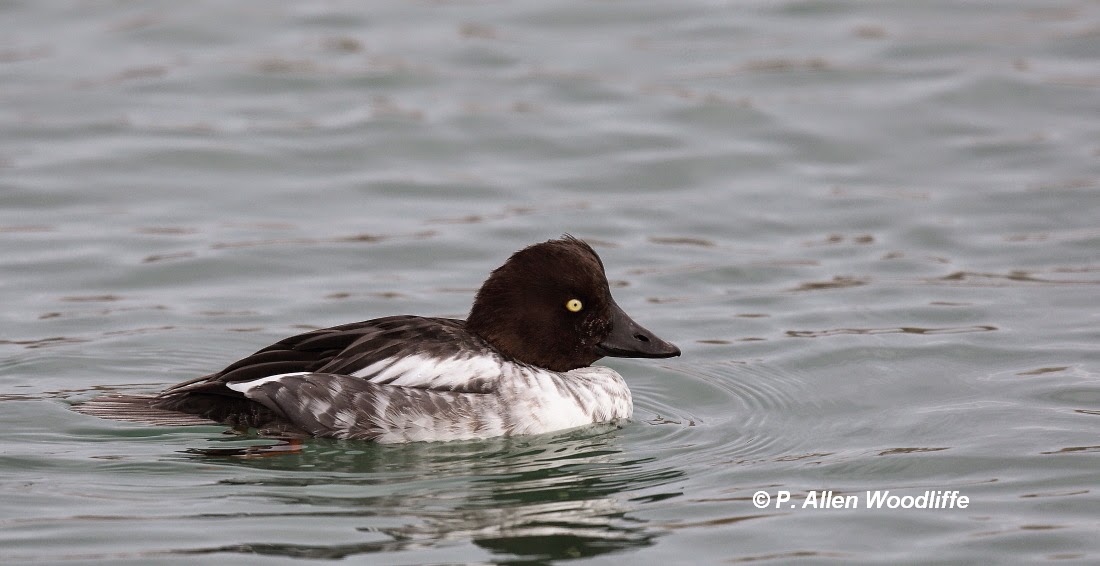
Out off the rocks on the opposite side of the channel there was a mix of Common Goldeneye, Bufflehead, scaup, Mallards and American Black Ducks. I was hoping a Harlequin Duck may have joined them, but I didn't see one.

Closer, and in the channel, was this female Redhead, below. It shows a little more white around the base of the bill than female Redheads normally would show. There are other characteristics that don't fit the 'normal' look of a female Redhead, but given that this genus (Aythya) of ducks regularly hybridize, it is possible that this individual might have some other species' genes somewhere in its heritage. A lot can depend on what stage it is in its moult as well, and individuals can vary.

You can get an idea of how cold it was by the ice clinging to the forehead feathers!
And two Mute Swans.


The skies were gray, with a hint of snow in the air. It made for an interesting setting for the light beacon across the channel, quiet at this time of year as there is no boat traffic.


On the way home, I noted a couple of Red-tailed Hawks protecting their food source. Turns out that there are a few less American Crows living among us! I'm not sure whether the Red-tails killed the crows or not, but there were at least 5-6 dead crows in the field. By this time it was getting even duller, so it made getting any photo at all a bit of a challenge.


So nothing terribly exciting...it is a quiet time of year. There were only a couple of gulls to be seen at Erieau, which is typical of this time of year when most of them seem to go at least to the southern side of the lake in January, but they will be back in February or early March, with some of them sporting some fresh, clean feathering and brightly coloured legs and mouths. Here is a photo of two Ring-billed Gulls I took several years ago, looking at their best!


Saturday, 3 January 2015

New Year's Day CBC at SCNWA

What better way to start off the new year than with a Christmas Bird Count? Which is why for the last number of years, the decision was made to hold the St. Clair NWA CBC on Jan 1. Also because at one point, waterfowl hunting ended on Dec 31, and so by holding the count in January, we would have a better chance of accessing some of the private marshes that are critical for the kind of greater numbers of birds we hoped to find.

However in the last few years, with the large population of Canada Geese persisting in the southwest, the goose hunting season has been extended into January. As a result, now we are finding some of those large private marshes not available to us as paying hunters get priority. But we persist and cover what we can.

The day began in impressive fashion, with spectacular skies to the south. I took this from the bridge at the entrance of the SCNWA.

The weather wasn't great however. We didn't have the snow and cold that we had to contend with a year ago, just a more serious cold and wind combination. With sustained wind between 30-40 km/hr and occasionally gusting to 60 km/hr in addition to the temperatures ranging from -7C to -3C, the wind chill factor was at times down to -18C. It certainly didn't encourage the smaller birds to show themselves! Seeing and hearing birds was greatly diminished under these conditions.

The abundance of waterfowl is a key component to tallying high numbers for this count. The recent cold weather actually may have helped in a way, since the very recently open marshes were now largely frozen with only a few sizable open areas available. It got the ducks more concentrated, so if one could find an open spot, the birds were all there.

Overall we got more than 15100 individuals of 22 species of waterfowl. This is far below one of the most memorable counts, when we had over 95,000 individuals of 27 waterfowl species in 2007.

As is often the case, Mallard (6476), Canada Geese (5368) and Tundra Swan (2454) led the way in terms of numbers.  Many other species of waterfowl were represented by fewer than 5 individuals, including Green-winged Teal (3), Hooded Merganser (2), Bufflehead (1), Northern Pintail (2), etc. We missed out entirely on species we usually get, such as Wood Duck and Canvasback. I'm sure they were out there, but just not in a place to be seen. We did, however, get a new high number for Northern Shoveler (61).

One waterfowl species which is not always recorded, but two groups of us saw this day, was Snow Goose. Given the large numbers of geese generally in the area, a small number are periodically observed in the autumn, but not always seen on the day of the count.

Here, a mixed flock of Snow Geese (6 snows and 9 blues) are flying with a few Canada Geese.

Canada Geese were in the air throughout the day, especially later. This was likely in response to their feeding schedule, as well as being shot at by hunters within the count circle or near by.


Other waterfowl included Common Merganser, mostly seen along the Thames River.

Although the majority of the Mallards were concentrated in the extensive wetlands, a few were elsewhere, including these three along a small creek system that was kept open by a municipal drain. Since they were in an area that isn't hunted, they were more tolerant of my presence.


Land birds were reduced in number, but there were some highlights. I found a group of 7 (with apologies to the original Group of Seven) American Robins feeding in a cluster of hawthorn trees along the river at the southern end of Bear Line. They were the only ones recorded for the count.


While I was pishing for other birds to see what would respond, this White-breasted Nuthatch appeared, one of only five of the species that was recorded on the day.

There were many other land bird species seen including Brown Creeper, Marsh Wren, Hairy Woodpecker, Northern Flicker, Red-breasted Nuthatch, Field Sparrow, Fox Sparrow, Hermit Thrush, White-throated Sparrow, and others but I didn't see them so I don't have any photos to show.

Our total for the day was a respectable 80 species, which matches the average of the previous decade, but well below our record high of 92. A little less wind, a bit more access to some of the best locations would, I'm sure, have made a difference.

We had record high totals of Northern Shoveler, as mentioned previously, as well as Wild Turkey (19) and Snowy Owl. Snowies have been present in impressive numbers again this year, all across southern Ontario. We tallied 15 birds, well above our previous high of 9. And I'm sure there were others. However the windy conditions resulted in them sitting on the ground rather than up on poles or buildings, and when hunkered down in the corn stubble they are much more difficult to see. The photo below was taken several days ago.


We sometimes get an impressive number and diversity of blackbird types. Not so this year, with only small numbers of Common Grackle and Red-winged Blackbird being observed. We missed out on both Rusty and Brewer's Blackbirds, both of which we get at least half the time. There were a couple of good sized flocks of Brown-headed Cowbirds, including the one in the next photo which shows a small part of the ~1900 birds in the group.


A much larger black bird species in both size and number was American Crow.

Yes we had crows, and lots of them as usual.

Although the count is officially called the St. Clair National Wildlife Area CBC, and was established by staff of the Canadian Wildlife Service who managed this NWA, it was centred on the NWA headquarters. As a result the Chatham crow roost was not originally included, but a large part of Lake St. Clair was, most of which was beyond the view from land. We shifted it a bit several years ago....we weren't giving up much value of the lake, since we couldn't see that much of it......and this crow roost phenomenon is too close by and intriguing to ignore. I discussed some of the reasons for this huge concentration of crows in Chatham-Kent in a blog post a few weeks ago. I also wrote an article for OFO News a few issues ago.

It really is challenging to get an accurate number of crows. Estimates by some experts a bit earlier in the season have been 250,000 or higher. Our highest official number for this CBC is 159,860, certainly an estimate but the best one we could get under the circumstances.

The crows come in from all directions towards the end of the day, in stages, alighting on buildings, in trees, on machinery, on gravel piles and on the ground. And then they start to head into the actual roost.

The above image shows 'a few' of them departing from one of their staging points to head towards the roost. At times, they were streaming by at a rate of up to 5000 per minute, and this would go on for some time and not include the birds already present in the roost. From the time the first birds arrive at the roost until the last birds arrive usually takes at least an hour. These next two images were taken a few years ago, well after dark, showing some of the birds in their roost along the river. On this occasion the birds were even roosting on the snow covered river!


If left undisturbed, this roost will extend for at least a kilometre along the river, with the birds occupying trees on both sides of the river.

It is an experience to see them depart from the roost just before daybreak. One can count thousands of birds leaving part of the roost, but the trees don't look any less congested with the remaining crows.

Our total number of crows for this year's count will go in at 134,000 birds. It is an estimate, to be sure. But in my opinion it is a conservative estimate.

Happy New Year everyone!