Wednesday, 24 June 2015

White-winged Dove, Acadian Flycatcher, Bald Eagle, Rondeau

A brief visit to Rondeau today proved more profitable than I had expected. After photographing a plant near the Visitor Centre late this afternoon, I heard the unmistakable call of a White-winged Dove. I knew that one had been seen and heard intermittently a bit north of the Visitor Centre between May 25-30, but I had not been able to catch up with it. As far as I know, it was last seen on May 30. So I was quite pleased to hear it and then find it. Fortunately I had my camera and telephoto lens relatively handy!
It was sitting about half way up in a White Pine tree, in very bright light with a dark background, making the photographic effort a little challenging. It remained in the area for at least half an hour, and is likely not far away given that it presumably has been in the general vicinity for more than three weeks.

A bit later, I checked on the two Acadian Flycatcher nests we had been monitoring. It seems that one right over the edge of the road that I reported on a few posts ago may be abandoned, as I have not seen any activity there in the last 4 visits. However the other nest is still active.....the contents are suspect, however.

I didn't stick around for a long time so as not to overly disturb the adults, and also because the mosquitoes were quite glad I was there! But the bird in this photo looks suspiciously like a Brown-headed Cowbird. Any thoughts???

Acadian Flycatcher

I also took a quick trip out the Marsh Road to check on a couple of things, including the pair of Bald Eagles that habitually nest within view in certain spots of the trail. They are using the same nest as last year, but with the higher water, it is more difficult to get to a suitable vantage point to photograph it even from a distance. But I did manage to get the next two images from the trail. They were taken with the equivalent of a 14X binocular, and even at that, were heavily cropped by at least 50%.

Adult Bald Eagle in White Pine
 The eaglet in the next photo isn't all that easy to pick out, but it is in the lower right of the nest.
Bald Eaglet in nest
All in all, not a bad day for a quick trip!


Saturday, 20 June 2015

Rondeau, end of spring

It is that time of year again when in less than 48 hours, the days will start to be shorter. Not that anyone will really notice for a few weeks, fortunately.

I've been out in the field a fair bit (more on that in a future post), but only at Rondeau on fewer occasions than normal. Nonetheless, there is always lots to see there!

A Ruby-throated Hummingbird is nesting in a quite accessible location along the South Point Trail. After checking her a couple of times, I think she is still incubating, but that may soon change, and hopefully I will be able to catch some of the feeding action.
There are a lot of butterflies along this trail, using the combination of woodland edge adjacent to an extended shrubby habitat, which results in lots of sunny areas. It is always a good strategy to keep an eye on animal poop on the trail, and not just so that you don't step in it. Butterflies are attracted to it! In the following photos, Northern Crescents are sipping away at this delicacy...judging by the amount of what appeared to be deer hair in it, it was likely the scat of a coyote. At times these attractions can be quite busy, with at least 4 crescents in the one photo, and a Question Mark is approaching this buffet in the third photo.


There are often swallowtail butterflies along this trail.
Giant Swallowtail
One seldom gets a chance to capture more than one species side by side, but on one occasion recently two species obliged. There was no special choreographic effort to get them so synchronized...it was simply a matter of waiting until the wind either subsided or blew them over simultaneously.
Eastern Tiger (l) and Giant (r)
Along the woodland edges, Canada Anemone is often prolific.

A brief stop at the Visitor Centre resulted in an encounter with three freshly emerged Red-spotted Purple butterflies. For some reason they were more interested in the boardwalk behind the VC than the surrounding vegetation.
The sloughs along the Tuliptree Trail were a good spot to see dragonflies. A large number of Blue Dashers had recently emerged and were fighting for their territories. They are medium sized dragonflies that have the characteristic pose showing their wings angled forward.
Blue Dasher female
Blue Dasher male
Common Whitetail female
On occasion, Blanding's Turtles can be seen basking in the bigger sloughs. 
Also on the boardwalk over the slough one often sees these Six-spotted Tiger Beetles, which interestingly enough often have more than six spots!

At another trail parking area, I noted a lot of bees buzzing and cruising just above the vegetation. It turns out that it was a colony of Digger Bees. They are often found in drier sandy soil with low, patchy vegetation, where the females dig into the sand so they can lay an egg. Fortunately they seldom sting, although like most bees, will do so if they feel threatened or provoked. Note the one bee right at the entrance while another hovers slightly above and to the right of the sandy mound.
Towards the north end of the park, several of us have been hearing and watching a pair of Acadian Flycatchers. This species is endangered in Canada and Ontario. Rondeau has long been known as a stronghold for them. There are usually at least a couple of nests noted along accessible trails each year, so given the amount of unexplored good habitat elsewhere in the park there are likely several more pairs nesting annually. Fortunately efforts in recent decades have shown that they are more widely scattered across southern Ontario than they were once thought to be. They almost always nest in an American Beech tree, often over the edge of a slough. For some reason one of the pairs decided that the edge of the road was appropriate. Note the location of the nest as indicated by the white arrow. It is easily identified by nesting material hanging well below the actual nest.

Here's hoping that they produce some young Acadians, rather than cowbirds!


Friday, 12 June 2015

Woodlands and wetlands

I recently took another trip to McKerral Woods, a 50 acre woodland in Chatham-Kent that is in quite nice shape and very few people know about it. It is just barely large enough to have a bit of Interior Forest, which is the area of forest more than 100 metres from the edge. In Chatham-Kent, where there is such a limited amount of woodland, any woodland greater than 5 acres is considered significant!

McKerrall Woods was donated to the municipality several decades ago, and is a great spot to get away for even a short excursion. It is a combination of upland and lowland. Although topographic relief is relatively minor, it is enough to make the difference between what is sometimes under water and what is relatively drier upland.

There are some nice sized trees scattered throughout. Some of the largest ones are maple, especially Silver Maple, but the one in the image below is a Sycamore, and is slightly over a metre in diameter. The upper trunk has lost much of its bark, which is typical, and shows a lot of pale greenish mottling.
A nice surprise was this quite large Swamp White Oak. It is approaching a metre in diameter, and that species doesn't often get much larger than that in its restricted range in Ontario.
The wildflowers are mostly finished now, but not that long ago there was a good variety. Some of the lingering ones are:
Blue Phlox
Jack-in-the-pulpit
White Baneberry
 White Baneberry is sometimes called Doll's-eyes since the fruit, as shown in the next image, was sometimes used by pioneers as eyes for home-made dolls for their children.
Note the green insect climbing in this fruiting head. It is an immature Assassin Bug. In spite of their small size, they can give a nasty bite!

I took a swing over to the Bear Creek Unit of St. Clair National Wildlife Area about the same time. The wetland was in good shape, and parts of the interior of it were quite visible from the road side. An Eastern Kingbird was fluttering about.


Several Great Egrets were feeding in the shallow water, but what caught my attention was this family of Pied-billed Grebe chicks, about half grown.
 There were two families of them altogether, totalling 8 young and two adults. Most of the time they did what grebes often do, and that is slowly sink out of sight below the water surface.

In the large creek system near by, several large female Northern Map Turtles were busy basking. This species is a Species At Risk in Ontario.

Elsewhere a Great Blue Heron was playing farmer, being outstanding in his field of soybeans.


Monday, 8 June 2015

Do you know where Swamp Cottonwood is?

I've had occasion to check out Bickford Oak Woods Conservation Reserve three times in the last few weeks. It doesn't take all that long to get there, but there aren't any official trails, so one has to be willing to follow some overgrown logging trails, or bushwack their way through once you arrive. At 308 hectares in size (760 acres) and much of it being wetland, it isn't the easiest place to get around, but usually well worth the effort.

Drainage is poor, leading to all sorts of small and large wetland pockets.
Typical forested wetland of Bickford Oak Woods
One of the things that Bickford Oak Woods Conservation Reserve (BOWCR) is known for is the only location in Canada for the tree species called Swamp Cottonwood. It was discovered by Gerry Waldron, John Ambrose and Lindsay Rodger in 2002, while doing some inventory work. It is hard to believe that even in this 21st century, new tree species are being discovered in southern Ontario!
Swamp Cottonwood
Swamp Cottonwood grows to a fairly good size, and occurs in a buttonbush swampy area. There are several dozen trees of various sizes.....the image here is from a very short young plant.

The wetlands are great spots for amphibians, such as this tiny Western Chorus Frog, only about 2-3.5 cm long.

In general, the BOWCR does not have a lot of large trees. It was acquired by business men during a time when industrial expansion of that part of Lambton County was thought to be a good investment. But industrial expansion did not occur in this area, so it sat for decades. It did undergo fairly intensive timber harvest about 50 years ago, as well as some cattle pasturing, so it wasn't in the most pristine shape. But in the late 1990s, the owners called me to see if any government or private conservation agency would be interested in purchasing it, and so a plan of action was put into place. With the extreme generosity of individuals, local field naturalist groups, the Nature Conservancy of Canada as well as Ministry of Natural Resources, it was acquired and eventually designated as a Conservation Reserve. The forest is rebounding from the harvesting and pasturing activity of the past. But hints of such activity remains, if one only looks at the type of tree form that is common to see throughout the drier sections of the forest.

Multi-stemmed tree trunks abound. Oak was a valuable forest product, and so the merchantable timber was taken out. But oaks have a tendency to sucker after harvest, and some of those suckers are now the well established tree trunks. It is quite common to see double and triple stemmed trunks of various oak species.

Triple-stemmed White Oak
 And on occasion, one may find one with as many as five trunks such as this Red Oak below shows.
With this forest being so large at over 750 acres, it has a significant amount of what is known as Interior Forest, which is the forested portion at least 100 metres from the edge. This is the maximum distance at which edge species, such as Brown-headed Cowbirds, will normally venture in, giving a safer area for birds such as Wood Thrush, Ovenbird and other forest interior species to breed without being parasitized by the cowbird which lays its eggs in other species nests.

Ovenbirds, Wood Thrush, Scarlet Tanager, Yellow-throated Vireo, Rose-breasted Grosbeak and others are fairly common here. Less common species include Cerulean Warbler, Tufted Titmouse and even Acadian Flycatcher. I have seen or heard all of these here from time to time, other than the Acadian......that one is pretty infrequent here.

Some of the largest wetland areas in the BOWCR will support Beaver, and a Great Blue Heronry is in the vicinity of these same interior wetlands.
Beaver cutting
I noted this One-spotted Stinkbug along the trail.
And in October, one can easily find Witch-hazel, a shrub that only flowers in the fall.
Some of the property that was formerly in farmland has been left to regenerate, and even had some tallgrass prairie plants and wildlife shrubs established about a decade ago. Right now, these areas are great for butterflies and dragonflies. This first one is a Common Baskettail, but it had me fooled at first because they normally have an obvious dark spot at the base of the wing. It is more noticeable in the second photo.
Common Baskettail
 Also fairly abundant was Common White tail, as in the next photo showing an immature male of the species.
 Twelve-spotted Skimmers were also well represented.
Twelve-spotted Skimmer
Wildlife shrubs, such as this Nannyberry, are coming into good flower these days, which is great for butterflies.
Nannyberry
Eastern Tiger Swallowtail
Giant Swallowtail
American Lady
In the grasses and clover were some smaller lepidoptera:
Common Ringlet
Juvenal's Duskywing
Peck's Skipper
I'm not 100% certain if this is a Peck's Skipper.....those little rascals are sometimes a challenge unless you get just the right angle to show the important characteristics.....if anyone has a better idea, please let me know.

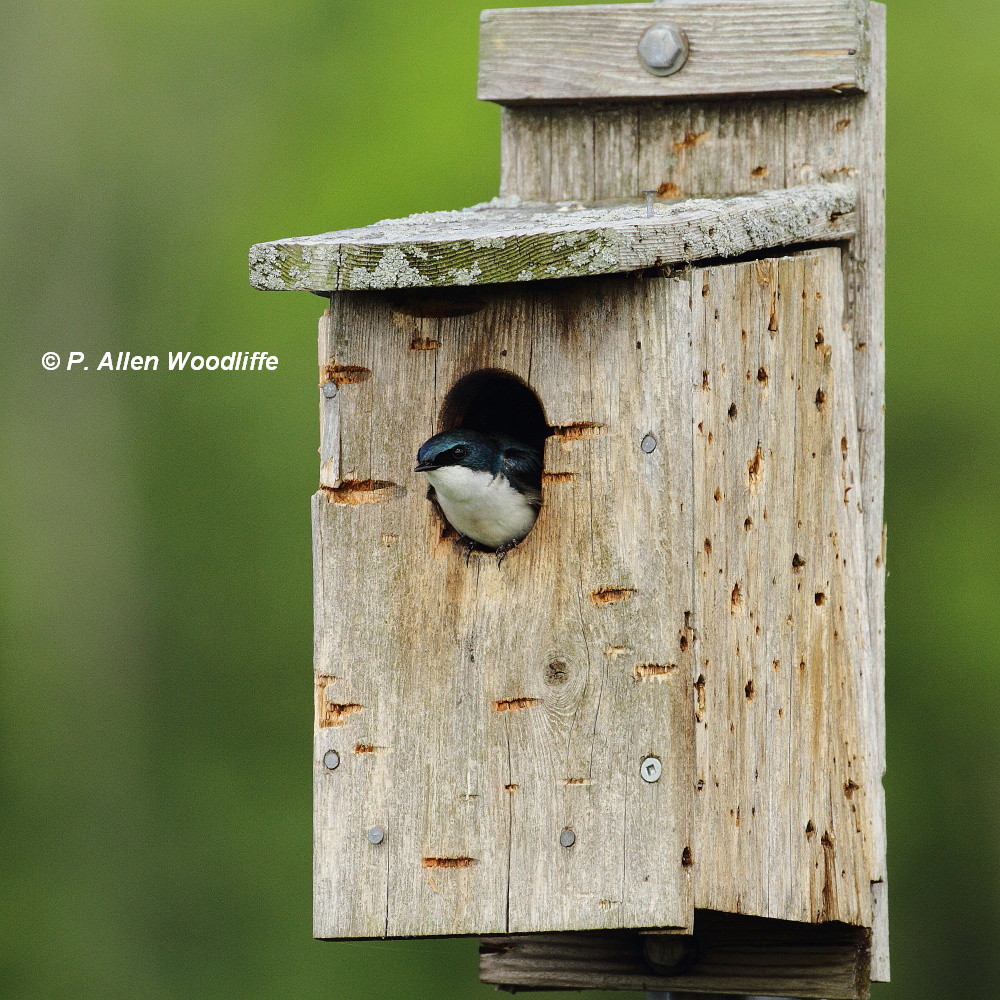
While I was busy photographing butterflies in the open grassy area, this Tree Swallow and its mate were keeping an eye on me.