Sunday, 10 January 2016

Bickford Oak Woods...some of the story behind the site

Now that a definite taste of winter has arrived, and there is less to find outside, it is a chance to remember the warmer, more colourful and diverse times in the field.

I have spent a fair bit of time over the year or so exploring a sizeable natural area, in west central Lambton Co, known as Bickford Oak Woods Conservation Reserve. It is about 308 ha in size as a single block of mostly forest. This property was purchased several decades ago on speculation that it would be eventually developed for commercial/industrial purposes. However that didn't happen, and while I was in my previous role with OMNR, I was approached by the owners to see if any agency would be interested in it. I had had my eye on the significance of this property for quite awhile, so I said yes, and immediately started some wheels in motion to see if a cooperative effort between conservation agencies and individuals could collaborate on its acquisition and protection.

Much of the natural drainage has not been affected, so on this predominantly clay plain, that means there is lots of water sitting on it.


As might be expected, wet woods are home to many amphibians, which are most vocal in the early spring. Here is a Western Chorus Frog, one of the more common species here, but generally declining on the overall southern Ontario landscape. It is a tiny frog, being only a couple of inches in total length. Their voices would make them seem much bigger, however.

At some points along the wetter woods, good stands of Marsh Marigold can be found in the spring.

Where there is long standing water and an open forest canopy, there are beaver. Their lodges are hard to access due to the dense vegetation, mostly the aggressive and non-native Phragmites, but there is evidence of their being in the area.
As its name implies, there are a lot of oaks here, and most grow on the drier parts of the landscape. It is interesting to see how many multi-stemmed individuals there are.
Of course oaks don't naturally grow with multi-stems. This is the result of intensive harvesting of them several decades ago. The stumps sprouted suckers and I have seen as many as 7 stems that survived.

Still other oaks, especially some that are near the edges of the woodland, are single stemmed and show an open grown character, with large low limbs.


Along the edges are some huge ant mounds. I'm not sure if they are any particular species, but they sure are evident. Some of the mounds are a metre high, and 3-4 metres in diameter.
 Large woodlands, especially oak woodlands, are favourite haunts of Wild Turkey. Oaks can be prolific producers of acorns, a favourite food. Turkeys are not often seen, especially during the hunting season, but you can see decoys up close!


Associated with this large woodland are two areas that at the time that the site was acquired, was in agricultural crop. They were planted into tallgrass prairie about a decade ago, and are coming along nicely.
Planted prairie habitat

Gray-headed Coneflower

Compass Plant

Compass Plant

Tall Coreopsis

Tall Sunflower

Dense Blazing-star
 Prairie habitat is fabulous for butterflies and other invertebrates.
Thistle with Crab Spider
Peck's Skipper on Prairie Dock buds

Great Spangled Fritillary

Eastern Tiger Swallowtail
Some small wetland areas have been created within the restored habitat, and wetland plants have appeared.


Monkey Flower

Twelve-spotted Skimmer
As the season progresses, schools of catfish appear. Given that this is not really directly connected to any other body of water, and even the small stream that the water of this pond runs out of, it makes one wonder how the mature fish got there in the first place to produce young.

There is lots more to be found at this wonderful site, and I plan on spending as much time as possible in this next field season.


Friday, 8 January 2016

CBC wind-up and big trees again

Things are a little less busy now that Christmas is over with all the festivities, numerous bird counts and all the scouting that goes along with them. Plus the weather has changed in the last few days and the bird diversity has declined, including the loss of some of those bright spots of December, namely the Harlequin Duck and the Vermilion Flycatcher. The Yellow-headed Blackbirds have been a little harder to find as well, if in fact they haven't left the area.

Nonetheless, I did get out on one more bird count since the St. Clair one that I reported on most recently. It was the Skunk's Misery count, in only its second year. It was not a great day for bird photography, so the 'goodies' that we saw went mostly unphotographed, but it was always nice to see Eastern Bluebirds, Pileated Woodpecker, Northern Flicker, Great Horned Owl and Red-breasted Nuthatch, among the more common species. It has been a great year for Bald Eagles. Not only did we see a record 27 on the St. Clair NWA count a few days earlier, there were lots on the Skunk's Misery count as well. I had 8 eagles in my area alone, some of which were reasonably cooperative for the camera (however if they could have stayed a bit longer so I could avoid the branches in front of them, which messed up the focus a bit.......)
I was on the lookout for Wild Turkey in my area, and I am sure they were there, but I never saw any. The closest I came to Wild Turkey were these Guinea Fowl, an uncountable species since they are not native and were roaming around someone's yard.
At one point, I met up with Brett and Vicki, and we spent a delightful couple of hours along a trail through a large county forest along Coltsfoot Line. It was in that area we saw the bluebirds, nuthatches, Great Horned Owl, Hairy Woodpecker, Black-capped Chickadees and others, along with 6 ATVs whose riders were enjoying their muddy trek. It is in this county forest that I usually seek out one its most impressive residents.....a huge Tuliptree. I have been enjoying this tree regularly since I first came across it more than a couple of decades ago, and hopefully it will be there for a few more decades. Brett and Vicki enjoyed seeing it. They aren't midgets....Brett is about 6' 3", and even taller with his hiking boots and toque!


The last time I measured this tree, a little over a year ago, it was 138 cm dbh (dbh = a forestry term for diameter at breast height, which is 1.3 metres above the ground). There are other impressive trees in this section of the forest, but nothing quite as large as this one.

In the last couple of days I have spent a bit more time at Rondeau, searching out and measuring big trees again, to continue on with my personal project relating to old growth forest that some of you will have read about on previous blog posts. With the ground mostly frozen, access is a little easier, and the ticks should be dormant.....certainly a priority for someone who has been accused of being a tick magnet and contracted Lyme Disease as a result!

One of the things I wanted to do was to photograph a couple of priority specimens, and do so using a new gadget I acquired. The challenge when being by oneself when photographing these trees, and trying to get in the photo to provide a sense of scale, is that once you set off the timer, there are only a few seconds to rush from the camera and get in position and wait for the click, and then repeat it each time you want to change something. While for the most part it is not difficult, it can be a little trickier when on uneven footing. I learned this the hard way one time when in my rush to get into position, I felt and heard a 'snap' from my leg, which was the sound and feeling of my hamstring being torn.

Ouch!

Fortunately I was very close to the road and my vehicle at the time, as it is not easy to walk very far with a torn hamstring while carrying camera gear! So to minimize the risk, I purchased a wireless shutter release. I can get all set up, stand wherever I like and in whatever posture I like and click away just by pressing the button on the transmitter! It couldn't be easier.

You may have seen another version of this next photo previously. It is a huge Eastern Cottonwood, the largest one I have come across in the park so far. It measures approximately 160 cm dbh. Those two large vines on the trunk are Poison Ivy, each one being several centimetres in diameter themselves!
 Not nearly as large, but big enough in its own right, is this Tuliptree. It is a mere 125 cm dbh, and shows a bit of damage probably from a lightning strike.
And here is another Tuliptree, almost right along the road, measuring 110 cm dbh.

There are bigger Tuliptrees in Rondeau which I haven't got to quite yet.

It is difficult to know how old these trees are. Both species are relatively fast growing, and Eastern Cottonwood trees seldom live to be more than 150 years old. Is this one older? Possibly, as it is in an area sheltered from all but the strongest wind, and it on a great site for growth. However we probably will never know until it comes crashing down and then use an oversized, two person chainsaw to get a cross section. And even at that, it may not be possible to tell, as many trees in Rondeau are hollow or at least rotting in the middle. As good as it is for trees growing at Rondeau, they do not necessarily have as long a life span as they would if they were on a drier, more upland site. The fluctuating water levels of Lake Erie put an enormous amount of stress on the trees. Being a sand spit, there is no place in the park more than about 6 metres above the lake level (depending on the lake level), and much of the park is closer to being only 2-4 metres above the lake level at the most. During periods of higher lake level, trees that are growing on the slight ridges because it is a bit drier, may end up having some of their root system 'drown'. When the lake levels drop again, the tree must grow new roots that help in their survival.

Those trees such as Silver Maple that only grow in moist or wet conditions, even growing in up to half a metre of water, will have some of their roots at least partially dry out when the lake levels drop. Since the lake levels seldom stay at a stable level for more than a few years at a time, most trees are constantly facing periods of adjustment.

Rondeau was historically identified on sailor's maps as 'Pointe aux Pins', which means Point of Pines. That is because of the many White Pines along the eastern side of the park, which stood taller than most of the surrounding trees. White Pines, due to their highly resinous sap, are very resistant to boring insects and also to rot. However it is rare to find a large old White Pine in the park. I don't know of any that are greater than one metre in diameter, and most barely make it to half a metre. Even White Pines, which grow on the driest ridges of the park, are susceptible to the fluctuating water levels, which results in their demise before attaining large diameters. This was highlighted during my most recent trip to the park where I came across two individuals that had snapped off due to the intense east winds of late, and showed how rotten they were inside.


This next one was within a few metres of the house Marie and I used to live in, and as it came down, it damaged the corner of the building.

Both trees looked quite healthy and solid before these high east winds did their damage.

Just before I left the park, I checked out the east beach near the north end. Nothing much has changed. The lake looked reasonably placid, and several hundred Canada Geese were continuing with their restful ways.


Monday, 4 January 2016

CBCs...a great way to start the New Year

January 1, 2016 was our 36th Christmas Bird Count at St. Clair National Wildlife Area. It has its challenges, due in part to the weather but more so because some of the best areas are privately owned hunt clubs. With the waterfowl hunting period extending well into January, we often don't get access to the best areas because hunters are using them. And if the truth be known, a lot of these first class wetlands would not exist if it weren't for hunters. Decades ago, large pieces of the St. Clair Marshes were acquired by well-to-do hunters just to have a place to hunt and do business at. Otherwise they likely would have been drained and turned into agricultural land. But that is perhaps the topic of another post.

With the weather of these last few weeks, there is lots of waterfowl around, so one cannot blame people for wanting to enjoy their hobby of hunting. (Full disclosure: I used to be a hunter, back in my teens, as most of my buddies did as well. But eventually, in my twenties, I put away my gun and began hunting with a camera, and that is perhaps a topic of another post as well sometime).

January 1, 2016 turned out as a windy, cloudy and cold day. Not the worst weather we've had, but not the best either. The winds were a sustained 30+ km/h, with frequent gusts or periods of wind in excess of 60 km/h. It stayed just below freezing, something we've not been used to very much this 'winter' so far.

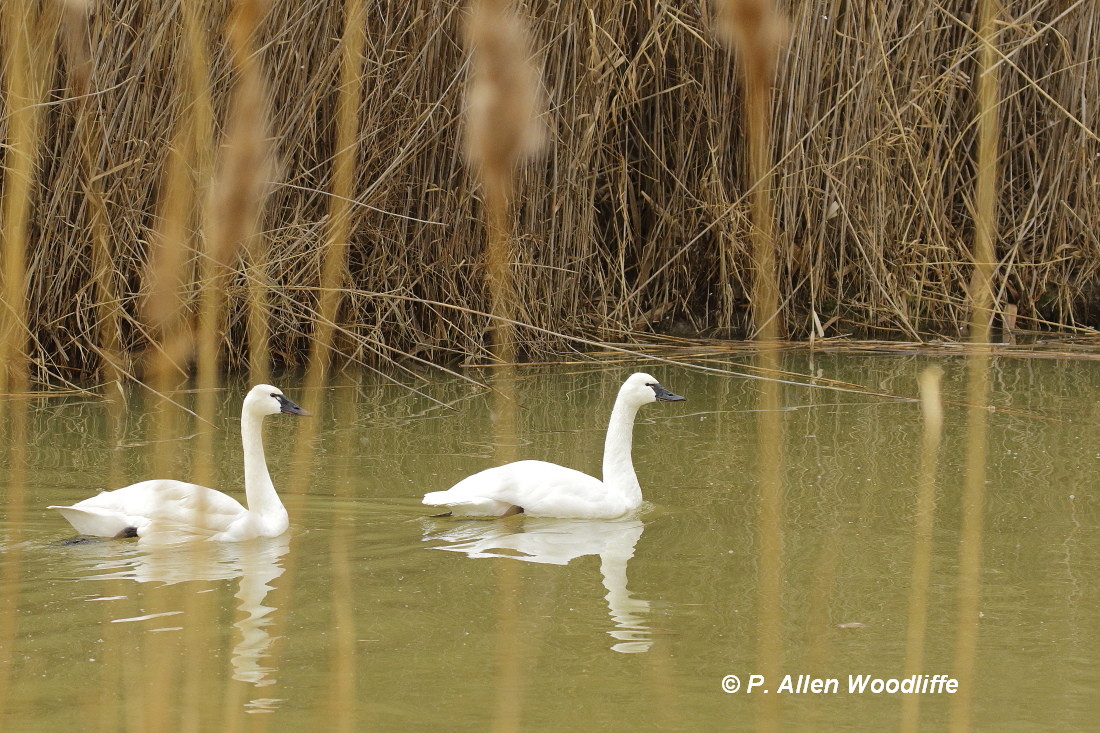
When I first arrived at SCNWA, it was still quite dark. The swans weren't really headless....they were sleeping! And it was hard to get this photo before 0800h on a dark cloudy day.
Swans a-sleeping

At about 0750h, the huge numbers of waterfowl in the marsh woke up. No...those aren't a multitude of specks of dirt on my camera lens.....the sky was full of winged things, mostly at the far side of the NWA. The telephoto lens I needed to capture them could only capture a small portion of the huge numbers spread across the sky.

While I was there, there were more swans arriving from the north, which I thought was a little unusual. Most of the ones that had been in the area for awhile were resting in the NWA. They typically leave for the surrounding fields to feed in the morning, returning later in the day. Presumably the ones arriving shortly after daybreak were ones that had flown in from the north as the winter weather there was finally driving them here.

A couple of swans were swimming in the open channel along the road.
Another wasn't so fortunate. Even though they are not a hunted species, they cannot all survive. It looks like this one will pass on some energy to some local crows.
In a nearby field were five sub-adult Bald Eagles fighting over something. This next image shows four of them.
 It was a good year for Bald Eagles, as we established a new high count of them at 27. Some were content to hang out at their nests.


Sandhill Cranes were in record numbers this year. We saw them flying into the NWA and also out into the fields.
 A record count of 48 was tallied.
 In with some of the waterbirds including the cranes, one could see some Snow Geese, including 5 blues.
Canada Geese, Snow Geese and Sandhill Cranes
Meanwhile out in the wide open landscape of the former Dover Twp, it was Snowy Owl time. We got another record----18 this time, up from the previous high of 15 last year. Many were well out in the field, sometimes half-way between the concessions, so it was difficult to photograph them. And there may have been more. With the windy conditions, they were hunkered down low.
Crows are always a major part of the total number of birds on this count, and this year was no exception. It is getting more difficult to come up with an estimate, as they are widely scattered in huge numbers on all sides of Chatham as they come in to the roost at dusk. A field can be almost full of them, and even after they start moving out of it, it can seem like there is the same number that was there a few minutes earlier. Some staging areas are in fields, sometimes on the rooftops of industrial buildings and some in trees.


And then when it is too dark to photograph any more, they will move in to the final roosting location, which is usually other trees if they don't get scared off by the municipal crow scaring crew.

The official estimate of crows for 2016, and it is only an estimate, is 125,000. Our all time official high count for this CBC is 159,860, made in 2000. Some folks have estimated that in November when they are at their highest, there are as many as 250000-500000 crows in the vicinity of Chatham. But there are usually from 150000-500000 that are documented leaving southwestern Ontario at two of the local hawkwatches (Holiday Beach in Essex and Lake Erie Metropark in Michigan).

For lots more detail on the phenomenon of roosting crows in Chatham, check out one of my previous posts here.


Our final tally for the day was 85 species, our fifth highest count ever, and a little below our all-time high of 92.