Sunday, 27 March 2016

Harlequins and Sandhills

First, an update on the Harlequin Ducks that have been hanging out at Erieau these last few days. I was checking on them a couple of days ago, in much calmer conditions, and both of them were in the vicinity of the farthest rocks on the eastern side of the channel. Still fairly distant but a lot easier to focus on than the previous time
After a bit, the Harlequins drifted off out of sight on the southeastern side of the rocks, so I left for awhile to check other things. When I came back a little while later, they had appeared in the channel, at the lake end, and were seen drifting in with a small group of Bufflehead. They didn't come real close, but I was definitely pleased with the better results.

Inland a little bit from Erieau, I noticed some drainage tiles going full tilt. The rain storm of a couple of days prior resulted in about 30 mm that fell, so there were wet spots in the saturated fields. Not surprisingly, water was being directed into the various ditches and canals......
 .......and from the canals, the water was being pumped into Rondeau Bay in large quantities.
It is a little surprising how saturated the soil is, considering how little moisture we've had. Certainly some of the woodlots are not wet at all. One forest that I check out periodically, the McKerrall Forest, is a swamp forest with Silver Maple being the dominant species. I usually have to wear good rubber boots to get around at this time of year. A few days earlier I had gone out to look and listen for the spring chorus of frogs, only to find that I could have used running shoes and not got even the least bit damp! There wasn't a single frog to be heard.

This first image is of an Eastern Cottonwood, which measured 108 cm dbh, which is often found near water.
This next image is of the largest Silver Maple in the forest, which measured 143 cm! Normally there would be 10-20 cm of water all on around the forest floor, but it was completely dry.
Last evening, I decided to go to St. Clair National Wildlife Area. It can be interesting either in the early morning or early evening. The light at the end of the day was particularly nice for photography, and I always consider that when I pick my travel spots.

There weren't a lot of ducks close at hand. Some hikers with dogs had been out just a bit ahead of me. But I heard Pied-billed Grebes giving their hooting and hollering. There were Ring-necked Ducks a-plenty, but not close by. A small group of Bufflehead had attracted a male Blue-winged Teal.

Red-winged Blackbirds were abundant. I was hoping for a Yellow-headed Blackbird, but it is a bit early for them, and in the last few years they seem to have avoided this NWA in favour of the marshes farther north near Mitchell's Bay.
 Canada Geese were abundant, as usual. It is a bit of a shame that they are somewhat of a nuisance in some areas....they really are a handsome species! It was relatively easy to get some flight shots in the beautiful light and crisp blue sky.


This next one was trying to look inconspicuous, skulking along the far side of the open water. It obviously had a nest nearby, likely with its mate incubating the eggs.
A highlight at any time of the year is to come across Sandhill Cranes. They used to be a novelty in southwestern Ontario, but have steadily increased in numbers so they are more predictable. They feed in nearby fields, and roost in various parts of the vast Lake St. Clair wetland complex. They probably breed in some of the marshes, too. Usually you hear them from afar giving their trumpet/tremolo, long before you see them. This pair came towards me without warning, flying soundlessly and low over the marsh. The camera wasn't at the ideal settings, but I was pleased with some of the shots.


 In just a few seconds, they were out of the good light and heading into the sun, so the images at that point required a lot more tweaking to overcome the high contrast.


Thursday, 24 March 2016

Early spring action

It seems like spring is reluctant to arrive for good, but it is providing hints of what is to come, and a few jaunts around the country side have been interesting.

On a couple of the briefly warmer days, there have been birds, herps and butterflies all to enjoy.

I saw my first of the year Eastern Phoebe a few days ago....two different birds, in fact, in different parts of Rondeau. This member of the flycatcher family is an early migrant. Although it eats mostly flying insects, in cold weather when insects are scarce to non-existent, they will eat berries.


There has been a moderate influx of Northern Flickers.......
....and a much greater number of Turkey Vultures. It doesn't seem that long ago when the last of the fall migrant vultures were dipsy-doodling across the sky on their southern journey. In the lead article of the most recent issue of OFO News, written by noted Ontario birder Ron Pittaway, raptor taxonomy was discussed. Included in that article was the point which cited Palmer in his 1968 work Handbook of North American Birds that our Ontario vultures were not related to Old World vultures but more closely related to the Condor group. In Ron's article he suggested that maybe it is time to change their name to Turkey Condor! That will take a bit of time to get used to, if it happens.


Typically as soon as the ice is off the ponds in the forests, the earliest amphibians emerge, including salamanders and frogs. I have heard Leopard Frogs, Western Chorus Frogs as well as Wood Frogs at times, and some of the larger sloughs of Rondeau have dozens of Wood Frogs clucking away in their attempts to attract mates.
Wood Frog
Unfortunately as some of the snakes emerge, they seek out the warmest sites to bask on, and this can lead to their death by vehicle. This Northern Brown Snake was not only smushed, it was decapitated along a paved road in Rondeau.


Butterflies that overwintered as adults, may appear in areas on sunny warm days. I have seen Red Admiral (but it was too quick to get a photo of) as well as Mourning Cloaks.
 It was trying to place its wings perpendicular to the sun's rays to get the maximum effect, until it flew up onto a tree trunk.
Groundhogs go into hibernation for the winter, and are emerging from their dens. This one was along a road side, and looked a little sleepy.
Snowy Owls are lingering, as they often do in an irruption year.


Waterfowl are numerous these days, and are getting into mate selection and even egg-laying mode. A pair of Mute Swans has taken up residence in McGeachy Pond, as is usual, and has a nest.

Canada Geese are paired up. I saw this one trying to look as inconspicuous as possible while floating in some shallow water. Its mate was nearby. Normally they would be squawking a lot, and moving away from any intruder. However these two were totally silent. Their behaviour suggests that a nest with one or more eggs is nearby, but probably just at the early stage and the adults are not yet incubating full time.
With all the ducks around, it is entertaining to observe their courtship displays. It varies with the species, and often involves some type of head bobbing, chasing, wing display, ducking and diving and various auditory sounds. Sometime it involves all of those things!

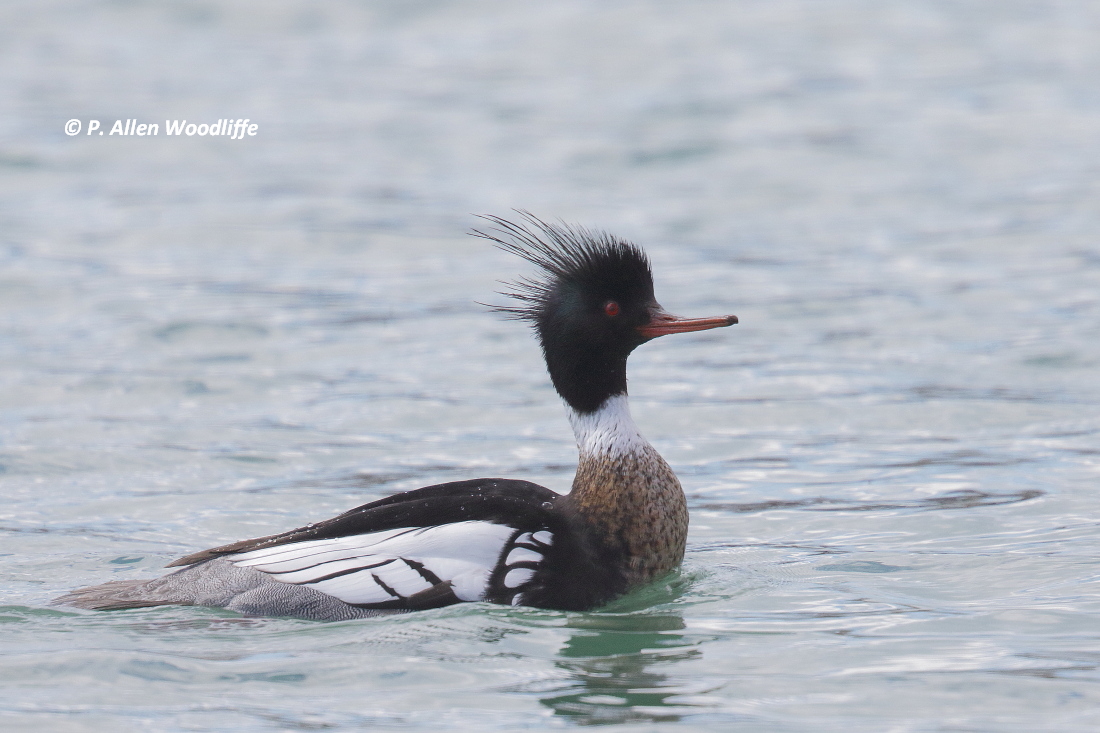
Red-breasted Mergansers are quite common in the area right now. I observed some of their antics at Erieau a few days ago.


A bad hair day
Chasing
 Neck stretching, above, typically followed by semi-submersing themselves, below.


Vocalizations between two males
The happy couple
One of the highlights of the duck world locally in the last few days has been the presence of two Harlequin Ducks at Erieau. A single bird was seen periodically earlier in the winter, but lately a male just coming into its breeding (alternate) plumage has been seen with a female. They aren't always easy to find, however. It took me three visits to the Erieau waterfront to finally catch up with this pair. On one occasion I had been looking and watching for about 30 minutes or so, and finally left. A little later I found out that if I had waited another 15 minutes, the pair of them were quite visible out in the main channel. Timing is everything......however the next day I did get to see them within minutes of my arrival. They flew in from the marina area and went across to the eastern edge of the rocks on the far side of the channel, where they proceeded to spend a lot of time diving into the surf. They seem quite at home in the rougher water. As a result due to their constant bobbing and disappearing into the surf, it was difficult to get a good photo. Auto focus was not going to work, so I had to anticipate approximately where they might surface, and manually focus the lens in hopes of getting something reasonably useful. They aren't the greatest shots given the light, the manual focus and the distance, but are identifiable.

male with the female just going under
male in centre with Red-breasted Mergansers on either side

Friday, 18 March 2016

Gyrfalcon success

I finally got to see the Gyrfalcon, which has been present along the Brickyard Line area south of Forest, in north central Lambton County. Marie and I had tried for it about 10 days ago, but it had only been seen briefly at about the first hour of that day. Even though a dozen or more birders were scouring the area for several hours over the course of that day, it was not reported again.

In viewing the reports over the last few days indicating the bird was still in the area, I decided to try again today, March 18. If I saw it, that would be great, but I have seen three others in Ontario over the years. I even had one already for my Lambton County list, having seen one at the south end of Walpole Island while doing a waterfowl survey in January of 1992. (Sidenote: biologically speaking, Walpole Island is much more closely related to Chatham-Kent, but politics being what they are, technically speaking Walpole is in Lambton, so I have to abide by that for listing purposes.) But that was almost 25 years ago, so I figured it was time to see another one.

As I got to the area where it was most frequently reported, I didn't see anyone else looking. After a few minutes, three ladies from London came by with Gyr on their minds. They hadn't found it yet either. We headed in opposite directions, on the lookout for it.

A short distance down the road I checked out a farm yard with a lot of spruce trees. A fairly detailed scan did not produce the bird in question, so I moved on. Same thing for another farm yard with even more spruce trees. But as I got to the long laneway, I decided to check from a different angle, and almost immediately I spied the bird. It was on the sheltered, southern side of the spruce grove, as the winds were brisk out of the northwest. But it had its back to me, so the frontal views were not to be had. However the look through the binoculars was convincing, and out came the camera. The images below were taken with the equivalent of a 22X lens, and heavily cropped on the computer. With the bird in the shade, and it being so heavily cropped, it isn't as crisp and clear as I was hoping for but I was pleased to be able to see this magnificent and rare arctic visitor nonetheless. On a couple of occasions, it turned its head enough to see the thin moustache.


 After getting a few  pics, I went back searching for the others, and showed them the bird. In spite of the brisk, cold wind, it was well worth standing around admiring this Gyrfalcon!

Wednesday, 16 March 2016

Endangered species habitat

Several weeks ago, I posted a few blogs about Pelee Island, including one post that dealt specifically with some of the endangered snakes. You can read about it here. 

With all of the development that has taken place on Pelee Island and is proposed to take place, some of the critical habitat elements that snakes require are at risk, placing these already endangered snakes at further risk. There are options, however, which may reduce further risk:
  • one option is to buy up the island and convert it back to its natural habitat (believe it or not, that was an option that was bandied about several decades ago! It didn't get too far, not surprisingly);
  • another option is to acquire some of the best remaining pieces of natural area and if possible, connect the pieces so that the snakes have a safe travel corridor along which to go to and fro; 
While acquisition of habitat, or creation of habitat might be done specifically for the benefit of these endangered snakes, in the bigger picture there may be lots of other species, some rare and some not so rare, which will be much better off as well.

If habitat is to be protected, it may be necessary to create features on it that would serve the snakes well for some critical aspects of their life cycle. There have been various efforts to create what I refer to as Critical Habitat Element Clusters (CHEC) on Pelee Island, and include:
  • Hibernacula
  • Egg-laying sites
  • Basking hot rocks
  • Brush piles
Ideally, if these CHEC are available in such proximity so that the snakes don't have to travel a long way and risk their lives crossing roads, it will save their energy and keep a lot more of them alive.

Hibernacula
Snakes are cold-blooded, and spend a good part of their lives underground, below the frost line. There are various ways to create hibernacula, but here are the basics of how we did it on Pelee Island.

A backhoe was used to dig a hole almost two metres deep.
We got large rocks to put at the bottom of the pit....the larger the better.
 The intent was that the rocks are large enough so that there would be numerous cavities at the bottom. We then placed 3 or 4 long plastic pipes (about 4"-6" diameter) leading to various cavities.
 Progressively smaller sized rock was placed on top, being careful not to damage the pipes. The smaller and smaller rock will prevent the uppermost layers of material from falling through, leaving the largest cavities at the bottom.

Fibre cloth matting was placed on top.
The top layer was fine gravel screenings.
The fine screenings at the top will become quite hard, and limit the amount of vegetative growth on the top. This exposed surface serves as a basking site when the snakes are just about to go underground in the fall, or when they begin to emerge during the first warm days of spring.
 Having several access points allows for safety: if for some reason one pipe gets plugged or collapses, there are still others to enter or emerge through.


Basking Hot Rocks
Being cold-blooded, snakes rely on the warmth of sunlight to maintain or increase their physiological activity. For females that are developing eggs inside of them, proper physiological processes are critical for them to be able to lay their eggs early enough, so the young will develop in enough time so that they can hatch early enough in the summer to be able to grow a bit before finding a place to hibernate for the winter. Timing is everything!

The top of the hibernacula can be useful for basking, as mentioned, but one can create other basking sites as well. It is important to have the basking surfaces in layers. And being elevated, it increases the time that the sun is available for basking.

First, place some blocks on the ground in an open area with lots of sun.

In our case, we had pieces of an old concrete slab available, which were perfect for our needs. By creating layers, it gives a basking snake options to choose the right exposure and temperature to its liking. If it feels threatened, it can quickly escape to a more protected part of the hot rock cluster.

Another version of basking hot rocks

Egg-laying site
Both the endangered Blue Racer and Eastern Fox Snake lay eggs. They seek out a pile of decomposing material that they consider to have the right sunlight exposure and moisture so that the eggs, once laid, will have the benefit of warmth and humidity to maximize the chances of the young being able to hatch successfully. In a totally natural setting, this could be an opening in a decomposing log. But where logs are unavailable, snakes have been known to use piles of straw, manure, or wood chips. Creating a suitable egg-laying site is really quite simple: find an open sunny area and dump a large pile of wood chips!


 Such a pile may not be suitable right at the outset, but it will gradually decompose, holding moisture and the snakes can use these piles for several years.

Brush Piles
Snakes shed their skin several times a year. During this period, their eyes cloud over as they "go into the blind". They are much more vulnerable at this time, so they seek out areas where they can hide safely for several days, until the skin is shed. Suitable sites for this period could include a brush pile. Since Pelee Island has a lot of grape growing operations, there are lots of old grape stalks being culled from the vineyards. They are robust, and should last for many years. The material was free for the asking.
 Of course one can just use good old brush and branches as well.
These brush piles may also serve as communal gathering places, where courtship and mating will take place.

As mentioned earlier, having these CHEC in close proximity will minimize the need for the snakes to travel far and wide to seek the habitat they require. This next image shows a brush pile, egg-laying pile and a hibernaculum all within sight. The basking hot rocks are just around the corner. All four of these Critical Habitat Elements are important. Just as a chain is only as strong as its weakest link, if any one of these CHE are not available, the survival of the population of Blue Racer and Eastern Fox Snake on Pelee Island is at risk.
We were able to create 7 of these CHEC all strategically placed in some moderate habitat that wasn't available to these endangered species before. Now this moderate habitat has become excellent habitat!


Friday, 11 March 2016

Late winter calm

It was supposed to be mostly sunny, with a hi of about 9C, but the weather forecasters have been wrong before....it never got above 4C, at least in south Chatham-Kent. Nonetheless, it was a pleasant day to be out, and the mostly overcast conditions until mid afternoon made it good for some landscape photography. The very light winds added to the appeal.

I went to Rondeau, heading for the South Point Trail first. I wanted to check on a few big trees, and of course was always on the lookout for birds. The former was satisfying, the latter was less so. The most interesting avian feature was about 800 Red-breasted Mergansers, and about 40 Commons, 'fishing' off the southeast beach area.

A few of the ~800 RBME
I always like to check a certain view along Tuliptree Trail under the cloudy bright conditions, so today was the day. I wasn't expecting much in the bird realm, and except for a couple of Hairy Woodpeckers, an American Robin and such, it was pretty quiet. But I got a few pics of this scene.
This upturned Silver Maple fascinates me. It is obviously an older trunk, with a couple of new lead branches emerging from the older trunk. As long as a Silver Maple has contact with some moisture, it seems that it never dies, even when it has been blown over. I like to mull over how many times this tree has grown up, fallen over, sprouted some new leaders that have matured, fallen over and repeated this cycle. Perhaps this particular tree is hundreds of years old, and maybe one of the original Silver Maples that got a foothold in this slough many centuries ago. We will never know of course, but it is fun to think of the cycles of nature.

On my way to the north end of the park, I noted a Bald Eagle circle over Lakeshore Road. As I kept an eye on it, I saw that it landed in a fairly open dead tree with good light. Out came the camera.

 The head is almost totally white, but it has a dark line through the eye. A close look at the tail which is especially evident in the image below, shows that it has a lot of dark feathers. Therefore this bird is a sub-adult, probably in the transition stage as it enters its 4th year.
The campground is often worthwhile checking, especially when there are no campers (that will change in a few short weeks, as the camping season opens in April). There was actually quite a bit of bird diversity, including another eagle, a Cooper's Hawk, a couple of Red-tails, lots of Am Tree Sparrows and Dark-eyed Juncos, a Field Sparrow, etc. Mourning Doves are busily calling....there were at least a dozen scattered about the campground.
I didn't see any warblers today, but there is probably a Yellow-rumped or two around. Ditto for Yellow-bellied Sapsucker. I did see a couple of Golden-crowned Kinglets, and the first Brown Creeper I've seen in awhile.....they aren't easy to photograph, as they are constantly in motion, creeping up a tree trunk and going around it at the same time.

The trails are fairly quiet right now, but it won't be long before trails such as this one will be busy with birders and hopefully birds as well.
These next few days are March Break, and the Visitor Centre is open 10-4 each day beginning tomorrow (March 12). So take advantage of the pleasant late winter and early spring weather forecast for these next few days and enjoy the park!