Saturday, 12 November 2016

Reptiles at Risk...an upcoming free event

Reptiles, and in particular snakes, aren't especially loved creatures by the average citizen. True, they aren't cute and cuddly, but they aren't slimy either. Much of the bad rap they have been given is due to misinformation that has been passed along.

You don't see many reptiles out in the wild these days, as most of them are tucked away for the winter, dreaming of next spring. Okay, I can't say for sure that I know what they are dreaming, or if they are dreaming at all. But I can say that the majority of them are in, or preparing, for hibernation.

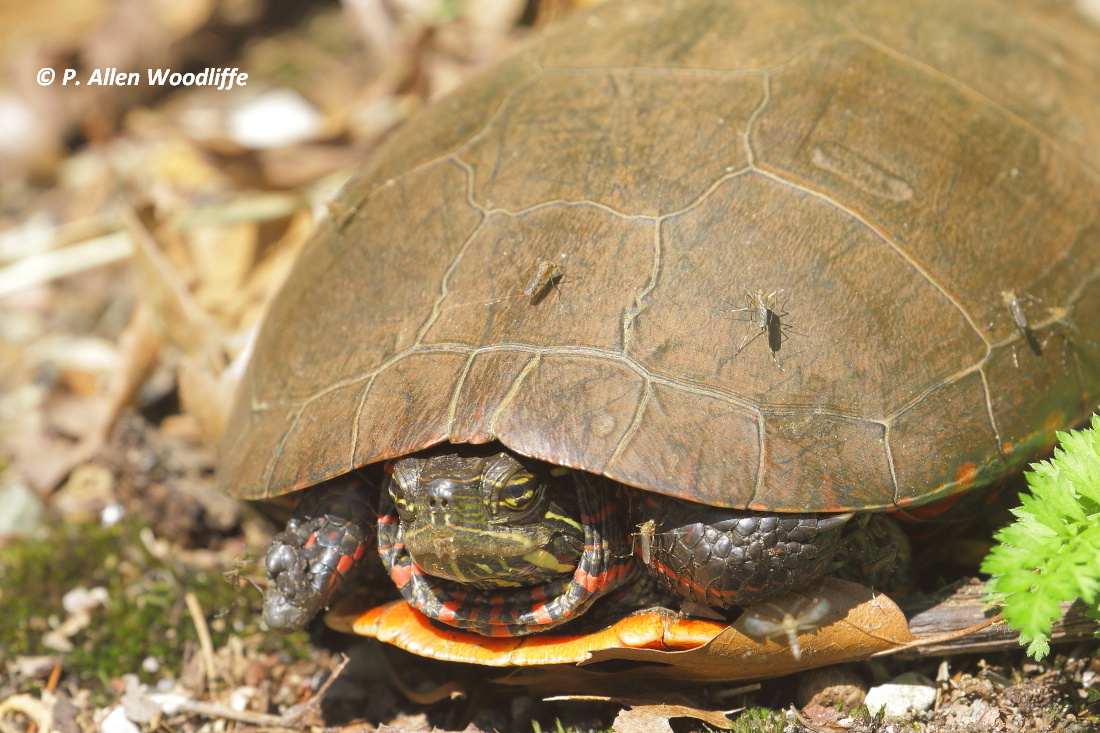
Midland Painted Turtle
If you are interested in a free family friendly program happening here in Chatham-Kent, there is a special event being held near St. Clair National Wildlife area this coming Tuesday, November 15, 2016. It is called Reptiles at Risk....On The Road.

The Eastern Fox Snake in this next image is literally on the road.

It is an educational event, where you can see some of Ontario's reptiles up close....as close as you are willing to get....and learn about some of their habits. This is focused primarily on Species At Risk, and many of Ontario's reptiles are at risk to one extent or another. In this area, there is a good diversity of reptiles, although their numbers are decreasing. Some of those rarities include:
Eastern Fox Snake
Musk Turtle
Ribbon Snake
Five-lined Skink
Blanding's Turtle
Snapping Turtle

This family friendly and free event is being held at the Dover Rod and Gun Club, located at 5806 Heron Line, which is the first road north of the entrance to St. Clair NWA. It starts at 6:30 p.m. This event is being hosted by the Dover Rod & Gun Club, and the actual event with all the reptile critters is being presented by Scales Nature Park in partnership with Sciensational Sssnakes, Laurentian University and the Canadian Herpetological Society.

For more information contact Christie at: christie.l.smith@hotmail.com.


Sssee you there!


Wednesday, 9 November 2016

They're baaaack!

It is November, and the crows are whirling around Chatham-Kent like they own it. Just like snowbirds head south for warmer climes in places like Florida, Texas and Arizona, those large black avian creatures have arrived in C-K from points farther north, intending to spend the winter here.

It happens every year. By mid-October hundreds of thousands of American Crows are beginning to pass through southern Ontario. They only go as far south as they think they need to go, and that means C-K is a likely spot to linger. Large numbers of them do continue on eventually, leaving Ontario for places even farther south. For example three years ago, over the course of about a month there were more than half a million documented heading across the Detroit River for Michigan and places beyond.

Driving around Chatham at daybreak or sunset these days, one can see huge numbers of crows in the air, in the fields, in the trees and on the rooftops of office and commercial buildings. This first image is of a small number of crows I saw yesterday. They were in a field of about 15 ha right next to my former office. About half of the field was covered, and more kept pouring in while I watched.
 Almost every tree within about a 4 sq km area had crows in it.

I estimated that there were about 125,000 crows in the area yesterday, at least from what I could see. I expect there were many more elsewhere around the city beyond my view. Some bird experts have estimated that there are often 250,000 or more that are in the Chatham area at this time of year, before tens of thousands move out, leaving us with 'only' 150,000 or so around for the winter.

A peculiar thing about the crows this year is that many may not have even arrived yet. Or maybe haven't left either. In 2013, as mentioned above, about 550,000 crows had been documented leaving Ontario. In 2014, by this date, there had been almost 175,000 of them documented leaving. In 2015, more than 153,000 had been documented leaving.

However in 2016 so far, there has been a mere 36,560 crows recorded leaving.

What is going on, especially this year? Has the population of crows in Ontario dropped? Not likely. Have the crows decided not to leave quite yet, uncertain about the chaotic elections south of the border? Again, not likely. Have those folks counting them at the two hawkwatches in Essex and Michigan been sleeping on the job? Not likely. Have they been distracted by such huge numbers of hawks that they haven't been able to keep track of the crows? Not likely. Have the crows taken a slightly different route to head to the US, at a location beyond the viewing of the two hawkwatches? Perhaps.

My guess is that with the unseasonably mild weather in 2016, crows haven't even arrived this far southwest yet. They are likely stopping at other similar urban/agricultural centres which provide the many benefits to them that C-K does, at least until winter sets in. In looking at the Christmas Bird Count data from counts across southwestern Ontario in the last few years, the numbers of counts  with larger and larger crow numbers are on the rise.

So maybe there are a lot more crows to come, but are waiting for winter to encourage them to move closer. We will have to wait and see.

A couple of years ago, I wrote a fairly extensive blog post on why crows are so enamoured with Chatham-Kent. Rather than repeat a lot of that, you can read about it here.


There are other birds that are around in rather large numbers. The other day I was driving along just east of Mitchell's Bay when I encountered probably the largest single flock of blackbirds I had ever seen. As with any huge, mobile flock of birds, it is difficult to get an accurate estimate, let alone an actual count. But I concluded there had to be about 40,000 birds, and at least 90% of them were Common Grackles, with a few Red-wings, European Starlings and Brown-headed Cowbirds mixed in. These next two images show very small portions of the flock. They were on both sides of the road, in the corn fields, in the trees, in the air and on farm lawns. I was hoping to see a Yellow-headed Blackbird, and undoubtedly there was the odd one, but it was so hard to scan through the entire flock.

At one point when a large section of the flock that was quite close all got up to fly, it sounded like a low rumble of thunder. It was truly an impressive sight and sound.

There are lots of waterfowl around these days as well, a fact well known to many. Chatham-Kent and particularly the Lake St. Clair marshes and adjacent areas have for more than a century and a half, been renowned for their waterfowl hunting opportunities. Hundreds of thousands of ducks, geese and swans pass through each fall.

Some of the geese are smart enough to know that hunting doesn't take place within Chatham. As a result, sometimes a thousand or more can be found within the city limits, either in some of the recently harvested fields, or in the green belt area. The Mud Creek area offers prime viewing. And with the large numbers of Canada Geese, one can find other species. For example a couple of Snow Geese have been seen from time to time. Garry Sadler advised me today of an adult and juvenile bird that had just arrived with a large flock of Canadas, so I headed out to get a few photos.

Adult Snow Goose
Juvenile Snow Goose

I've seen other species of waterfowl at Mud Creek as well, although not frequently. However on occasion one can find a Northern Pintail or Wood Duck joining the gang. These next four photos were all taken at Mud Creek at one time or another.
Northern Pintail
Wood Duck

Cackling Goose looks like a miniature Canada Goose, and can sometimes be found with a bit of effort. They are small, not much larger than the Mallard in the background of this next photo, and definitely smaller than the more common Canada Goose also in the background.


Late this afternoon, I headed for the Mitchell's Bay North Shore Nature Trail, hoping for something of interest. There was a huge number of American Coot.....an estimated 5200 of them in various flocks out in Mitchell's Bay, but too far away to bother with a photo.

It was a beautiful evening, and I spent a bit of time enjoying the sunset. If you didn't catch it from where you were, I hope you can enjoy it vicariously through this last photo.


Monday, 7 November 2016

You win some, you lose some.....

So the other day, I got a text from Steve Charbonneau indicating that the brightly coloured Eurasian Wigeon was really close to shore off of an access point at Erieau, and great for photo ops. Trouble is, I didn't have my cell phone on at the time, and so I didn't see the message for about an hour and a half. I eventually acknowledged his message. He had also texted Garry Sadler, who was on top of his game and got the message and headed right out. Garry saw the bird, and got some fabulous shots (read on).

By the time I arrived, it was almost deja vu all over again (to quote Yogi Berra). There wasn't a duck in sight, at least not like it had been a short time earlier. There were ducks well out in 'scope range, but nothing close, and definitely no Eurasian Wigeon in sight. So I moved on a bit elsewhere to where there were a few ducks and satisfied my photographic urges with subjects like American Wigeon, Ruddy Duck and even Double-crested Cormorant.
American Wigeon female
Ruddy Duck female

Ruddy Duck male in dispute with another male


I even saw the McArthurs out for a late season boat ride, presumably looking for things to add to Ric's blog.


The reason it was deja vu, is because the day before another, but less brightly coloured male Eurasian Wigeon had been seen along the park side of Rondeau Bay close to shore near the yacht club. I was busily scanning the thousands of waterfowl there in mid-morning. And as I was scanning, I heard a major whoosh of wings from the head of the bay, and the thousands of birds I hadn't yet scoped, came tearing by. I had only looked through about 10% of the birds, when this mass exodus occurred and the ducks all headed out towards the middle of the bay towards Shrewsbury.

Birding is often about being at the right place and at the right time. Fortunately I had seen a Eurasian Wigeon in the spring, so I didn't need it for my year list, but to miss a couple of opportunities to get some decent shots of this colourful bird was frustrating.

There are, fortunately, many other things to enjoy. And on the weekend I was back at Rondeau again. This time there were only a few ducks along the park side, and it didn't take long to determine that the Eurasian Wigeon was not in sight.

I went down the Marsh Trail. Birds were not plentiful, but all this warm weather has resulted in a fair number of butterflies continuing to do what they do. I saw at least 8 Eastern Commas and a Fiery Skipper, plus the usual Cabbage Whites, Orange Suphurs and Clouded Sulphurs.
Eastern Comma
Fiery Skipper...I just got one shot before it left
Pollinators were glad of the warmth, and also of the small number of flowers that were hanging on. Sowthistles (Sonchus spp) were the most abundant flower, and many had one or more pollinators crowding the inflorescence.
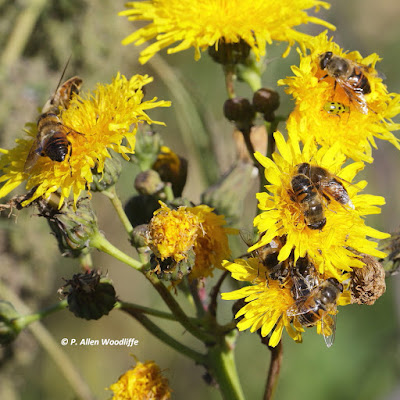
Pollinator gathering


An unexpected bonus for my hiking around Rondeau this day was to come across a never before documented location of the endangered Red Mulberry. It was in fine shape, a mature tree that was about 20 cm in diameter and likely 15-18 metres tall. The leaves are distinctive and quite visible at this time of year.
Rondeau has one of the best populations of this species in Canada. It only occurs in a handful of locations, and while a couple of them (Lighthouse Point Provincial Nature Reserve and Point Pelee National Park) have decent numbers of them, many are affected by the hybridization with the non-native and quite aggressive White Mulberry and are anything but good examples of pure Reds.


Today I went back to Erieau. A Red-necked Grebe had been reported there yesterday afternoon, and I hadn't seen one of those for awhile. I scanned the lake from the pier, and although I saw numerous Horned Grebes, I could not find any evidence of a Red-neck.


I did see another butterfly on my return to the car: this time it was a Common Buckeye, and it was looking quite fresh.

Steve Charbonneau came along just as I was getting ready to leave, and after a bit of a chat, we decided to look at the waterfowl on the bay again. Steve got there first while I checked out the empty fish tug harbour, hoping that the lack of boats and sheltered water would have attracted something of interest. And then a text from Steve arrived, indicating that the Eurasian Wigeon was indeed in view, albeit a fair way out. Needless to say I didn't spend any more time than necessary getting there. And there it was, a bit too far for a photo of any type, so I moved to the vantage point behind the fire hall. I got a better view, and a record photo.

Barely a record photo, as you can see.....it is the second bird on the left. It is a far cry from the fabulous photo that Garry got a few days earlier. To enjoy that one check out this link. 

Congratulations, Garry! Maybe next time I will be at the right place at the right time, or at least have my cell phone on to get the message in time.......


The Blenheim Sewage Lagoons are always a treat to stop by. It isn't very crowded, as you might guess.....the only folks who go there are birders!

A Cattle Egret persists.....up to four have been seen at a time in recent weeks, but in the last few days, only one is sticking around.


A Greater Yellowlegs was there, looking quite lonesome. It was the only shorebird that I encountered, and the first time all year that I haven't come across at least a Killdeer.

Hooded Mergansers are around, mixed in with hundreds of other waterfowl (mostly Ruddy Ducks).


And some butterflies are as well. Aside from the usual Cabbage Whites, Orange Sulphurs and Clouded Sulphurs (although their numbers are diminishing), I came across Eastern Comma, Common Buckeye and Common Checkered Skipper.
Common Buckeye
Common Checkered Skipper

One final photo and thought: take a look at this photo and what does it remind you of? The late day sun rays bouncing across the gentle waves of the lake?

Would you believe that all of those lines are spider webs? This is a scene that Marie brought to my attention shortly after I returned home late in the afternoon this past weekend. It is the grassy park behind our place, and the number of spider webs captured by the late day sun is absolutely amazing! The world of nature is so abundant with photo ops, even in places where you wouldn't think to look. And thanks, Marie, for bringing this to my attention!



Friday, 4 November 2016

Salamander Snippets

I've recently had several people send me photos of salamanders they've come across, wondering what kind they were. Some are quite easy to tell, but others not so much. What are salamanders doing out so late in the season, you ask? Well it has been warmer than usual, and in reality, salamanders can tolerate quite cold temperatures, even though they are cold-blooded. In fact in the spring, they will emerge from their over-wintering sites and be found mating in woodland pools even while there is still snow on the ground and ice on the water!

One of the most easily identified salamanders in southwestern Ontario is the aptly named Spotted Salamander (Ambystoma maculatum). It is a small type of salamander, but the bright yellow spots are unmistakable.

Another one that is quite easily identified and also small, is the Red-backed Salamander (Plethodon cinereus).


A colour variation of the Red-backed is known as the 'Lead-backed' Salamander, as the back is more grayish than reddish in colour.

Another spotted type of salamander fairly common in southwestern Ontario is the Blue-spotted Salamander (Ambystoma laterale). It is also a small salamander normally ranging between 10-14 cm as an adult. The amount of blue spotting can vary a bit, as the following two images show.


This next image shows both of the latter two species, which I found under the same piece of woody material on the ground.


There are other salamander species that occur, or historically occurred, in southern Ontario but are quite rare. These include species such as Small-mouthed Salamander (Ambystoma texanum) found only in some areas of Pelee Island and Tiger Salamander (Ambystoma tigrinum) which is a much larger salamander that historically occurred in portions of Essex County. I have never seen a Tiger, unfortunately. Others are restricted to the Niagara Gorge such as the Allegheny Mountain Dusky Salamander (Desmognathus ochrophaeus) and Northern Dusky Salamander (Desmognathus fuscus) neither of which I have seen, either. Still others are more often found in eastern Ontario: Four-toed Salamander (Hemidactylium scutatum) and Northern Two-lined Salamander (Eurycea bislineata). Rounding out the line-up of Ontario salamanders are the Mudpuppy (Necturus maculosus), an aquatic species, and Central Newt (Notophthalmus viridescens louisianensis). You can read more about all of these salamanders via the Ontario Nature link provided below.

And that leads me to discussing one of the most challenging and confusing salamanders of southern Ontario: Jefferson's Salamander (Ambystoma jeffersonianum). The Jeff's is largely restricted to south central Ontario, although ongoing research has had it turn up slightly beyond that area. It is a large salamander, with adults reaching 18-20 cm in total length. It is dark bluish black, with a few lighter whitish-bluish flecks, but not as large or as brightly marked as the Blue-spotted Salamander. What makes things especially challenging in identifying these salamanders in the field is a result of the unusual reproductive process and ultimate genetics of these two species. They hybridize, and there is a broad zone of hybridization. One can really only tell what kind one is by doing DNA analysis, which for these salamanders requires snipping a small tip of the tail, running it through a blender of sorts, and then examining the DNA. There are many variations of the genetic make-up of these hybrids, as there are crosses and back-crosses through many generations. It is by far one of the most bizarre and complicated reproductive systems of any organism, which is still puzzling biologists and researchers. For more information you can check out this link.

In the immediate Rondeau area, there are no known pure Jefferson's Salamanders. However there are individuals that have some Jefferson's genes, and are larger than typical Blue-spotted Salamanders. A few years ago there was some sampling of salamanders in the park. There is a tremendous amount of habitat for salamanders with dozens of kilometres of linear slough habitat interspersed with ridges of woodland habitat. Some of the individuals caught were quite large. This one in the next photo is almost 15 cm, certainly long for a Blue-spotted.
It doesn't have the typical well defined and numerous bluish-white markings that a typical Blue-spotted would have, especially on the body. This one, although it has characteristics of Jefferson's, turned out to be predominantly a Blue-spotted hybrid.

Salamanders are most often found under objects on the forest floor when they are not under ground. Even though they are seldom seen, they are a valuable part of the forest ecosystem, both as predators of worms and grubs as well as being food themselves for larger predators.

Salamanders are just one part of the reptiles and amphibian group known as herptiles. There is an ongoing effort to document the reptiles and amphibians of Ontario through the Ontario Reptile and Amphibian Atlas, coordinated by Ontario Nature. For more information on this worthwhile project, and to contribute sightings if you can, please visit this link.