Thursday, 6 April 2017

More early bird action

It is that up and down weather so typical of spring. Sunny and mild one day; blustery with cold rain and even snow the next. Nevertheless, birds are attempting to move north as evidenced by some of the latest findings.

A couple of trips to the Rondeau Provincial Park area in the past few days has been worthwhile. Sparrows are a typical early season migrant, and there has been no shortage of them. There have been lots of Chipping Sparrows....

 ....I got my first Savannah Sparrow of the spring.
 ....Song Sparrows are everywhere.
 ....I had at least 4 Vesper Sparrows on one occasion.
I also got my first Swamp Sparrow of the spring, although no photo as it scurried amongst the branches and fallen logs in a slough. There are still lots of American Tree Sparrows and Dark-eyed Juncos present, and an occasional White-throated Sparrow has shown up.

The sloughs are also good for Rusty Blackbirds, although I haven't seen hordes of them yet. Hopefully there are more to come. It is a declining species in Ontario, but not officially At Risk yet.
There have been lots of Golden-crowned Kinglets, although in their continuous active search for food, it is hard to get them in focus long enough for a photo. At least the cooler weather has kept them down low.
 Eastern Phoebes can be seen throughout....sometimes along the forested edges of Lakeshore Road, and other times deep in the forest playing hide-and-seek amongst the trees. They will be nesting very shortly, if they haven't started already.
 There has been an occasional Yellow-bellied Sapsucker noted over the winter, hanging out at the north end of the park. This is the first one I have seen in the forest, so a spring migrant.
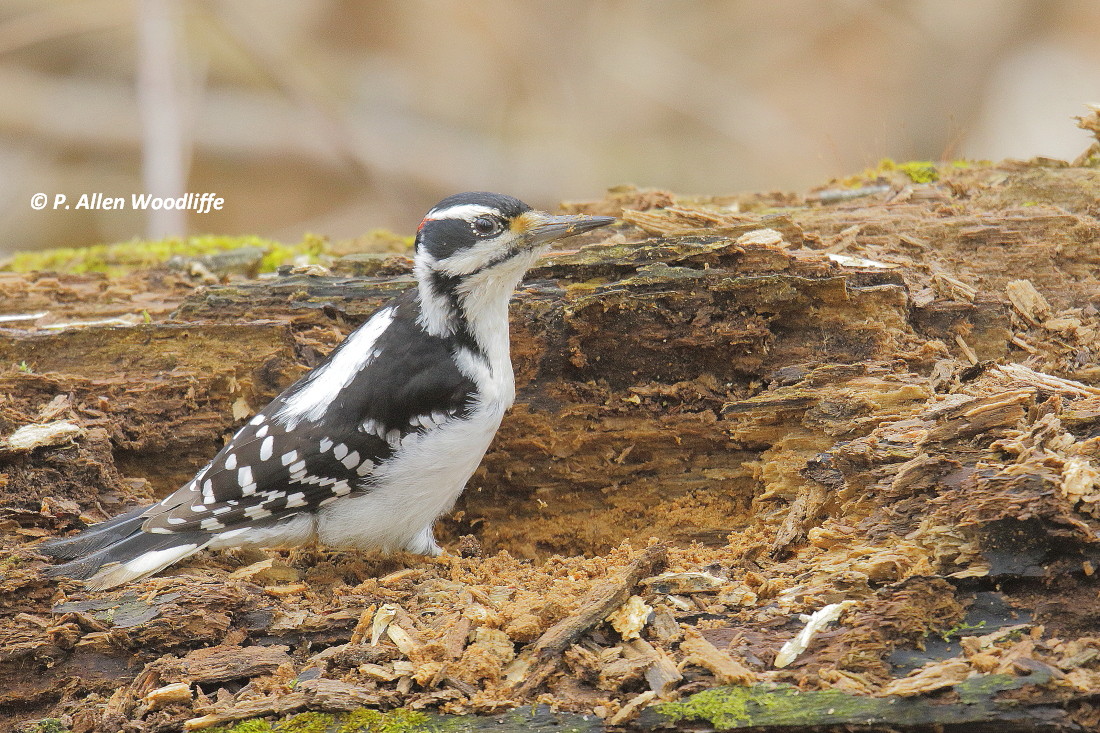
On one of my trips around the Spicebush Trail, I had 5 species of woodpecker, missing only Red-headed. There haven't been any spring arrivals of Red-headeds yet that I am aware of, although there has been an occasional one overwinter somewhere in the extreme southwest. Hairy Woodpecker is not as commonly seen as it used to be, and photo ops are even fewer in my experience. This one cooperated for me for a few seconds.
Hairy Woodpecker
Killdeer have been back for awhile now, and their nesting season has begun. One of the adults is usually pretty close to the nest, especially during this cold wet weather. They aren't incubating yet....that won't likely start until the third of four eggs is laid.

Killdeer nest


Some of the park's other wildlife provided photo ops in my travels, including this larva of some insect which was resting on the top rail of one of the boardwalks. I don't expect it to get much older given the exposure and wet weather.


Sandhill Cranes are a normal occurrence these days, which is nice compared to the rarity that they were a couple of decades ago. The first nesting record for the Rondeau area occurred about 15 years ago, and there are probably 2-3 pairs that nest annually now. It might have nested historically, but probably at least a century or more ago and was never recorded to my knowledge. This pair was apparently gleaning residue from a nearby soyabean field just outside the park.
The weekend looks promising, and the camping season at Rondeau begins tomorrow (Apr 7).


Sunday, 2 April 2017

Fire: a hot topic which often gets a bad rap

On Wednesday, March 26, 2017 a fire got started in the Point Pelee National Park (PPNP) marsh, the cause of which is as yet undetermined. I have my own theory, as do others. Regardless, the fire was allowed to burn itself out, with park staff and local firefighters successfully protecting the boardwalk. From some media reports, I believe the area burned was about 125 hectares.

Kory Renaud posted a few pics on his blog which you can see here.

There was lots of local media coverage, including social media, and it was interesting to read all the comments of concern in how horrible this was for the marsh and the wildlife. Of course it is encouraging to know that so many people have concerns for wildlife and natural areas. Unfortunately people have been programmed, it seems, to believe that fire in a natural area is always devastating.

Some people will remember the Smokey The Bear ads and posters, declaring that "Only you can prevent forest fires", or have seen other posters showing a firefighter rescuing little bambi from a forest burning in the background.


There is no question that fire can have a significant impact on a natural area. But it is imperative to remember that fire is a natural aspect of many natural areas, and in spite of the effects it might have on some species or individuals, contributes in a positive way to the overall health of the ecosystem.

Remember the fires of Yellowstone National Park in the late 1980s? It was initially declared a national disaster by the masses. Some people knew better. In short order, it was shown how critical periodic fire is to the broader ecosystem, and without it, future fires can be a lot more devastating. There were photos showing bison grazing peacefully in the meadows, while smoke lingered in the background. Wildlife in general were not nearly as alarmed as people were. The event which had so much attention provided an opportunity to inform the masses of how necessary, and beneficial, fire can be. (These next two images were not taken at the time of those fires.)
Bison resting at Yellowstone National Park


The same kind of thing has happened, albeit on a much smaller scale, with the recent fire at PPNP. There was a 'firestorm' of comments posted to various media, some of them which were quite concerned about how devastating it would be to wildlife, such as the recently emerging frogs and turtles. Supposedly the marsh would never be the same. Admittedly there is the possibility that a very small number critters might have been impacted, but far, far fewer than people might realize. And in reality, fire is an essential component to maintain healthy natural ecosystems, including marshes, certain types of forests and in prairie and savanna. In one sense, fire is perhaps more important nowadays in marshes than it was in decades gone by.

Let me explain.

One of the most common species of plants typically found in many marshes is cattail (Typha). Yet the cattail we see in our marshes these days is not the same cattail that used to dominate. The native species is Wide-leaved Cattail (Typha latifolia). Unfortunately there is a similar looking species that is native to Europe and Asia and arrived decades ago, known as Narrow-leaved Cattail (Typha angustifolia). The two of them hybridize, and the hybrid is known as Typha X glauca. Unfortunately both the non-native species and the hybrid are quite aggressive, and quickly dominate most marshes they occur in. They grow thicker and taller than the native cattail. A stand of cattail these days, is very dense, and has fewer benefits to wildlife than in days gone by.
A really healthy marsh which supports a greater diversity of plants and wildlife is referred to as a hemi-marsh, which really means that it is about half emergent vegetation such as cattail, and half mostly open water which may include things like water lilies floating on the surface. There are lots of edges, where the emergent vegetation and open water intersect, and that is the most critical area for many species of wildlife.
Virginia Rail using the edge

This first image shows a relatively healthy mix of open water and emergent vegetation at St. Clair NWA.

This next image shows what the south end of the Rondeau marsh looked like in the mid 1980s, where there was a good mix of emergent vegetation and open water. The amount of open water is exaggerated a bit, since I used a 24mm wide angle lens.
The areas that are open at the beginning of the year, may gradually get partially covered over by floating vegetation such as water lilies, and this provides shade for the water, making the metre or so depth of water below a more suitable temperature for fish, frogs, and millions of invertebrates, etc to survive in during the hot summer months. All of these creatures are essential for the survival of many other forms of aquatic life. For example the under surface of the lily pad is where some invertebrates such as snails attach. Birds such as rails, with their long toes, can walk on top of these lily pads and will turn up the pad to feed on the invertebrates.
The seeds of the lily pads as well as for many species of submergent pond weeds (Potamogeton species) are invaluable food sources for migrating waterfowl.

When the non-native cattail and hybrid cattail dominates, it steadily fills in the openings of a healthy marsh, suppressing the sub-mergent vegetation and making the area generally less beneficial to wildlife and other native plants. Many marshes today are dense, with very little open area amongst the cattail. This next photo shows a very dense stand of cattail, with the only open water actually not directly associated with the marsh, but is part of the deeper water of Rondeau Bay.


If a wetland is impounded, that is, surrounded by a dyke system and the water levels can be controlled via a pumping system, one can raise the water level to slow down the advance of these dense stands of cattail. The PPNP marsh is not impounded, with a dyke only at the north end, so it is subject to the natural fluctuation of water based on adjacent lake levels.

In lots of cases, the expanding stand of non-native cattail is not rooted to the ground; the roots and thatch build-up can create a dense floating mat of vegetation, sometimes a metre or more thick, which floats over water too deep for it to take root in. Fire, however, can reduce the thatch build-up and kill off the expanding edges of these floating mats, suppressing the expansion and giving the open areas of water a chance to survive. It also burns the buildup of dead plant material which has accumulated over many previous years, exposing the organic material at 'ground' level. The plants themselves, whether it be cattails or others, will for the most part not likely be harmed. They will survive, since the growing points have been underwater and thus have not burned. But the outer edges of these mats may be slowed down in their expansion.

As for the concern over wildlife: there are few, if any, birds nesting yet, so nests and young will not be affected. Adult birds can fly, so they can escape. Frogs and turtles, if they feel threatened, will simply go underwater until the fire has passed. And in reality, there were probably very few frogs or turtles in the dense stand of cattails....it was likely too dense for them to use. They were likely at the edges or in the open water basking on hummocks when the fire approached, so they could easily plop into the water and escape. Mammals such as muskrats will also be able to escape by going underwater.

Likely the only types of wildlife to be affected may be the larvae of certain species insects which may have overwintered in the stalk of the cattail.

As for the benefits of fire:
-it will likely open up the dense stand of cattail, making more edge around open water which is where most of the wildlife prefers; they can get out into the open water, yet if they feel threatened from avian predators such as a Northern Harrier (marsh hawk), can retreat to the denser vegetation;
-the surface of the now exposed organic matter will, for a few weeks, have some water on the surface or at least be moist, which will attract frogs as well as shorebirds and members of the heron and egret families;

 
-if there were muskrat houses in the cattail stand, they will be exposed and potentially be a nesting site for Black Tern, a species at risk ranked as Special Concern;

-an exposed muskrat house can also serve as a basking area, as well as a place to lay their eggs, of turtles, including the Endangered Spotted Turtle;
-where open water and emergent vegetation meets, reeds such as bulrushes (Scirpus sp) may grow, and this is a favourite spot for the Threatened Least Bittern to nest.

So please keep in mind that fire is natural and beneficial to ecosystems and wildlife. Take a walk on the boardwalk (no this isn't an advertisement for a Monopoly game :-) over the next few months and watch how the marsh and wildlife responds.


Thursday, 30 March 2017

Early spring action and a visit to see a very rare species

Earlier this week I went to Rondeau to see what was happening, since I hadn't been for a few days. As I approached the park, it was quite foggy....not what I was hoping for, but eventually it turned out to be a relatively nice day with lots of sun, unlike the kind of weather that awaits Blake on most weekends :-). From the forecast, this coming weekend might actually be fairly nice.

The park was quiet. It was just after 8 a.m. and the deer hadn't ventured back into the more wooded areas yet; more than a dozen were still out in the wide open spaces.

Sparrows are back in good numbers. I noticed lots of Song Sparrows and an occasional Field Sparrow, but any Chipping Sparrows that were seen by others on previous days eluded me.

While photographing this Field Sparrow from the van window, I heard a Pileated Woodpecker call not far away. In a few minutes it appeared, and in fact flew right towards me, just about 5 metres over my head. I wasn't quick enough with the camera out the window, but the sky was very bland and a mostly black bird against a bright gray sky would not have been a great shot anyway. The female flew out just a few minutes later and at least had the decency to land in a tree so I could see a bit of her, and I managed to get this next photo. It has been heavily cropped to eliminate the undesirable background.
As I drove slowly along Lakeshore Road looking for more sparrows and such, I noticed this American Woodcock right at the edge. It bounced and danced on the spot before slowly working its way back into the shrubbery. This next photo is not cropped at all.
There are lots of Killdeer scattered around. This one was hanging out on a parking barrier.

I saw several Turkey Vultures soaring overhead, which isn't surprising since they had arrived in southern Ontario in good numbers over the last week or so. This one was apparently having a picnic in the picnic area, helping park staff clean up some of the carcasses and debris. The carcass looked a little desiccated; I'm not sure how much nutrition the vulture got out of it.
Eastern Phoebes are widely scattered, along the trails, and along the roadsides. I noted about 10, but I expect there were several times that many throughout the park away from the trails and roads. Getting one to stay still for a photograph does not come easy.


As the day wore on, the sun came out and warmed things up nicely. I saw an Eastern Comma along Spicebush Trail, but it was constantly on the move. This photo was from another time.
The sloughs along the trails were quite active with frogs. I heard and saw lots of Wood Frogs and heard the occasional Spring Peeper.
Wood Frog
A dozen or more Wood Ducks were enjoying the quiet of the sloughs as well. Most were males.

This Leopard Frog was a little confused. It was sitting on the white paint at a stop sign. I'm sure the darker pavement would have been slightly warmer since it absorbs the heat from the sun, whereas the white paint reflects it.


Yesterday I went up to Bickford Oak Woods (BOW) in west central Lambton County. It is an intriguing property....a Conservation Reserve managed by MNR&F. There aren't any official trails, just a few very old logging trails, and only a couple of small parking lots. It is about 308 hectares (761 acres) of mixed lowland and upland forest. There is very little topographic relief but being on heavy clayey soils, it holds surface water very well, so any slightly lower area supports lowland vegetation. There are two small prairie plantings for extra diversity, which were planted on the section of former agricultural land between the parking area and the woodland. It makes a nice transition and is a great spot in season for butterflies and dragonflies. 

The goal of my trip this day was to check out the stand of Swamp Cottonwood (Populus heterophylla). BOW is the only location in Canada where this species is known to occur. It was discovered as recently as 2002 by none other than Gerry Waldron, John Ambrose and Lindsay Rodger. While I was with MNR, I contracted them to do a vegetation inventory of this site as it was being promoted as a Conservation Reserve.

The location of the Swamp Cottonwood is not all that hard to find if you know where it is. And that is the challenge. It involves about three kilometres (round-trip) of hiking through the prairie patch, following the edge of the woods, then accessing an old muddy logging trail to get through wet woods, traversing a creek that usually has lots of water in it. And once you get there, you are standing in water, which isn't surprising since after all it is 'Swamp' Cottonwood. The water was about 30 cm deep at the time of this visit, but with the heavy rains in the days since, undoubtedly is much deeper. These next two photos show the Swamp Cottonwood in its preferred habitat, with a dense Buttonbush thicket in the background.


All in all it was a wonderful time, not only because I was amongst a grove of one of the rarest trees in Canada, but due to the time of year and the bright sunshine, there was a very loud chorus of Chorus Frogs along with a few Wood Frogs in this swamp busily calling to attract a mate. In fact it was so loud it drowned out the sounds of truck traffic on Hwy 40, about a kilometre away.

There were a few other things I noted along the way, including at least three Eastern Commas and my first of year Mourning Cloak.
Other wildlife was relatively minimal, with only a few birds (Red-tailed Hawk, Eastern Phoebe, Song Sparrow, Am Tree Sparrow, etc) noted, and a couple of White-tailed Deer which acted like they hadn't seen anyone for a long time. Chances are given the relative lack of human visitation to this Conservation Reserve, they hadn't seen any humans since the hunting season of last year.

I did see a couple of Snowy Owls along Winter Line on the way home. Up to 7 or more have been in that area for much of the winter, but I expect these holdouts will be gone soon. As much as I liked this Snowy Owl photo currently on my blog header, I will be changing that pic very soon to something more appropriate for the season.


Saturday, 25 March 2017

Spring is trying to arrive...really!

We often get a bit anxious for spring to arrive once the end of March is in sight. But in reality, it can take its time. Of course we were spoiled by warm spring-like weather back in February, so the ever so slow arrival now that spring has officially arrived, at least according to the calendar, makes one impatient.

The presence of Snowy Owls is not an indicator of spring, and only a few days ago I came across 3 birds in more or less the same spots they have been all winter. They weren't in very good places for photos, and the distance, back-lighting and sunlight shimmer made getting any photo at all a challenge.

 The same conditions applied in my attempt to capture a shot of this Northern Harrier that had just pounced on a vole.

As is usual for this time of year, waterfowl are quite plentiful. There are many thousands of ducks scattered across Rondeau Bay, for example, even though it became mostly covered in ice again following the recent cold spell. But as the ice diminishes, the waterfowl become more abundant.
 Species such as Canvasback, Redhead and both scaup species seem to be the most common, but there are good numbers of Gadwall and American Wigeon as well.
Canvasback

Canvasback, with a few Lesser Scaup arriving

Greater Scaup
Northern Shovelers are getting to be more common. When they are feeding, they are quite distinctive as the swim around in a tight flock and appear headless, since their spoon-bills are under the water searching for food.


One of my favourite ducks, the Ring-necked Duck, is showing up in good numbers.....
 
 ...as are Red-breasted Mergansers.

It has been a good year for Greater White-fronted Geese, once considered a rarity in this region. Small groups have been seen in various places, including both the Ridgetown and Blenheim Sewage Lagoons as well as the vicinity of both Rondeau and St. Clair NWA.

Not a species of waterfowl in the strict sense, is the Horned Grebe. Some of them are looking kind of scruffy at this time of year, as they are changing from their winter plumage to their breeding plumage.
 Others are much farther along. Numbers of them are building along the local waterways, with up to a dozen seen recently in the Erieau area.


American Robins have been around all winter it seems. On occasion I've had 12-15 right around our house, but they are fairly common and widespread throughout the area.

Killdeer are also building in numbers, and I expect that I will soon be seeing them laying eggs. Last year I came across a full clutch of 4 eggs in mid April.
Sparrows were noticeable by their absence most of the winter. However Song Sparrows have arrived in large numbers, with several hundred being reported by more than one observer at Rondeau in the last couple of days.
I have yet to see my first Tree Swallow or Eastern Phoebe of the season, but they arrived in southern Ontario in the few days. Purple Martins won't be far behind!