Saturday, 20 November 2021

Autumn bird action and colours

 It continues to be an interesting time of year for various reasons. The bird contingent is changing, as are the forest colours, and lakes are going through their seasonal turnover.

While many bird species have moved on to more southern destinations, the autumn species are showing up in greater numbers.

White-throated Sparrows are fairly common.....

....and surprisingly, Fox Sparrows are as well. In fact, in my last few forays around Rondeau, I have seen far more Fox Sparrows than White-throats. On one outing, I saw a minimum of 35 Fox Sparrows. They were mostly in two loose flocks, but a few individuals were seen scattered about elsewhere.
If you can find a puddle in a quiet area, there is a good chance birds will stop by, such as this Fox Sparrow....
....as were these Cedar Waxwings. As I was partially hidden in some brushy vegetation, and remained quite motionless, I noted more than a dozen birds of several species coming and going quite regularly.
I liked this trio of waxwings, with the central one sipping a drink and being nicely balanced by the two others.
Golden-crowned Kinglets are becoming more abundant than their Ruby-crowned cousins, as expected for this time of year. They can be challenging to get a photo of, as they seem to be constantly in motion.
While Black-capped Chickadees can be found even during the breeding season, they are not plentiful at that time. However their numbers are increasing now as more northern individuals are passing through, or maybe planning to stick around for the winter.
Carolina Wrens are year round residents, most often found in tangles of vegetation. Their numbers fluctuate, depending on the severity of the winter.
Yellow-rumped Warblers are still around in small numbers, and some may stick around all winter if they can find enough berries and spiders to subsist on.

A late Blue-gray Gnatcatcher and Black-throated Blue Warbler have both been seen in the campground recently, but I have not caught up to them yet.

Waterfowl are quite abundant, with often several thousand of several species scattered across Rondeau Bay. In quieter ponds, such as at Keith McLean Conservation Lands, species like Hooded Mergansers can be abundant. On one outing a quick count resulted in 87 individuals that I could see, with likely more in some more out of the way areas.


Also at KMCL is this pair of Bald Eagles, with the male on the left, and the larger, female on the nest. It looks like the female is about a 4th year bird, given its dusky head.

One or both have been seen perched on this platform for a few days in a row. In southern Ontario, late November and into December is typically the time when eagles either repair existing nests, or begin to build a new one. It is possible that this pair is planning to make use of this platform in 2022, usurping the long-gone Osprey pair that used it in 2021. It may be a new pair that has come into the area, especially since it seems to involve a 4th year bird. Birds as young as 3rd year can pair up, but this is more likely to happen when the population is very low. Now that the population has grown considerably in the past 2-3 decades, birds that pair up and start to nest are likely at least 4th year birds. They don't get their full adult plumage of bright white head and tail until their 5th year.

Back on about the last day of October, Steve C, Mike B and I spent some time at Erieau, watching for gulls and other waterbirds to fly by on the brisk winds. While there wasn't anything all that unexpected, we did get distracted by this dark gull on the pier. What made it stand out was that it appeared a lot like a first year Herring Gull, but it had some definite differences. It was darker than a normal first year HEGU, as well as being smaller than those HEGU quite close by. It also has dusky legs and a smaller head and bill, additional characteristics that didn't quite fit. 

We puzzled over it and never quite came up with a definitive identification on the spot. Fortunately the photos that both Mike and I took ended up being helpful in order to study the bird and compare it with various gull reference materials. It was interesting that when I posted it on iNaturalist for its computer visualization process, it came up with various options, but Herring Gull was way down the list, so that added to the puzzlement. We eventually thought it must be some unusual type of Herring Gull, and at first thought it might be the Atlantic Coast type, as some characters fit. There had been several Atlantic seabirds show up in eastern Ontario, so why not an Atlantic Herring Gull?

I sent the photos to a gull expert in the Toronto area, who has had considerable experience with them along Lake Ontario and elsewhere, especially in the region of Niagara Falls which annually hosts thousands of gulls. He indicated it was a Herring Gull, but not one that was hatched anywhere in southern Ontario. Apparently birds hatched in the northern parts of Ontario and Canada are typically darker, smaller and with a smaller bill and dusky legs. Mystery solved.
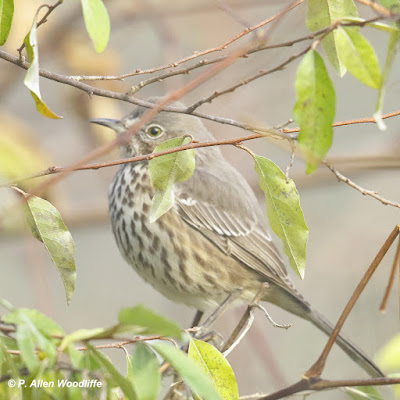
The Sage Thrasher has continued, at least for a few more days, along the Mitchell's Bay South Lakeshore Trail, although not seen as regularly in the last few days. Views continue to be partial due to the branches, although there are fewer leaves to contend with as the days go by.

The bird was not reported for a day or two, but when I was out on Nov 18, after about two hours and checking an area a little way from its usual tangle, I spotted some movement, determined it was the bird in question, and managed this one photo. All of my other attempts were messed up with branches and leaves. There have been birders out there since, but to my knowledge, no one has seen it since, at least according to eBird.
It likely isn't too far away as there is a long stretch of shrubs and berries along that dredged ditch. Given how furtive the bird has been even at the best of times, it may be very difficult to find again.

On one occasion after I left the site of the Sage Thrasher, I meandered down the back roads towards St. Clair NWA. I noted a large falcon flying low and around a cedar hedge, but couldn't quite catch up to it for a photo. I sped up to the end of the cedar hedge and waited, with camera in hand. The falcon didn't quite get to the end before it peeled off and headed across a field, continuing to fly quickly and relatively low. I got off a couple of distant photos, but didn't manage to capture much detail. What follows next is the best I could do, and it really wasn't very helpful. When I posted it on iNat, the CV came up with Prairie Falcon, which would be quite unusual but not impossible. Prairie Falcon is a western species, of course, and moments ago I had come from viewing a definite western species, the Sage Thrasher, so why not a Prairie Falcon. However the detail is just not sufficient to make any kind of accurate ID, and it is most likely a juvenile Peregrine Falcon. Probably.....or not.

November happens to be one of the windiest months of the year, as is March. It is not unusual to see this along the lake front.

And now this cement structure has become visible again. It is part of where the camp office structure was located, back in the day when there was a south campground in operation at Rondeau in the 1960s and very early 1970s. Eventually the sand will shift and it may be covered up again, but for now it is at least partially exposed. Such is life on a sandspit.

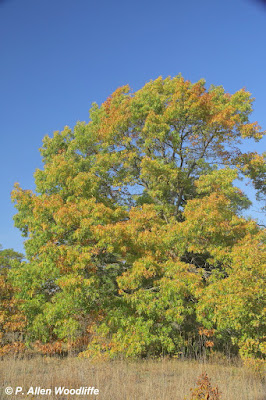
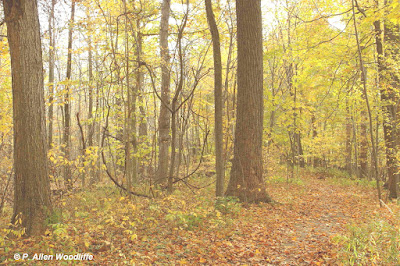
There have been some mighty fine colours to enjoy in places at Rondeau.

It is obvious why this one is called Red Maple.
Closely related is Sugar Maple. It was in prime condition for a very short time, as a brisk wind blew most of the leaves off a couple of days later.
More subtle are the seed heads of an uncommon prairie plant, Cylindrical Blazing-star, which is widespread across the southeast beach dune area.
On one of the days I was roaming Rondeau and it was pleasantly warm, I saw a few Eastern Garter Snakes basking on the pavement. Unfortunately more than one had been schmucked by a vehicle of some sort, but this individual was still okay when I last saw it.
And finally, some of the oaks were in fine shape. I had been particularly focusing on Black Oak for a photo project I was working on, paying close attention to several that were especially photogenic for various reasons. This first one is along the southeast beach, and was looking promising on this occasion.
Five days later it looked like this, showing the golden brown colours this species is known for.
The campground has a lot of Black Oaks, and were relatively colourful on one of my last visits, but by now most will have turned to a deep dark brown, or will have fallen off altogether.


If you want to subscribe, or unsubscribe, to Nature Nuggets, send an email to: prairietramper@gmail.com


Sunday, 14 November 2021

A not so 'Sage' Thrasher?

 Many readers will be aware of the presence of a Sage Thrasher here in Chatham-Kent. It has been reported on eBird daily for slightly over a week, and given its furtive nature spending lots of time amidst some fairly dense shrubbery, might have been here for quite a few days before that. 

I have been out to see and photograph it a couple of times, and even got some fairly good photos in spite of it furtiveness.

This first one is a typical setting: in the shadows and amidst many branches. The image is unprocessed, but it is a start, and sometimes one like this is as good as it gets.

Waiting for it to get into a better lit situation pays off, and one has to maneuver the camera to reduce the branch distractions.....
....but there are still shadows to contend with. However the side profile is useful to get the overall shape and the relatively short beak, short, at least for a member of the thrasher family.

Here is a side profile of the typical thrasher of this area. The size of the bird, the reddish brown colour, the large beak and long tail make it easy to separate the two species.

Brown Thrasher

A frontal view of the Sage Thrasher shows a heavier and slightly different dark streaky pattern.


Catching it out in a more open spot where it is picking away at some berries and in good light, makes waiting for it all the more worthwhile. There is a slight shadow at the back of the head, and continuing down onto the back. The shadow was caused by an over hanging leaf.

There are quite a few berry producing shrubs along this trail. One of the most abundant is Staghorn Sumac. However the berries are covered in small bristly hairs, probably making them less palatable.

Staghorn Sumac
Honeysuckle is not all that abundant, and most berries are gone by now.
Honeysuckle
Climbing Bittersweet is scattered along the trail, but most have not opened up yet. They still have their hard outer shell protecting the smaller berry inside. The second photo shows the exposed berries which may be suitable for this thrasher.
Climbing Bittersweet

Autumn Olive is quite abundant, and while the berries likely would have served the Sage Thrasher well, I expect, at this time of the season virtually all of those berries are gone. Many warblers and thrushes have already passed through, feeding on the abundance of these berries.

Autumn Olive
The main shrub that seems to interest the thrasher for feeding on is Multiflora Rose. I'm not sure whether it is the size of the berries, the taste or the general availability of these rose hips, but for some reason the thrasher is most often seen in the vicinity of a Multiflora Rose bush where there is an abundance of the berries.

At least there was an abundance, but as the days have gone by, the number of berries has definitely diminished. And that begs the question, where will this bird go when this food source runs out? Will it just move along the shrub row searching for more berries, or will it finally leave the area altogether and head for where it normally would be at this time of year?

I used the term 'sage' in my title. That was because I'm not so sure this bird was 'wise' in its decision to fly to southwestern Ontario at this time of year. Sage Thrashers are a mid-western to western species, and are named because the habitat they occupy normally has a lot of sage growing in it. In Canada they can be found breeding in southwestern Saskatchewan, for example in the Grasslands National Park area, and farther west into the drier open habitats of southern Alberta and British Columbia. Normally this species would migrate south, not east. Perhaps this bird got its internal compass bearings misaligned, and in combination with the periodically strong westerly winds, ended up here. It appears to be a young bird, hatched this year, so likely hadn't had any previous experience with respect to the species' normal migration. Regardless, it is here.

Yesterday I took a small branch of Multiflora Rose out to add to the thrasher's favourite bushy setting. There were still a few berries lingering from rose bushes that grew there, but I didn't think that a few more added to its dining area would hurt. And close to the parking lot, but well away from where the bird was normally found, I noticed quite a few other berry laden rose bushes, so snipped off a couple of branches and added them as well.

This isn't the first, second, third or even fourth record of Sage Thrasher in Kent/Chatham-Kent. It is the fifth!

The first record was one I found back in late April, 1981, at Rondeau, while on the search for another rare species. I had seen a Louisiana/Tri-colored Heron flying south, along the east beach of Rondeau, on April 25. I thought it might drop in to the Rondeau marsh, so on Apr 27, I headed out the Marsh Trail looking for it. As rare as the Louisiana Heron was, I got distracted by a bird which I had no idea what it was. I took notes, and then called out to some of the best known Ontario birders about it, including Alan Wormington and Norm Chesterfield, the latter of which had the biggest life list of birds in the world. There were others that came out as well, and although we got some decent looks, no one could definitively say what it was right off. After more looks and discussion, someone came up with Sage Thrasher, and then it all fit together. This was only the third record for Sage Thrasher in Ontario, with the two previously accepted records being in the mid-1960s and only seen by a very few. While my camera gear wasn't great at the time, I managed to get a few acceptable photos, all on film of course. This is a scan of one of them.

Fortunately for many birders, this thrasher remained along the southern half of the Marsh Trail for almost exactly three weeks. As it occurred right at the peak of spring birding, resulted in many hundreds of birders trekking down the trail to see it, as it was a lifer for almost everyone.

There was another record for Rondeau, and the second for Chatham-Kent, in early July of 1985, but only seen for a short time. A third record was in the winter of 1997, in Wallaceburg. The fourth record was one I had, again along the Rondeau Marsh Trail, on the Christmas Bird Count, in mid-December, 2008. And now this one. Five Sage Thrashers in C-K, and I've had at least one in each of the four main seasons.

Stay tuned as this particular bird may be around for awhile yet, and be the subject of another blog post.


If you want to subscribe, or unsubscribe to Nature Nuggets, send an email to: prairie_tramper@gmail.com


Sunday, 7 November 2021

Forest Photography tips

 I have always been intrigued with forested habitat. There is always something new to see, even if one travels the same route for many years, and therefore provides so many photographic opportunities. It can also be an inspiration, a balm to the soul, especially considering the turbulence that life throws you from time to time. The exercise and fresh air is always a healthy thing as well.

I've had a lot of fun photographing woodlands, with varying degrees of success. I have been asked, from time to time, about helpful hints for successful forest photography. So with this post, I will attempt to share some of the things I have found to result in the kind of photos I am fairly happy with.

First of all, there isn't necessarily an absolute right and wrong way to capture forest photos, other than to make sure you have a camera with you, and it has enough battery power as well as a flash card of some type. One of the ABCs of photography is Always Bring Camera. Of course with the way phone cameras are developing these days, and most everyone will have a phone with them, even those cameras can take some fairly impressive pics, but may require a bit of processing to get the most out of them.

Successful forest photography can be spontaneous, but it can also benefit from a bit of planning: what will the weather be like, what lens(es) should I have, do I need a tripod, etc.

Many folks will go out to a woodland trail on a bright, sunny day, with some great weather for hiking. However that can present challenges for a good photo. The camera averages the light, so the area in shadows is almost totally dark, and the bright spots with all the colour may be overblown. The next photo is an example of this.

(As always, click on the photo for a larger view)

 
I waited a bit and a few minutes later, a cloud came over the sun, giving much more even lighting, and a more satisfactory result.

If you can focus on an area where all or most of the light is the same brightness, that often resolves the issue of extreme contrasting light. But one has to be open to looking for a different perspective.

Look up at the sky.....

...or at your feet.

Photographing the seasonal changes can be especially effective if you take a series of photos from the same vantage point. Here is an example of a series along the Spicebush Trail at Rondeau.

Late April

Early May

Late May

Early October

Early November

February

I used to do this at a few spots back in the film days. When giving a presentation using slides and a dissolve unit, one slide would blend into the next, and one could see a whole season unfold on the screen in just a few seconds.

Here is another sequence, from Bennett Ave at Rondeau.

May

July

October

November 
December

Here is a comparison of a great view in Clear Creek Forest Provincial Park, from essentially the same vantage point.

May

October

This next photo was taken the same day as the previous one, but showing a different perspective of the same scene.

  Another cool thing is to take a photo of the same place, but several years apart, to show the changes. The first one was taken in late May of 2008, showing a nice layer of Mayapple growing beneath a canopy of American Beech.

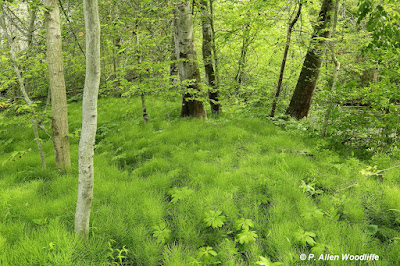
With Rondeau being a sandspit and subject to the changing water levels, the last few years have caused some changes to the ground layer of vegetation. This next photo was taken in early June, 2021, from essentially the same vantage point. One can see a few Mayapple leaves, but the predominant vegetation is that of Horsetail, a species that thrives in damp to wet situations. It clearly shows the results of the change in the water table.

Sometimes you can find a spot where most things work well at eye level.

But sometimes if you want to show the height of the trees from a fairly close-up vantage point, there can be some minor challenges. This next photo was taken with a 24mm wide angle lens. The large tree on the left is a Tuliptree, and in real life is quite straight. However it shows an unnatural curvature, the typical effect of a wide angle lens at a close distance.

This next image was taken at the same vantage point, and the camera was on a tripod. However I switched the 24 mm wide angle lens to a 24 mm tilt/shift lens, which creates a straighter tree.

While the tilt/shift lens works well for vertical images, it can also work well for landscape images, as the next pair show. In the first photo, this normally straight Tuliptree, the large one on the left, shows an unnatural lean. The large Tuliptree down the road a little way, is straight enough.

24 mm wide angle

Here the largest Tuliptree is as straight as it is in real life.

24 mm tilt/shift

The extra cost and fuss using a tilt/shift lens isn't for everyone, and in lots of cases, isn't necessary, but it can be helpful depending on how critical one wants to be.

Sometimes keeping an eye on a certain spot can work well, as in the following case. The endangered Red Mulberry occurs in a few places at Rondeau. It is slow to develop its leaves in the spring, and is one of the last trees to drop its leaves in the autumn. In this next photo, most all of the trees and shrubs have had their leaves turn to a golden yellow. Not so with the Red Mulberry. Its large leaves are distinctly green and are nicely highlighted here.

Often when I am photographing a forest, I look for an interesting trail layout. Curving trails are always more interesting to me, and here I've captured the winding trail along the Tuliptree Trail at Rondeau.
Foggy, misty days will bring out a different mood than those bright, colourful days. The foggy day here in early December, along with the curving trail, and a person shown for perspective can be satisfying. Here Marie wearing her yellow coat is taking a photo a little farther along the trail.
A winding trail through the woods invites one along for the walk and view.
This Tuliptree trio is always a highlight on this trail. But rather than just enjoy it at eye-level....
....look up!


If you want to subscribe, or unsubscribe, to Nature Nuggets, send an email to: prairietramper@gmail.com