Saturday, 22 January 2022

Mostly Water Birds

 It is that time of year, when most water is frozen, that an open spot is where water birds can be found. And since most other birds are scattered far and wide, and difficult to photograph, any place of open water is a worthwhile place to check out.

One of my 'go to' places this time of year is a warm water outlet along the Thames River, on the downstream side of Chatham. There can be hundreds and hundreds of water birds, as this first photo illustrates. There are at least as many other birds upstream, to the right, of this image.

Canada Geese can be fairly abundant......
....but a closer look reveals these two very similar Cackling Geese with their shorter, stubby neck, smaller body size compared to nearby Canada Geese, and a stubbier bill.
There is often a variety of other ducks that have dropped in, sometimes for a day, or sometimes longer, such as this female Bufflehead.
This male Wood Duck is one of the most vividly colored ducks.
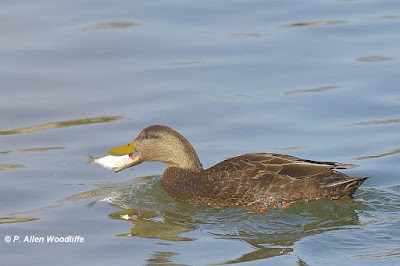
American Black Ducks are more common in winter.....
.....and when the opportunity arises, will try out a fish dinner, although it has to be quick as other ducks and gulls will attempt to go after it, hoping that their harassment will force the duck to give it up.
It is not uncommon to see a duck that has a mix of Mallard and Am Black Duck genes. This next photo shows an Am Black Duck with a distinctive green stripe on the head, likely indicative of some Mallard heritage at some point in its past.

 Mallards are, of course, one of the most abundant species anywhere, and this location is no exception. Probably at least 95% of the waterfowl here are Mallards.
 
 
A female Common Merganser is occasionally present...
...as is a Common Goldeneye. You can see that the ice is a common resting place for the waterfowl!
I much prefer this photo; the same bird, but location, location, location makes all the difference in the appeal of the photo!
Pied-billed Grebes are very uncommon at this time of year. This is one I saw on the St. Clair NWA Christmas Bird Count at the beginning of the month, just a short distance down stream from this spot. Apparently it has decided to hang around for the time being.
There is often a small number of gulls cruising up and down the river, or stopping in for a rest, such as these two Herring Gulls were observed doing.
Not really a water bird, but crows are scavengers and there is often a handful in the immediate vicinity waiting for an opportunity.

Just upstream from this spot is where a Peregrine Falcon sometimes overwinters, as it is able to feed opportunistically on a large flock of Rock Pigeons that hang out on some of the commercial buildings. I haven't seen any sign of the falcon yet this year, and presumably the pigeons are resting more comfortably. And even though some of the buildings have added fake Great Horned Owl and Peregrine Falcon decoys on top of the buildings to scare the pigeons, clearly they haven't had much effect, as this next photo shows. I haven't seen any pigeons land right on the owl, but certainly within a couple of metres! The sky leaves a lot to be desired, at least from a photographic perspective.

The ice is building rapidly out in Lake Erie, although there are a few open spots within view of Erieau. I was there a couple of days ago and noticed several thousand ducks crammed in to three open spots, two out in the lake and one in the bay. This first photo is immediately across the main channel. There were probably at least a couple of thousand ducks there, the majority of which were Greater Scaup, with Redhead, Canvasback, Lesser Scaup, Common Merganser, Red-breasted Merganser, Bufflehead and Common Goldeneye mixed in, but in much smaller numbers.


There were flocks in the air regularly, as birds moved around from one open spot to another.

After leaving Erieau, I went to Rondeau for a nice long walk, and always on the lookout for birds. Birds were few, and even a usually active bird feeder was devoid of birds, which probably was due to this non-bird critter rooting around for something to eat.

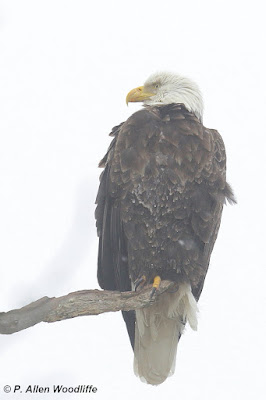
Along the water front was this adult Bald Eagle, perhaps waiting for something to drift by.
Today, I went out to where the Pump Road meets the Thames River, and had a lot of ducks in the open spot a few days ago, including Snow and Greater White-fronted geese. There were very few ducks or geese of any kind on this visit, but I did see this light-phase Rough-Legged Hawk on the prowl along the grassy bank, hoping to flush something out to chase down. It was always facing away from me, so this is the best I could do.


If you want to subscribe, or unsubscribe, to Nature Nuggets, send an email to: prairietramper@gmail.com


Monday, 17 January 2022

Early New Year Outings, Before the Snow and Cold

 Since the Christmas Bird Count season is well past, I have altered my outings a bit. Certainly a few visits to places like Rondeau Prov Park have been in order, but as the winter progresses, birds have become fewer. However there are still great reasons for getting out! I have spent some of the time just going for long walks through the forest roads and trails. Much of the time it seems I have the place to myself, which I don't mind.

I quite enjoy the incredible diversity in the shades of gray and green in winter, which can vary quite a bit depending on the direction and intensity of light. As Rondeau is an example of old growth forest, it shows how tree trunks are not always perfectly straight, as you typically see in a plantation.

Yellow Birch root systems are often interesting. The seeds sprout on things like a fallen tree trunk or other root system. As they grow, they can show curious forms such as this one.
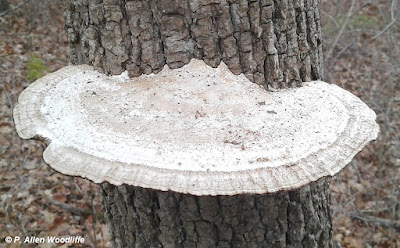
Fungi are still visible, at least the hardier ones like the bracket type of fungus shown next.

Northern Cardinals can be fairly abundant, and the males really stand out. In spite of their relative abundance now, it was just a little more than a century ago when they were first recorded breeding in Ontario, and only in the extreme southwest at Point Pelee. They certainly have expanded their range, as birds do. Now they are seen somewhat regularly well into Northern Ontario, even as far as Moosonee.

One day in my travels, I was out checking to see if a Wilson's Snipe had shown up at its usual wintering spot, in a spring fed stream southeast of Blenheim. As far as I know, it hasn't been seen by anyone there yet, but once the more intense cold arrives, along with a bit of snow, it will likely appear.

Snipe from a previous year

I did see this Red-tailed Hawk comfortably perched on a road-side snag, looking over a few juncos and tree sparrows beneath it. 

However its nervousness regarding my camera sticking out the window overcame its comfort, and off it went.

I had been out to Lighthouse Cove at the mouth of the Thames River, as well as points farther west a few days ago, to cover my area for the mid-winter waterfowl survey. It was just after a recent cold snap, and the ice kept most waterfowl beyond view. In an open spot at the river mouth, I did see a few Double-crested Cormorants....

...and a Hooded Merganser.
An adult Bald Eagle was perched in a tree right along the road, seemingly not bothered by traffic frequently passing almost right below. I managed a couple of photos.....
.....but as with the Red-tail, a stopped vehicle and a camera made it decide to move on.
At Jeannette's Creek where it meets the Thames River, there were about a dozen Great Blue Herons looking a little out of place.

A couple of days ago I went back out to see what was at the river's mouth. The ice had taken over almost completely, and there was only a small opening about half the size of a vehicle, where there were about 8 birds crowded in: two Canada Geese, two Common Mergansers, and four domesticated Mallard types.

I also stopped a bit upstream of the river's mouth, as there was an opening with several hundred geese. Included were 12 Snow Geese, including at least 4 blue phase.....

...and eight Greater White-fronted Geese. We had 5 on the SCNWA CBC, and it is quite likely that they were part of this group. Most were tucked in to the larger group of geese, and difficult to photograph, but one or two were more or less out on their own.

Yesterday I was back at this spot, hoping to get some slightly crisper and overall better photos since the light on the previous trip was quite intensive, but alas, they had been seen leaving this spot a couple of hours earlier. There are still lots of geese hanging around the Chatham area and points downstream, so maybe they will turn up again.


If you would like to subscribe, or unsubscribe, to Nature Nuggets, send an email to: prairietramper@gmail.com


Thursday, 6 January 2022

Two More Bird Counts in the Rearview Mirror

 The Christmas Bird Count season is now over, except for finalizing numbers and entering them on the Audubon web site that hosts all the data from the thousands of counts held each year.

On Jan 1, we had the St. Clair National Wildlife Area CBC. I have been the compiler for this count since 1988. The weather was quite mild, about 5C, with light north winds. There was no ice or snow anywhere, which had advantages such as having lots of open habitat for the thousands of waterfowl and other waterbirds to occupy. Driving around was not a problem either, and spotting the white Snowy Owls against a dark farmland background made achieving a record number of that species much more likely. The disadvantage of such mild, open conditions, is that so much wetland habitat was unobservable due to the numerous open spots not visible to where we were able to access. So there were probably some species, and overall numbers, that were not documented.

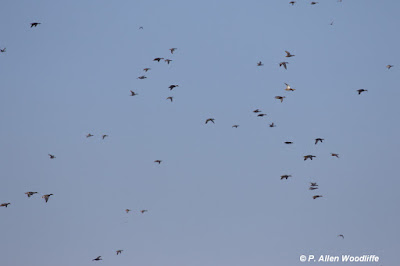
How did all of this play out? We had 15 observers spread over the count circle, and saw 91 species, a bit shy of our record of 93 species seen a few years ago, but quite respectable. Waterfowl were well represented by 25 species, but by far the most abundant were ducks such as Mallards, shown in flight with a few American Black Ducks. At times it seemed much of the sky was filled with flocks of various sizes and mixes. We recorded over 10000 Mallards, but due to the inaccessibility of some prime wetland areas, there were likely more. (Note: most, but not all of the following photos were taken on the day of the count. When one is walking several kilometres carrying a 'scope and tripod, one sometimes decides not to carry those few extra pounds of camera equipment, especially with the threat of rain. However they represent what was actually seen on the day, even though they were taken a few days before, or a few days after, the count day.)

Northern Shovelers were present in good numbers, at least for that species, with 132 individuals recorded.
Canada Geese were numerous as well, with almost 9000 recorded. Some flocks were resting and feeding in fields of green....
...while others were scattered in the lower, wetter areas of harvested farm fields.
About half as many Tundra Swans as Canada Geese were recorded, in flight to or from their feeding and resting areas....
....but most easily in the open wetlands of the NWA.
A small number of Sandhill Cranes was observed, well away from the road, and almost invisible as their plumage blends well with the harvest corn field. The 25 cranes seen on the day beat the previous count record of 10.

We added two new species to the overall count list, with one each of Orange-crowned Warbler and Sora documented by two separate groups of birders. Somewhat surprisingly we missed species such as Hairy Woodpecker, Redhead both of which were undoubtedly present somewhere.

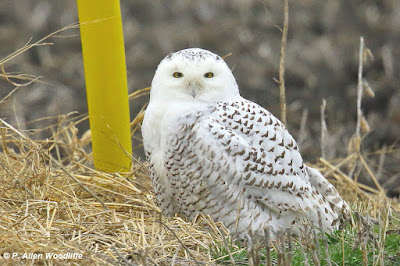
We did get a new record for Snowy Owls, as anticipated, but never for certain until all the results are in. The previous high was 18 birds, and this year we collectively recorded 23! The actual total reported was even higher, but after taking into consideration the probability of double-counting, settled on 23. When this count started back in 1981, we considered ourselves fortunate to record even one or two. Some years we didn't find any. In the decade prior to this day, however, we have never missed them, and have averaged 7 birds over that decade. Adding these 23 to the 2022 results will definitely boost the average a bit higher. One group of birders more or less in the heart of the snowies wintering territory was able to do a careful count and saw 11 from one vantage point!

Most were well out in the fields, but several were close enough for some quite satisfying photographs, as the following results will show. While not all of the photos shown above were taken on the day of the count, these snowy photos were.


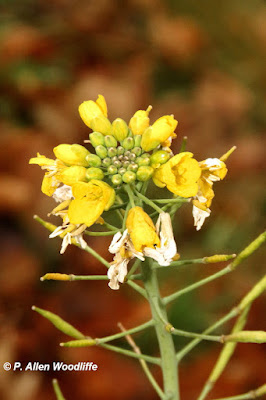
To further illustrate how mild the weather had been to this point, I noticed this plant still in flower, with some individual flowers still in development! It is a member of the Mustard family.


What a difference a day makes. 

The day after the SCNWA CBC was the Skunk's Misery CBC, centered just west of Bothwell in eastern Chatham-Kent. As mentioned previously, as yesterday went along, the weather deteriorated, first with some light rain, then by the end of the day, some of it had transitioned to a wintry mix. Overnight, it had changed fully to snow, and by daybreak there was 8-15 cm on the ground, depending on where you were. While that wasn't too bad for a winter's day, it made traveling a little treacherous in places. Nonetheless, birders went out and began covering the designated territories as soon as they could. 

My territory was not nearly as productive as that of the previous day at SCNWA, but then it never is since the habitat is vastly different. The snow and cold did not help. The overall count currently stands at 64 species, although there is always the possibility of late additions.

I was mostly on my own, but did team up with Brett & Vicki for a few hours as we traversed a woodland that we had access to at the northern edge of Skunk's Misery. It was definitely worthwhile with some nice additions to our day's list, and two Golden Eagles were highlights. But since that was along a section of the 5 km trek which required that we go through the sometimes wet woods, none of us had a camera. Afterwards I jokingly said that the one was so close we might have gotten an acceptable record shot with a cell phone camera had we thought of that at the time.

Much of the territory was on private land with limited access, so combing through the countryside via the local road system is part of the process. I took a few photos of some birds along the way, such as these Mourning Doves.....


 ....with quite a surprising photo op of an adult Bald Eagle feeding on the remains of a carcass of some mammal just a few metres from the roadside. Fortunately it was not feeling any threat from me stopped along the road with my camera pointed out the window. These are hardly cropped at all.


A day or so later, I had the opportunity to look for Long-eared Owl and Northern Saw-whet Owl, both of which had been recorded on the Blenheim/Rondeau bird count. While I had a brief look at a Long-ear, I was not able to get any photos of it. I had more success with the saw-whet although it was well hidden near the top of a cedar tree. This first image is most of what I initially saw, at an equivalent of about 8X.

From a slightly different angle and cropping a bit, it got better.....
...and finally when I pished slightly, I got its attention just enough for it to take a quick look at me, giving me the eye as I had likely disturbed its daytime rest.

It seems that this little owl species is most often well, or at least partially, hidden. On occasion they will sit right out in the open, such as the time I photographed this one at eye level in a small white pine tree after a recent heavy snow fall.

This was back in the early 1980s, so obviously this isn't an original image, but a photo of my photo. I was fortunate enough to have it selected for the December, 1988 calendar produced by Nature Canada.


If you wish to subscribe, or unsubscribe, to Nature Nuggets, send an email to prairietramper@gmail.com