Friday, 13 April 2018

Finally...a taste of spring.....

.....but not for long! The weather of the last 2-3 days has been decidedly improved compared to what we have been used to so far this 'spring'. It has been a delight to be out, checking various places for newly arrived birds and other types of wildlife. However, the weekend is upon us, and the weather will be considerably less to most people's liking (so get ready for some lamenting comments about weekend weather by a well-known blogger :-).

I've been out to various places over these past few days, including Rondeau (of course!), Erieau, Mitchell's Bay, St. Clair NWA, Fletcher Ponds and various places in between. With the arrival of warmer weather brought on by southwest winds, it will not be surprising that a number of early migrants have appeared, some of which are first of the year (FOY) for me.

My FOY Brown Creeper was in my front yard.

 Sparrows arrived in a big way. Most abundant was this first one. On some days over 100 individuals were seen at places like Rondeau.
Singing Sparrow
Chipping Sparrows have arrived.
 Fox Sparrows are sometimes in full song. I was caught off guard when I first heard one singing in a thicket at Rondeau, but figured it must be a Fox Sparrow. I eventually tracked it down hunkered in this thicket, where I manoeuvred my way to a more favourable position and got a few pics.
Fox Sparrow
The open grassy areas typically attract sparrows. I got both Vesper and Field, which didn't cooperate for the camera, as well as a couple of Savannah Sparrows, which did. The latter one was playing in the fence by the tennis courts at Rondeau.
Eastern Phoebes are widely scattered in small numbers.
Eastern Phoebe
 Golden-crowned Kinglets are abundant. Their less well-marked relative, Ruby-crowned Kinglet, is  just starting to arrive in very small numbers. I saw my first one today at Fletcher Ponds.
Golden-crowned Kinglet
 Swallows are taking their chances this early in the season, but typically arrive by now. Tree Swallows are the most common species seen, but I caught up to Barn Swallow and Purple Martin today. Rough-winged Swallows have been seen, and Cliff won't be far behind.
Tree Swallow
 I went to Mitchell's Bay today, knowing that a cluster of nesting structures for Purple Martins were already in place in anticipation of their arrival. At first the cluster was devoid of any birds, but after about 10 minutes a lone male arrived, scouting the area for potential nest sites. At this point, the holes are plugged off to deter species like House Sparrows or Starlings from taking over, but I expect they will be opened up soon for the arriving martins.
 Obviously the sky was pretty washed out as I got this next photo of the male Purple Martin.
 Winter Wrens, those small, very active songsters of deep wet woods have arrived. I saw at least half a dozen on my most recent trip to Rondeau, and one was trying out its song. It wasn't full yet, but almost. I am always amazed at the loudness and variety of musical notes that emerge from this small bird when it is in full song.
 The occasional Yellow-bellied Sapsucker has been around for awhile, but in the last few days they are much more easily found. Even though they don't nest at Rondeau, some are already exhibiting territorial behaviour when another one enters their space.
While searching for newly arrived species, one comes across some of the more permanent residents.
 Great Horned Owls are not abundant...they are at the top of the food chain. And nests are often hard to find. This one below had us puzzled the last couple of years as we thought its nest was in one area only to find flightless young in a large willow tree much closer to the path than we expected. I discovered the nest just yesterday, in a well camouflaged site at about eye level. It is a ways from the trail so is not at risk unlike the nest in the cherry tree at Paxton's Bush a few years ago. This next photo was heavily cropped and is shown at an approximate equivalent of about 20X magnification.
 I almost caught this male wild turkey with its tail feathers all fanned out, but had to settle for this photo instead.

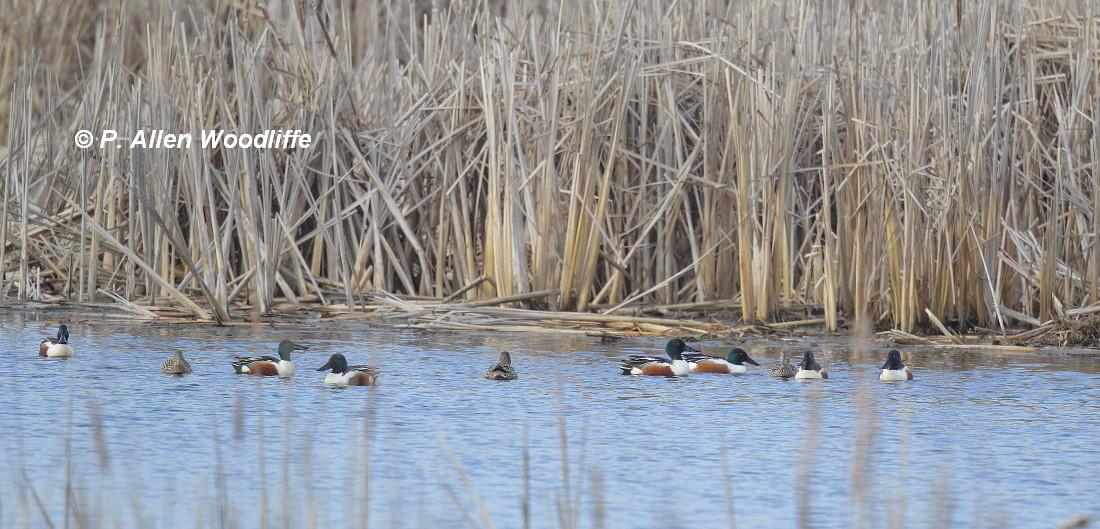
Waterfowl are dispersing and are not nearly as abundant as they were a few weeks ago. However there is still a good variety around, and I always enjoy seeing them in their spring-time finery.
Northern Shoveler
Ring-necked Duck
Wood Duck
Gadwall
 There is always more to see than just birds. I saw my first butterfly of the season yesterday....a Mourning Cloak. It is later than usual. Last year I had a couple of Eastern Comma butterflies in late February!
Photo from a previous year
Some mammals are more visible.
Eastern Chipmunk
Muskrat
Reptiles and amphibians are finally able to enjoy some warmer weather, at least until the weekend. The wet woods at Rondeau were very noisy with all of the Wood Frogs chortling away. Spring Peepers were also vocalizing, although they are so tiny I didn't really have much hope of finding one for the camera.
Wood Frog
 While I was out on one trail, Marie photographed this Leopard Frog on the road.
 I heard Chorus Frogs at Fletcher Ponds today. At the Mitchell's Bay trail today I came across this tiny Painted Turtle, which would have hatched late last summer, walking along the same path as I was.
It has been great to be out these last few days. Hopefully the weekend isn't a total washout, but it will get slightly warmer again next week, with a lot more sun!


Monday, 9 April 2018

Whitey returns

A White-winged Dove in Ontario is an unusual event. They do show up somewhere in the province from time to time. However for a species that is normally not a long distant migrant, and its usual breeding range is limited to southern Arizona, New Mexico, Texas and Florida, to have one arrive in southern Ontario is notable indeed.

This first image was taken of a bird in a creosote bush in southeast Arizona in early 2012.
 The first record of White-winged Dove (WWDO) for the Rondeau checklist area was surprising. Now seeing a WWDO in winter in Arizona is one thing, but in the snow of southern Ontario is quite another. In late January 2013, Jim Burk was the first to notice a WWDO at Rondeau, at the feeder at the Visitor Centre. Needless to say it looked a little out of place surrounded by snow. When it wasn't feeding, it stayed in the sunlight with its feathers ruffled.


The bird disappeared after about a week, and since there had been a Cooper's Hawk seen in the vicinity, it was thought that possibly the hawk enjoyed a southern taste to its normal menu of sparrows and finches more typical of the area. Or the dove had just decided that while some folks from Ontario spend parts of the winter in the sunny south, for a resident of the sunny southern USA to spend part of the winter in snowy Ontario just wasn't to its liking, and hastened back to where it had come from.

No more thought was given to this species until the spring of 2015, when in May a WWDO had been seen by various birders in scattered locations along the east side of the park. It seemed to wander about quite a bit, and was not easy to find. It seemed to have disappeared, or at least there were no reports of it for several weeks. However in late June I re-discovered it along Lakeshore Road close to the Visitor Centre.
Where this bird spent most of its time was a mystery, and it eventually disappeared for good. Or so we thought.

Fast forward to 2016, and a WWDO showed up again along the east side of Rondeau, found by Steve Charbonneau on May 2. It moved around a bit, but was fairly easily found by the numerous birders that were visiting the park during the month of May. It deposited nesting material on a cottage owner's car, trying out both a Toyota Venza and a Lincoln from time to time. It vocalized regularly, but never did attract a mate, not surprisingly. It was around until well into July.
Tight-rope walker
nest material on a Lincoln
On Sunday, April 9 2017, Steve Charbonneau and Blake Mann discovered a WWDO at the same location that it had spent most of its 2016 time at. As usual, it was seen or heard along this same east side of the park, but ventured more regularly to a point farther south where it attempted to place nesting material on the top of a stove pipe. Due to the slope of the top of the pipe and the very exposed nature, the nesting material did not stay in place for more than a short time.


At Mel's place

A single bit of nesting material deposited by Whitey
This time the bird stayed into August.

As the spring of 2018 arrived, local birders regularly checked out the east side of Rondeau wondering if the WWDO would return. On Saturday, April 7, Jim Burk and Steve Charbonneau were looking at the dove in its usual area. It has been seen by quite a few birders in the last couple of days, as it spends much of its time exhibiting the same early season behaviour roaming around the cottage lot community between the Visitor Centre and Dog Beach (beach access #11).


It will be interesting to see how the White-winged-Dove saga at Rondeau unfolds.


Friday, 6 April 2018

Natural Areas of Chatham-Kent, Part 12 (Erieau Rail Trail)

The Erieau Rail or Marsh Trail is another excellent area to explore and it is just a short distance away from the previously described natural area, McGeachy Pond. Both are shown in the following image. McGeachy Pond is the triangular area along the lake in the upper part of the image, and the Erieau Rail Trail is shown as the linear blue line. This is part of the Waterfront Trail system.
 It is sometimes noted as the Erieau Marsh Trail since the trail goes by marshy areas at the edge of Rondeau Bay. The trail is actually on an old railroad bed. The railroad connected Chatham with Rondeau Bay more than a century ago, when at the time it was believed that Rondeau Bay would be an excellent shipping port since it was so well protected from a more turbulent Lake Erie. However it was eventually realized that Rondeau Bay was too shallow for the increasingly large ships so its role as a major shipping harbour quickly fell out of favour. Nonetheless, the railroad bed ended at Erieau, and ships and barges could enter the harbour to that point. The railroad through Erieau was located on what is now a boulevard between the two one-way streets. I remember as a kid, seeing piles of coal which had been unloaded at Erieau. Now that spot is a trailer park and marina for mostly recreational water craft.

The railroad was abandoned several decades ago, and became an unofficial trail for hikers and birders. It was only a few years ago when it became an official trail thanks to many local residents, stewardship groups and the like.

It is notably different from the McGeachy Pond area, with a greater amount of treed area along the trail. That makes it especially good for attracting migrant birds. The following four species of warbler are examples of birds that occur only as migrants. To date there are 194 species of bird that have been recorded here.
American Redstart
Black-and-white Warbler
Blackburnian Warbler
Palm Warbler
There are many other bird species that use it as either a breeding or feeding location.
Eastern Towhee
 A pair of Great Horned Owls are often seen, and occasionally nest in the immediate vicinity.
Great Horned Owlet
Marsh Wren
Swamp Sparrow
Yellow Warbler
The adjacent wetland makes the trail an ideal spot to see water birds.
Common Tern
Great Blue Heron
Red-winged Blackbird
 Some water birds are very furtive, such as the Sora, a member of the Rail group (and therefore fitting along this Rail Trail). They are more often heard than seen, and even when they are seen it is usually only a brief, partial look like this next one.
 On occasion, they can seem to be quite bold. I watched and photographed this one from the observation tower for an hour in 2017, and it was apparently unconcerned about my presence.
A larger and less common rail species is the Virginia Rail.
Part way along the trail is an observation deck, giving excellent views of the adjacent wetland and this corner of Rondeau Bay. This next image was taken from the observation deck. There is a small pond right below the deck, and in late summer one can see a cluster of pink flowers at the edge of the cattails.
 The pink flowers are those of Swamp Rose Mallow, an rare species in Ontario, but relatively widespread around high quality wetlands here in the southwest.
 There is a Wood Duck nesting box at the edge of the pond, but so far all I have seen using it are Tree Swallows.
With relatively little open area along much of the trail, it doesn't seem to have the same diversity and abundance of butterflies like the McGeachy Pond area has. But species that like more wooded areas, such as this Eastern Tiger Swallowtail, and others, can be found.
It is a good spot to find the Eastern Fox Snake, an endangered species in Ontario. While it can be a large snake, well over a metre in length, it is not dangerous. It moves slowly and may vibrate its tail in leaves to sound like a rattlesnake if it feels threatened, but is quite harmless. Even though they are there, the chances of seeing one is not very high.
It is a wonderful spot to see a diversity of wildlife along a relatively short trail, and has many photo opportunities from sunrise on.
Sunrise looking north east from the observation deck