Friday, 12 February 2021

Where there is water, there are birds

 Open water is a significant attraction for many species of birds, especially at this time of year. Just like humans, birds need water to drink, if nothing else. Of course the term 'waterfowl' implies the importance of water to that group, and many open water areas in wetlands and rivers are a great place to find concentrations of them. With the current cold weather, areas of open water are very limited, not surprisingly. The warm water outlet along the Thames River, on the downstream side of Chatham, is very popular with various water birds. I've made several visits there over the past few days. 

 Certainly Mallards are by far the most common, with typically more than a hundred of them in the area.

 Of course with the warm water flowing into the river, it is also attractive to small fish, and that turns out to be a food source for ducks. In spite of the fact that many ducks are primarily vegetarians, when they are hungry enough any source of food and protein is important. I've even seen Canada Geese gobble down the occasional fish!

There is a small number of American Black Ducks, closely resembling a female Mallard but darker and with a greenish, rather than orangey, bill.

A few domesticated Mallards are present, showing a mix of normal Mallard colours but often with patches of white, since they may have hybridized with domestic white Pekin ducks.
One of the most colourful of our native ducks is the male Wood Duck. A pair of Wood Ducks has been present most of the time.
The female woodie is less vibrantly coloured.
There is at least one female Hooded Merganser, the smallest of our three native merganser species, usually around. In the second photo, there is a Mallard close by, giving an idea of scale.

A female Common Goldeneye has been hanging out as well.
Of course there always seems to be a large number of Canada Geese around. Some are on the ice, but a majority of the several hundred individuals can often be seen on the snow-free grassy river slope across the river.
A few gulls may be around, but not always. This next bird is a Herring Gull. A much rarer Iceland Gull has been seen from time to time.
Where there are concentrations of waterbirds, predators of waterbirds may be around waiting for an opportunity to pounce on some unsuspecting or weakened individual. I have seen an immature Bald Eagle, shown next in the trees across the river from this patch of open water, as well as a full adult Bald Eagle flying through or perched nearby.

On a much smaller scale of open water, are some large ditches which are fed by springs. One such ditch just south east of Blenheim often has one or two Wilson's Snipe present, their long bills probing the unfrozen muddy bottom for some morsel.

A little more unusual for the location, is this Northern Mockingbird. It shows up from time to time, and while it likely is feasting on some berries in the nearby bushes, it will come to the water for an occasional drink.
Right nearby where the mockingbird was, this Red-bellied Woodpecker was found. It probably had nothing to do with the water in the ditch, but was more interested in the woodlot close by.

A day or so ago I decided to roam around the former Dover Township, northwest of Chatham. There really isn't any open water readily available given all the cold and snow, so this departs somewhat from the open water theme above. With the landscape almost entirely covered by snow, I really wasn't expecting to see any Snowy Owls. I expect more than one of them saw me, however. But it was still very much a worthwhile time to roam around. I managed to get a few distant photos of a coyote scampering across a field. Being hunted as much as they are, I suspect they are very wary of any vehicle that stops. This individual was probably at least 500 metres away, and although it kept loping farther and farther away, it would stop from time to time and look around. The light wasn't the best angle with the bright sun bouncing off the snow; these are highly cropped.


Another highlight of my roaming around that day was encountering this Merlin perched in a tree. It was a little leery of me stopping the vehicle and pointing something out the window at it, and I only got three or four photos.
I am quite sure that this is the first time I have ever photographed a Merlin!

Closer to home, a periodic walk through Paxton's Bush shows that the resident Great Horned Owls are still around. I'm not sure where they are going to nest this year, as the tree stub they started with in 2020, is not available to them. In case you missed it, you can read up a bit about last year's saga by checking out this. Nonetheless, the owls are still here, although this first photo shows three birds.

Given how close it is to the beginning of the nesting season, and how territorial this species can be, I was a little surprised to see three birds so close together. Presumably the third one might be offspring from last year, and may be learning the ropes for its future activities. Marie and I go for somewhat regular walks to Paxton's Bush, and we will be keeping an eye out for the whereabouts of this nesting location.


Friday, 5 February 2021

Early February jaunts, before the real cold

 It definitely seems more like winter! I got out a couple of times before the forecast for the cold and snow was to arrive, looking for lingering things. The Stefina Line area southeast of Blenheim can be worthwhile, especially if a Wilson's Snipe shows up at its usual haunt in the winter. It hasn't yet, to my knowledge, but other things are around. Northern Harriers can be seen regularly floating over the grassy fields. They usually aren't very close, and with a busy background, are hard to get and keep in focus.


On one occasion as I approached the ditch where the snipe is often seen, I was surprised to see this adult Bald Eagle in a tree at the edge of a woodlot. I only had time for a couple of quick shots, and these were taken through the front window of the vehicle, so they aren't as crisp and clear as I would like. This is the first time I have ever seen a Bald Eagle anywhere near this spot. It makes one wonder if it is looking for a new nesting location, as the Ontario population generally is expanding, so it bears watching.

At another scrubby old field pasture type setting a bit farther north, I sat watching several dozen sparrows coming and going, all the while several raptors were on the hunt for something to eat. Most of the sparrows were House Sparrows, but there were several Am Tree Sparrows and upwards of a dozen White-crowned Sparrows mixed in. This young White-crown obliged me for a minute or so.

I took the opportunity to check out part of Rondeau. It was a nice sunny day, albeit a bit cold and with a brisk northerly wind. Clearly there were other people who had the same idea, as most of the parking lots had several vehicles. I chose to go out the west side of the South Point Trail (SPT), which is a nice walk through the forest and ends up at the lake. There were very few birds, but woodlands are normally fairly quiet at this time of year. Even looking out over the lake produced absolutely no birds in sight. But the shoreline landscape was worth the walk out. 


Lately it has been next to impossible to make one's way through the shrubby tangles and fallen trees along the shoreline. The former South Point Trail is now officially two trails, with one being SPT East and the other SPT West. With the buildup of ice piled along the shoreline, and the north winds which meant the waves weren't crashing on shore, I decided to tackle the challenging shoreline from the west side around to the east. It wasn't easy, but a whole lot easier than it would have been a month ago. Once I got to the east side, I continued up along that side of the SPT, then followed Harrison Trail north to Gardiner Ave and then back to where I had initially parked. It was a total of at least 8 km, and in all that distance, I only came across 6 people going the opposite direction, so physically distancing was easily done.

Upon returning to Chatham, I realized that the Thames River was almost totally frozen, so that made it an easy decision to take a side trip to the water treatment plant where it spewed warm water out into the river. Even in the coldest weather, there is usually an open spot varying in size depending on the intensity of the cold, and that makes it attractive for lingering waterfowl. This first photo, taken a couple of years ago, shows how small the open spot can be, but the waterfowl congregate in large numbers regardless. When they aren't resting on the ice, many can be seen in the water, waiting for a small fish to appear. The fish are likely also attracted to the warm water flow, so it serves the waterfowl well. It does seem a bit odd, however, to see Mallards, normally an eater of grain types of food or other vegetable matter, swallowing a fish!

Mallards are the most plentiful, with typically at least 100 birds. There are a few Am Black Ducks mixed in.

And usually there are a few singles of other species.

Common Goldeneye
This next photo shows the male Wood Duck, which was my primary target for this photo. It wasn't until a bit later that I noticed the duck to the right, which is a female Wood Duck. It always had its head tucked in, so wasn't immediately apparent from a distance.

An immature Bald Eagle flew through fairly quickly, as did a Red-Tailed Hawk, but I didn't get their photo. A Belted Kingfisher is often here, perched within easy sight of the water outlet, waiting for a small fish to appear. But I didn't see one on this visit.

As I was returning home, I had to wait for a stop light near a taller apartment building more or less overlooking the river, and where a Peregrine Falcon was seen regularly last year. The presence of ~150 Rock Pigeons in the immediate area is a readily available food source for this aerial predator, and although it had been reported on one occasion a few weeks ago, I had not encountered it yet. That changed today, as while I was waiting for the light to change, I glanced up at the top of the building and saw it perched on one of the tallest aerials. So I immediately changed plans and got myself located to a spot where I might get a photo. It wasn't close by any means. This first photo, taken with a lens combination at an equivalent of about 14 power binocular, was cropped to the equivalent of about 21X. 

And this is what it looked like cropped to about 110X!


Saturday, 30 January 2021

Northern Bobwhite!

 A few days ago I had a call from someone who photographed a bird in his yard, and didn't know what it was. The description over the phone sounded game bird-like, but there wasn't anything that jumped to my mind other than a female Ring-necked Pheasant. The observer was quite definite that it wasn't a pheasant. The bird had been seen several days earlier, and he didn't have a way of getting the photo to me, so I agreed to stop by in the near future. I did, and he showed me the photo, and it was immediately apparent that it was likely a female Northern Bobwhite!

I used my 'phone to take this photo from the back of Mr. Rivard's camera, just to look at it more closely on the computer at home. It was a female Northern Bobwhite, indeed.


How could it be? Where had it come from? Northern Bobwhite (NOBO) had been recognized as an endangered species in Ontario and Canada for at least a couple of decades. I remember hearing them occasionally on the farm where I grew up, just a bit north of Rondeau Prov Park. In checking the results on the Rondeau/Blenheim Christmas Bird Count, which began in 1939, they were seen somewhat regularly with a few gaps, between 1939 and 1977. In 1944, as many as 89 were observed! More typically half a dozen to a dozen were observed in any given year when they were seen, although the last year there were 32 reported on Dec 18, 1977.

It was a species whose numbers fluctuated considerably over the years, and that was a known trend. According to the account in the unpublished manuscript "The Birds of Kent County, Ontario" by A. A. Wood, it was stated that "in 1892, E. W. Sandys wrote that Quail were plentiful, River Road traversing Howard Township" and in 1896 Sandys stated that "Quail increasing in Southern Ontario near Lake St. Clair after being so nearly destroyed a short time ago."

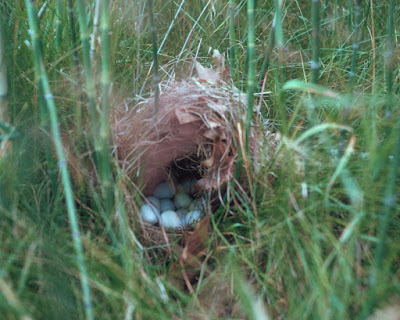
While I was the park naturalist at Rondeau in the 1970s and 1980s, I came across this next photo in the slide files. It is that of a NOBO nest which had been found nearby in the 1960s, and photographed by R. D. "Dick" Ussher, the park naturalist at the time. Knowing how desperate the species was even then, I took the slide with me when I moved into my District Ecologist position in Chatham, and eventually had it scanned. The roundish nest with a dome of grass is quite distinctive.
Woods also described an interesting series of events in 1944, where eight tobacco moth traps had been set out around a two acre field of Burley tobacco. "A count of moths was made July 2 totaling forty-five moths but on July 6 all that remained in the traps was the bits of wings of the moths. The soil was smoothed in front of all trap openings to check for tracks and on the next visit Bob-white tracks were around and in all of the traps. They continued to eat the moths in the traps until July 21. The county seems to be well suited to this game bird but until more protection is given them there is little hope for much increase."

What has contributed to the demise of NOBO in Ontario? There are several main reasons, the first being the loss of good quality grassland. But in more recent decades, other things have factored in, mainly weather. It was in early March of 1976 that a major ice storm hit much of southwestern Ontario, and it was several days before the temperature warmed up enough to melt the ice. In late January of both 1977 and 1978 there were major snow storms. On the one occasion, the temperature started at about freezing, so not a big deal. But then came the rain, turning to snow and then the bitter cold arrived. Temperatures dropped to close to minus 18C. It was a recipe for disaster. I remember hearing about various birds such as crows and starlings dropping dead from their perch due to the rain, snow and bitter cold. With three severe weather events in three successive years, it spelled the end of NOBO in southwestern Ontario, other than at Walpole where at least they had some quality prairie to survive in.

Northern Bobwhite is a species that likes large tracts of tallgrass prairie, and when that isn't available, can adapt to grassland such as pasture or hayfield. And certainly the larger the better. Some people have suggested that the species can do well, or at least okay, in smaller tracts, which have shelter from severe weather by trees, hedgerows, and such. That might be true to a point. However this must just be the case when the population is doing well in the first place. It is important to realize that the main predators of NOBO are things like hawks, foxes, coyotes and cats. Where do hawks perch to search for prey with their incredible eyesight? On trees, which would line the prairie or pasture. Where do most four-legged predators travel as they roam the landscape? Along fence-rows and tree lines. So by forcing NOBO to spend a significant amount of their time in or close by fence-row type habitat, it only served them up as a food source for predators. If they have large areas of grassland, and ideally the native tallgrass prairie, they stand a much better chance for survival. Here are a couple of examples of large tallgrass prairies I've visited in Missouri.

Treaty Line Prairie

Wa Kon Tah Prairie

 Even with grassland, tallgrass prairie is so much better than a pasture or hayfield. To start with it has a greater diversity of seeds and invertebrates to feed on, and just as importantly, many of the grasses in a tallgrass prairie are bunch grasses. This means that the grass grows up in a clump, with the stems at the edge of the clump often falling over, leaving space at ground level for the birds to travel through, sight unseen by aerial predators. With the predominant species of a healthy prairie being made up of up to 75% bunch grass, such as Big Bluestem, the NOBO has lots of ability to travel throughout its territory without much danger.

Big Bluestem

 The only place I have ever photographed NOBO was in Missouri on one of my major forays to that state to explore the fabulous tallgrass prairies there. I had heard them regularly giving their diagnostic Bob-bob-white whistle, but seeing them was not easy. This one was in a leafless, thorny shrub of some type not far from where I parked, but the light was harsh and I couldn't get closer, so this heavily processed and cropped photo is the best I could do.

It was immediately adjacent to the Charles Schwarz prairie, shown below. Clearly this is a huge tallgrass prairie site and it is in very good condition. It is owned by the Missouri Prairie Foundation, which is an amazing not-for-profit organization with the primary goal of protecting and restoring the tallgrass prairie that is particularly well represented in the southwestern part of the state.

 Sadly, it seems that NOBO is almost, if not actually, extirpated from Ontario. Although good sized parcels of prairie used to occur, it is also very productive, so it was converted to agriculture many decades ago. Even pastures and hayfields are declining. The only naturally occurring population of NOBO left in Ontario, at least considering the map of Ontario, is the unceded territory of the Walpole Island First Nation. Even there, in spite of the continued presence of tallgrass prairie, NOBO is not doing well. They seem to have disappeared from parts of the island complex, probably due in part to the expansion of the needs for residential area, the decline in fire which would have kept the prairies in good condition and the increasing presence of predators such as coyote and cats. This site below, which we call Island Prairie, is one of the few fairly large remnants, and it was near here where I last saw NOBO during a visit about 5 years ago.

The observation of a single, female NOBO was described at the beginning of this post. And it still begs the question regarding its origin. Given that the species is not migratory, and the closest population is at least 15 to 20 kilometres away in a straight-line direction at Walpole, it likely didn't leave the best quality habitat there to arrive at the edge of a small village community surrounded by intensive agriculture. NOBO is sometimes kept as a game bird in private collections, and some in the hunting community even raise and release birds for hunting purposes. I am not aware of anyone in the immediate area doing this, but it could be happening. So it is likely that this is either an escaped or released bird, and in its wanderings ended up at Mr. Rivard's yard, at least for a few minutes, and it has not been seen since.


Tuesday, 26 January 2021

(Mostly) Bird highlights of late January

 Since winter hasn't gotten all that vicious yet (and hopefully won't get too vicious!), there are still birds around. Some which you expect, and others that definitely aren't normally here.

Water birds are the most likely to be found. Along the Lake Erie shoreline, flocks of ducks are regularly noted flying by, usually well out of camera range. Mergansers, bot Common and Red-breasted, are still around in good numbers, as are some scoter species.

Common Mergansers
Most Wood Ducks are long gone by now, but this one is hanging around the Thames River with several dozen Mallards, feeding on things that people put out for them on the river bank.

A water bird that really shouldn't be here, but four of them were still around a few days ago, is the Great Egret. When I was out to the Jeannette's Creek boat launch on the weekend, I saw not one, but all four of them. Three were together, but one left when I stopped the vehicle, with camera in hand.


I caught up to the fourth one a little way down the mostly frozen canal.

Snowy Owls have become more reliable in the last dozen or so years. It used to be quite a novelty to see even one other than in an irruption year. At least in the former Dover Twp, it isn't all that hard to find at least half a dozen on any given day, as long as the landscape remains fairly snow free.


Still on the subject of owls, I roamed around the Blenheim Sewage Lagoons yesterday to see if I could scare up a Short-eared Owl that had been reported from time to time. After a lot of walking to check the berms and grassy fields, I did literally scare one up. And immediately the crows in the area noticed, and began mobbing it. The owl climbed higher and higher and eventually I lost sight of it. Due to the heavy overcast, I only got a couple of record shots, shown here, and even these have been greatly processed and then cropped to the equivalent of about 85X.

These three muskrats didn't have to worry about the owl or the crows, it seems, as they were busily feeding on some vegetation at the edge of one of the cells.

Roaming around Rondeau hasn't been especially birdy lately, although it is still great for a nice vigorous and refreshing hike. As in previous visits, one sometimes is lucky to see more than one species per kilometre of walking. But on occasion, one will encounter a flock of sparrow types which are worthwhile checking over carefully. Most will be American Tree Sparrows, but sometimes a lingering Chipping Sparrow or Field Sparrow will be mixed in. I came across a couple of different flocks of sparrows in the park, and each one had two or three Field Sparrows, as in the following photos.

Next up, I plan to feature Northern Bobwhite!