Saturday, 9 October 2021

Gorgeous Rare Hummer!

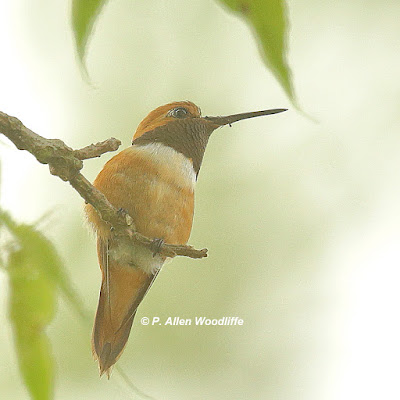
A few weeks ago, I was told of a male Rufous Hummingbird visiting a feeder in southwest Chatham-Kent. This is the first record for C-K.

Rufous Hummers are gorgeous birds, as the photos show. They are one of the most common species in western North America, but do meander to the east on occasion when in migration.

According to the eBird database, there have been no more than 20 known sightings anywhere in Ontario, and only about 5 in the last decade. They have shown up in various locations from western Ontario to eastern Ontario, but sometimes only for a few hours. Many of these migrant wanderers are less colourful or distinct first-year birds, or females, and on occasion some that have been reported have taken a bit of time, with analysis of photos, to determine if they are in fact a Rufous or a hybrid or some other species which is also in a less distinct plumage. Such was the case when one showed up in the Kingsville area several decades ago, which was the first time I had seen this species in Ontario. Therefore many birders have never seen this species in Ontario. Based on the occurrence of other rare hummingbirds when they show up at a reliable feeder, the deluge of birders could be overwhelming. With the quite challenging logistics of any public access to this location, it was the consensus of the first finders and the landowners not to make it publicly known. I'm not even sure how many actually saw it, but there were very few, so I consider myself quite fortunate.

On the day that I ventured out to see this bird, I had a brief and encouraging chat at the very long road entrance, which wasn't much more than a narrow lane way through an agricultural field, with one of the home owners. Sure enough, within minutes of arriving and getting my camera gear ready, I heard the distinctive sound of hummingbird wings. But it wasn't the Rufous hummer. It was one of several Ruby-throated Hummingbirds that were also trying to feed at the feeder. However the Rufous hummer would not have it, and immediately after hearing the wings of the Ruby-throat, the Rufous hummer zipped by almost within arms reach to drive the other hummer away. After successfully doing so, it would perch half way up a nearby walnut tree, constantly on the lookout for any competition. This happened steadily while I was there, and was told by the landowner this was its normal behaviour. Due to how high up the Rufous hummer was while on the lookout, how short a time it would perch before taking off after another hummer, not to mention the back lit conditions, it was difficult to get a decent photo. This is one of the best ones. I used the Canon 5D3, the 500mm telephoto plus 1.4X teleconverter, and cropped the photo to the equivalent of about 65X.

At times it would totally disappear, chasing a Ruby-throat somewhere out behind the house, and on occasion I saw it rest in another more distant tree. Or on a cable entering the house. But always just for a few seconds before dashing off again.


I didn't bother trying to track it down when it briefly disappeared. I decided that this particular feeder was where most of the action was, and so just hung out nearby hoping that I could get a few good photos in the almost perfect light conditions. And it worked.

After it successfully drove off one of the Ruby-throats, it would sometimes stop by the main feeder for a few sips before returning to its walnut tree perch.

The bird was only present for a few days, and as far as I know, there have been no further reports of it in Ontario. Hopefully it made its way to its winter haunts hundreds of kilometres south of here. Once it was gone, it was possible to share the experience and photos, finally.

It was quite a busy and fun experience!


If you want to subscribe, or unsubscribe, to Nature Nuggets, email me at prairietramper@gmail.com


Sunday, 3 October 2021

3d outings, Nelson's Sparrows and waterbirds

 First of all, I must apologize for not responding to some of the comments that readers have left on the past few posts. For some reason unbeknownst to me, this blog site periodically goes into a funk, and even though I can post blogs and comment on other's blogs, it does not allow me to reply to comments on my own blog! It will eventually straighten around. At least it always has in the past.

On to this post. 

There has been quite a mix of weather these last few days, ranging from wonderful sunny, bright, comfortable days to what I call 3d days: dull, damp and dreary days. I've been out in all types. Sometimes I choose to go out on a 3d day, as I know the places I want to go will not be crowded. On a couple of those that occurred recently, I went for a long hike at Rondeau. On one of them I didn't even take my camera with telephoto lens, just the camera with a short zoom lens. And also an umbrella.

Some readers will be familiar with the term 'forest bathing'. It is becoming more popular, although it is not a new type of outdoor experience. While some attribute it to an experience first developed in Japan in the 1980s, in reality it has been going on for a lot longer than that! I expect that the intensely driven nature of Japanese society to be productive following the war, might have caused some to realize the dangers in such an intensively driven society, and thus realized the benefits of spending relaxing time in nature. But the reality is that humans have been finding comfort, relaxation and inspiration, and therefore many health benefits, for centuries. It just wasn't called forest bathing.

I have been doing it for decades. I intentionally choose places where I am least likely to encounter other humans, especially if there is a lot of human activity on a nice day. 3d days are ideal. One can walk along at a very leisurely pace, soaking up the ambiance of the quiet woods. Or one can go along at a brisk pace, stopping along the way when you want, but getting good cardiovascular benefits as well. If one is out for long enough, both brisk and leisurely time can be done.

I typically try and get about 5-7 km in a walk of this type. Sometimes hiking this far or longer on a 3d day I might only encounter 2-3 people, and then only briefly as the cyclist is going the other direction. As mentioned above, I have been out to Rondeau a couple of time with this in mind. On the occasion when I didn't take my long lens, the only photography I did was to capture the quiet greenery of the forest.


Without focusing on birds, one may notice some of the other inhabitants of the forest. While some might consider them 'lesser' inhabitants, I don't, as they all contribute in the way that they were intended, and without them the conditions of the forest might be quite different!


Fringed Gentian

New England Aster

 Some, unfortunately, will not be around anymore, but the scavengers and decomposers may get some benefit.

Northern Watersnake

On other occasions, I have taken the telephoto lens with me, and encountered scattered flocks of migrant birds. Under the shaded canopy, and with numerous leaves to contend with, getting good photos is not easy. Most photos ended up in the deleted file.

Blue-headed Vireo

Black-throated Blue Warbler
Most of the migrants are busily, even frantically, feeding on whatever they can find, to gain enough energy to continue on their southward journey. Sometimes they get into some rather unconventional positions in their search, which may or may not end up successful. This Black-throated Green Warbler was getting into all sorts of positions looking under the leaves for a tiny morsel of something.

There are lots of berries still clinging to the shrubs and vines that produced them. Dogwoods, Viburnums, Wild Grape and Virginia Creeper are some of the most abundant berry producers, but the one shown next is that of Winterberry, not a very common species here at all. While it likes to grow in damp locations, which there is a lot of at Rondeau, I only know of it occurring in about three locations. These berries seem to be popular, and will not last long with all of the berry-eating migrant birds passing through these days.

On another occasion, Marie and I spent some time hiking the Mitchell's Bay North Lakeshore Trail, and also the southern trail. I find the north trail a bit more enjoyable, as it is less busy and with better view points to appreciate what is along the trail. Parking can be a challenge, however. Very few people, even birders, explore this trail. Nonetheless, almost 140 species of birds have been recorded here.

The trail has been upgraded in the last year. It was closed for most of a year, due to high water damage of the dyke much of it is built on, and this visit was only the second one of the year for me. The trail has had a good layer of crushed stone on it, with one part of it leading to a slightly higher viewpoint looking over Lake St. Clair and the south end of Walpole Island First Nation. There is even a picnic bench at the end, to make spending time at the viewing point more comfortable. Thanks to the municipality of Chatham-Kent for maintaining these trails!


One often will see Great Egrets here, not surprising since there is at least one sizeable nesting colony at Walpole.

Ospreys don't nest anywhere nearby that I am aware of, but given that it is their time to migrate, birds passing through will make use of the watery environment from which to catch their next meal, as this one has done.

As long as there is open water, one will almost certainly see anywhere from one to several dozen of the non-native and problematic Mute Swans.

The Keith McLean Conservation Lands just north of Rondeau continue to be productive for birds. While the water levels are down from the past couple of years, at times migrating shorebirds and others make good use of the more limited flooded field habitat. I have stopped there a couple of times as well, and had good success at finding and photographing some of these migrants, including:

American Golden Plover

Greater Yellowlegs

Lesser Yellowlegs

Stilt Sandpiper
Long-billed Dowitcher

 Long-billed Dowitchers are not common, but show up annually in small numbers, at least for a few days. I came across two birds on my second last visit.


 Up to a dozen Hudsonian Godwits dropped in for a short time a day after one of my recent visits. Most left, but at least three remained, and on a subsequent visit, I managed to get a very distant photo of them. It is highly cropped. The godwits are to the right of the smaller, single Killdeer, with their heads down feeding in this photo.

Great Egrets are regularly found here as well, although not usually very cooperative at close range.

Turkey Vultures pass through daily right now on their migration, with some sticking around for a short while.

On my second last visit, I saw some small sparrow types that I suspected could be Nelson's Sparrows, but they were furtive and I never got conclusive looks at the. Other birders were there the next day, and confirmed seeing several. As a result, there has been a fairly steady stream of birders spending time here to search for them, and as far as I know, always with some success. Since I was going to the park for some black lighting last Friday, I went a bit earlier to also search. The soybean field along the natural area had been harvested, and the weedy edges along that field that seemed to attract these shy, elusive sparrows, was gone. Fortunately there was enough habitat elsewhere, and in a more concentrated area, to keep the sparrows from moving on. I did manage to see not one, not two, but eleven Nelson's Sparrows! It was a breezy time, and since the birds didn't sit atop the vegetation for their views, they were always a little lower, and with the wind blowing the weedy vegetation back and forth so steadily, it was difficult for the camera to lock focus in time for a clear photo. This first one is one of the 'better' out-of-focus shots I got. Many others were quickly deleted.

Fortunately there were a few photos that I was pleased with.

This next one has two birds, with the front one being in relatively good focus, but partially obscured by vegetation. Another bird is in the blurry background to the left.


I was definitely more satisfied with the results this time. Last year, while there weren't quite as many as far as we know, I did not get a single photo that I was pleased with.


If you would like to subscribe, or unsubscribe, to Nature Nuggets, send an email to: prairietramper@gmail.com


Saturday, 25 September 2021

Forests vs trees vs...nothing?

 This past week, September 19-25, was National Forest Week. There is no question that forests are important as part of the Canadian landscape. But to travel through most of Chatham-Kent (CK), one would not recognize forests as being important at all. CK has about the lowest amount of forest cover of any municipality in Ontario, at about 3-4%, and that is being generous. Some people consider any tree cover, such as recent plantations and hedgerows as legitimate forest, but that is really stretching it. Even much of the real forest cover that still exists in CK is not in great condition, as water tables have been altered, they have been influenced by agricultural chemicals, there has been the arrival of invasive species, almost every woodland has undergone some logging, some of it heavy, etc.

A good quality forest has a tremendous positive impact on the local, and even more distant, environment. It stores water, preventing flooding and keeps harmful chemicals out of things like the Thames River and water bodies downstream, all of which are sources of drinking water for parts of the human population, not to mention the better quality water that the natural wildlife requires.

Residents of CK and adjacent municipalities might have vivid memories of the most recent serious flooding which took place in February, 2018. These photos were taken from the general down town part of Chatham.


Forests reduce soil erosion, with the top layer being most important for crop production and thus reducing the extra costs of adding artificial fertilizers, part of which will wash away into the downstream areas thus negatively affecting water quality. Soil erosion is a serious problem. Here is an example of severe erosion which happens all too often: a tilled field, with a bit of snow on top and then covered with wind-blown soil from a nearby field.

Forests are also important for storing significant amounts of carbon, which helps alleviate increased temperatures associated with climate change.

The lack of forests obviously has a huge impact on our native wildlife. Southwestern Ontario has arguably the greatest biodiversity of native flora and fauna in Canada, even in its present state. But many of those species are rapidly dwindling. The greatest number of species at risk occur here in the southwest, in part because there are relatively few places for them to occupy.

In recent years, there has been a lot of effort by local people in CK to try and get a Forest Conservation By-law in place, to protect the remaining woodlands and prevent scenes like this.

 But it has been met with lots of opposition by a few landowners who don't want anyone to influence what they can do with the woodlands on their land. Some landowners are really good stewards of the natural resources they have, and credit should be given for their efforts and foresight. However the ones most vocally against such a by-law are apparently more interested in short-term profits than the long-term benefits of woodlands. Admittedly if the local council had put a by-law in place decades ago, like the majority of other southern Ontario municipalities, there would be more woodlands in CK and so the responsibility would not fall on those landowners who still have some.

I'm not against agriculture. I grew up on a farm in CK, and I get it. And I am not suggesting that landowners should bear the brunt of maintaining woodlands totally. If it is good for the community, then the community should ante up support to relieve any financial pressure on the landowners. One of the reasons that remnant forest are even more valuable nowadays is because so many landowners of yesteryear got the jump on the action, removing many hectares of forest since settlement.

There are some who have taken it upon themselves to plant trees, either as a hedgerow or even taken out some perhaps less productive farm land and put in a plantation. While these are useful, they are very small steps towards maintaining quality woodlands.

One must consider the huge differences between planting say, 5 acres of trees versus retaining a 5 acre woodland. There really is no comparison, and won't be for decades, even centuries. It is even hard to know where to start when considering the differences. But consider the following.

A good quality forest will have:

  • high diversity of tree and shrub species

  • impressive displays of spring wildflowers


Long-spurred Violet

Large Yellow Lady's-slipper

White Baneberry

  • interior forest, meaning they will have good forest habitat a minimum of 100 metres from any edge. Some knowledgeable bird specialists maintain the minimum distance should be 200 metres. There are forest interior bird species that will not nest in any forested habitat that doesn't have interior forest, and also there are edge species of birds such as Brown-headed Cowbirds, which lay their eggs in other species' nests and out-compete the other nestlings. More on this may be the topic of another blog.
Acadian Flycatcher, an Endangered Species

American Redstart, an interior species


Scarlet Tanager, primarily an interior species
  • large trees interspersed with younger trees.

  • natural variation in the topography, resulting in parts of the woodland being upland and a bit drier, and other parts being a bit lower resulting in lowland forest habitat. This increases the diversity of the forest and creates water retention areas and habitat for other species such as reptiles and amphibians.

Blue-spotted Salamander

  • fallen trees. Decomposing trees laying on the forest floor for a decade or more are known to host many more species of flora and fauna than a healthy, standing tree.

  • fallen trees where their roots have been ripped up, leaving a shallow depression in the soil where the roots once were. These shallow depressions serve as important small habitats for things like amphibians and insects to survive. They also hold water for nearby plants to tap in to when they need it.

Eastern Grey Treefrog

  • a good diversity of fern species. Ferns seldom grow in a poor quality forest, and especially not in plantations.
  • standing dead trees, important for numerous insects which are critical in the decomposition process, and are in turn important for woodpeckers as a food source. Such trees in the earlier stages of death and decomposition are also good for nesting cavities for species such as woodpeckers, and other birds such as Prothonotary Warblers and Great Crested Flycatchers which may nest in these cavities when the woodpeckers are finished with them, or owls that use them for roosting in.

Pileated Woodpecker


  •  a good diversity of fungus. Most people don't pay much attention to fungus, unless they are really vivid and colourful, but any fungus you see above ground is usually short-lived. The fungus you see above ground, or growing on a fallen log, is just the 'fruit' of the rest of this plant. Most of the fungus is below ground, greatly involved in the decomposition of whatever it is growing on, recycling the nutrients into small enough elements so that other living things can use them. The below part of the fungus is made up of tiny threads called mycorrhizae, which are not only connected to dead plant material as they decompose it, but also to many of the living plants such as trees, and are a tremendous source of food for living plants. Without fungus, most trees, shrubs and wildflowers would have a much more difficult time to even survive, let alone thrive.

Chicken-of-the-woods


Turkey-tail

Overall, the greater diversity of flora and fauna there is in a woodlot, the more stable it is, and will be more able to withstand the difficulties it must face over the years, whether it be an invasive species infestation or extreme weather conditions.

 This certainly has been borne out with examples of plantation planting in CK and elsewhere. In the last century or so, there have been many plantations established in southern Ontario. Most were planted as conifers, such as spruce or pine, especially if they were on the more sterile and well drained sandy soils. The spruces used were not naturally occurring in southwestern Ontario, but were a good start in some ways. The spruces were used as a 'cover crop' essentially until native hardwood species might arrive and become established many decades later, if there was a naturally occurring source of seed nearby. In the 1980s, local forestry staff thought that skipping that 'cover crop' stage and directly planting native hardwoods, such as ash trees, would speed up the process. It was a great idea and initially had some success. However most readers will know the longer term outcome. The non-native Emerald Ash Borer (EAB) arrived about two decades ago, and quickly killed most ash trees in southwestern Ontario. It has now reached more northerly and easterly parts of the province.

Here is a recent photo of an ash plantation that was established in about 1989. While parts of it are still alive, with ash trees that suckered after the main stems were killed by the EAB, and nearby tree species started to come in, it is anything but a good looking plantation and likely never will be, assuming it lasts for another century or more. I know of other ash plantations planted at the same time which suffered heavy damage by the borer and were completely removed and turned back into an agricultural crop on the poor quality soils.

Here is an example of another plantation effort in CK also established in the 1980s, this time of Black Walnut.  Clearly they are still alive, and haven't been affected by an invasive insect such as the Emerald Ash Borer. Maybe this plantation will survive. Some people would consider this as part of the 3-4% forest cover in CK, and from an aerial view, it does sort of qualify. But as a good quality functioning forest? Not even close!

The trees are fairly uniform in size due to their similar age. The diversity is non-existent, as it is a single species planting, although it is native. What is really telling is what is growing under the tree canopy. It is primarily, if not entirely, made up of non-native species, with a lot of grasses. While some of the visible wildflowers may be pretty, they are Purple Coneflower, a tallgrass prairie species not native to Ontario. And herein lies the problem. Precipitation is taken in primarily via the roots of the trees. Grasses create a dense sod, and intercept most of the precipitation before it gets to the tree's roots. depriving the trees of needed moisture in which to thrive. Although the trees themselves are around 35 or more years old, most of the trunks are spindly for their age. They have not grown anywhere close to their potential given the full sun and no competition from other tree species. It will take many decades, even centuries, if ever, for this plantation and others like it, to even begin to look and function as a forest. And with the current high value placed on Black Walnut for the furniture industry, chances are it will be cut down in several decades, assuming the trees will get to merchantable size.

One of the most difficult things for a plantation type forest to overcome is the lack of critical mycorrhizae in the soil, a very important but fundamentally necessary component of productive soil as described above. Years of agricultural disturbance, from annual tilling, compaction of soil due to heavy equipment as well as the addition of chemicals, whether they be fertilizers or for weed control, have destroyed the mycorrhizae.


 The only responsible solution is, for starters, to protect and retain the limited forest habitat still surviving in Chatham-Kent. Plantations adjacent to these forests will have a much better chance at becoming functional decades before a stand-alone plantation, as the seeds from the functioning forest will gradually enter the plantation. Will the current elected officials decide on a Forest Conservation By-law that is in the best interest of all citizens as well as the numerous species of flora and fauna that are struggling to survive in these habitats? Or will they capitulate to a small number of individual landowners in opposition to such common sense, as so many of their predecessors have done in the past? Only time will tell.


 If you want to subscribe, or unsubscribe, to Nature Nuggets, email me at prairietramper@gmail.com