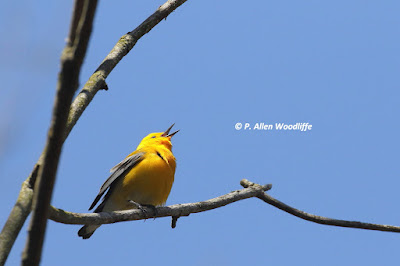
I think it is safe to say if there was an iconic Carolinian bird species, the Prothonotary Warbler would certainly be right at the top of the list for consideration. It certainly would be for Rondeau. I have had several birders over the years state that when they think of birds and Rondeau, the Prothonotary Warbler is always first in their thoughts.
There are likely several good reasons for this:
-they are a colourful and relatively tolerant species;
-they nest down low, seldom in natural cavities more than 3 metres (10 feet) above the water, so are easy to see;
-it was first discovered nesting in Canada at Rondeau, back in the early 1930s, by none other than Jim Baillie, the highly regarded ornithologist from the Royal Ontario Museum;
-Rondeau has always been the stronghold for this species in Ontario and Canada, not surprising since when the conditions are right (a reasonable water level in the slough habitat it prefers) there can be as many as 50 kilometers of linear habitat, which is a lot of space for whatever birds make it to this side of Lake Erie in the spring migration.
I have been on the hunt for Prothonotary Warbler (PROW) since the early 1970s when I first started working as a naturalist at Rondeau. I recall that there wasn't necessarily any one place to find them, as there was so much habitat for them throughout the park. There were lots of rotting stubs with suitable nest holes, presumably created in the past by other birds such as woodpeckers. It was always a treat to find a nesting pair, and I had the opportunity to work with another bird photographer and set up blinds to photograph these colourful birds. It was very pleasing to see how tolerant the birds were, as sometimes when we were setting up a portable blind on a short platform to get the best angle, the birds would continue to carry on their normal activities coming and going, feeding the young, even before we were all set up. And once I was in the blind, it was quite captivating to watch and photograph them.
There were many satisfactory nest holes, no nest boxes back then, so it meant a little harder to search and find an active nest. Certainly their relatively loud, distinctive song helped to locate them. Here are a few nest shots from back in that day, all of which were taken on slide film, of course, and scanned digitally.
This next one is one of my favourites of that era, and the curling bark of the Yellow Birch stub that it nested in certainly added to the appeal. This photo was used for several years as a cover shot of one of the park's newsletter series that came out 4 X a year.
One could capture all kinds of poses and interactions. It was photographing a nesting PROW pair that remain some of the highlights of those years.

This all took place before it was legally endangered, and there was no PROW Recovery team in place. Eventually there was a recovery team, and I was on it for many, many years. But before that time, I knew that more information was necessary to know about this incredible species. In both 1982 and 1983, I took it upon myself to undertake some unofficial PROW surveys. I concentrated on the best available habitat, following many ridges mostly south of Gardiner Avenue. In both of those years, I tallied about 23 or 24 pairs or singing males which may or may not have been mated. I barely covered about half of the good habitat, and I knew from previous experience that they would nest in areas that did not fit the normal description of what constituted good habitat. I therefore concluded that there could have been as many as 40-50 pairs of PROW at Rondeau at that time, an incredible number even back then. Nowadays, it is highly unlikely that there are even a dozen pairs at Rondeau. There are several reasons for this, including:
-a decline in some of the best habitat in the park, due to the ongoing expansion of invasive Phragmites taking over some areas;
-the weather patterns have been less conducive in quite a few recent years, failing to bring the push of southern species to southern Ontario during the peak of spring migration. There have been northeast and east winds all too often during mid-May, rather than the southwesterly winds which are more likely to bring southern species this far north;
-a loss of good wintering habitat. When I visited Costa Rica on four occasions in the late autumn and winter periods of late 1980s and very early 1990s, I always found PROW in the coastal mangrove swamps. However even over the course of those four years, I noticed a concerning trend: coastal mangrove swamps were regularly disappearing, being filled in to build large touristy hotels. Even though I have not been back in over 40 years, I expect that trend has continued, and without suitable wintering habitat, the PROW had to go elsewhere into likely less suitable habitat.
One of the things that certain members of the PROW recovery team strongly recommended was to provide nest box habitat. It was felt that the existing natural cavities in some areas were being dominated by House Wrens and Tree Swallows. That did happen to some extent, but I always felt that at Rondeau there were far more natural cavities available, and nest boxes were not necessary. I did not agree with the push for nest boxes, and I did not want PROW to become another Purple Martin type, which only nests in artificial nest structures such as Purple Martin houses anymore. But I was only one vote.

Certainly there might be some advantages of nest boxes. They can be placed in locations that are fairly visible, to enable birders to have the pleasure of viewing them. Also they can be maintained by staff, to be certain of a suitable nest cavity from one year to the next. They can be cleaned out and made suitable from one year to the next, and surveyed to get a handle on how many pairs there are. At least where all the PROW uses are nest boxes. At any rate, there has been a general acceptance of nest boxes.
I have had no trouble catching up with one or more pairs of PROW over the years at Rondeau. One of the main and relatively easy locations to be guaranteed to find them is along the Tulip Tree Trail, and certainly that is one of the most popular trails for birders in the spring, because with a little bit of patience, the sighting of a PROW at a nest box is almost a guarantee. And at times, they can be quite cooperative, at least for a short time, enabling a prepared photographer to get some quite satisfying photos. Here are some I have taken over the years, all since the era of my digital photography.


Things didn't work out quite the way I had hoped in 2023. Certainly there had been periodic reports of them along the Tulip Tree Trail, but not consistently. There were periodic reports of them at the sloughs along Bennett Ave as well. But in spite of the many times I was in those areas during the peak of migration and the beginning of the nesting period, sometimes waiting patiently for them for a fair length of time, it got to the point that I thought this might be the first time in almost exactly 50 years when I would be skunked in my attempts to see this iconic species.
I was on my way back to the parking lot, after having tried again along the main slough of Tulip Tree Trail without success, and just as I was approaching the last boardwalk, the loud, ringing song of a PROW reached my ears! As I cautiously approached the boardwalk crossing the slough, there was a male sitting up on a dead branch in plain view, singing his heart out! And just a short distance away was a promising looking nest hole in a dead Fraxinus stub, a mere 10 metres or so away. Within a short time, a female popped out! I was ecstatic! And in a matter of minutes, the female returned, but popped back in so quickly it was hard to get a photo.
Although there was a crew of staff monitoring the nest boxes in various sloughs of the park, for some reason this nest had completely escaped their notice. I suspect it was because it seemed to just become occupied a little later than normal, in the third week of June rather than the typical nesting period beginning in the second or third week of May. Perhaps this pair had been ousted by a House Wren or Tree Swallow in the area they had initially attempted to nest at, and relocated here. We will never know, of course, but it certainly was exciting to find this pair so accessible.
Over the next 2-3 weeks, I visited this site at least seven times. On
one occasion the male was so cooperative that I took almost 150 shots and could have taken a lot more.
And on other occasions I took upwards of 50 shots. Never had I had such a
fine setting, with the male especially so cooperative, even as I stood
on the boardwalk just a few metres away. At times the bird was so close I had to back my zoom
off, just to get him all in the frame. I won't include the well over 200
photos I have on this post, but here are some of my favourites.
On occasion the male would bring something for the female to feed on while she was busy incubating.
He spent a lot of time singing, advertising his territory, and occasionally defending it from a Downy Woodpecker or Eastern Wood-Pewee.
Although he hadn't just come from having a bath, based on how nicely his feathers were arranged, he clearly spent a lot of time preening in between singing.
Sometimes he was so busy preening that he wouldn't sit still. I confess I tried to make a little chirping sound once or twice, just to get his attention, and then he would peer over at me for a second or two, just to see what I was up to.
This next one is probably my favourite of all, which I have had printed up on a 16" X 16" canvas print, and it looks amazing.
At times either the female or male would withdraw from the nest cavity with a fecal sac in its beak, of course confirming that the nestlings were growing.
Eventually when the young had hatched, he spent more of his time bring food to the nestlings.
I was hoping to be there when the young finally left the nest, but missed out on that event. But there is no question that this overall experience with Rondeau's, and indeed the Carolinian Zone's, iconic bird, was a highlight, and overall probably the best experience I have had with this species.
If you would like to subscribe, or unsubscribe, to Nature Nuggets, send an email to: prairietramper@gmail.com