Wednesday, 4 October 2023

Birds, birds, birds (mostly)

 There have been some quite satisfying bird photography opportunities lately. The unseasonably mild weather has likely contributed to the birds that had recently arrived, to stick around a little longer.

I've made several stops at the Blenheim Sewage Lagoons, where shorebirds and others have been fairly diverse. One of the ongoing highlights was one or more Wilson's Phalaropes that have been seen most often in the sprinkler cells.


It is a regularly occurring species, both spring and fall, but not always easy to catch up to with the camera. At first it can blend in with the abundant Lesser Yellowlegs, although a closer look shows that it is a bit smaller, has duller yellowlegs, a finer bill and generally for its size, looks a bit chunkier. Plus it has a whiter, breast area.

As rare as it has been for quite a few years, it has been recorded nesting here. That was back in the late 1970s or early 1980s, when the maintenance of the berms wasn't quite what it is now, and a pair of them nested successfully on at least one occasion. I was able to photograph it from a blind at the time, as shown in the next photo. 

For a bit of comparison, here are two of the yellowlegs species. The Lesser Yellowlegs, the three closest birds to the camera, are smaller than the Greater Yellowlegs which stands taller, is chunkier and has a heavier bill.

When you see them individually rather than side by side, especially if they are at a bit of a distance, it should cause an observer to take a more careful look to decide which species it is.
Greater Yellowlegs

Just to add a bit more of a challenge is when a Solitary Sandpiper is seen nearby. Upon first glance, especially at a distance and not in ideal light, it may appear to be similar to a Lesser Yellowlegs. But a closer look reveals the white 'spectacles', a slightly heavier bill and legs that are at best, a dull yellowish green. They never seem to be traveling in groups of any size, just one or at the most two at any time, which adds credence to the name 'Solitary'.


Other shorebirds that I have photographed at these lagoons recently include these Pectoral Sandpipers,

...and the even smaller Least Sandpiper. This first year bird is distinguished by it rufous back feathers and greenish yellow legs, the latter of which are somewhat visible in the first photo....
....but since they are often in deeper water, the colour of the legs is not always visible. The fairly similar Semipalmated Sandpiper (not shown) is a bit bigger than the Least, and has obviously black legs.
Dowitchers are periodically seen, although not often very abundant. At this time of year, it is typically the Long-billed Dowitcher. Not that the Short-billed Dowitcher has a much shorter bill; the lengths can sometimes overlap. But the Long-bill shown here, has a less barred flank, and grayer tertial feathers most obvious on the lower back when it is not in flight.

Here is a comparison with the Long-billed Dowitcher standing between two Lesser Yellowlegs.

Generally speaking, shorebirds are fairly tolerant of one or two people looking at them, if movements are slow and methodical. However when something like a Northern Harrier or Peregrine Falcon swoops by, the shorebirds will get quite lively and scatter. 

Northern Harrier

Peregrine Falcon

 Sometimes the shorebirds will return, but often they will settle down at another part of the lagoon complex. Given that there are lots of raptors migrating at this time, I expect that some of them are hoping for an easy meal, but at other times, are just practicing their hunting skills, especially the first year birds.

The waterfowl diversity is increasing as well, and on my last visit I came across a small number of Redheads at the lagoons, the first time this autumn season.


A visit to the Erieau Marsh Trail gave me the opportunity to see a few birds, but photographic opportunities were few. An Osprey was seen feeding on a fish in a distant tree....

....and a Northern Harrier cruised by, presumably hoping to scare up some small bird it could catch.

A couple of Great Blue Herons were feeding, or trying to stave off the unseasonably warm heat.

The same bird as above, was sometimes in this position. I am not sure whether it was trying to cool off, or more likely, giving the sunlight a chance to clear its wings of any little critters hunkered down in the heron's feathers.
A little farther along, this heron spent most of its time with it bill open, and breathing hard it seemed.

A visit to St. Clair NWA wasn't overly productive from a bird photography perspective. There were lots of Canada Geese in the air, as usual.

In some of the shrubbery along the trail, there were lots and lots of small birds, including a couple of Eastern Phoebe....
....numerous sparrows of different kinds, including Song Sparrow,  Swamp Sparrow and my first of the season White-throated Sparrow and White-crowned Sparrow.
Song Sparrow
Another flycatcher or two was seen, but not heard. I ended up calling it a Trail's Flycatcher, which is a combination of Willow and Alder Flycatcher, which are very difficult to separate unless they are singing.

There were not many warblers that I saw, but this Yellow-rumped Warbler popped into view for a short time.
A pair of Sandhill Cranes came by and landed in the marsh....

...but a short time later, decided to move elsewhere.
 With the warmth, it resulted in a few butterflies flitting about, such as this Eastern Comma.

Leopard Frogs were abundant, with a couple of dozen or more hopping along or across the trail.

I often include a visit to the Mitchell's Bay North Lakeshore Trail after a time at the SCNWA. There were the usual things.

Great Blue Heron

Great Egret

Ring-billed Gull
A European Starling posed for me.

A bit of a surprise was to see about 150 Tree Swallows, busily foraging over the shoreline vegetation or settling onto the branches of a dead tree. This photo shows a very small number.

While I was watching, a Merlin came flying past, scattering the swallows in every direction. Some returned, but not many.


If you would like to subscribe, or unsubscribe, to Nature Nuggets, send an email to: prairietramper@gmail.com



Thursday, 28 September 2023

A bird with the aerial view decides to nest

 Nesting Mourning Doves in southern Ontario aren't uncommon at all. But the timing for this one, the chance to photograph it from start to finish, and from the comfort of air conditioning over the course of those mostly hot and humid days of August, gave the opportunity to create this post.

 This pair didn't even start to build their nest, as sparse and flimsy as it was, until early August of this year. The vast majority of bird species have finished their nesting cycle weeks earlier, and some have even begun their southward migration. But for a year-round resident species, the lateness of the summer isn't all that much of a problem.

A pair of Mourning Doves (MODO) have attempted to nest at this spot in the past. On one occasion, they were at least partially successful. Building a nest of their style does not lend itself well to this particular location. The branches of the White Pine tree are quite smooth and getting a bit of nesting material to stay long enough to construct the next stages is next to impossible, especially if there is any wind. Nonetheless this pair persisted, and eventually they had what they thought would do the job.

In spite of the visibility of this nest location, photographing it was not without its challenges. If there was any kind of wind from a northerly direction, some pine branches got in the way at just the wrong time. And for any morning photos, which was generally the most active period, the nest was backlit. Overcast days were generally better for morning photos, but that put the ISO of the camera higher than I would have preferred. The mirrorless R7, which I used almost entirely for these photos, handled the increased ISO much better than my other DSLR cameras,

 They were well along at this stage, but still had some finishing touches to complete.

It was interesting to see some aspects of the nest building process. The male comes in with a bit of nesting material.....


...and then typically climbs onto the back of the female, which is sitting in the partially constructed nest, passes the material over and she decides where it is needed.

This next photo was taken on Aug 8 the first day of incubation of what presumably were two eggs, the typical number for this species.

Day 1 of incubation

I took a few photos over the next several days, but there wasn't a whole lot of difference to show. It was on Day 14, that the hatching began. Nothing really to see in this photo, but the adult's general actions indicated something was happening underneath. The adult kept getting up and looking at the eggs it was sitting on....

Day 14 after incubation begins

...and by Day 16, activity increased to the point where it was clear hatching had begun.

It was around this time that I was reminded of a well-known bird observer from many decades ago, who made numerous astute and detailed observations of a common nesting species, the Song Sparrow: it was Margaret Morse Nice, and you can find a bit of information on her at this link. She didn't have high quality optics and camera equipment available, but used her exceptional ability to observe detail, and record that. She was definitely ahead of her time, and contributed observations of bird behaviour for several decades.

I am not putting myself at the same level of observing and interpreting bird behaviour as she was, but I thought at least I had the optical and camera equipment available to document some things that I could. While MODO is a commonly breeding species, they don't often nest in such a location that has an accessible view.

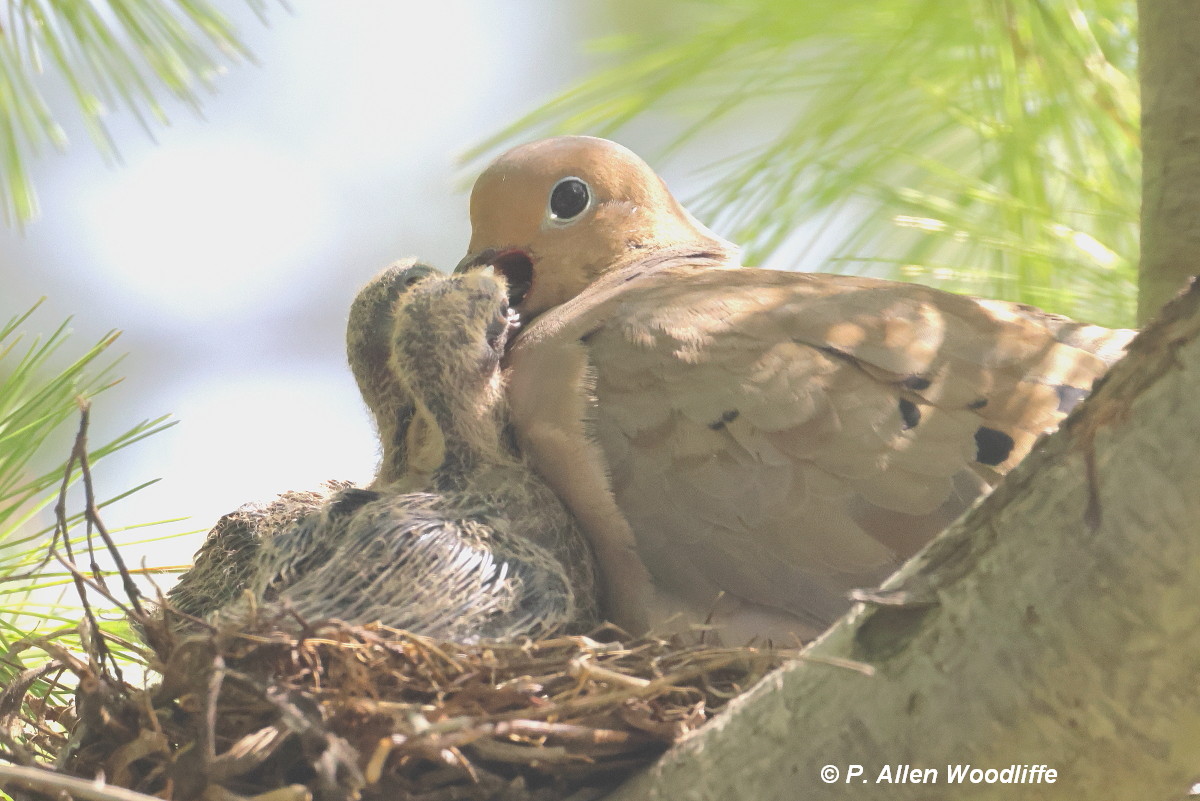
During the first few days after hatching, there wasn't much to observe. I took a few photos, but by Day 21, 5 days after hatching the two young were much more visible. They grow quickly!

The MODO does not feed its young in quite the same way most other species do. The adults ingest their normal diet of seeds and then proceed to create 'pigeon milk' in their crop. The young, as shown in the photo above, then 'dig in' to the adult's mouth and either get to where the pigeon milk is waiting, or sometimes cause the adult to regurgitate some of the pigeon milk to a more accessible part of its mouth. This goes on during the entirety of the nesting period, and continues for even a couple of weeks after they have left the nest. Then they will eventually switch over to the normal MODO diet of seeds.

Most of the first few days the young, when not feeding, are content to sit low in the nest, barely visible. It seems the adults were getting a bit restless from time to time, probably to stretch to compensate for the long periods of just sitting.

Day 22

By Day 26, when the young were about 11 days old, they were much more visible and active in their own way.


By Day 29, they were getting quite large, and a crowded nest was more and more the case. When one tried to move around at the edge of the nest, it might have even lost its balance a bit. At least this caused it to develop its wing muscles in preparation for future air borne mobility.

I should mention that the vicinity of the nest seemed to have been kept clean. In many songbird groups, the adults remove the white fecal sac from the nest and immediate area so that predators have less to go on when looking for something to prey upon. I never saw the removal of white fecal sacs with the MODO. However I did frequently observe the adult poking around in the nest, and coming up with and even eating small dark things which I expect was what the young had eliminated from their digestive system.

The young were increasingly observed just by themselves at the nest. It was definitely getting more crowded.

Day 30

The next morning, on Day 31 and about 15 days after hatching, there was only one bird in the nest. It seemed a little more restless and it was observed moving around on the supporting branches beyond the nest itself.

Day 31
It spent a lot of time on the edge of the nest, looking for where its sibling had moved on to.....
---and discovered it was sitting at the edge of the garden, all by itself unless an adult came in to feed it.

Later that same day, the presumably younger bird had decided it was time to get out, and by mid-afternoon it too, had vacated its home and re-joined its sibling.

They were seen in or near the garden on a regular basis for several days afterwards, always on the ground, but with decreasing frequency.
By Day 38, they were seldom seen at all, and on occasion clearly had developed their flying capability to get to above ground locations. At this stage, they were looking more and more like the adults.

MODOs are still around the neighbourhood, and will be for the remainder of the year and beyond. But it is next to impossible to determine which are the youngsters that came from this nest.


If you would like to subscribe, or unsubscribe, to Nature Nuggets, send an email to: prairietramper@gmail.com