Showing posts with label American Pipit. Show all posts

Saturday, 23 November 2024

Autumn's final warm fling?

 Butterflies in late November? Yes, and a few other warmish season creatures have been out and about. Eastern Comma, first, is a species that will overwinter as an adult, so when the weather is warm, they can be out basking as this one was.

Common Buckeye does not overwinter in southwestern Ontario, but there has been a good number of them this late summer and fall, so it isn't all that surprising to see the occasional one stick around in this unseasonably warm weather.


  There have been a few Autumn Meadowhawks flitting around in sunny, sheltered places.

Next is a Black Blow Fly.

...followed by a Common Drone Fly.

There were a few of this next one around. It is a possibly a Tufted Clusterfly, although the exact type of clusterfly has not yet been determined.
Woolly Bear Caterpillars are often seen, even in winter. It is the larval stage of the Isabella Tiger Moth, and this first image shows the typical coloration.
According to a specialist on iNat, this next one is a Tiger Moth of the Phragmatobia species.

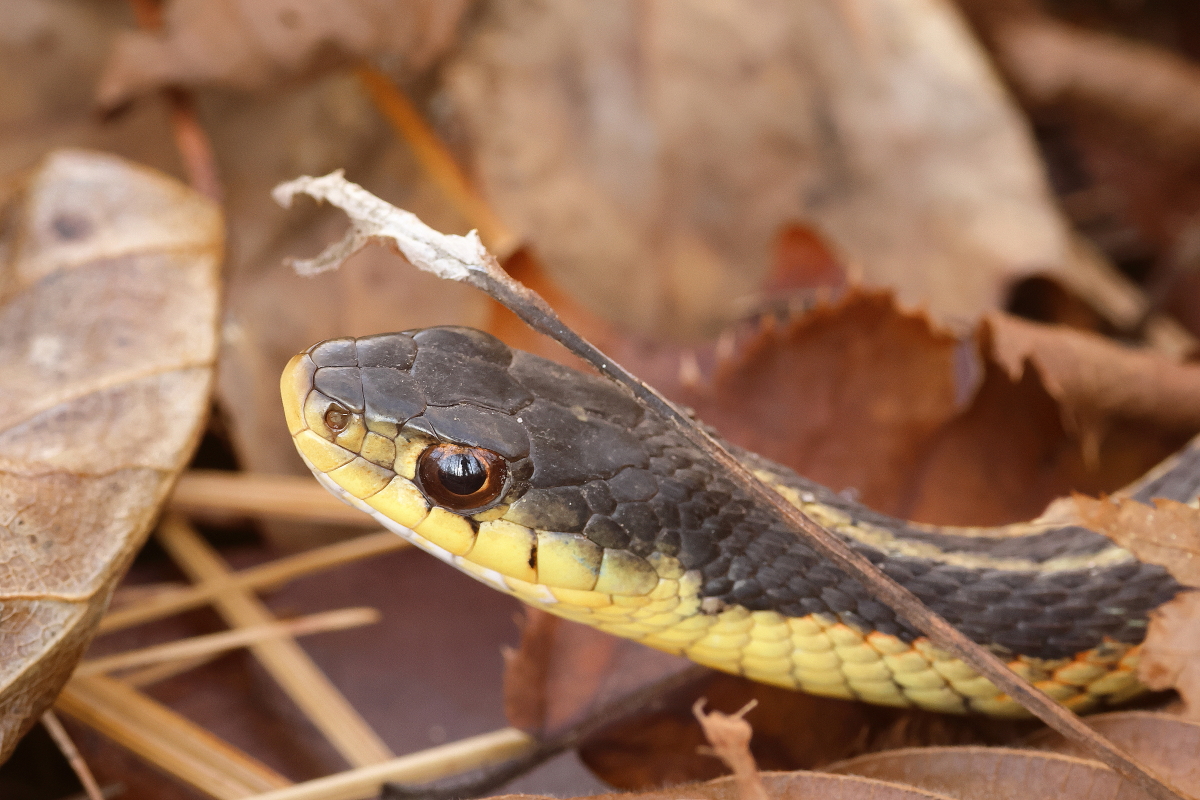
Reptiles are cold-blooded, and are not often seen this late in the season. However due to the warmer than normal temperatures, a few Eastern Garter Snakes were out....

.....as were a few Midland Painted Turtles.

I even heard several Spring Peepers on more than one occasion! I'm sure all these reptiles and amphibians are now safely in their winter quarters!

On one of my outings to Rondeau, I spent a bit of time scanning the lake from the east beach. I was hoping for a few loons, especially a Red-throated Loon or even a Pacific Loon. Both have been seen on occasion in the last week or so. I did see up to a couple of dozen Common Loons.....


....and there was at least one Red-throated Loon mixed in from a distance, but I didn't get any photos of it. As for a Pacific Loon, I struck out on that one so far, but I have seen them in Ontario in the past. When I was involved with some wildlife surveys at Polar Bear Provincial Park in about 1990, we came across a nest, and one of the adults was cooperative enough to allow me this photo. The fall plumage is considerably more drab than this photo, however.
While looking for loons, there was a massive movement of Red-breasted Mergansers flying by. I think they had been stirred up by a passing ship, so there were probably 3-4000 of them in flight that stretched like this photo, for at least a kilometre with smaller groups going by as well.

I spent a bit of time up along the Mitchell's Bay North Lakeshore Trail, and while I didn't see any shorebirds on this occasion in spite of the extensive mud flats, there were some raptors in the area keeping an eye on waterfowl and other things. There were probably three adult Bald Eagles in the area, although they were sometimes on the move for a short distance and maybe there were only two.


This Merlin, next, was initially seen hopping around in some shallow water. Not sure what it was trying to do, maybe wash something before eating? It wasn't clear, but after a few moments it got up and left....
....and this next photo is likely of the same bird, on the top of a pole a short distance away, surveying its domain.

I also spent a bit of time along the Erieau Marsh Trail. There wasn't a huge diversity of birds, but a few things caught my eye and gave me some photo ops. I was a little surprised to see at least a couple of dozen American Pipits flying around in a loose group and landing near the tree tops. I usually see them in much fewer numbers, and typically on the ground, but these were migrating so were behaving a little differently.


American Tree Sparrows are one of the more common sparrows this time of year. This one was busily tearing into some goldenrod seedheads.
A Downy Woodpecker was digging into a tree trunk....
...and this is a Rusty Blackbird, one of a small flock of a dozen or so on the move.
This Great Blue Heron was first noticed when I heard its loud 'croak' that indicated where it was, so enabled me to get this rather distant and cropped photo.


If you want to subscribe, or unsubscribe, to Nature Nuggets, send an email to: prairietramper@gmail.com

Saturday, 14 November 2020

Purple Sandpiper Plus Other Bird Photo Highlights

 Birds continue to be one of the highlights of this time of year. There is the continuing migration in effect, and the relatively fine weather, has resulted in some individuals lingering a bit longer.

Waterbirds in particular have not been forced to flee southward due to encroaching ice. The availability of food is typically the deciding factor in causing birds to migrate. A recent somewhat dramatic example of this is the ongoing movement of winter finches, whose food source farther north has diminished more than usual, resulting in good, even large, numbers of northern finches passing through southern Ontario. My previous post expanded on that somewhat. But on the waterbird front, shorebirds in particular continue to be present, albeit in smaller numbers than a few weeks ago. Where there is shallow water, there likely will be shorebirds, and the Keith McLean Conservation Lands continue to attract several dozen shorebirds. By far the most common has been Dunlin.....

.....with one or two Greater Yellowlegs as well.
A Semipalmated Sandpiper has been present on occasion. One or more Great Blue Herons will continue for awhile.
On a recent visit to Erieau, it is always worth checking the pier for gulls and shorebirds. While I was moving into position to get the best angle of light for these Sanderling, shown next, I heard a 'kwit' call that I didn't recognize at first. Upon turning around, I saw a chunky dark shorebird fly in and land on the lower side of the pier behind me.
It was immediate apparent that this was a Purple Sandpiper, a rather rare, but somewhat regular, species in the area as it passes through from its high arctic breeding grounds. We don't get to see them every year, so it is always nice to have one in the area, however briefly. In a relatively mild winter, one may stay for weeks, or possibly the entire winter. Last year there was one around and seen intermittently up to about the middle of December, then wasn't seen again. But one was present along the south beach of Rondeau in early March. Given how open that winter was, perhaps it was the same bird that was able to stick around?
When I saw this one, I got some photos, and put the word out on the local bird alert. However being that it was a nice day, there were non-birders enjoying the walk out the pier. Although this species is relatively tolerant of people, I watched three non-birders continue to the end, and the bird kept moving on. When I last saw it, it had flown out over the lake, heading for the south beach.
Within minutes of observing this, I noted that the first local birder had arrived, with a few others shortly after. Disappointment was obvious, not surprisingly, so we 'scoped every other location within view, including parts of the south beach, but without success. I had to leave, but the others decided to check the pier again, and before I got too far out of Erieau, I got a text indicating that the bird had returned to the pier, so persistence paid off! Since there were several out-of-town birders in the area or passing through Chatham-Kent, they decided to try for this bird, and were successful. So all's well that end well.

I did manage to see and photograph an American Pipit on the pier during this time as well.

Hiking around Rondeau is always worth the effort. Even if there aren't many birds to see, or photograph, the hiking and enjoying the ambience of this remarkable provincial park has untold benefits. Seeing and photographing birds is the added bonus!

I have been there a few times of late, and the birds and fine weather have resulted in the following highlights: 

A trio of Carolina Wrens were vying for territory, vocalizing frequently and chasing one another.


A few flocks of Cedar Waxwings were around, usually in the vicinity of berry bushes such as this Multi-flora Rose bush.
It is always fun to watch their antics, vying for these berries.

The birds above are adults. The one below, is a first year bird.
Most of the warblers one might find this time of year would be Yellow-rumped, some of which may even stay the entire winter as long as there is a food supply. So finding a non Yellow-rumped is a bit more exciting. I had this Orange-crowned Warbler pop out of a clump of goldenrod in the campground. Fortunately it remained in the open for a few seconds while I managed to rattle off a few shots.

I liked this next one, with the bird giving me a somewhat quizzical look, wondering what I was up to and perhaps also wondering what that frequent clicking noise was.
Black-capped Chickadees have not been very plentiful these last few weeks. This one paused briefly, although against a very bright background, and it required a fair bit of tweaking to get it to even look like this.
With the sunny and warmer than usual weather, even a few butterflies have been out. I've seen several Eastern Commas.

When the winds are in the right direction, it is often worthwhile to be somewhere along the lake shore to hopefully see a few raptors on the move. In Chatham-Kent, places like Morpeth Cliffs or the Craford Road are two of the best vantage points. The raptors that are seen are all too often too distant for good photos, but once in awhile they may come within range of the camera. A fair bit of cropping is required nonetheless. 

Red-tailed Hawk


Monday, 25 November 2019

Late autumn birds, butterflies and a snake!

The weather has been fairly typical autumn-like, with a hint of winter some days and a reminder of some of the warmth of early autumn on others. And that translates into some birds of winter, as well as some hold-overs of late summer and early autumn.

The snow of a couple of weeks ago was a contrast to what we had been experiencing, and with it came some late autumn and early winter migrants such as American Pipits, which were widely scattered and as abundant as I had seen them in several years.....
 ....as well as good numbers of Fox Sparrows, here seen scratching around in the less snow covered area under some Red Cedar trees.
Ruby-crowned Kinglets were fairly abundant. They are in constant motion, making the attempts at photography challenging indeed. There are usually far more photos slightly blurry or out of focus than there are keepers, and the delete button gets used quite regularly.

 As Ruby-crowns diminish in numbers, their equally active Golden-crowned relatives increase.
 A few hardy thrushes occur, such as Hermit Thrush. On one occasion it seemed like it was a 'thrush' day, as I had about a dozen Hermit Thrushes, about 15 American Robins and an equal number of Eastern Bluebirds, all members of the Thrush family.


Eastern Phoebes, a member of the flycatcher family which seems to be quite adaptable to feeding on non-fly items, such as berries, have been noted regularly in small numbers. On occasion one will still be around for the Christmas Bird Count coming up in mid December.
Shy Phoebe
All through that were a few lingering shorebirds. Dunlin and Killdeer were widely scattered along shorelines, and even in still flooded fields.

 And then a warm-up happened, perhaps the only time we will experience anything like 'Indian Summer' this year. For one day only it was unseasonably pleasant, with bright sun, very little wind, and temperatures reaching 9-10C. And the wildlife responded, however briefly. There were butterflies flitting around at Rondeau, including this Eastern Comma......
 ...and an Eastern Garter Snake was seen stretched out across a sunny spot on a paved road at the park. It seemed hesitant to move, but I encouraged it to move to the side so it wouldn't become a victim of an unobservant (or uncaring) driver.
 I heard, and then saw, this cricket busily 'singing' its song at the base of the Visitor Centre siding.
A few other bird species were a pleasant surprise. Red-headed Woodpeckers used to be quite common during the spring and summer period, but in recent decades are quite unusual. Having one linger this late is even more unusual for this migrant.
 Baltimore Orioles are usually many hundreds of kilometres south of here by now. For some reason this brightly coloured male is content (?) to stick around a well stocked feeder just north of the Visitor Centre. It isn't always easy to find, as it appears out of nowhere and may spend a bit of time in a willow tree, which typically has some leaves remaining. It makes it difficult for the camera to focus.
 But eventually it may come to the feeder, which the owners have stocked with jelly with a few meal worms mixed in. Not the kind of spread I would like on my toast, but the oriole seems to enjoy this source of protein. Last year there was a female Baltimore Oriole that was seen erratically in the Rondeau campground even into January. Maybe this is the year that we will be able to add the species to the Christmas Bird Count.
A couple of weeks ago there was an immature Red Phalarope which showed up at the Blenheim Sewage Lagoons. I got a few photos on that cold, snowy day and included them on a blog post shortly afterwards. Red Phalaropes are quite irregular for this area. We sometimes go for several years without any reports at all. But just this past weekend, an adult in its winter/basic plumage was seen at Erieau. Fortunately it stuck around for both weekend days, giving numerous birders a chance to see it.
It was quite cooperative, and a life bird for some of those that came to view it. Cameras were clicking steadily, and photos have shown up on numerous eBird lists and blogs. Fellow bloggers Dwayne Murphy and Ric McArthur were there at the same time I was, and blogger Blake Mann had been there earlier.

Sandhill Cranes and Tundra Swans are harbingers of mid to late autumn, and they have not disappointed this year. While the cranes used to be a rarity in this area, it is not unusual to see or hear several dozen to several hundred if you are at the right place at the right time. This first photo is part of a group of about 135 I saw today out near St. Clair NWA. I saw about 235 there a few days ago.

Incoming!
Tundra Swans are around by the thousands, mostly in the fields near Lake St. Clair and the NWA. On occasion 3-4000 may be widely scattered in one very large field, but more typically smaller flocks are scattered over various field throughout the western portion of the former Dover Township.


 And almost right on time, the first of the season Snowy Owls have appeared. I had been out several times over the previous couple of weeks checking out their usual haunts, without seeing any. However most of the crops of corn, beans and carrots, etc., are now off, making it more conducive for the owls which like wide open spaces, as well as for those of us looking for them. I photographed this one today in a recently harvested corn field. In recent years it is not all that uncommon to find several in a day during the peak of winter. Who knows how many will appear this year? Regardless, it is always satisfying to see the first one of the season.