Earlier this month, I went to Rondeau to try and get some impressive shots of the super moon. I spent a bit of time ahead of the moon rise, exploring other areas, including the Marsh Trail. One of the first things I was able to get photos of was this Merlin keeping an eye on me.
On the trail itself, I encountered a Short-tailed Shrew. It was dead, and that is the most likely way to encounter one.
A few more living things were noted, and photographed, including Blue Jays, which are migrating through in large numbers....
 |
| Eastern Phoebe |
 |
| Northern Flicker |
A flock of ducks flew high, overhead. Most of these are scaup, but hard to tell whether Greater or Lesser from this photo.
 |
| White-crowned Sparrow |
 |
| White-throated Sparrow |
As the evening progressed, I went out to the east side of the park in anticipation of a large, orange super moon at the horizon. There was a bit of haze at the horizon, so I waited and got this one as it rose a bit.
I went back a couple of days later, with a different camera\lens combination, as the horizon appeared to be clearer. Unfortunately it was quite windy, and I couldn't hold the camera still enough in such dark conditions especially with such a slow shutter speed, and when there is often more atmospheric interference right at the horizon. So the quality of photo I was hoping for wasn't what I got.
Later in the evening, I got this:
It is sharper, of course, but it doesn't look a lot different than a normal full moon. Oh well, I guess I will have to work on my moon rise photography technique and keep trying!
In other park explorations, I managed to see these things:
Yellow-bellied Sapsuckers are more plentiful, as they are in migration mode. The occasional one may stay the winter at Rondeau.
As the human crowds thin out a bit, deer are more likely to be out and about.
 |
| Wild Turkey |
Next is a fruiting capsule of the endangered Nodding Pogonia. It wasn't a great year for this species, as the dryness at a critical time of the summer likely had an impact, as did other factors. For those that did flower and produce a seed capsule, this is what one will find. It is a very small plant to begin with, as one can tell in comparing it to the fallen leaves beside it, and so even extra care had to be made as I searched for evidence of seed production. As the capsule develops, it sits upright, and starts to split along some of the lines, enabling the tiny seeds to disperse with a bit of breeze.
Something I was surprised to encounter was this next little critter. It doesn't have a common name, but is a member of the Tree Hopper family, and its scientific name is
Stictocephala basalis. According to iNaturalist, it is the first record for Rondeau and although generally widespread across southern Ontario, is not common at all. When I came across this little rascal, I only had my 100-500mm lens, so had to be creative in getting even a few record shots. Fortunately the lens will focus down to 1 metre at 500mm, so that helped.
Next is a member of the
Trametes fungal group, commonly known as the Turkey-tail group.
In spite of the fairly sunny and warm temperatures, butterflies have really dropped off, most likely to that stretch of cold overnight temperatures not long ago.
 |
| Fruiting bodies of Fringed Brome grass |
 |
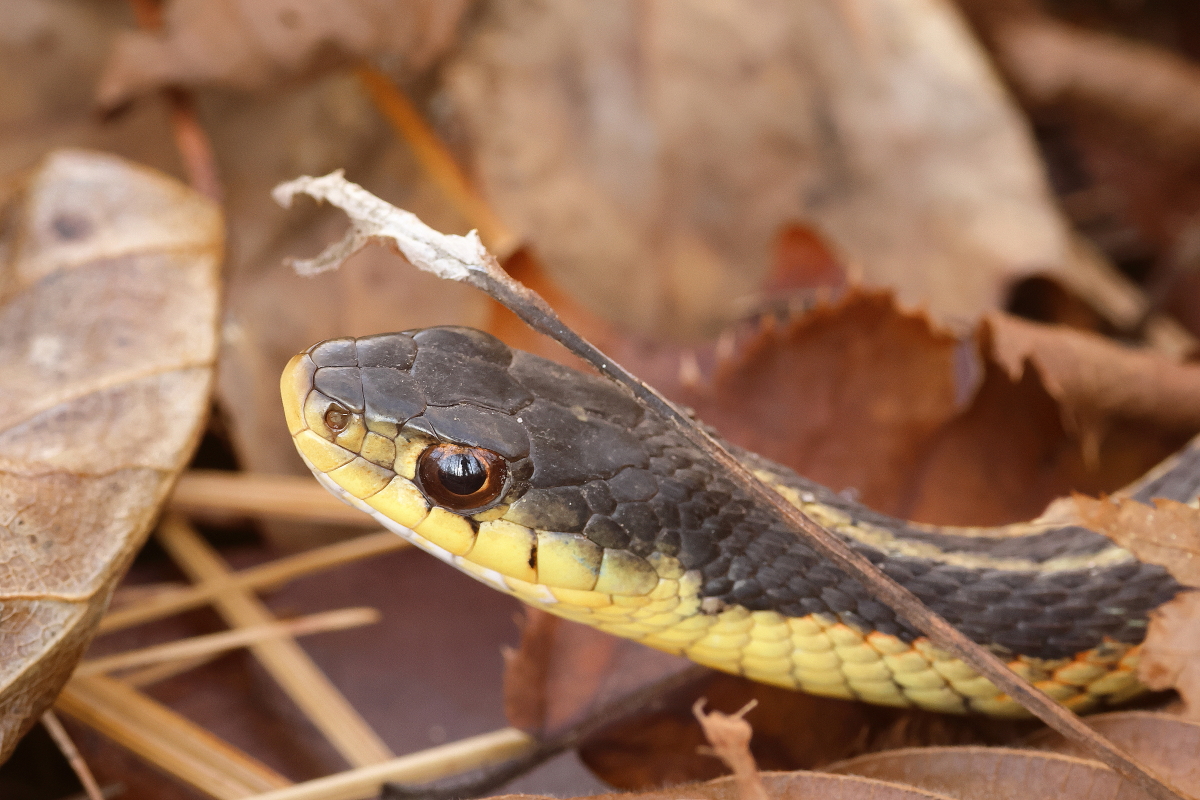
| Eastern Garter Snake |
 |
| Downy Woodpecker |
Next is a photo of a fungus called Destructive Pholiota. The first photo shows it a week later than the following photo, indicating that these fruiting bodies don't last very long.
 |
| Dekay's Snake |
Lots of Common Grackles are migrating these days!
 |
| Seed pods of Bristly Sedge |
Salamanders are fairly common across the damper areas of the park, but are seldom seen, especially considering how dry the sloughs are now. This one is likely a Blue-spotted Salamander, but with the genetic research taking place by researchers amongst the salamander group, it might be a hybrid.

Mid to late October is one of my favourite times to search for another endangered species, Red Mulberry. This species occurs in very few places in extreme southern Ontario, being limited primarily to Pelee Island, Point Pelee and in the extreme eastern Niagara Peninsula. Rondeau has a fairly good population, but that may be changing as the forest conditions have changed a little more dramatically in the last few years. I intend to discuss that topic in more detail in a future post. In the meantime, in the last week or so, I have been looking for this species to determine its continued presence at known locations, as well as keeping an eye open for new locations. As a result, I believe I have found at least two, possibly three, new locations. The leaves are much fresher looking this late in the season compared to most other trees. The leaves are quite large, round and have obvious 'drip tips'. These drip tips are helpful in that due to the slight hairiness of the leaves, which can hold moisture, the drip tips allow for a greater falling off of the moisture droplets. The leaves have a fairly symmetrical base, unlike those leaves of somewhat similar looking Basswood leaves.

As mentioned, they retain the green colour later in the season than most other species. All of these Red Mulberry photos were taken in the last week. There are numerous non-biting midges present lately throughout the park, and they often take refuge on the underside of the leaf which this next photo shows.
This species never grows as tall as most of the other species it associates with, so if you see a relatively short tree with a trunk only a few centimetres in diameter, and with lots of large green leaves as described above, it may be a Red Mulberry. A species it can be confused with includes Basswood, a native species, and Northern Catalpa which is often planted in built up areas but can be distributed into forests, so be aware!
If you would like to subscribe to Nature Nuggets, send an email to: prairietramper@gmail.com