Showing posts with label Eastern Ribbon Snake. Show all posts

Monday, 31 May 2021

Rare birds and herps

 I've been fortunate to have encountered quite a few rare, threatened or endangered bird and reptile species lately. Of course in the part of the province, the chance of encountering such creatures is higher than many other parts of Ontario. Some are permanent residents, while other are regular breeding species. Still others are just passing through, or way off their usual migration route.

I've also been fortunate to have encountered them with some very good photographic conditions. A prime example is the Acadian Flycatcher, currently featured at the head of my blog and in a previous post. It continues to cooperate, and I have gotten some additional good photos while showing it to a park staff person.


On another occasion, I specifically went out to see if one of the breeding Prothonotary Warblers would be cooperative. I had photographed it on a couple of earlier occasions this month, but always from a distance. On this day, as I approached its breeding territory on the boardwalk, several other folks were trying to photograph something almost right over the boardwalk. As I cautiously approached, it was clear that a female Prothonotary was busily poking through some spider web material. After a few moments of this, it headed directly to the nest box about 25 metres away. Although the light wasn't ideal, I shot it anyway. It is slightly less brilliantly coloured than its male counterpart.

That was the only time she was out in our area, but the male flew in very close on several occasions. At times the light wasn't great, but at other times is was about as good as one could hope for. These next two examples of several photos I took are some of the best ones I think I have ever gotten! They were taken with the full frame 5D3 and the 500mm lens, and not cropped very much.

I was quite pleased with the photographic efforts so far, as I should be. Yet while I was arriving home, I got a text message from Steve that two Glossy Ibis had been reported at the end of Angler Line, a bit south of Mitchell's Bay, along Lake St. Clair. My plans to arrive home were delayed a bit, as I headed towards the spot.

None were visible at first, and even after Steve arrived we saw no sign of them. As we were pondering what to do next in our search, one flew up from behind some cattail vegetation, then another and then a third! They didn't land in a good spot for photography, but they moved around a bit more and eventually landed out on the open side of the cattails. It turned out there were four of them. They were still a bit farther away than we would have liked (a typical birder/photographer lament :-) but eventually we got some fairly good record shots. These are heavily cropped.


I still hadn't been at the right place at the right time to see any Whimbrel, in spite of spending the equivalent of several hours over several days looking out at the lake. The south beach was a likely spot, so Kevin and I headed out to check on whatever we could find out there. The south beach has always been one of my favourite spots in Rondeau, due to the sometimes wild weather conditions as well as the wide open view of the lake, bay and marsh. The narrow sandspit is a draw for birds. So off we went. We saw many of the more common shorebirds, including Ruddy Turnstone, Semipalmated Plover, Semipalmated Sandpiper, Sanderling, etc. And eventually we came across 28 Whimbrel, which at first were not giving us any good photo ops, but eventually they did.


There were hundreds of gulls, most of which were Ring-billed and Herring, but we also saw a Lesser Black-backed Gull, and a single Little Gull which we saw clearly but were not able to photograph until it headed out over the lake. This is a poor record shot.

We also had a very cooperative Eastern Tiger Swallowtail stop by to sip something from a small area of wet sand.

On the herp/reptile side of things, some of them are becoming more visible in the warmer and sunnier weather. Unfortunately this first one, an Eastern Hog-nose Snake, will not be with us any more. It is, quite sadly, quite dead. Some folks had seen it writhing around, and at first thought it may have just been going through some of its defensive antics the species is know for. It will wriggle and writhe, and play dead when it feels threatened and any escape route is not available. However this one was fighting for its life and breathing its last. It was disgorging two American Toads, the largest one is shown below. But after a few minutes it stopped moving. I was told about it (thanks, Mike!), and after I came off the trail I had been hiking, went to the spot and found it quite dead. The second photo shows a close-up of its upturned snout, from which it gets its name. There was some speculation that the snake had bitten off more than it could chew, and was choking on the two toads. It didn't make a lot of sense, since even though toads will inflate themselves when threatened to appear much too big for a snake to consume, this snake species has a couple of teeth towards the back of its mouth specifically designed to puncture a toad, deflate it and make it manageable. So I was interested to hear from Kevin that when he checked it out, he could tell that there were several parts of its rib cage and vertebrae that had been crushed. While there was no outward injury visible, which would have been the case had it been run over by a car, it is most likely that the snake was run over by a bicycle and did enough damage to effectively kill it. So sad, when you consider that it is a species at risk in Ontario, and quite a rare find at Rondeau since it occupies the pine-oak forest community and edges, which are some of the most developed parts of the park. And this one was a very mature individual which had the potential to add to its population for a few years yet.


A much more positive encounter was one I had with this Eastern Fox Snake, a species at risk, seen on Harrison Trail. I had just come back from birding, and noticed it quite motionless. I suspect it was hoping its pattern might make it less noticeable and that I would pass it by. After getting a few shots with my camera I did, and when I came back a few minutes later with a different lens combination hoping for some better photos, it had moved on.

Ontario's only lizard, the Five-lined Skink, is another species at risk, and occurs in various spots at Rondeau. While I was hiking along Tuliptree Trail, I noticed at least three of them meandering around a large fallen tree.
On another occasion, I came across an Eastern Ribbon Snake basking on the same tree trunk. It is also an official species at risk.
It looks very much like the much more common Eastern Garter Snake, but has a more defined black and yellow striping, as well as a small white spot in front of its eye.
So much to see and photograph!


Thursday, 13 April 2017

More first of year things, including birds

I thought it was time to give my Snowy Owl header photo a rest, especially since most, if not all, of them seem to have left the area. I was out yesterday to where the last lingering Snowies have been seen, and did not see any sign of them. Undoubtedly since farmers are getting busy on the land spreading fertilizer, etc, the extra activity has convinced the owls to move on.

I thought this Prothonotary Warbler photo was in keeping with the upcoming season. Hopefully there is a healthy number of them that arrive here in the next few weeks!

The last few days have been productive. That isn't surprising, since this is the time of year when many signs of spring are gaining momentum: early migrant birds are relatively abundant, and the next wave is arriving; reptiles and amphibians are becoming more noticeable; native wildflowers are appearing, and butterflies are becoming more numerous. Yaaay!

Winter Wrens have been back for a few days, but they are so hard to photograph. They are constantly on the move it seems, playing hide and seek amongst the branches and debris on the forest floor or swamp. Once in awhile, you get lucky.


Ruby-crowned Kinglets are starting to be a bit more numerous. They are almost as hard to photograph as Winter Wrens. This one was photographed through a fence at the maintenance yard of Rondeau, into the row of White Cedars, so not as clean and sharp as I would like.
I got my first migrant Yellow-rumped Warbler skulking amongst the leafing out branches of an invasive honeysuckle.


The star of last spring at Rondeau was the White-winged Dove. It was quite predictable and remained for several months. This spring, every time I went by the cottage lot that hosted it in 2016, I would slow down and glance in, but it wasn't until this past Sunday when I wasn't at the park, that it was first seen for this year. It was noted carrying on similar behaviour....checking out its reflection in the sun roof of the cottage owner's car and calling regularly. I got to see it a couple of days later. Too bad it didn't think to bring a mate along with it!
A pair of Black-capped Chickadees was noted excavating a rotting stub.

This species is generally quite tolerant of people, but this nest site is a mere metre or so away from a boardwalk along a busy trail. With the busyness of the birding season building, will they continue their quest or move to a quieter neighbourhood?

The trails have been good for other things besides birds, of course. I recently noted my first of the year (FOY) Eastern Ribbon Snake swimming along a slough, slithering over logs, etc. It looks much like the more abundant Eastern Garter Snake, except that it normally inhabits swampy areas, has more vivid yellow lines down its back and has a small white dot in front of its eye. The reddish brown colouration along its sides are on slightly different rows of scales as well. This species is declining in Ontario, and is designated as Special Concern under the Endangered Species Act 2007.
 I noted my first of year Hepatica in flower. Until the leaves appear, which will be very shortly, it is more difficult to determine if this is Sharp-lobed Hepatica or Blunt-lobed Hepatica.
The open male flowers of Silver Maple are becoming more apparent.
I saw my FOY Red Admiral recently.
Eastern Commas have been out for awhile now, as have Mourning Cloaks. I saw my first ones during the warm spell in February, but it isn't hard to find a dozen or more along the trails on these sunny days. This particular Eastern Comma was willing to sit still for awhile.
 I wanted to get a different perspective from ground level to show the underside of its closed wings. Fellow nature photographer and Canon camera aficionado David Barr captured me with this shot, and graciously allowed me to use it here.
 This is what I was photographing.

From Rondeau I sometimes scoot over to Erieau in a round-about way home. The pair of Bald Eagles nesting in a woodlot along Fargo Road have been more successful this season than they were in 2016. There are two little ones in the nest. Garry Sadler sent along a photo he had showing an adult and two small young. At my most recent check of the nest, one adult was perched on the side and there was a very brief showing of a young bird's head for a fraction of a second. No photo, however.
At Erieau, there was a FOY Forster's Tern resting amongst a small group of Bonaparte's Gulls.
In the fish tug harbour area, there were a few Red-breasted Mergansers.....hardly uncommon at this time of year, but I always enjoy their courtship antics. They start out with their 'hair' looking quite unkempt, swimming directly towards their target or sometimes another male.


 They then 'slick their hair back' and get ready to extend head and neck, dipping partly underwater in the process.

 The ritual concludes with the male extending its head upward again.
This is the target of their affection.
 And this close-up of the partially open beak shows the serious looking row of teeth that point back toward the base of the bill. That feature is very important for a species that feeds almost entirely on fish, slippery critters that they are.
I've sprinkled some of my outings to the southern parts of Chatham-Kent with the occasional trip north, at least to the Mitchell's Bay/Lake St. Clair area. The two trails north and south of the village are often worth checking out.

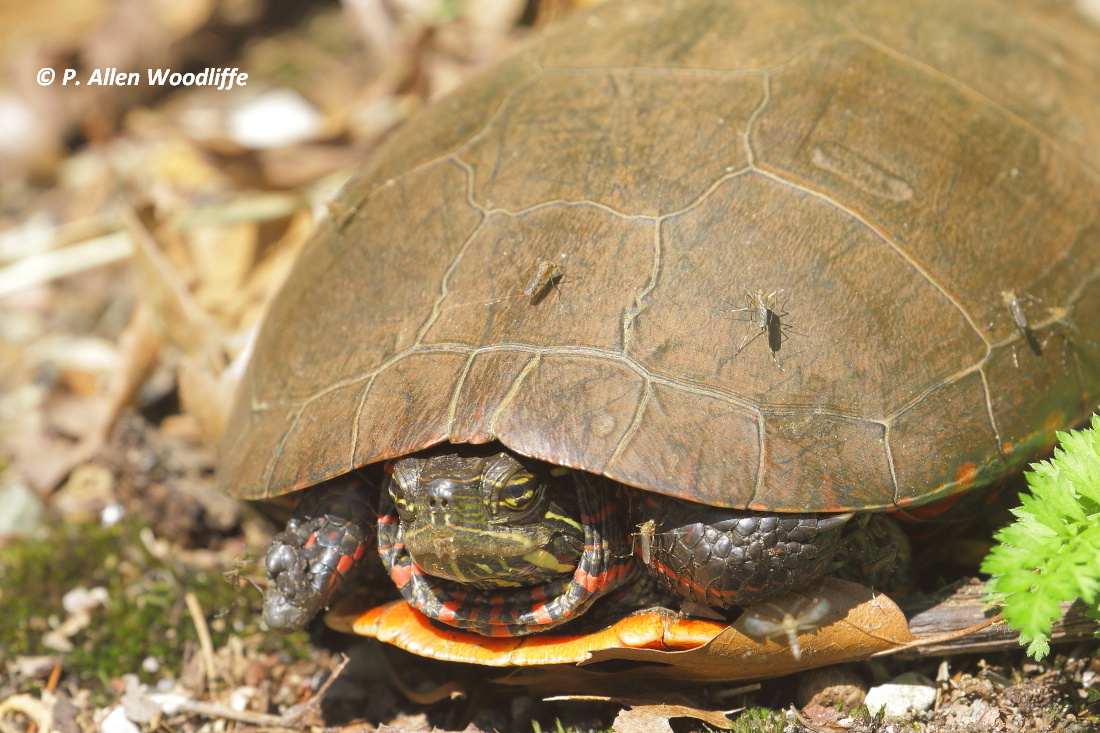
The sheltered areas of the canal along the south side trail is a great spot for basking turtles. It isn't hard to find a couple of dozen Painted Turtles out. I haven't come across the much rarer and designated Threatened Blanding's Turtle yet, but I am sure it won't be long.
I got my FOY Great Egret along these trails, not surprising since just a short distance away at Walpole Island First Nation at the north end of Mitchell's Bay is a large nesting colony of them. This particular one came up behind me and was almost missed, but I managed two photos.


Saturday, 12 November 2016

Reptiles at Risk...an upcoming free event

Reptiles, and in particular snakes, aren't especially loved creatures by the average citizen. True, they aren't cute and cuddly, but they aren't slimy either. Much of the bad rap they have been given is due to misinformation that has been passed along.

You don't see many reptiles out in the wild these days, as most of them are tucked away for the winter, dreaming of next spring. Okay, I can't say for sure that I know what they are dreaming, or if they are dreaming at all. But I can say that the majority of them are in, or preparing, for hibernation.

Midland Painted Turtle
If you are interested in a free family friendly program happening here in Chatham-Kent, there is a special event being held near St. Clair National Wildlife area this coming Tuesday, November 15, 2016. It is called Reptiles at Risk....On The Road.

The Eastern Fox Snake in this next image is literally on the road.

It is an educational event, where you can see some of Ontario's reptiles up close....as close as you are willing to get....and learn about some of their habits. This is focused primarily on Species At Risk, and many of Ontario's reptiles are at risk to one extent or another. In this area, there is a good diversity of reptiles, although their numbers are decreasing. Some of those rarities include:
Eastern Fox Snake
Musk Turtle
Ribbon Snake
Five-lined Skink
Blanding's Turtle
Snapping Turtle

This family friendly and free event is being held at the Dover Rod and Gun Club, located at 5806 Heron Line, which is the first road north of the entrance to St. Clair NWA. It starts at 6:30 p.m. This event is being hosted by the Dover Rod & Gun Club, and the actual event with all the reptile critters is being presented by Scales Nature Park in partnership with Sciensational Sssnakes, Laurentian University and the Canadian Herpetological Society.

For more information contact Christie at: christie.l.smith@hotmail.com.


Sssee you there!