Showing posts with label crow. Show all posts

Friday, 27 January 2023

An Avian Spectacle Indeed

 Residents of Chatham-Kent and area, might know immediately what kind of spectacle I am referring to. It has been a controversy for many years, but it is a spectacle nonetheless. I am referring to the mega crow roost that Chatham has become known for.

I used to drive by it daily as I went back and forth to the office where I worked. But since I retired 11 years ago, it has become much less frequent that I give it much thought. And that is on me, as it continues to be quite the bird phenomenon.

Beginning in mid-October or so, and until about mid-March, there are many tens of thousands of American Crows that migrate no farther than Chatham-Kent, and have established their night-time roost along the Thames River more or less at the west end of Chatham. The above photo shows a 'few' crows roosting in a tree just upstream from the Keil Drive bridge. They will use trees at least 100 metres or so upstream, but the majority of them use trees downstream from the bridge, and on both sides of the river.

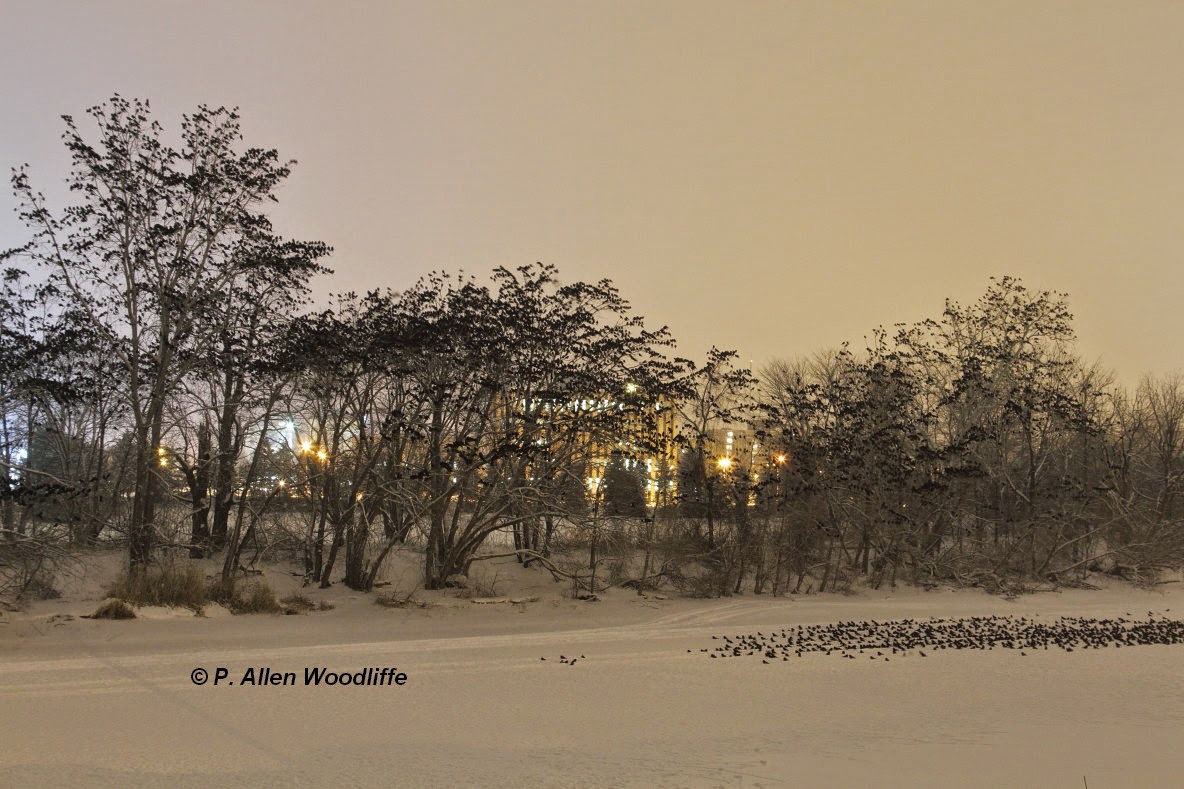
They will also use rooftops of commercial and private buildings, and on occasion when the river is frozen, rest on the ice itself! Here is a photo from late January a few years ago, showing just that. It was a 15 second exposure, so I had to wait until well after dark when they were settled in and movement would be minimal.

Numbers of crows reported have varied widely. When the municipality hired a raptor specialist to come in during the fall, with several raptors, to try and disperse the crows, he indicated that there were likely about 250,000 birds. He was not able to successfully make a dent in the population, and after 2-3 years, the project was cancelled. More recently a municipal councilor at the time, who I doubt knew anything about estimating bird numbers, but wanted to make a statement in the hopes that the municipality would become aggressive towards this crow roost, was quoted in the local paper stating that there were 20 million crows!

Hardly. And nothing really came of his proposal to be more aggressive at deterring crows from roosting where they were.

On a couple of occasions, as we were preparing for the Christmas Bird Count, we organized ourselves to try and count, or rather estimate, the number of crows as they were leaving their spread out roost. It was a challenge to be sure, but on one occasion we came up with 159,860 birds. More or less. But it was impressive to see many hundreds of them leave a single tree over the span of 15 minutes or so, and realize that the tree looked just as full as it did before we started counting them as they left!

This past October, the municipality sponsored a Crow Fest, at about the time when the crows were arriving in Chatham. I didn't attend or participate, as it seemed to be mostly geared towards using that time to have some displays, music and celebrations of some sort, but I don't think there was anything that actually explained what the crows were all about.

A number of people have asked "Why are there so many crows that spend the winter in Chatham?" A few years ago, in the first year I started this blog, I wrote in a fair bit of detail why that is. Check it out so I won't have to repeat myself here. As some of you will know, the crows return to Chatham late in the afternoon to stage, before eventually coming into the roost after sunset. The numbers on the ground as they stage, can be enormous. Just try counting them, and these show only a small portion of the huge flock that is spread out across various fields at the edge of the city. The following two photos are from a few years ago.


But I hadn't given it much thought lately until Craig, a crow enthusiast from the greater Boston area, who pays a lot of attention to a crow roost within sight of his place of work, contacted me a year or so ago, and we started to correspond about crow roosts. Fast forward to late December of 2022, and he told me he was interested in seeing crow roosts in both Quebec and Ontario. So he spent the better part of a week in his January travels to check out first hand, two roosts in Quebec and three in Ontario, culminating with his visit to Chatham on January 15. I met him and spent almost two hours on site right at the roost, describing some history of it, the St. Clair NWA Christmas Bird Count which includes this roost, and the like. It was a most enjoyable time sharing it with a fellow crow enthusiast. I didn't have my camera with me that evening, but the weather was just about perfect for it. Mild temperatures, little to no wind, and a colourful sky as the sun was going down. Craig's most common comment as the crows arrived was "Wow, wow, wow". Wow indeed! He returned the following morning and got more photos of the crows leaving the roost. In his opinion, the Chatham roost is likely the largest one in North America, and I think that has been my understanding as well.

 Upon returning home, Craig processed a multitude of his still images, as well as a video clip, and sent it to me, encouraging me to share it. So with that, here is Craig's blog which features the Chatham roost. It is well worth checking it out.

Viewing the arrival of the crows with Craig on the 15th inspired me to get my camera and get some photos as well. I wanted a bit of colour in the sky so waited until earlier this week, on January 24, to attempt it. I also wanted to put my mirrorless R6 to the test, since it can get good results at much higher ISO than my older DSLRs. I was not disappointed, and here are a few. (Click on the individual photo to see them even larger)

The trees upstream continued to see more crows arriving.

At times there were some relatively brief lulls in the action.
Looking downstream one could see that almost every tree was full of crows, on both sides of the river....
...and a close-up of the previous photo showed that a bit further downstream, the sky was full of them.

As it got darker, I had to push the ISO up and up. I eventually took a few at an ISO of 12800, including the next one! That is a far cry from back in film days, when one didn't want to use film much higher than 400 ASA/ISO, and even that was pushing it. The best results came from film that was in the 64-100 range. How technology has changed. Given the quality of images taken at 12800, I will likely try some at an even higher ISO just to see what it can do.
I left after about an hour, as it was getting a bit too dark even for my camera I thought. Maybe I missed some opportunities trying at a much higher ISO, as even when I got back to my vehicle in quite a dark setting, the crows were still streaming in by the thousands.

If you want to subscribe, or unsubscribe, to Nature Nuggets, send an email to: prairietramper@gmail.com


Thursday, 20 November 2014

Tis the season for crows, and lots of them! Here's why.....

Most residents of Chatham-Kent, and especially those living within the urban area of Chatham are in some ways loathe to see this time of year arrive. It means that huge numbers of American Crows have once again, descended on the area. This event results in many a local discussion about why they are here and what can be done to eliminate them or at least shoo them off into someone else's area.


American Crows are migratory birds. They nest across much of Ontario and elsewhere, but as many birds do, they migrate south in the fall. And like most birds, they don't migrate any farther than they feel they have to. Insect eating birds must fly far enough to where the temperatures are warm enough to allow for adequate insect activity. Birds that are less specific in their eating habits have more options. Crows will eat many different things, from animal matter (think mice, other birds, frogs, insects, dead critters along the roadsides) to plant matter (corn, soybeans, other vegetable matter) to garbage. It takes a lot of energy to fly to the southern US or farther, so if they can find what they need without flying that far and using up that energy, they will take their chances.


Enter the municipality of Chatham-Kent.

C-K is on the major autumn migratory flight path for many birds. The shape of southwestern Ontario is like a funnel, directing birds from all across Ontario down through C-K. In spite of the large numbers of crows still hanging around, be glad that far more have already left the province. For example, there are two hawkwatch sites that are key to gathering this information. One is at Holiday Beach, a bit south of Amherstburg, Ontario, and the other is more or less right across the river in southern Michigan. These hawkwatch sites were initially established to document the large numbers of hawks passing through in the autumn. From one to several people are counting raptors at each site on a daily basis, from the beginning of September until the end of November. Birders being what they are, started including the sightings of many other bird species, and sometimes butterfly and dragonfly species as well. The movement of American Crows passing through in sometimes large numbers did not go unnoticed, and not undocumented.

In the autumn of 2013, there was a total of at least 550,000 crows that exited Ontario at these sites. There were some days when the hawk counters at these sites were so busy counting hawks, that the crows were simply noted as 'streaming by all day, but we were too busy counting hawks' to come up with a number to add to the cumulative total. Therefore there could easily have been tens of thousands more crows passing through.

But the sad truth for many of the human residents of C-K is that far too many crows decided not to venture any farther than here. Thus we have the annual dilemma of an extraordinarily large winter gathering of crows to contend with.

Crows have been using Chatham as a wintering area for decades, according to some of the oldest residents.


Besides being on the main flight path of the crows, why do they remain here? I'm glad you asked.

Food is the number one need for any species to survive. As mentioned above, crows eat a wide variety of things. Besides food, they need a source of warmth if available to reduce their energy expenditures, and adequate roosting opportunities to protect them from predators. C-K provides just what they are looking for.


Food:
  • there are many thousands of hectares of farmland nearby, much of which is devoted to the growing of corn and soybeans. There is enough grain and other vegetable matter left in the field, unintentionally no doubt, to provide scavenging crows with food. The grain also supports a population of mice, which in turn can be part of a crow's diet.
  • there is lots of garbage available. Residential garbage is one source, especially if the garbage is put out in bags rather than in hard covered containers. Crows have no problem whatsoever ripping plastic bags apart to obtain the delectable (to them) morsels inside. Some restaurants put out massive amounts of garbage bags on garbage day, with the accumulated food remains that are enormously attractive to crows. And just a short crow flight away is the largest landfill in Ontario. The landfill a bit west of Blenheim and south of Charing Cross is by far the largest landfill in Ontario, according to the latest data from the Ministry of the Environment, at least in terms of Total Approved Capacity (TAC). It has 36.8 million cubic metres of TAC. The next largest one is Twin Creeks, in Lambton, with a TAC of about 26.5 million cubic metres. The landfill along Hwy 401 just west of London is quite small by comparison, with a mere 16.75 million cubic metres of TAC.


Habitat:
  • crows like open spaces during the day. With their sharp eyesight, it gives them lots of opportunity to see predators, so the fewer the trees and hedgerows, the better they like it. The small amount of forest cover (less than 5%) in C-K works well for crows.
  • but crows typically spend the night roosting in trees, where mammalian predators are less able to sneak up on them. The trees within the urban area of Chatham are ideal. They are mostly open grown, resulting in large spreading branches that can hold a lot of crows. If you look at Chatham from the air as a crow does, it is the largest treed area of the entire municipality. The urban area of Chatham occupies ~32 square kilometres, and there are lots of trees in that area unlike the agricultural landscape beyond. So the urban area of C-K is very attractive to crows.

Part of the winter roost along the Thames River

  • there is less wind within the urban area due to the trees and buildings, affording some slight benefit to roosting crows. During the coldest periods of winter, anything to reduce the wind chill effect will help them survive.
  • the presence of buildings, as well as the river itself (at least when it is open) provides a slightly warmer environment, which also helps a crow to survive. 

A small part of the winter crow roost

  • the urban lights are a definite advantage for crows. Their main predator is the Great Horned Owl, but these owls seldom spend much time in partially lit areas after dark. 

Adult Great Horned Owl

For those who remember the family of Great Horned Owls raised in Paxton's Bush awhile ago, there were always a few crow feathers decorating the nest cavity or lying on the ground below. Note the crow feathers stuck in the tree in the following photo. So roosting in well lit areas means that the crows are less likely to be bothered by hungry Great Horned Owls.
Great Horned Owlets of April 2013 in Paxton's Bush
From a strictly bird perspective, the comings and goings of such a large number of birds is truly an impressive avian phenomenon. They of course spend much of the day beyond the urban limits, but by mid-afternoon, they begin gathering in open fields just outside the city limits. They will gather in various fields, and this is part of the 'staging' process just before entering the roosting area. It is quite an event to see the birds lift off of these fields, blackened with crows, and stream overhead as they head towards the roost. At this point they are almost completely silent, quite the opposite of their noisy daytime behaviour. It is almost an eerie experience, and seeing this almost always reminds me of that famous Albert Hitchcock movie.


As problematic as the presence of large numbers of crows in C-K seems, it is a growing problem in other municipalities as well. One useful comparison is that of data compiled by the Christmas Bird Counts (CBC), an event that takes place between mid December and early January, in many areas across North America and beyond.

The highest number of crows on any CBC to include the Chatham roost is 159,860 birds, recorded several years ago before more serious efforts were in place to disrupt them from their roosts. Counting crows (not the Californian rock band by that name :-) in the bird context is more art than science, and may be a topic for a future post.

The number of crows in other large centres in southern Ontario is much smaller by comparison, but has been on the increase especially in the last decade or so. For example as of about 2011, London has been getting about 13-15000 crows; Woodstock has had as many as 38,000 crows; the town of Essex, in the county by that name, used to be recognized as the crow roost hotspot, with as many as 117,000 crows; at times, Essex and Chatham used to vie for the Canadian title; urban areas such as Stratford and St. Thomas both have around 3000, obviously small by comparison, but all of these centres have noticed an increase in recent years. Even as far east as Ottawa, there are numbers of crows on their CBC typically in the 10,000 to 21,000 range.

It is interesting to note that according to the statistics in the North American database of CBCs, the Chatham roost is one of the largest, if not the largest, crow roosts in North America!


What are the solutions?
Unfortunately they are few. Certainly the topic of all garbage being in hard containers might make the streets less attractive to crows, but if you've been reading this far, hopefully you will realize that there are many other factors that make the area attractive to crows, most of which cannot be changed very easily.

If there was more extensive tree cover, especially along the Thames River beyond the urban boundaries, and if at least some of it that was semi-lit to make it less attractive to owls, it is possible that crows might gravitate to those areas where they could roost in relative peace rather than put up with the various scare tactics by Chatham residents.

The bottom line is that over time, we have created a haven for wintering crows. But by mid-March, with the lengthening of days and with the birds venturing farther and farther away, the numbers locally will drop just as steadily as they built up these last few weeks.