It is also Lyme Disease Awareness Month, but I won't go into detail about Lyme Disease on this post. If you want to read one of my most informative posts on that subject check out this link.
May is the month when many birders are out on the hunt for those (mostly) colourful birds that are arriving from southerly areas, heading to our area to nest or stopping by for nutrients before continuing on their way to more northerly breeding grounds. While this year has been average at best for warbler movement, almost all of the regular species have appeared, at least in small numbers. One always hopes for a major event when warblers seem to be 'dripping from the trees'. That hasn't happened to any great extent yet this year, but one can always hope.
In the meantime, I thought I would feature a few photos of many of the warblers, which I have been fortunate to capture digitally over the years. Almost all were taken at Rondeau and in the spring, when they are at their most colourful, before they turn to those 'confusing fall warblers'. They are in no particular order. If it is labelled (B), it has been known to breed in Chatham-Kent, and especially at Rondeau. If it is labelled (M), it is a migrant moving on to more northerly habitat.
 |
American Redstart (B)
|
 |
Black-and-white Warbler (M)
|
 |
Bay-breasted Warbler (M)
|
 |
Blackpoll Warbler (M)
|
 |
Blackburnian Warbler (M)
|
 |
Black-throated Blue Warbler (M)
|
This next one, the Black-throated Green Warbler, has not been confirmed as a breeding species at Rondeau, but has probably nested. And given the number of conifer plantations that are becoming more mature in scattered parts of CK, it is possible that it has nested.
 |
Black-throated Green Warbler (B?)
|
These next three are interesting. The first one is Blue-winged Warbler, an elusive and not common species. It has possibly nested in the area, but it has not been confirmed.
The Golden-winged Warbler, next, is not common either. In fact its numbers have declined considerably over the last couple of decades, and it is now a Species At Risk, with the status of 'Special Concern'. Part of the reason for the decline is that it shares habitat with the Blue-winged Warbler, and they regularly hybridize. The result is a hybrid known as 'Brewster's Warbler', which depending on the family lineage, can result in quite a variable plumage.
 |
Golden-winged Warbler (M)
|
The image below shows an example of a Brewster's Warbler.
Canada Warbler is next. It is also listed as 'Special Concern' due to declining numbers.
 |
Canada Warbler (M)
|
Common Yellowthroat, next, is common and nests regularly in the area, especially in wetlands and shrubby areas.
 |
Common Yellowthroat (B)
|
I include two of the following species, Cerulean Warbler, since the male and female are quite different in appearance. This species used to be a regular nesting species at Rondeau, but is quite irregular now. It is a Threatened species in Ontario. They are often fairly high in the trees, so getting a good photo is not easy!
 |
Cerulean Warbler, male (B)
|
 |
Cerulean Warbler, female (B)
|
 |
Cape May Warbler (M)
|
Next is Chestnut-sided Warbler. It has nested at Rondeau on very rare occasion, being much more common farther north.
 |
Chestnut-sided Warbler (B)
|
A species that used to be a Species At Risk in Ontario is shown next, a Hooded Warbler. It was quite unusual to see one, but in the last couple of decades, their numbers have increased considerably, and have been removed as a Species At Risk. It is seen somewhat regularly at places like Rondeau, and on occasion one might see two or three in a day on migration. It has not been confirmed nesting at Rondeau, although it is believed that attempts have been made.
 |
| Hooded Warbler (M) |
|
|
|
Louisiana Waterthrush, next, is also a Threatened species, with its breeding range in Ontario limited to the very south. It has nested at Rondeau on rare occasion.
 |
Louisiana Waterthrush (B)
|
A very similar looking warbler is the Northern Waterthrush, next. There are subtle differences, such as the width of the light stripe above the eye, the amount of speckling on the throat, and the slightly yellowish cast to the belly feathers. It is more common, but does not nest at Rondeau as far as any records show.
 |
Northern Waterthrush (M)
|
 |
Magnolia Warbler (M)
|
A regular, but not common species is the Mourning Warbler. It has nested at Rondeau on rare occasion.
 |
Mourning Warbler (B)
|
 |
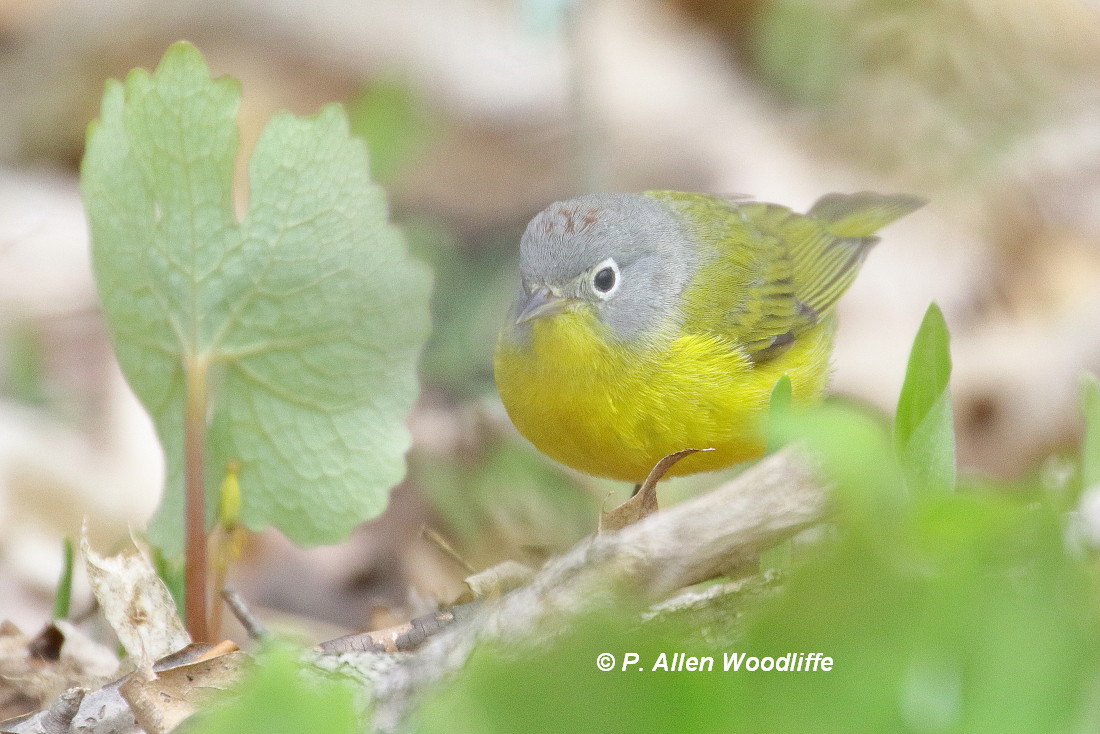
Nashville Warbler (M)
|
 |
Northern Parula (M)
|
Next is an Orange-crowned Warbler. It was photographed in the autumn, as you can tell by the seed heads of a goldenrod in the photo.
 |
Orange-crowned Warbler (M)
|
 |
Ovenbird (B)
|
 |
Palm Warbler (M)
|
This next one is a Pine Warbler. It is a winter shot, as I got it coming to a feeder in January!
 |
Pine Warbler (B)
|
I have featured Prothonotary Warbler on many occasions, as it is Rondeau's unofficial bird species, and certainly my favourite.
 |
Prothonotary Warbler, male, (B)
|
 |
Tennessee Warbler, (M)
|
The Townsend's Warbler is a western species. I found the first Rondeau record back in May of 1983. Interestingly, the Rondeau area has had more records of this species than any other location in Ontario. It is more often found in late fall here. This photo was taken in late November.
Worm-eating Warbler, next, is a southern rarity. There are not many records for Rondeau, with barely one report annually.
 |
Worm-eating Warbler (M)
|
 |
Wilson's Warbler, (M)
|
 |
Yellow-rumped Warbler (M)
|
Yellow-throated Warbler, next, is generally a southern species. There are a few records for Rondeau, and at one point, for several years in a row, a male showed up in the vicinity of a cottage and the Visitor Centre. On one occasion there was a female as well, and it is believed that attempts were made to nest, although in spite of the search efforts of various birders, it was never confirmed.
 |
Yellow-throated Warbler (M)
|
One of the most common warblers in southern Ontario and elsewhere, is the Yellow Warbler. It is an abundant breeding species, and it is not unusual to see several dozen on a day in May. On occasion, one may encounter more than 100 in a single day in May.
 |
Yellow Warbler (B)
|
There are several other warbler species that have been recorded at Rondeau, some of which are almost annually occurring. These include Kirtland's Warbler, Prairie Warbler, Swainson's Warbler, Kentucky Warbler and Connecticut Warbler. For various reasons, I have yet to be able to photograph any of these five. Will it happen in 2022? Maybe!
If you would like to subscribe, or unsubscribe, to Nature Nuggets, send an email to prairietramper@gmail.com