Showing posts with label Great Plains Ladies-tresses. Show all posts

Tuesday, 28 October 2014

Middlesex moments

I've had the privilege of doing some fieldwork on some sizable private property in Middlesex County recently. It was a place where I had never spent any time before, but as a result of this field work, look forward to getting back next year.

There was a nice variety of habitats, including woodland, wetland and prairie. If you've been following my blog posts for very long, you will know that I have a particular fondness for tallgrass prairie, so coming across some of these patches was unexpected, and definitely a highlight.


What made this site interesting was the dominance of Little Bluestem (Schizachyrium scoparium).
Little Bluestem seedhead

And one of the highlights, was to find an Eastern Hog-nosed Snake! This species is one of the most fascinating of our native reptiles. They are very rare, considered a Species At Risk in Ontario and Canada. They are named for their flat, upturned snout which enables them to dig in the sand searching for toads, their primary food source. They can vary in colour....this one is quite dark above, but I have seen them a mottled orange and black, brownish and also a whitish-gray. What makes them especially fascinating is their behaviour. When startled or threatened, they will vibrate their tail to sound like a rattlesnake. Other non-rattlesnake snakes do this as well.

If they are handled, they will excrete a very foul smelling substance. But if this doesn't scare away the potential threat, it will hiss and puff up like a cobra, and even pretend to strike. Which is amusing, since they don't have any teeth at the front of their mouth. (They do have teeth towards the back of their mouth cavity, but they point backwards and are important at deflating toads which will puff up as they are being eaten, so puncturing the toad will enable it to be swallowed more easily.) And if this doesn't scare away the potential threat, they will go through various contortions, writhing and eventually turning upside down to play dead. It is really quite well done, as when they are upside down playing dead, their tongue will hang out, and there will even be a drop of saliva at the tip of the tongue.


Another good species to find at this site is this Great Plain's Ladies'-tresses (Spiranthes magnicamporum) which is ranked as S3.
Spiranthes magnicamporum

A more common prairie plant of late in the season is Fringed Gentian (Gentianopsis crinita). It is certainly more common than the aforementioned Spiranthes, but not all that common and always a treat to find.


As mentioned, we also had the pleasure of surveying some woodland and wetland areas, including floodplain. Here one of my colleagues carefully manoeuvres his way across a small beaver dam.


Along the creek system, we came across a large Chinquapin Oak (Quercus muehlenbergii). It was approximately 80 cm in diameter. It isn't one of the more common oaks of southern Ontario, and is always nice to find. However it is typically found on more upland sites than this one was occupying. I had never seen one right at the edge of a creek system before! We also came across a large White Oak nearby, which measured almost exactly 36" diameter (~91.5 cm), a good sized tree indeed.

Chinquapin Oak

I hope to get back to this site next spring!

Elsewhere in Middlesex Co, I've stopped in at Skunk's Misery quite recently. Skunk's Misery is a large woodland complex in the southwestern part of the county. About half of it is privately owned, but fortunately for those of us who like to wander through natural areas, the other half is owned by either the Lower Thames Valley Conservation Authority or the county of Middlesex. The mosquitoes can be pretty abundant during the late spring and summer, but most of them have disappeared by now. I enjoy autumn walks through some of the trails.


This latter image shows a very large Tuliptree on the left. It measures 1.38 metres (54") in diameter! It is measured at a standard height known as diameter at breast height (dbh) which is 1.4 metres (4.6') from the ground level.


Friday, 26 September 2014

Recent North Lambton travels

I've been out a lot these last few days, so it is time to catch up on some blog posts.

A few days ago I was doing some inventory type of field work with a couple of colleagues at a site in northern Lambton County. The weather was great, and we found some interesting things, including a small tallgrass prairie type of site. There wasn't anything really exceptional in the site.....it hadn't burned for quite some time, and a regular occurrence of fire is absolutely essential for the long-term and short-term health of the prairie and its inhabitants. Nonetheless, we did find a few stems of a rather rare orchid called Great Plain's Ladies'-tresses (Spiranthes magnicamporum), which is provincially ranked as S3. I look forward to re-visiting the site at another time of year to see what other goodies might be present.

There are several other Ladies'-tresses types of orchids, but this is one of the later flowering species, and it is distinctive by its larger size compared to most of the others. It also has a very distinctive fragrance reminding me of a combination of hot plastic and vanilla!

On our lunch break we observed several Sharp-shinned Hawks, a 3rd year Bald Eagle, a Red-shouldered Hawk, a Red-tailed Hawk, one or two common Nighthawks and a couple of Sandhill Cranes.

Back on site, we found a few snakes (Northern Brown and Eastern Garter) as well as frogs (Leopard and Green) and American Toads, but nothing exceptional. Some of the plants we were on the lookout for we encountered, including American Ginseng, Green Dragon and Butternut, all officially Species At Risk. Due to their significance and legislated rarity, I will not divulge their locations. 

This next image features a fruiting individual of American Ginseng. It was not taken at the site we found it, but is one I had in my photo files. I did take a photo with my cell phone, but on the chance that someone could obtain the location from the cell phone pic via some internal GPS reading, I decided not to use it here (aside from the fact that it is a relatively poor quality). I do not have my main camera connected to any GPS coordinate software, partly so no one can track the location where I have taken my photos. American Ginseng is highly sought after by collectors for its apparent medical benefits, and the major illegal collecting problem is the reason it is now a Species At Risk.


Towards the end of the day, we were travelling near Kettle Point, and noted an obvious movement of raptors. In a matter of minutes we recorded several kettles (appropriately near Kettle Point!) of Broad-winged Hawks totalling more than 500 birds, a juvenile Bald Eagle, 2 or more Red-tailed Hawks, more than 20 Sharp-shinned Hawks and 20 Turkey Vultures. Later in the day, I read where a resident of the area had reported a total of 15,600 hawks passing through between 1-4 p.m., just to the north of where we saw our birds a bit later.


Broad-winged Hawk


I had heard from another birding friend that large numbers of hawks can be found migrating along the Lake Huron shoreline during periods of brisk east to northeast winds. The brisk southeast winds of this particular day had pushed migrating hawks up along the Lake Huron shoreline, so we were at the right spot at the right time to view this phenomenon.

Before heading back home to Chatham, I stopped in at one of my favourite places in north Lambton to view one of the area's relatively well-kept secrets. 

One doesn't normally associate waterfalls in the extreme southwestern flatlands of the province. If one wants to see such landscapes, one has to go to the more rugged part of the country along the Niagara Escarpment or central/northern Ontario, right? 

Not!! 

This waterfall is located at Rock Glen Conservation Area, at the NE edge of Arkona. The Ausable River Conservation Authority manages this site which is famous for its fossils in the sedimentary rock that are exposed along this stream. There is a parking area, picnic area, rustic washroom facility, museum and best of all, a hiking trail compete with stairway to reach the bottom of the gorge to see the falls up close. The first photo shown above was taken from 2/3 of the way down the stairway.

Side views are generally my preference, but one can get downstream a bit to see it from different vantage points and angles. One has to be cautious, of course, because the wet rocks are slippery!!!

Venturing a bit farther downstream, one can get intimate views of some of the minor sections of the falls.

A few days earlier, I had noted a plea for help posted on ONtbirds to track down a certain Great Egret which had been spotted in the Petrolia area. This egret had a blue wing tag, but the tag number was not easy to determine. So while travelling down hwy 21, I stopped where Black Creek flows under a bridge immediately north of Oil Springs. My primary goal was to photograph the flooded creek, overflowing with water from recent rainfall events. 


As I looked at the flooded pasture, I noted a Great Egret, and upon a closer view, noted it had a blue wing tag. Out came my 'scope and telephoto lens.


Part of the individual identification alpha/numeric code was visible, but even in looking at the bird for several minutes with my 'scope, it was clear that the letter was hard to discern. I sent the photos to the individual with Environment Canada who did the banding. We agreed that it was likely bird 95K rather than 95R. This bird was banded this year on June 26. The colony was on an island in southern Georgian Bay and the bird was too young to fly when it was banded.


Monday, 8 September 2014

Rondeau, September 7

Yesterday (Sept 7) it was time for another trip to Rondeau. It is the time of year when, due to the cooler temperatures and bright sunny days, it is so invigorating to get out. There can still be some hot steamy days, but I can work around those.

On the way to the park, I always check one of the harvested wheat fields along County Road 15, across from the Keith McLean Conservation Area. Not that long ago one could typically see a family of Sandhill Cranes feeding in the wheat stubble. It is believed they nested in the wetland at the head of the bay, near The Summer Place campground. I didn't see them on this trip, so possibly they have moved on.


A Willet had been seen on Saturday by Blake Mann at the pond adjacent to the Dog Beach Access, so a stop there was on my agenda. Sure enough, it was still there! (Thanks, Blake!) It was hanging out with 5 Semipalmated Plovers. Willets are not very common this far east, as their normal range is the prairie pothole region in the mid-western part of the continent. In fact I don't see them every year. They pass through for a very brief time in both spring and fall. There are at least half a dozen records for them at Rondeau in late August and early September. Several other birders were around during the day, most of whom saw this bird, I believe. The question is: Willet or Won't It still be there tomorrow :-)

The South Point Trail always has something to offer, so it was next. There were birds, but not many warblers....they must have moved on with the clear skies and northerly winds overnight......although there were a few small passerines flitting well back in the shrubbery. Swainson's Thrushes were plentiful, as were Cedar Waxwings.

The shrubby vegetation found here is the type that produces masses of berries, which are essential fuel for birds. Most of them are dogwoods, and already the white or bluish berries of the two main species of dogwood are noticeably dwindling, so there have been lots of warblers and thrushes passing through recently. There are lots of red berries still around, however.
They look inviting enough, but the reason they are still plentiful is because the birds know that at this time of the year they are too bitter. These berries are of the European Guelder Rose (Viburnum opulus), a.k.a. Highbush Cranberry. The European variety has been planted elsewhere in the park and beyond for ornamental purposes. After the berries are eaten, the seeds may be dropped a long way away from their original location, and subsequently become well established.

The berries look very similar to the native Highbush Cranberry (Viburnum triloba). Birds only eat the berries of the European variety after the dogwood berries have been picked clean and even then, they do so reluctantly. In fact sometimes the Highbush Cranberry berries remain on the bushes all winter. By late in the winter the berries have fermented enough to be somewhat edible. If you see a flock of Cedar Waxwings feeding on them at that stage, the birds can even appear a bit drunk due to the fermentation!

There are lots of grasshoppers along the open, grassy areas along this trail. Some of the 'hoppers are identifiable by the colour of their hindwing, but you only see that for a brief time when they are in flight. This large grasshopper below is probably the Carolina Grasshopper, identifiable in part by its long wings (longer then the abdomen), large size and specific arrangement of black markings on the inside of its hind legs. It is widespread across much of southern Canada and the US.


There were a few butterflies around, as expected: Mourning Cloak, Summer Azure, Orange Sulphur, Northern Crescent (lots!) and Eastern Comma were all noted.

Eastern Comma
The edges of these semi-open woods are full of sunflower species. One of the most abundant ones at the moment is Pale-leaved Sunflower (Helianthus strumosus).

Pale-leaved Sunflower

Another one that is found along the woodland and open trail edges is White Lettuce (Prenanthes alba), a.k.a. Rattlesnake Root.
White Lettuce
It is also a member of the sunflower family. If you look closely at the stamens of the open flower on the left, you may see a mosquito resting there.

Yet another plant that is often seen along sunny edges, or even open disturbed areas, is the White Vervain. It often looks quite unkempt, especially as it gets older, with very long branching stems, and often a dusty look to its leaves. There are seldom any more than 3-4 tiny flowers present at any given time, but the long branches of the flowering stems last a long time. The plant may go on flowering for well over a month.


There is an abundance of insects and other invertebrates in the dense vegetation at this time of year. In some cases the young are developing, such as these nymphs of the Red Milkweed Beetle.


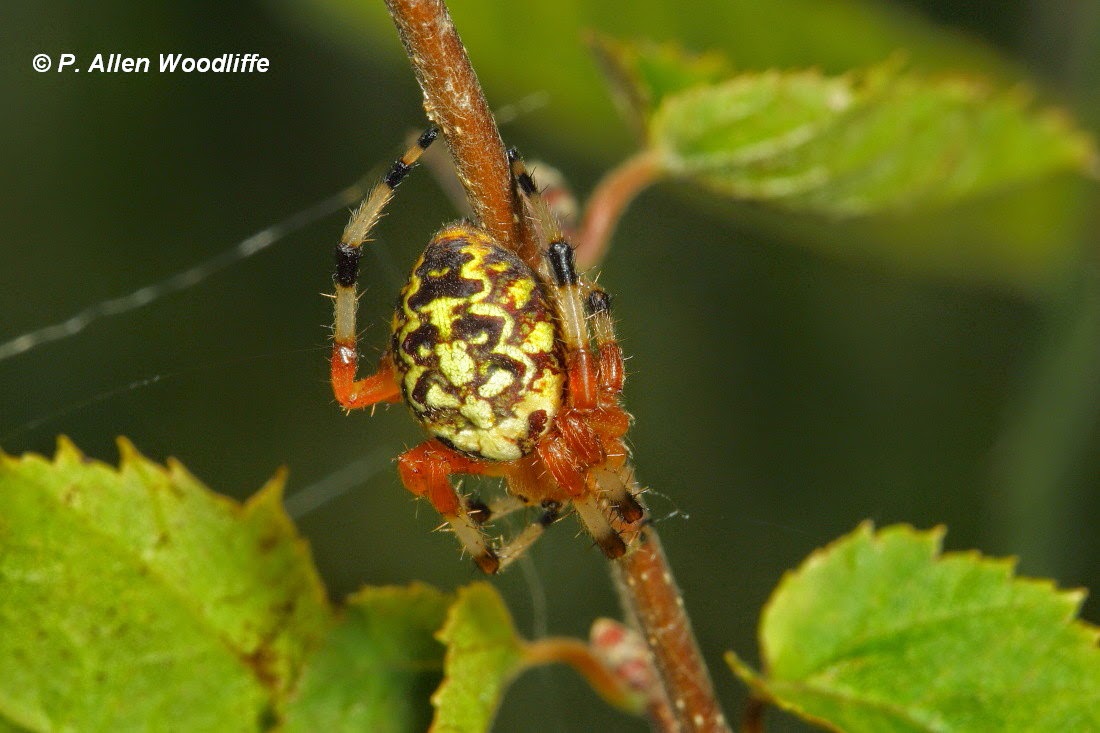
And spiders, which aren't technically insects since they have eight, not six, legs, are in the invertebrate group, and are abundant as well, as they are feasting on the multitudes of insects. One of the more common ones in the shrubbery and grassy vegetation is this Marbled Orb Weaver, as illustrated in the top and side views that follow.


A colourful little critter, isn't it? Most spiders are, if you get close enough to appreciate it :-).

Another species of spider will lay its eggs in a sac and attach it to a sturdy stem with spider silk.


Eventually hundreds of these little spiders, appearing as miniature replicas of the adult will hatch. They will stay in a tight cluster for awhile, exploring their local area via the silk threads but returning to the web cluster. I have images of these spider clusters taken a few years ago.

In the richer and moister parts of the woodland, especially towards the north end of the park, are a few colourful plants which are in flower right now. This first one is Richweed (Collinsonia canadensis). It is a southern plant and not a weed at all in spite of its name. It is, however, restricted in Canada mainly to the Carolinian Life Zone, of which Rondeau is one of the main areas.

Richweed

Another one that has a much wider range, is this Great Lobelia (Lobelia siphilitica). It is related closely to other colourful native lobelias such as the brilliant red Cardinal Flower often found in wooded wetlands and the pale blue Pale-spiked Lobelia, found in tallgrass prairie.

Great Lobelia

The rich, moist woods is also the domain of salamanders. The Blue-spotted Salamander is one of the more common ones of Rondeau.

Blue-spotted Salamander

And finally for this post, I present this orchid: the Great Plain's Ladies'-tresses (Spiranthes magnicamporum). It is the last of Rondeau's 19 orchid species to flower. And it is just getting underway now.


You may recall that I did a post earlier in the season featuring the early season orchids of Rondeau and area. There will be a future post featuring the later season orchids.