Showing posts with label Mute Swan. Show all posts

Sunday, 9 February 2025

(Mostly) Water creatures and a memorial marker

 Most of my outings of late have been out where there is a bit of open water, since woodlands and non-wetland areas seem to be fairly devoid of birds, at least those that are able to be successfully photographed. So places like the Erieau harbour and immediate area with at least some open water, is one where ducks and other waterbirds collect. 

American Coot can be found, sometimes by the hundreds, but they are usually well out in open spots too distant to photograph. Some will hang out in the main channel.

Canvasback are regularly seen.
A comparison between Canvasback, in front, with a Redhead, behind.
Common Goldeneye are relatively few, but regular.
Scaup, primarily Greater Scaup, are well represented. There are strong similarities between the two, but the Greater Scaup, shown here, has a fairly rounded head. It also has a wider black tip of the bill.

Hooded Mergansers, the smallest of the three merganser species in the area, are around in small numbers, such as this female.

A bit similar to the scaup is the Ring-Necked Duck, with its more pointed head, and a distinct white area on its frontal flank as well as across the outer part of the bill.

Mute Swans, next, are not native to North America, and are not well regarded by birders or wildlife biologists, as they are very domineering over native waterfowl. They were introduced to North America by Europeans after settlement. But one should realize that in themselves they are impressive and beautiful birds. There are often a dozen or more scattered around Erieau.


There isn't much open water in the Thames River these days, given the extent of cold weather in recent weeks. But where the warm-water outlet occurs, there are usually a few ducks. American Black Ducks, shown first, are much fewer than Mallards which follow. At Erieau, there are often quite a few Am Black Ducks.....


....and an occasional female Red-breasted Merganser will be seen.

Not a duck, obviously, was this Beaver swimming through the open water, carrying a branch to its burrow, likely in the side of the river bank.

Northwest of Chatham, there is very little open water on Lake St. Clair or adjacent rivers, but where there is some, one can find a few birds. This next, somewhat distant, photo was taken from the very north end of Bear Line, looking in a small area of open water along the Chenal Ecarte, a.k.a. the Snye, which separates Walpole Island First Nation from the Ontario mainland. Most birds were Canada Geese, with a few Mallards, scaup, and Hooded Mergansers mingled within. A closer look just to the right of centre shows one of the four Great Blue Herons hanging out with the waterfowl.


 One of the herons was off by itself on the ice.

Elsewhere in a few spots were some Tundra Swans in some corn stubble. At first glance, due to the lack of the yellow patch on its black bill, one might figure it is a Trumpeter Swan. However some Tundras lack the yellow patch, and the black gap right in front of the eye is narrow like a Tundra. Also the swans that it was associating with were all Tundras, so it was an easy decision.

Elsewhere I came across a couple of Wood Duck boxes, which maybe in the spring will have a Wood Duck family occupying it, but at the moment, there is an Eastern Screech Owl making use of it.

On a sad note, I came across this marker along the road not far from St. Clair NWA. It marks the location of where a murder victim was dumped over the road bank and into the adjacent channel. It was in early January of 2024 when I was out looking for Snowy Owls that I came across this victim from Tilbury, and reported it to the police. I waited until they arrived, gave them the details of my discovery, and then left so they could get their investigation underway. Three people all known to the 54-year old victim, were charged with murder, and the case is still before the courts. Certainly unfortunate in so many ways, but such is the reality of society. This is the first, and hopefully the last, time I encounter this type of thing. It is along a road that I regularly drive, so there are unfortunate reminders of this every time.


If you would like to subscribe, or unsubscribe, to Nature Nuggets, send an email to: prairietramper@gmail.com


Wednesday, 22 February 2023

Whoopee....a Whooper!

 In the last few days, a Whooper Swan has been seen in the Rondeau Bay/Erieau area. It is the first time one has ever been seen in Rondeau checklist area, or even in Chatham-Kent as far as I know. However why it did get a bit of attention with local birders, birders from afar did not pay it much attention. The reason? It is likely an escapee from someone's waterfowl collection.

The Whooper Swan is a very large swan, native primarily to northern Europe and Asia. While there are occasionally legitimately wild records of birds in western North America, the fact that it is a sometimes popular swan for captive waterfowl enthusiasts to have in their collections, sometimes birds escape captivity and can show up in the area where they escaped from.

I am not aware first hand of who in the region has a few captive waterfowl, but I do know there are some, and there have been a few records of this species in wild areas across southern Ontario in the past. All have been treated as escapees. (Update: Mystery solved.....apparently a local fun park with various waterfowl recently had three of their Whoopers get spooked, and one headed in the direction where this bird showed up.)

Here is a size comparison with a Canada Goose, which looks fairly small beside it.
There is no question that a Whooper is an impressive bird, not only for its size. The all-white bird along with its massive mostly yellow bill, accented with a nice bit of black, makes it really stand out. A Bewick's swan, which is the European version of a Tundra Swan, also has a fair bit of yellow on its bill, but nowhere near as much or in the same configuration as a Whooper has.
The bird can obviously fly, since it has been seen in several areas in the vicinity of Erieau along the shoreline of Rondeau Bay, as well as a road-side pond north of Erieau where I got these photos. I am sure the bird did not leave one favourable body of water and walk across fields to get to this much smaller pond. Most owners of captive waterfowl will clip a birds wings, so they are unable to fly. There were no wing tags or leg bands either.
Regardless of its origin, it is nice to see it especially at this time of year when birds are not as abundant as they (hopefully!) will be in a few weeks time.

Just for a general comparison, here are a couple of photos of another exotic swan that has become quite abundant in the wild. It is the Mute Swan which is not native to North America but was released in the wild many decades ago due to its popularity in Europe. It is about the same size, but has a quite different and distinctive bill.


Smaller than both of the preceding species is our native Tundra Swan. It will migrate through southern Ontario by the thousands, and as is often the case, may spend the winter here if there is enough open water.


 A larger, native swan that is about the same size as the Mute is Trumpeter Swan, at one time totally eliminated from southern Ontario but re-established in south central Ontario a few decades ago. It is gradually becoming a bit more regular in its former Ontario range.

Moving on from swans, I have noted a few other things in my travels. For example another white species of waterfowl, is Snow Goose. There were several at the St. Clair National Wildlife Area. I think they have been in the region all winter, but aren't always seen.

They are usually mixed in with the Canada Goose population, and this next photo includes a blue phase Snow Goose, seen at the middle back.
Sticking with a bit of a white theme, Snowy Owls have been mostly noticeable by their absence this year, at least compared to last year. I hadn't seen one since December, but finally saw one the other day. It was on a pile of rubble, which had lots of grasses to partially hide it from a distance.
I managed to maneuver the vehicle slowly to where I could get a relatively clear photo of the bird.
Not far away from the Snowy, I glanced at a Wood Duck box along another road, and saw this Eastern Screech Owl peering out. I have checked this box a few times before, but never seen it occupied until this time.


If you would like to subscribe, or unsubscribe, to Nature Nuggets, send an email to: prairietramper@gmail.com


Thursday, 14 May 2020

Roaming locally, and safely!

Spring continues to unfold, somewhat slower than many would like, but I'm not in a rush to get into full-blown summer. Some years seem to have a long, cool spring, and then it is like someone turned a switch and the heat and humidity are in full force, leaving us to wonder if spring took a vacation. It will be nice to have things a bit closer to normal over the next few days however, as long as the leaves don't unfurl too quickly to obscure the various warblers, vireos, etc. passing through.

The partially leucistic American Robin continues in the vicinity of Paxton's Bush. I might try and canvass the neighbours to see if and where this bird is nesting. It would be interesting to see what any young birds will end up looking like.
I haven't chased any of the rarities that have been surreptitiously reported over the last few weeks. Scissor-tailed Flycatcher, Pacific Loon, Black-necked Stilt and such would be nice to see again, but I have had fabulous views of them elsewhere in Ontario, and sometimes even in Chatham-Kent, so didn't go looking.

I did make a few brief ventures away from home these last few days for various reasons, however. One spot to check out was the Moore Wildlife Area in central Lambton. I wanted to investigate just where I could set up my black light equipment, in good proximity to the Sydenham River as well as being surrounded by forest, to maximize the potential for a good variety of night-time insects. It turns out that a moth I photographed there last year was the first record for Ontario. Who knows what else is out there? While I was examining the prospects, a male Rose-breasted Grosbeak serenaded me from the upper branches of a tree. He had his beak full of things, so it wasn't a full bore song.


There wasn't a lot of bird action there, but I did pick out a couple of spots for my black light adventures, as the weather permits.

A brief stop at Clear Creek Forest on a cool, windy day, kept the birds quiet and under cover. Even this Great Egret, the first I think I have ever seen at this site, was taking shelter amongst some shrubbery along the far side of the upper pond.
While I was in eastern Chatham-Kent, I checked out a very large White Oak that someone had told me about. It is near the municipal campground at the south end of Clear Creek Forest Provincial Nature Reserve, and officially on the boy scout property. You can get a glimpse of it from the road. I took my diameter tape with me, and it turned out to be about 180 cm (70") in diameter. That is a large tree!
I stopped at Peer's Wetland one time as I was passing by. There was a ton of swallows of all types, attempting to snatch up a few insects to carry them through the cool weather. The pair of Mute Swans have successfully hatched their brood.
 While watching the swans for a few moments, I noticed that the male swan was constantly patrolling the water, making sure to keep any and all others away from the little ones. He would first go after one Canada Goose, then another, then another, and so on. While Mute Swans are large, impressive waterfowl, they are also not native, no thanks to humans of European descent who, decades ago, thought they would be an addition to the fauna of North America. And since they are naturally so very aggressive towards the native wildlife, it makes it challenging for the native inhabitants to carry on normally. There is a lesson here....

At any rate, while I was exploring the McGeachy Pond Trail on another day, I noticed that the Mute Swans there are down to one remaining youngster. Presumably the others have served as food for some of the naturally occurring turtle population, most of which are considered officially At Risk. It may sound rather callous, however I can not help but root for the turtles and hope that their numbers will be at least partially sustained by this non-native food source. Go turtles!
I was at the McGeachy Pond Trail due in part to look for a Grasshopper Sparrow, which had been seen earlier in the day at the far end of the trail. I had heard about it while I was over in the Bate's subdivision just outside of Rondeau, and since the birding was fairly quiet at the time, decided to take my chances in going over to Erieau. Arriving at the location about an hour and a half after the sparrow had first been reported, it was not to be found. There was no one else looking at the time, and there had been a variety of walkers, some with dogs, and cyclists passing along the path that the sparrow had been seen. There were lots of sparrows, including White-crowned, White-throated, Swamp, Song and Lincoln's, but no sign of the target species. I looked for at least half an hour and just as I was leaving, another birder came along, so together we looked for a little longer, but came up empty. But that is birding.

I did manage to get a distant view of about 15 Black-bellied Plover out in the field across the road.
On the way back to the parking lot, I came across a couple of Northern Waterthrush....
...and several Gray Catbirds feeding on a shrub of European Guelder Rose, sometimes confused with the native Highbush Cranberry. The berries of the European Guelder Rose are much more tart, so they stay on the branches until late winter or even early spring, when they are still available and birds are hungry enough to go after them.

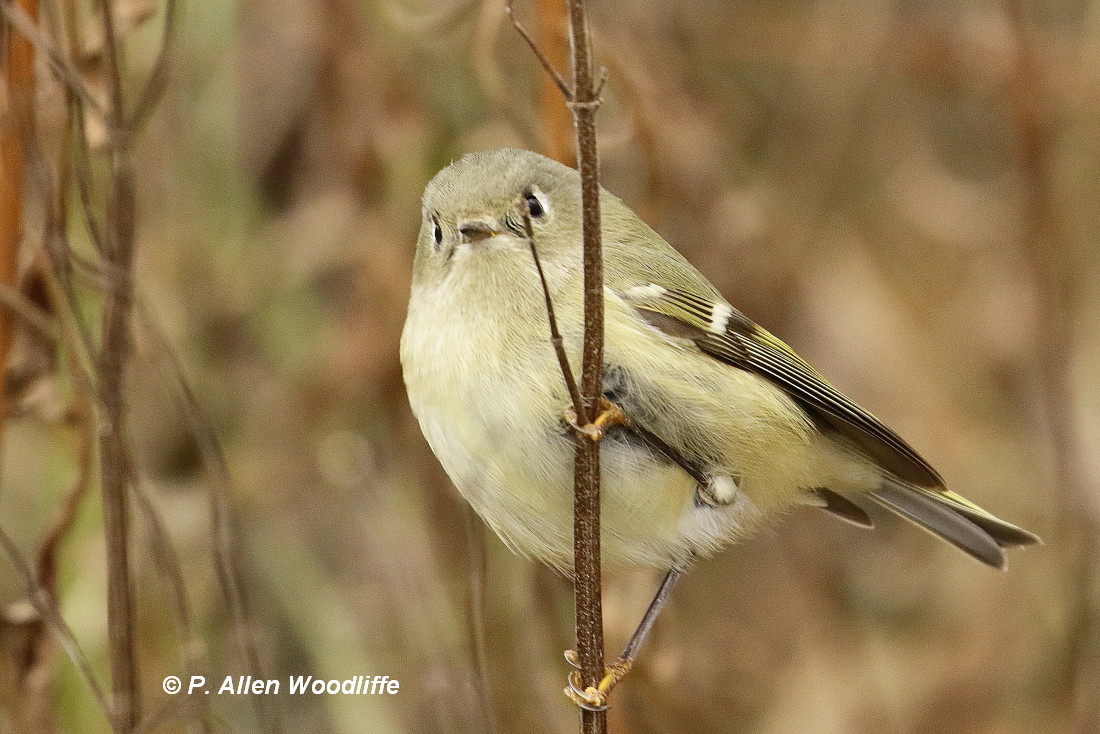
Ruby-crowned Kinglets are everywhere.
There is a lot of Garlic Mustard showing up in many places.
 Manitoba Maple has just about finished flowering.
While I was so close to Erieau itself, I decided to check out the water front. Some less common gulls are always a possibility, as a Laughing Gull had been seen a few days ago, and I had a Lesser Black-backed Gull quite recently. The brisk easterly winds on this day caused many birds, other than cormorants, to find another spot to be. But just as I was starting to drive away from the channel, I caught a glimpse of a black bird with vivid white wing patches, just as it dove into some shrubbery. I quickly pulled off the road and started looking. Was it a Yellow-headed Blackbird, or a Lark Bunting, or a Myna? The first of these three was the most likely, and still an unusual bird for the location. After a few moments, I got a glimpse of the bird amongst the shrubs and on the ground. It was a Yellow-headed Blackbird, my first for the year. It was acting very un-blackbird like. Normally this species will be out on a lawn searching for grubs or something. This was acting more like a thrush or a thrasher, two of the latter which happened to be in the shrubs as well, and difficult to see.
I got a few record shots and put the word out to a few local birders. Steve came by a few minutes later and we got a few more partial looks, but no better photo ops. Garry arrived a bit later, and for some reason this bird escaped without being seen again. As before, that's birding.

Rondeau opens tomorrow! It will be nice to see it after the almost two month hiatus since it closed!


Wednesday, 20 March 2019

Avian Harbinger(s) of Spring

Today, March 20, spring arrives. It seems to have been slow in coming compared to some years. In considering some of the bird arrivals, there have been a few indications of its arrival. Certainly one of the ones quite obvious has been the arrival of Tundra Swans. But by now, many of them have moved farther along their northern migration pathway.
 Ducks are present in quite impressive numbers. As the ice disappears from places like Rondeau Bay, there can easily be 10,000 or more birds of a couple of dozen species scattered across the water. And flooded fields are popular with some. The flooded fields of the Keith McLean Conservation Lands, just north of Rondeau, have had several hundred ducks. One of the more common species in recent days was American Wigeon.
 On occasion there will be the much rarer Eurasian Wigeon somewhere in the mix. Such was the case late last week, although it was never very close for photography.

 Also seen from time to time was another unusual wigeon, which may be a hybrid between American and Eurasian. I haven't seen it yet, but may do so soon.

Some waterfowl are already getting underway with nesting. Pairs of the non-native, and very aggressive, Mute Swan are establishing territories in marshy sections.
 Other species are pairing up even as they pause here in southwestern Ontario before making the next leg of their journey.
Northern Shoveler

Bufflehead
Land birds are becoming more plentiful. American Robins have arrived in good numbers lately, with the darker headed males being the first to arrive.
 Golden-crowned Kinglets are constantly on the move in the shrubs and grasses, searching for an insect to devour.
 Northern Cardinals are frequently heard in song on the sunnier, warmer days.
 There has been an influx of Song Sparrows lately. It is not unusual to see 50 or more in just a couple of hours or so, scattered throughout the open areas and shrubby edges.

But the real harbinger of spring, at least to many, is the Eastern Bluebird. On occasion one or more will manage to stay the winter here in southern Chatham-Kent, but this year there were none to be found once winter finally arrived. So it was with great delight that birders came across half a dozen or so of them at Rondeau in the last few days. Most were seen in the oak savanna habitat between the campground and Lakeshore Road.
 For a brightly coloured bird, they can sometimes be difficult to find as they perch quietly on a branch scanning for evidence of an insect in the dead vegetation below. But watch carefully and eventually their movement will give them away. They don't like to be approached, so waiting quietly for them to come closer is often the best solution. At least it worked for me as they got closer and did not seem to mind my presence.