Showing posts with label butterfly. Show all posts

Thursday, 28 September 2017

Butterfly Bonanza

One doesn't normally consider September, and late September at that, to be a prime time for finding butterflies. But then the extended mid-summer weather isn't exactly normal, either.

It had been a little more than two weeks since I had last been to the McGeachy Pond trail and checked on the butterfly bush by the west end parking lot, so I decided it was time again. I went out this past Tuesday morning....another hot sunny day.

The butterfly bush still had numerous flower clusters, with lots of butterflies vying for a spot from which to sip the nectar. It was hard to decide which butterfly to photograph first! The west end of the trail also had numerous butterflies, and overall I ended up with well over 150 butterflies of a dozen species! This area had been mine to cover during the butterfly count back in July, a time when butterfly diversity is usually at its peak, but on that occasion I got only half a dozen species and only a few dozen individuals at the most.

The following photos were taken on this visit. I didn't attempt photos of Cabbage White or Red Admiral.

It has been an excellent late season for Painted Lady. On this occasion I saw at least 30, and most looking quite fresh.

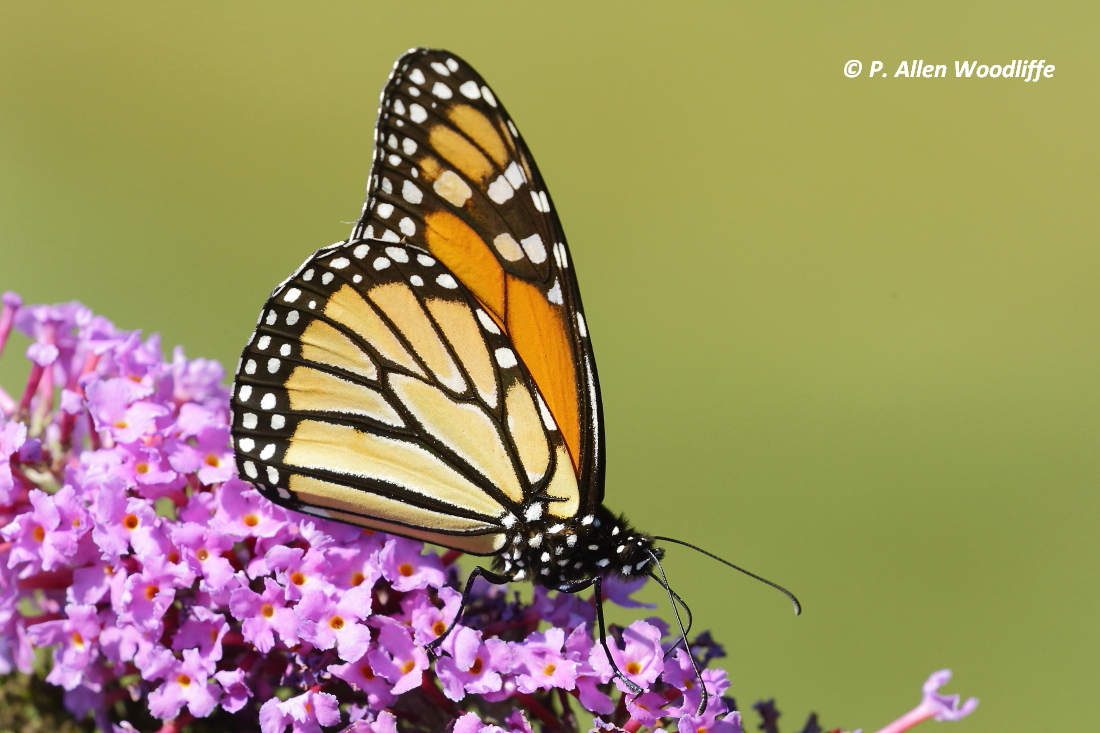
 Monarchs were not surprising at all, as they are well into their southwestern migration. There were at least 22 of them.
 Silver-spotted Skippers were few....no more than 5.
 I didn't bother counting Orange Sulphurs, although there were at least a dozen.
 One which I was hoping for was Fiery Skipper. If it shows up in southwestern Ontario, it is usually late in the season, so not a total surprise but nice to finally see one for the year. There were actually two individuals.
 Gray Hairstreak is also more likely to be seen later in the season, and this single individual was my first of the year, and one of the few I've photographed in recent years.


Along the trail was a profusion of goldenrod and New England Aster, among others, but it was clear that New England Aster was the favoured plant.

There were a few Clouded Sulphurs, another quite expected species.

Common Buckeye is another late season species. The one individual I observed wasn't my first of the year, but I've seen no more than half a dozen so far.
 Certainly one of the highlights was to see a super abundance of Bronze Coppers. I had a couple on the early July Butterfly Count, a little early for them, but only one or two since. It is a species that is often associated with wetlands, so the adjacent McGeachy Pond wetland was undoubtedly a factor. I was quite surprised to count at least 55 individuals along the trail, certainly more than I usually see in an entire season!
 It wasn't uncommon to see three or more in close proximity to each other......
 .....or even 7! There are 6 visible (one only partially) in this tight shot.
 Another first of year for me was this Common Checkered-skipper. It had been reported in other areas, but for some reason has not been common in Chatham-Kent. It is very tiny...about the same as the width of the aster flower head.
While the temperatures are dropping a bit for a few days, getting to be about normal, a slight warming trend early next week will likely continue the butterfly action, so at least one more visit will be attempted then to see what differences there might be. Stay tuned!




Friday, 25 August 2017

Transformation of a monarch

It is always fascinating to see the transformation of invertebrate life. In my opinion, there is no more interesting example than to follow the development of a butterfly, and in this case, the Monarch butterfly.

The following images weren't all taken in the last few days, but many of them were. This first one shows an adult female with the tip of her abdomen turned up to the underside of a milkweed leaf as she lays an egg.

 The egg is very small, as to be expected. It is only a couple of millimetres in diameter.
 After a few days, it hatches (hopefully!). Ants are known to find and consume the developing larva, so not all eggs will hatch. Upon hatching, the larva consumes the remains of the egg and will chew a small hole through the leaf.
 This next one shows a larva that is probably 2-3 days old. It hatched out on a small milkweed plant that I was growing from seed in some plug trays.
 Over the course of several days it feeds ravenously.

 After several periods of growth, it gets to the point where it seeks out a place to change to its pupa stage. This usually is in a more obscure location, and often happens well away from the milkweed plant. The caterpillar hangs upside down with its hind end producing a sticky mass of threadlike substance which will provide an anchor, holding it in place while it develops into the adult. While hanging upside down, the caterpillar splits its skin and wriggles out of it, revealing this beautiful chrysalis of the pupal stage. It is decorated with black and gold spots.
When the above photo was taken, it shows a slight darkening of the chrysalis at the bottom. Just before the adult emerges, the outer part of the chrysalis turns clearer and somewhat brown. A close look will show some of the detail and colour of the newly formed adult inside. I wasn't expecting it to happen quite so quickly, and so I missed that part! This next photo was taken less than 24 hours after the one above. The new adult emerges and climbs a bit to a surface where it can hang for several hours while its body fluids are pumped into the venation network making the wings rigid.

 Usually within 4 or 5 hours of emerging, the butterfly is able to take flight and will hopefully survive to continue the propagation process.
It truly is an amazing transformation!

Now that the end of August is close at hand, over the next few weeks, Monarch butterflies will be heading south and west by the hundreds of thousands, on their long journey to the wintering ground in some Mexican mountains. In southwestern Ontario, the peak of their migration seems to occur from about the middle of September to the end of the month, although some individuals can be seen up to the end of October or even after. It all depends on when the latest generation emerges as an adult, which is somewhat weather related. Corridors of natural vegetation and lots of milkweeds are critical for the butterflies to make it to Mexico as well as for future generations to return.

Thursday, 9 June 2016

A very rare butterfly, new for Chatham-Kent....

.....and a very rare one for anywhere in Ontario!

A few days ago, Marie was working around in our back yard as she often is. At one point, she popped her head in the back door, telling me that there was a butterfly on our chives, and that she thought it was a skipper. I left the computer, grabbed the camera and went out.

Good call, Marie....a skipper it was, but it wasn't one I was familiar with (there are a few that fit that category :-). I got a quick shot, bent down to get a different angle all the while looking through the viewfinder, and before I got a second shot, the skipper shot out of view. I quickly looked up, but the little rascal was nowhere to be seen.

I waited and watched, and combed through the rest of the yard hoping for another opportunity, but it wasn't to be. So I eventually gave up, went inside and downloaded the single image onto the computer. I checked what reference books I had, and tried to identify it. Even after looking through at least three books, the only one that seemed to match it was a male Zabulon Skipper.

It is rare in Ontario....very rare....could it be that one?

There is apparently a very small population on Pelee Island, and there have been a couple of records in neighbouring Essex County, primarily in the Ojibway area of Windsor. So I sent the image to Paul Pratt, naturalist extraordinaire and retired director of the city of Windsor's Ojibway Nature Centre who would be much more familiar with this species, as well as any similar skippers that I could be mixing it up with. Needless to say, I was pleased when he got back to me later in the day, agreeing with it as a Zabulon Skipper!

Zabulon Skipper
I believe this is the first record for Chatham-Kent, and likely the first one in Ontario beyond Essex County. It normally inhabits the southern, central and eastern US, barely reaching to southern Michigan on occasion. Undoubtedly this one blew in on some of the brisk south/southwesterly winds of a few days earlier.

This discovery has made me even more aware of that challenging group of butterflies known as skippers. So small, so similar to each other unless you get that angle with all the right views, that many of them remain as skipper spp. Without having the camera handy and getting in this one shot, successful identification would not have been made.

Note: an update to this post is forthcoming!