Showing posts with label White-crowned Sparrow. Show all posts

Saturday, 9 December 2023

A Long-tail, lingering shorebirds, snow geese, and puttyroot

 More about fungi in a future post, but for now, there is a bit of catching up to do mostly regarding birds. With the weather being above normal, there is lots of open water, including muddy edges for lingering shorebirds. I was at the Blenheim Sewage Lagoons a few days ago, and was treated to some good photo ops. Certainly a highlight was to get a pair of cooperative Long-tailed Ducks fairly close to the edge of the middle pond, and they didn't seem to mind my presence all that much.

Long-tails are not seen all that often in southern Chatham-Kent, although they do occur on Lake Erie, but usually seen only from a distance. The southern end of Lake Huron at Point Edward can be a good spot in the winter, so seeing them so handily at the lagoons these last few days was a real treat. They swam back and forth, dove under at times,

...and got up to fly around. They didn't go far, staying at this middle pond all the time I was there.

Some shorebirds were there to be found as well. Three Dunlin, which also stayed close enough to be photographed were there. Again, with the weather being what it has been, it wasn't a bit surprise, but nice to see just the same.

There is a lot of mudflat along the Erieau Marsh Trail, and a Pectoral Sandpiper has been seen from time to time. It is much less likely to be seen this late in the season than the Dunlin, so I was pleased to get this photo, even though it was at the far side of the mudflat and the photo is greatly cropped.

There were three Lesser Scaup in the more open area of the mudflat, where there was open water, but they were far less tolerant of me aiming my lens at them. I guess it being hunting season, with a couple of hunter's duck blinds not all that far away, it wasn't too surprising.

While I was at Erieau, I checked the waterfront, hoping that there might be a Purple Sandpiper or some other shorebird hanging out along the shoreline, or even at the pier, but it wasn't to be on this day. I did manage to get a reasonable photo of a Snow Goose along the shoreline, as it was with a large flock of Canada Geese....

...and when I took a drive by St. Clair NWA, in amongst the gazillion Canada Geese were at least eight Snow Geese....
...including several blue phase Snows.

In meandering around the former Dover Twp.,  I knew that a particular Wood Duck box was often used by an Eastern Screech Owl. It was there on this visit, nicely peering out at me.

I went out to the Jeannette's Creek boat launch, hoping to catch sight of a lingering Great Egret, which happens this late in the season from time to time. In fact it was just a few short years ago when up to three hung around for the SCNWA Christmas Bird Count, and even stayed well into January! But there were none to be seen on this day, although there is lots of area for one or more to still be around. So instead, I satisfied my birder/photographer's urge by shooting this Belted Kingfisher. It was on the far side of the Thames River, so is greatly cropped. I doubt it even knew I was there.

There were up to 6 Great Blue Herons that I saw, or at least partly saw. They were usually obscured by something or other.

I usually make it out to Rondeau on one or more occasions each week. I haven't been out at the right time to catch up to the Western Flycatcher of a few days ago, or even the adult male King Eider that was a flyby for a few hours one day. The Western Flycatcher would definitely have been a new species, but the King Eider is something I have seen before. It was on the Rondeau CBC back in about 2000 when one that had been seen in the Erieau area off and on. It was present when I got to the west end of the south beach of my territory, so already had that species on my Chatham-Kent list. But there is no question that an adult male would have been great to see. But in my various wanderings through the park, I was able to digitally capture a few of the more expected species, as follows.

American Tree Sparrows are fairly commonly seen....

...as are Dark-eyed Juncos.

House Finches are resident, although not abundant.
White-crowned Sparrows, such as this immature one shown next, seem to be declining this late in the season....
...but White-throated Sparrows are plentiful.
At one point this accipiter type of falcon showed itself briefly, but I only got a look at it from the backside. Based on the overall size, and the length of its tail beyond the wing tips, as well as the slightly pale back and side of the head, I felt it fit Cooper's Hawk most closely. It certainly is a relatively common accipiter type.
On one of my trail jaunts, I checked the leaves of a rare orchid: Puttyroot. The leaves are most visible from about November through April, as long as they aren't covered with snow. While this known population only had two flowering stems this past June, on this visit I counted a total of 146 leaves, one of the highest totals I have ever had in all the years I have been watching this population! It will be interesting to see how many flowering stems appear this next June.

Since it is getting close to Christmas, I will put in a plug for my first book, Life on a Sandspit, which I published last spring. 

 It is still available at several locations in Chatham-Kent, including:

Bayview Market, Rondeau

Mindful Market and Eco Hub, Blenheim

Mitton's Jewelers and Gifts, Ridgetown

Five-Eau, Erieau

Book Brothers, Chatham

Sydenham Field Naturalists, through their web site sydenhamfn@hotmail.com

Friend's of Rondeau Bookstore at the Rondeau Visitor Centre, although the centre is only open on weekends and the bookstore is not always open. The centre will be open more frequently during the Christmas break.

And just so you know, I have a second nature book at the printer, titled Natural Treasures of Chatham-Kent. I am not sure when it will be available for purchase, so stay tuned for a future blog in the very near future describing it in some detail, as well as where it would be available, price, etc.


If you would like to subscribe, or unsubscribe, to Nature Nuggets, send an email to: prairietramper@gmail.com


Sunday, 29 October 2023

Random seasonal highlights, late larvae, etc.

 With the seasonal ups and downs, it must have some of the butterflies confused. I don't recall ever seeing Black Swallowtail caterpillars so abundant so late in the season, but just in the last couple of days before the temperature took a significant drop (Oct 25), we came across three caterpillars out feeding on some carrots that are still in the garden.

They were all fairly well developed, so if they hurried, they may have been able to complete this stage and form a pupa for the over winter period.

Good luck to them!

The Keith McLean Conservation Lands have been an ongoing place of interest. One never knows what to expect, except that it seems to attract Nelson's Sparrows fairly regularly in October. I have been there a couple of times, and have seen them both times, but they are often elusive and do not cooperate for the camera. Some folks have gotten some quite good photos during their visits, but so far I have only gotten one poor record shot, as shown next.

This is one of my best shots, from a couple of years ago. There is still time for more attempts this year, but depending on the weather, opportunities will be dwindling.

White-crowned Sparrows were a little more accommodating.

There have been lots of Green-winged Teal, and other ducks. This next photo shows some of these teal, and in their midst are some Dunlin and a single Killdeer. Dunlin have been quite abundant, with sometimes more than 100 noted.


Dunlin in flight
Occasionally another lingering shorebird can be found, such as this Greater Yellowlegs I photographed there a couple of days ago.
One or two Great Blue Herons sometimes provide a photo op.

I missed out on the Cattle Egret that was seen on one occasion, but it may still be around somewhere in Chatham-Kent. I will keep looking!

At Rondeau, there is an abundance of berries on some but not all, of the Red Cedars, especially in the campground, and if one can find the right tree that the birds have also found, it can be rewarding. Light is important, but the birds are not considering that in their quest for nourishment. 

Robins, of course....

....and it is nice to see a group of Cedar Waxwings, both adults....
...and young of the year. I kept an eye open for the very rare Bohemian Waxwing, but did not see any. No one else has reported them lately either, but it is not impossible.

Pileated Woodpeckers are year-round residents of Rondeau, but not commonly seen. Decent photo ops are always fun.

It wasn't all that long ago that the forest looked typically like this, still fairly green and luxuriant.

These next few are from one of my 'go-to' spots to show the changes. It is at the corner of Rondeau Road and Gardiner Ave.
October 19

Oct 23

October 27

There is more and more sky showing, but by moving a bit and using a longer focal lens, I can get the colourful tunnel look.

This next photo is at another one of my 'go-to' spots to show the colour. It is along Bennett Ave.

Elsewhere not far from home, I have been up along the Lake St. Clair wetlands. There have been a few of the usual things of interest, including a few Midland Painted Turtles soaking up some late season sunshine.

Sandhill Cranes continue to be seen.....

Duck diversity is increasing, such as these three Northern Pintail in amongst Canada Geese and other ducks.
A highlight was to see this single Snow Goose, not all that surprising given the time of year. More are likely soon, along with things like Ross's Goose and Greater White-fronted Goose. I will be on the lookout for them soon!

If you would like to subscribe, or unsubscribe, to Nature Nuggets, send an email to: prairietramper@gmail.com


Sunday, 2 October 2022

Exploring local wetlands results in some interesting birds!

 Wetlands are the place to be these days, it seems. On one occasion I went out to St. Clair National Wildlife area, which is often a good choice. There are thousands of individuals of waterfowl to be seen, partly because of the great wetlands, and partly because the hunting that takes place in adjacent wetlands, causes many of the birds to take refuge in this NWA. Of course at this time of year, Mallards are by far the most numerous.

American Black Ducks are building in numbers. At the time of settlement, they undoubtedly outnumbered the Mallards, simply because Mallards were a species more common to the west, and Am Black Ducks were more common in the wooded wetlands of the east. Now that the habitat is much more open and wooded wetlands have been converted to agriculture and other forms of development, Mallards are more abundant.

Along the trail I noted quite a few White-crowned Sparrows, both adult birds, shown first....
...and first year birds, shown next.

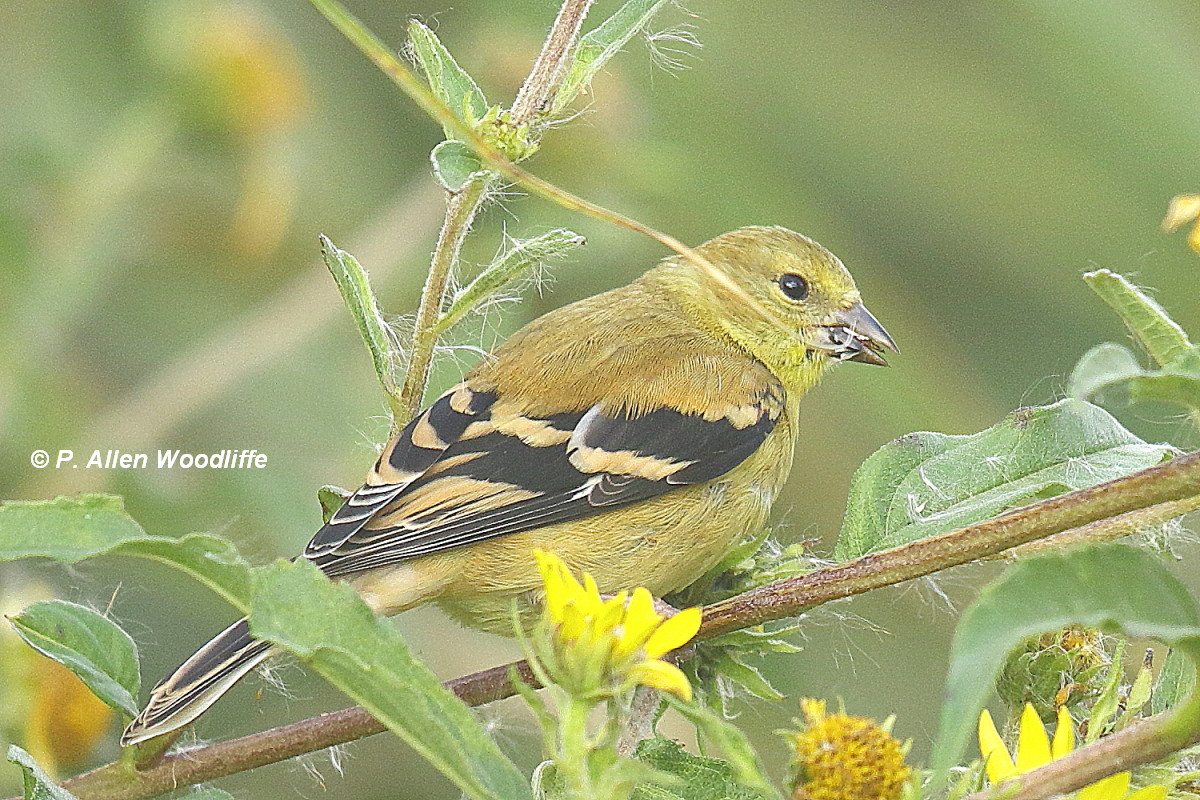
 Lots of American Goldfinches were feeding on the numerous sunflower type plants along the trail.

Wood Ducks are quite common here as well, although at the time these flew by, the bland sky made for extra challenging photography.

At some other wetlands along Lake St. Clair, I had better success at getting more identifiable photos of Wood Ducks.

Not a wetlands species, but along one of the shrubby edges, I encountered this Eastern Phoebe. Again, the bland sky made it a challenge!

In other parts of the wetlands, I came across wading water birds. It was fairly breezy, and these two seemed to be content just to hunker down and face into the wind.


Great Egrets are quite plentiful in the local wetlands, and for good reason. They nest in some of the larger wetlands nearby, and there are lots of things for them to feed on locally. They are especially common in the non-hunted wetlands.
They are regularly seen even in some of the road side ditches.
Will we see them in the numbers and concentration that sometimes have occurred in the past?

If the water levels are low enough, it might happen again, but probably not this year. This setting occurred a few years ago, when the water was drawn down at SCNWA and this photo was taken from the access road at daybreak. There were over 100 birds in the overnight roost.

One morning while I was having my second cup of coffee, this Cooper's Hawk landed in the tree outside the window, with its breakfast (or lunch?) in its talons.

There had been some interesting waterfowl seen from the Erieau Marsh Trail on a couple of occasions: Brant and Greater White-fronted Goose. Neither are common locally, especially the Brant. Unfortunately they did not want to show themselves on a couple of occasions when I was out looking for them. I had to settle for a Trumpeter Swan, not a common species in this area.

I must admit that when I first saw it, I noted the yellow on the black patch of the bill. Many field guides would point out that Trumpeters do not have yellow on those lore areas, only Tundra Swans.

However the size of the swan, more or less the size of the nearby Mute Swan and much bigger than a Tundra Swan, gave reason for a more careful look.


In fact on occasion Trumpeters can have a bit of yellow on the lores, and the size of the bird, in addition to the somewhat pointed white feathering at the top of the bill, and the large and long bill, definitely made it a Trumpeter.
A Great Blue Heron was close by, and usually they are nervous and are quick to get out of camera range. This one must have been quite acclimatized to people on the trail. At any rate, it hardly paid any attention to me, so naturally I had to oblige and take a photo or two (actually, more than two :-)


 I also stopped by the Keith McLean Conservation Lands to see if I could catch up to, and even photograph, one of the Nelson's Sparrows that have appeared there in the last week or so. This site is becoming increasingly popular for this sparrow at least on its autumn migration, and if the food supply and weather conditions work out, one or more may stick around until the Christmas Bird Count in mid-December. 

The amount of weedy vegetation between the agricultural fields and the wetlands is increasing, much to the delight I am sure, to these uncommon sparrows. And with all of the construction going on to create habitat for fish species, etc., there is even more weedy vegetation. I thought it might make finding the Nelson's more challenging to find, if there was only a very small number present. So I was pleased to find at least two in fairly short order and, with a bit of patience, getting some photos.


Savannah Sparrows were more numerous.....
...and even an occasional Marsh Wren popped into view long enough for a photo.

I have been into Rondeau on occasion, partly to look for plants. There are lots of asters around. I was looking specifically for a species that had been recorded for the park many years ago, but not seen in more than half a century. I did not find any sign of it...yet. 

Here are a couple that I captured. Neither are particularly rare, but asters in general can be challenging. In fact Asa Gray, one of the main authoritative plant specialists of early last century, who wrote one of the standard botanical reference manuals of the day, Gray's Manual of Botany, wrote that if he ended up in an insane asylum, to blame it on Asters, as it would be because he had gone half mad trying to sort them out! (My paraphrase) With my limited capacity for sorting out this group, I don't spend a lot of time with them.

This first one is known as Arrow-leaved Aster, and the base of the leaf shown in the second photo shows that characteristic.


A quite common aster is Sky-blue Aster, especially abundant in dry grassy areas such as the Black Oak Savanna.
I've also been out black lighting when the weather seems appropriate, with some success, and sometimes in spite of the weather. The moon can vary, sometimes being almost full....
...and other times just showing a sliver of itself.

A future post will deal with some of the highlights of those night-time adventures.


If you would like to subscribe, or unsubscribe, to Nature Nuggets, send an email to: prairietramper@gmail.com