Showing posts with label Musk Turtle. Show all posts

Tuesday, 13 February 2018

Some Natural Areas of Chatham-Kent, Part 5 (Mitchell's Bay South)

This post features the Mitchell's Bay South Nature Trail. It is located between the south side of the village of Mitchell's Bay and Angler Line. The photo below has been turned 90 degrees, so that north is actually at the left hand side of the image. You can see a bit of Mitchell's Bay. The hard surface road at the right hand side of the image is Angler Line. The 'X' at either end of the blue line, which depicts the walking trail, represents the location of a small parking area. The 'B' marks the location of a boardwalk that goes out into the lake.


From the Angler Line parking lot, you will see two trail entrance signs.
 The trail has a fine textured gravel surface, perfect for walking or biking.
The trail is situated on top of a berm that was constructed decades ago, to protect the farmland from the fluctuating water levels of Lake St. Clair. Therefore looking east from the trail you will see all farmland, which is sometimes good for finding shorebirds such as Black-bellied Plovers and Ruddy Turnstones early in the season, especially if the land has just been worked up. On the west (lake) side of the trail, there is a canal as well as a mix of some woodland and wetland separating the trail from the lake.

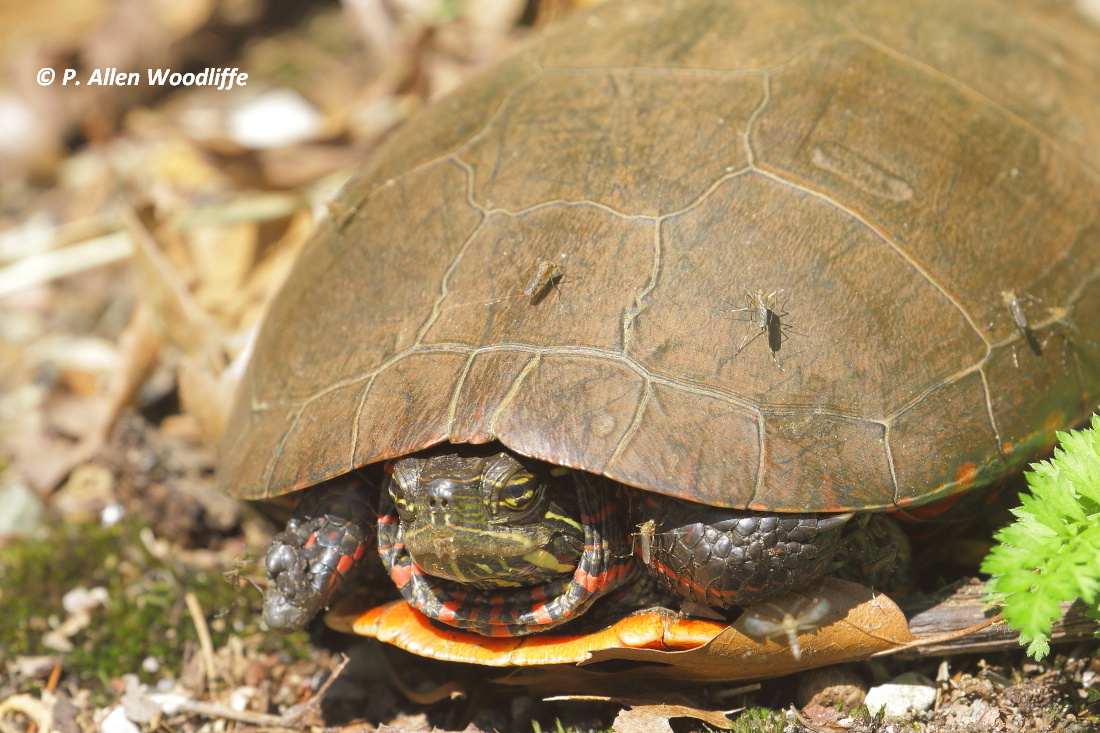
The canal is an excellent vantage point to see things like turtles. On occasion I have seen more than two dozen Painted Turtles.
Painted Turtle
 There are other turtle species in the vicinity, although much more challenging to see. The next photo is of a Musk Turtle, a legislated species officially listed as 'Special Concern'. It is a small turtle that spends most of its time in the water, hence the mossy look to it which is actually algae growth from being in the water so much. I took this photo a short distance away from this trail, as it was crossing Angler Line going from one wetland to another.
 Herons are sometimes seen in the quiet water of the canal, such as this Green Heron which I watched hunting for frogs.

A small population of another 'Special Concern' species, Swamp Rose Mallow, can be found along the edge of the lake, and is best viewed from the boardwalk. It is most obvious in August and early September.


Great Egrets are often in the vicinity, either along the shallow water of the lake shore, or sometimes flying overhead.
 Raptors are often seen, depending on the season. Osprey don't nest in the area, but can sometimes be seen hunting for a fish to catch.
Osprey
 On other occasions, things like this Peregrine Falcon may be in the area watching for small birds to try and capture.
One bird species that is a highlight to find, and has been seen annually somewhere along the Lake St. Clair shoreline area for a couple of decades, is the Yellow-headed Blackbird. It is a western species that is very much at the eastern edge of its range here. A small colony has nested in the wetlands of the Mitchell's Bay vicinity for about the last decade. Sometimes their colony has been right along the road making for excellent viewing opportunities, but in the last 3 years they have been nesting in wetlands out in the lake. They can be seen mixed in with flocks of other blackbirds, foraging on lawns or in nearby fields.


Saturday, 12 November 2016

Reptiles at Risk...an upcoming free event

Reptiles, and in particular snakes, aren't especially loved creatures by the average citizen. True, they aren't cute and cuddly, but they aren't slimy either. Much of the bad rap they have been given is due to misinformation that has been passed along.

You don't see many reptiles out in the wild these days, as most of them are tucked away for the winter, dreaming of next spring. Okay, I can't say for sure that I know what they are dreaming, or if they are dreaming at all. But I can say that the majority of them are in, or preparing, for hibernation.

Midland Painted Turtle
If you are interested in a free family friendly program happening here in Chatham-Kent, there is a special event being held near St. Clair National Wildlife area this coming Tuesday, November 15, 2016. It is called Reptiles at Risk....On The Road.

The Eastern Fox Snake in this next image is literally on the road.

It is an educational event, where you can see some of Ontario's reptiles up close....as close as you are willing to get....and learn about some of their habits. This is focused primarily on Species At Risk, and many of Ontario's reptiles are at risk to one extent or another. In this area, there is a good diversity of reptiles, although their numbers are decreasing. Some of those rarities include:
Eastern Fox Snake
Musk Turtle
Ribbon Snake
Five-lined Skink
Blanding's Turtle
Snapping Turtle

This family friendly and free event is being held at the Dover Rod and Gun Club, located at 5806 Heron Line, which is the first road north of the entrance to St. Clair NWA. It starts at 6:30 p.m. This event is being hosted by the Dover Rod & Gun Club, and the actual event with all the reptile critters is being presented by Scales Nature Park in partnership with Sciensational Sssnakes, Laurentian University and the Canadian Herpetological Society.

For more information contact Christie at: christie.l.smith@hotmail.com.


Sssee you there!


Sunday, 25 May 2014

Yellow-headed Action, and more....

The presence of the colony of Yellow-headed Blackbirds, along Angler Line just south of Mitchell's Bay, is such a treat. One wants to make the most of it, as they are quite likely to be in more remote and inaccessible locations next year. So for a few hours today, I decided to check them out again.

The cattails are growing quickly, so there is no telling how that will affect the visibility of these colourful birds. At the moment, they can be quite visible, sometimes perched on last year's stems of Phragmites, right along the road side.


I had really been trying for the perfect shot.....adult male with the wings out and curved, against the bright blue sky. I got one, sort of.....


Close, but not as in focus as I would like. They don't often get up that high in the air, spending most of the time at cattail level or just above, but with more cattails in the background. There was a brief time when one or more got higher, as a raptor floated by, causing many blackbirds to sound the alarm and go up to let the hawk know it better not come any closer. Turns out it was a Cooper's Hawk, which afforded some decent views and photo ops.


Both Red-winged Blackbirds and Yellow-headed Blackbirds exhibit fairly aggressive territorial behaviour, making for some interesting interaction.


The red-wings like to show off their brilliant red epaulets. Research has shown that the brighter and more vivid the red is, the more dominant the male will be in a colony. Some researchers, many years ago, captured some dominant males and painted their red epaulets with some dark water-based paint. The result was that during the time the red was covered up, the dominance of these males dropped to almost zero. But when the black paint washed off and the red was more visible the birds once again returned to their dominant position in the colony.

I'm not sure what the Yellow-headed Blackbirds thought about this behaviour. There clearly was some territorial defence-work in action. Here, a male of each species was quite vehement about the presence of the other.


It seemed that, for the moment, the Yellow-headed won this round.


Red-wings were quick to harass some of the other birds.....perhaps in frustration over being beaten out by the Yellow-headeds?

Great Egret being harassed by a male Red-wing

I did manage to get a few other shots of the Yellow-headeds in flight, to show the white wing patch.


While all this was going on, there were other birds of note: a Least Bittern dropped in from a short distance away; an adult Black-crowned Night-Heron flew over; Common Moorhen was heard cackling from the cattails and a probable Virginia Rail called as well. One or more Green Herons flew by from time to time.


A non-bird highlight of this outing was finding a rare species of turtle out crossing the road. A fellow photographer noted it first, and proceeded to get it to the side of the road before an oncoming truck came along.


This little one is a Musk Turtle, quite a rarity in Ontario. It has a high (for its size) rounded shell, and its nose is rather pointed. It is small and spends almost all of its time in the water, hence the mossy look to its back. Due to its shy nature, small size and tendency to spend so much time in the water compared to many other species of turtles, it might not be as rare as its status indicates. Nonetheless, in my ~40 years of field work, I have only seen them on land on half a dozen occasions.


And with that, I will bring this post to a close.

The End!
Although I should point out that unbeknownst to many observers, the feathers under the tail are a bright yellow.