Showing posts with label Sharp-shinned Hawk. Show all posts

Thursday, 21 September 2023

Brilliant blue skies and raptor photography

 Migrating raptors have been on the move a lot recently. The two hawk watches in extreme SW Ontario and SE Michigan have documented thousands of raptors, especially Broad-winged Hawks, but sometimes ten different species over the course of a day. Mid to late September is definitely the peak time for the Broad-wings. However seeing them, and photographing them, certainly have their own challenges.

Many raptors, especially the broad wing types, also known as Buteos which is the genus of their scientific name, use the uplift of air thermals from the effects of bright sunshine on the ground, to carry them upward, When the effect of the uplift falls off, the raptors then stream off in the direction they intend to migrate to catch the next thermal uplift to form the next kettle of soaring hawks. It really is quite amazing, but means that weather is a significant factor influencing their migration. On sunny, warmish days with winds from a generally northerly direction, the migration along the lake shoreline can be quite spectacular. They seldom fly over the lake, as there are no thermals created by the sun reflecting off the water, so they follow the shoreline and leave Ontario, via crossing the Detroit River, to continue on their southward migration all the way to Central or South America.

The challenge can be, in a bright blue sky, and if the hawks happen to be at the top of their kettle, they can be impossible to see without good optics. So to help to find a kettle, a hawk watcher will explore some of the white clouds while using binoculars as a dark raptor stands out better. But that makes it challenging for photography, as a dark hawk against a bright white cloud, is not the kind of lighting photographers like.

I have been out on several occasions trying to see and photograph migrating raptors. Success has been variable, but on one recent occasion, things worked out fairly well. It was on a morning when there was lots of blue sky of late summer, and only a few white clouds. At first I was not seeing much of anything, but when I started to explore the sky through my binoculars, I could see hawks on the move. This first photo shows a distant group of Broad-winged Hawks, flying almost directly overhead, but without binoculars, I couldn't see them at all. I managed to find them in my telephoto lens, and this first shot is taken at about the equivalent of a 22X binocular. The birds are not all that big, are they (the large on on the lower right is a Turkey Vulture, while the rest are all Broad-wings).

I took several photos, and cropped some to show them in a little more detail, as the next photos illustrate. These are shown at an equivalent of about 75X.

One kettle of Broad-wings I estimated to be around 400 birds,and there were several smaller kettles. In less than a couple of hours, I concluded there were at least 800 Broad-wings which had gone over. According to the hawk watch sites a little farther to the west, there were probably 10,000 or more of this species pass by over the course of that same day.

There were other broad-winged types of hawks go by, especially a few Red-tailed Hawks.


 Other species went through as well, albeit in much smaller numbers. The accipiters and falcons generally did not soar quite as high, and were fairly quick to show up and flew directly southwest, so it was hard to get the camera and focus on them very successfully. A few American Kestrels came by....


....as did some Sharp-shinned Hawks.
Northern Harriers came by in very small numbers, and I didn't get any photos of them. They were usually too far to attempt. Turkey Vultures, were steadily in sight but not always very close by.

All in all, it was quite a successful time, and I am sure there were many hawks that I missed since I was on my own, and putting most of my effort into photographing them. At the hawk watch locations mentioned earlier, there are usually several watchers whose main purpose is to record everything in sight, and some days the records are in the tens of thousands overall.

On other occasions I went to places like the Erieau Marsh Trail. There wasn't a lot to photograph or even see during the time I was there, but I did get a few photos. Small groups of Wood Ducks are here and there. They are normally skittish when people are around, but I got these photos through some small gaps in the shrubbery surrounding the ponded area they were feeding in.


An adult Bald Eagle flew quickly overhead, and this shows what photographing a black and white bird against a white cloud can end up looking like even after a lot of processing.

A quick stop at the local sewage lagoons turned up a few species of shorebirds including a somewhat uncommon White-rumped Sandpiper, but I only got photos of the much more common Lesser Yellowlegs....

...and Pectoral Sandpiper.

If you would like to subscribe, or unsubscribe, to Nature Nuggets, send an email to: prairietramper@gmail.com


Tuesday, 16 October 2018

Nelson's Sparrow, HUGO and more.....

I'm taking a break from the recent black-lighting posts. There have been some interesting bird occurrences to highlight, not surprising at this time of year.

I hadn't been to the Erieau area for quite awhile, so decided to check it out on Saturday. The winds were favourable for some hawk movement. Turkey Vultures, although technically not a raptor but fly in with many raptors on the fall migration, were fairly common.
There was a smattering of Sharp-shinned Hawks and the occasional Northern Harrier passing through.
Well out along the Rail Trail was a bit of mud flats, which shorebirds were making use of. On this day there were a few Killdeer, a Least Sandpiper and a Baird's Sandpiper. They were all a bit distant, so the photos are as well. We saw two Peregrine Falcons, one of which swooped over the shorebirds scattering them to who knows where.
Baird's Sandpiper (L), Least Sandpiper (R)
A few Yellow-rumped Warblers, the most common species this time of year, were also around.

On Sunday I got word from Steve Charbonneau that there was an abundance of Nelson's Sparrows at the Keith McLean Conservation Area. In a way this was not surprising. I lived right across from the KMCA for more than 5 years when Keith was alive and farming the property. He always left some natural habitat, especially near the wetland areas, and even planted several acres of tallgrass prairie on the east side of the property as well as the east side of the creek system. After Keith passed away and the property was given to the St. Clair Region Conservation Authority several years ago, the property has increased in wildlife values and I knew it would draw a greater diversity of wildlife and therefore a greater number of birders. To date there have been 173 species of birds seen here, and likely other species that have not yet been reported.

With the high water levels of this year resulting in much more extensive wetland habitat, it was only a matter of time when some rarer species of birds showed up. It has not been disappointing in the least, as species like Snowy Egret, American Avocet, Willet and Red Knot have put in an appearance for birders this year already. Looking at the grassy/weedy field edges adjacent to the creek system, it looked perfect for Nelson's Sparrow. The species migrates through southern Ontario every year from their Hudson Bay Lowlands breeding range, but are very secretive even in the usual spots one finds them. A conservative estimate was on this day was 15, with the likelihood of at least 20. However they were always on the move flitting back and forth between the grassy area and the cattail vegetation and being the very furtive species that they are, it was difficult to get a precise number. I headed out in the afternoon, and although I did see several, it was so windy that even on the rare occasion that a bird was visible, it wasn't visible for long. They dropped into the grasses and out of sight very quickly. I did not get any photos.

Yesterday was another windy, blustery day but I decided to try again for some photos of this relatively elusive species. While searching for the target species and waiting for one to pop up and remain in some kind of view for more than a split second, I saw lots of other species.

One of the less expected species was Indigo Bunting. Most would have departed the province several weeks ago. There were actually at least 4 and possibly 5 or 6 individuals, all sporting the female/immature plumage. It is entirely likely this was a family group, and perhaps raised locally.

 I also saw things like Tennessee Warbler, a late warbler species, as well as Marsh Wrens, but did not get photos of either.

Sandhill Cranes are not unusual, as they nest nearby, with some persisting into early winter. But they are a photogenic species so I often try and get a photo when the opportunity arises.

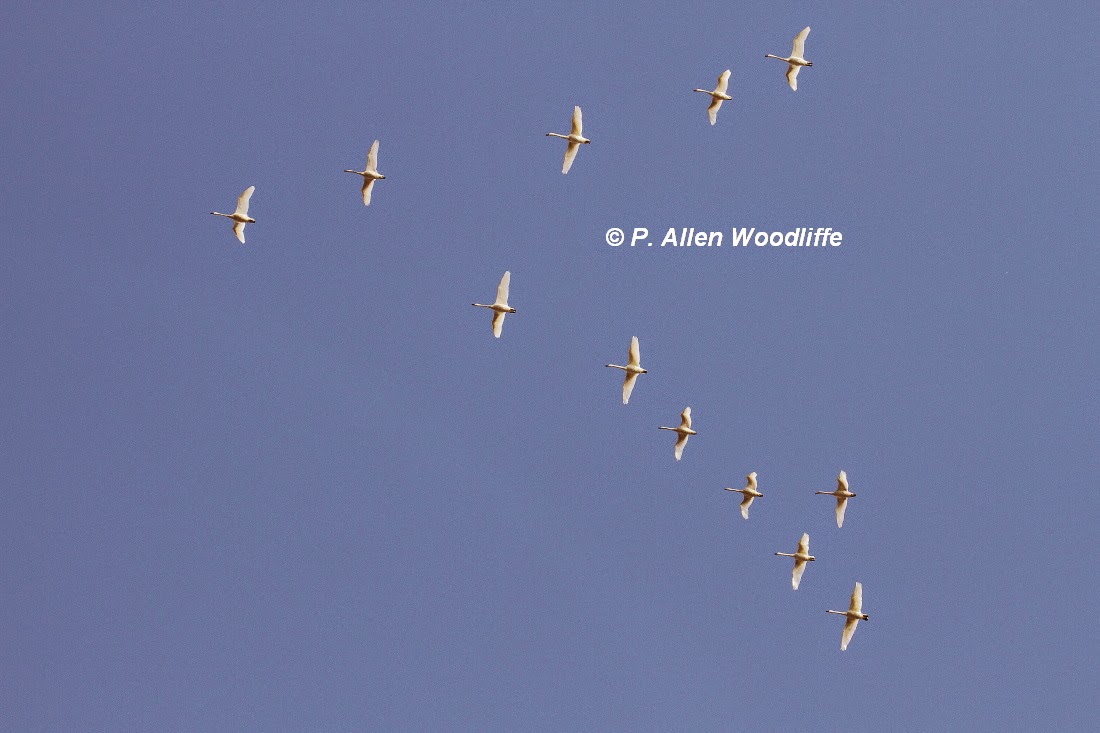
A couple of Tundra Swans came by. Their numbers are building now here in the southwest and should be here in the thousands in a few short weeks.
A couple of Northern Harriers also went through, causing some of the waterfowl a brief bit of consternation.
A Bald Eagle soared through. It is encouraging to see the numbers of Bald Eagles continue to increase. Hawk Cliff, along the north shore of Lake Erie south of St. Thomas, has already recorded 170 of them passing by that Hawk Watch station since early September.
In spite of the windy, blustery conditions there were a few butterflies quite literally hanging on. I noted a Monarch and this Bronze Copper.
I was much more successful in photographing my target species than on the weekend. But the birds flushed up quickly from the weedy patch and headed to the stand of Typha and Phragmites where they often dropped out of sight almost immediately. Some of my early attempts resulted in photos like this:
Then finally one popped up and instead of dropping down into the Typha, remained in view.....sort of. This photo is what you would see with an equivalent 16X binocular, so not all that close and even at that, with vegetation partially obscuring it. But at least it was identifiable.

Unfortunately with the 35-55 km/h wind blowing the vegetation in front of the sparrow which played havoc with the focus, as well as blowing my telephoto lens slightly off target, many of my photographic attempts resulted in this next one.
But thank goodness for digital photography rather than film. Out of about 50 shots, a few turned out relatively unobscured and then with significant cropping, got some worthwhile results.

On the way home I wanted to stop in at the Blenheim Lagoons, where Jim Burk had noted a Hudsonian Godwit there on the weekend, along with a few other shorebird species. They were reported to be skittish, so before I went to far, I scoped out the muddy edges. There it was along the far shore, along with a few Pectoral Sandpipers, etc. This photo is likely the equivalent of about 60X.

 As the shorebirds were reported to be skittish, I cautiously headed over to a closer vantage point where I might get a better shot. All of a sudden the shorebirds took to flight chattering loudly. I knew it wasn't because of me, as I was not in view of them at the time. The shorebirds wheeled around, and this is the only other photo I got of the godwit, cropped significantly.
It was only seconds later that I noted a Peregrine Falcon swooping after the shorebirds, although I did not see it successfully capture anything. Peregrines used to be extremely rare and legally endangered throughout eastern North America, and seeing one swoop after shorebirds was an infrequent and awesome sight. It still is to some extent, but it seems that it happens all too often when one is trying to get a better look at the shorebirds. Oh well.
The last time I saw the godwit it was heading southwest. Whether it returns or not remains to be seen, but given that it will be heading a long way south on its migration, perhaps it was using this event to be a good reason to vacate this area altogether.


Monday, 3 November 2014

Sunny and brisk on the Marsh Trail

The strong northerly winds of the last couple of days had died down. They were more out of the west, and a mere 10-15 km/h, so I decided it was time for a trek out the Marsh Trail of Rondeau. It was a non-hunting day, so the trail would not be busy with vehicles full of hunters, dogs, plastic or wooden ducks, etc going back and forth.


It is also prime time for eagle migration, especially Golden Eagles. I hoped that with the wide open skies, my chances of spotting one, and possibly even getting a photo, would be good. So off I went.

Given the beautiful day, there were very few people on the trail.....a total of 6 people and two dogs over the space of about three hours. Two people per hour was okay by me, so as to give me more of a chance to see the wildlife. Perhaps the very cool breezes off Rondeau Bay were not enticing to many folks, and the ones in the park this day stuck to more sheltered trails.

Song birds were quite few. I noted a few sparrows and juncos, including this first year White-crowned Sparrow.

A Sharp-shinned Hawk zipped by.


Golden Eagles were not to be seen, but both resident Bald Eagles were perched in one of their usual spots a few hundred metres from their nest tree.

There were lots of ducks, geese and swans on the bay or flying by, most of which were too far to bother photographing. Ruddy Ducks, Mallards, American Wigeon and Gadwall were the most abundant, with a few Green-winged Teal, Northern Shoveler, scaup and Redhead as well. I also saw my first Common Goldeneye of the fall. I'm sure they have been around for a little while....I'm sure I need to get out more :-).

A mink scampered across the trail 50 metres or so in front of me, but it was not spending any more time than necessary out in the open. I stood still and squeaked and pished, hoping to convince it that a mouse or a rabbit was injured and it would come to investigate, hoping for an easy meal and giving me an opportunity to photograph it. However this large member of the weasel family ignored my attempts, and thus I was left only with a memory of it registered in my brain cells, rather than in a series of pixels in the digital realm.

I came across an 'orange' tree! It wasn't going anywhere.

OK....we may live in the banana belt, but that doesn't mean we have southern fruit trees here. This is actually the ripening fruit of Climbing Bittersweet, a native vine that grows along forest edges. Before long, the outer orange husks will split open and reveal deep red berries, which birds enjoy.

On the return, this Northern Harrier floated by fairly quickly, and I only had time for a quick shot before it headed into even more challenging light.

And several small flocks of Tundra Swans were winging high overhead.....and heading north! They have been building in numbers gradually over the last couple of weeks, with most of the population yet to arrive before heading southeast to spend the winter at Chesapeake Bay. Maybe they were really just heading inland to feed in recently harvested soybean or corn fields, and the wind turbulence was less problematic for them at a higher altitude.


I checked part of the campground before leaving, since there is a nice mix of shrubbery amidst the planted conifers and deciduous trees. The fruit of the Red Cedar isn't as plentiful as it was last year, but there were still birds around. Lots of robins, starlings and a few kinglets. I was hoping for Fox Sparrow but didn't find one. There were the usual Song Sparrows and juncos. I spotted at least six Yellow-rumped Warblers, a single Blue-headed Vireo and two Red-breasted Nuthatches. The vireo didn't cooperate for the camera.

American Robin

Yellow-rumped Warbler

Red-breasted Nuthatch
After leaving Rondeau, I drove through Sinclair's Bush, a provincial Area of Natural and Scientific Interest, and one of the few places in Chatham-Kent where there is a bit of forest on both sides of the road. There is still some autumn colour there.

Looking southwest
 Right behind where I took this forest scene from is a stand of Pawpaw. It is a southern large shrub/small tree species, and quite rare in Ontario and thus also rare in Canada. At one point, C-K had the greatest number of locations where Pawpaw was known from. I'm not sure that is still the case, given the recent loss of woodland. It likes rich deciduous woods, but I've seen it along roadsides adjacent to where deciduous woodland used to occur. Pawpaw is easily identified by its large, long leaves and, in the early spring, by its maroon coloured flowers that are out just as the leaves are beginning to emerge. The leaves persist longer than most other tree and shrub species in the fall.
Pawpaw
There has been a fair bit of timber harvest out of Sinclair's Bush in this last year, both large sawlogs and firewood. Firewood extraction is continuing at the moment. Of course there was a lot of ash growing in this woodlot, most of which was killed by the non-native Emerald Ash Borer, so the harvest of dead timber is a preferred option for most landowners. I anticipate that more timber will be extracted sometime in the near future, as trees in other sections of the woodlot have typical markings on them indicating they have been selected for a future harvest.


Sunday, 14 September 2014

Some hawk migration observations

Hawk migration is just getting well underway these days, as one can see from the various hawk watching reports. Hawk Cliff just south of St. Thomas, Holiday Beach in southwestern Essex County and the Detroit River Hawk Watch in eastern Michigan adjacent to the Detroit River, are the best known and most prolific sites in the region. Daily watches since about the first of September have resulted in between 1300 and almost 2000 birds being recorded passing through so far.

These migrating raptors follow the Lake Erie shoreline, since they don't like to cross large open stretches of water, and exit the province where the water is the narrowest. Hence places along the Detroit River are where the birds are eventually most concentrated.

However before the birds get to the Detroit River many pass through southern Chatham-Kent, and near the shoreline is often a good place to watch from. Winds from the NE-N-NW are typically good conditions to help the birds to move.

Yesterday, Saturday Sept 13, the winds were fairly brisk from the N-NW which is usually favourable. However the heavy overcast conditions were not the best for hawk watching, at least initially, but when the forecast indicated some clearing in the afternoon, I ventured out. But I went to a more local place. The shoreline east of Rondeau and south of Morpeth is one of the better locations. And since a rare Swainson's Hawk had been reported from the Hawk Cliff site the day before, I was hoping I could find it passing through the Rondeau area!

Initially there wasn't much movement. Almost immediately a single Sharp-shinned Hawk flew through fairly low down. I decided to get my camera ready in anticipation of more action. The raptor movement was rather sporadic, which is par for the course. From time to time, there were several birds in view, and then there were stretches of 10-15 minutes or so without a single bird to be seen.

As the sky cleared a bit, the birds got a little more active. Overall in the almost two hours I was there, I observed 34 raptors of 7 species: Sharp-shinned Hawk--14; Cooper's Hawk--1; American Kestrel--2; Broad-winged Hawk--2; Merlin--1, Bald Eagle--7; Turkey Vulture--7.


Photography wasn't the easiest, since much of the sky was still partly cloudy. And the birds were on the move, of course, and mostly quite distant. However I got a few shots.

Sharp-shinned Hawk


Broad-winged Hawk
 This isn't the normal profile one expects of a Broad-wing on migration. However due to the brisk wind and cloudy skies, there weren't any thermals of rising air to float upwards and along on. So today their wings and tail weren't showing the typical look.


Broad-winged Hawk


Bald Eagle juvenile


Bald Eagle adult
It is possible that one of the sub-adult eagles I saw was double counted, so I may have only seen 6, not 7. At one point I did have three eagles in view simultaneously. Photos of these birds were a challenge. Even though the camera set-up I was using was the equivalent of a 12X binocular, with the birds being mostly a kilometre or more away, I had to do some heavy cropping to even get these!

Alas, I didn't see a Swainson's Hawk. But I did see this.

Gashawk (not a raptor :-)
The Broad-winged Hawks should be moving in large numbers in the next week or so. Mostly sunny skies with light NW winds are ideal for them to move in substantial numbers. Usually upwards of 100,000 of them are recorded from one or more of the hawk watch sites over the course of the season. On one occasion several years ago, the Holiday Beach site recorded about 80,000 in one day! Kettles of them can be seen almost anywhere slightly inland from the Lake Erie shoreline. I am looking forward to getting out again soon!