Showing posts with label Barred Owl. Show all posts

Tuesday, 18 February 2025

Owls!

 Owls are one of the most admired and sought after creatures for anyone even remotely interested in nature. As they are mainly active at night-time, finding and seeing them is not always easy, even though some of them are year-round residents. One of my first, quite rare owl species to see and photograph was this Great Gray Owl, which Keith B and I went to see in the GTA back in March, 1979.


 It is very much a northern resident, and a few years later, I got a quick glimpse of one while I was on the Polar Bear Express train on my way to Moosonee. However in January of 2012, one showed up in Essex County, of all places!


 It created quite a stir amongst birders and even curious onlookers. As a northern species, it probably didn't know what to make of all the people. It perched right out in the open at times, as the next photo shows. However it did perch in a more natural looking setting, as the previous photo illustrates.


Great Gray Owls are the largest owl species for Ontario, at least in overall dimensions. Snowy Owls and sometimes even Great Horned Owls are slightly smaller, but have more body mass, so can be a little heavier.

A much smaller, and perhaps even rarer owl for southern Ontario that I saw is this next one, a Boreal Owl, that again, Keith and I went looking for in March of 1977. It was tucked away in the branches of a pine tree, and with the bright sky background, made for a difficult photo. Hence this less than ideal photo, a scan from my film days, is just a record shot.

Winter time seems to be a good time for finding owls, especially some of the more northern residents that come a bit south for the winter. Barred Owls are more commonly found here in the south than the first two species shown. There have been a few records, including this next one which Josh P and I discovered on the Blenheim/Rondeau Christmas Bird Count in December of 2018. It was the first confirmed one for this count, although one had been reported a couple of decades earlier.
This one stayed in Rondeau until at least late February, although it moved around a bit and was not always easy to find. There were lots of squirrels to feed on! Plus since it had been seen regularly, the novelty had worn off, and fewer people were out looking for it as time went on. However it was likely gone to its more northern haunts by sometime in March.

 In early January of 2023, another one showed up in the village of Shrewsbury, and initially could be fairly easily seen right from the street in this birch tree.

Again, this one moved around the village a bit, but was seen in various places for at least a month.

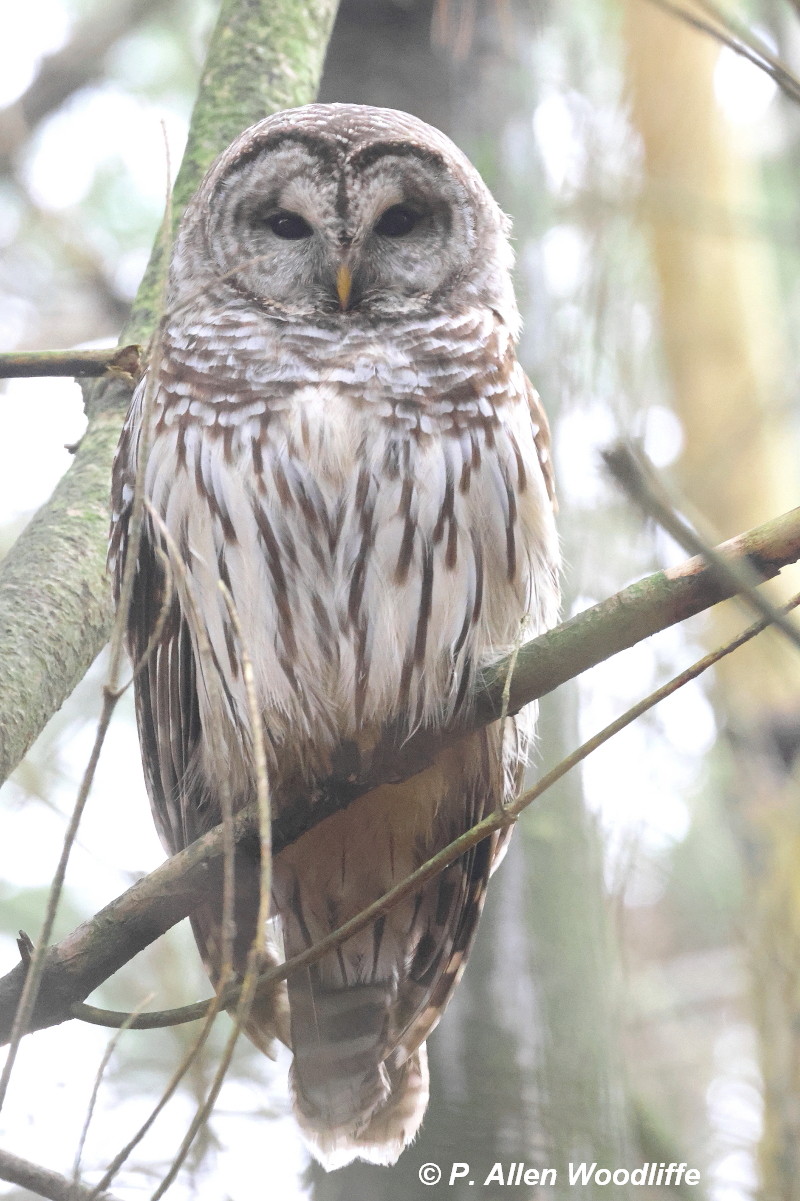
Fast forward to late December 2023, and this next one was found in a small pine plantation of a local conservation area not far from Rondeau.

It has been seen fairly regularly, but not by all who have ventured out looking. It will often be fairly high up, and visible only from a certain angle. And getting a good photo isn't easy, as there are often branches in front of it partially obscuring the bird, as well as affecting the focus. It has been present up until at least early February, and could likely remain in the area for a few weeks yet, especially given the fairly intense winter that continues.

In the same general area is this next one: a Northern Saw-whet Owl, which I photographed on the same day as the Barred Owl above.

This one likes to stay well inside a fairly dense pine tree, making nice clear photos a bit of a challenge. Fortunately for birders and photographers, they are more frequently found than any of the ones above, and can sometimes be quite out in the open.

Here is one of the first ones I ever found, in a small pine plantation just west of Cedar Spring, back in February of 1978. This photo was featured on a Nature Canada calendar in 1988.

I've seen a few others over the years in both Chatham-Kent and Essex, with some photographic success.

November, 1987

November, 1990

November, 1987

 Another owl that I photographed on the same day as the Barred Owl and Northern Saw-whet Owl of a few days ago, was this next one, a Long-eared Owl. It was one of two or three individuals, which have been roosting in a stand of White Cedars, but unfortunately are difficult to even see let alone photograph. They are often right up against the main trunk, with lots of cedar branches obscuring them.


 Another owl species that is primarily a winter visitor in recent decades, although there are historical records of them occasionally being present in suitable habitat during the breeding season, is this next one: a Short-eared Owl. They are most often seen in flight during later afternoon, or at least in more subdued light, and not always easy to photograph as they dip and dive in their search for something to feed on.....

...but on occasion, one will be perched out in the open, such as this next one, which I photographed along a pasture on this dull day in January of 2016.
Of course one of the owl highlights that many people look forward to, and have a relatively good success in seeing, is the Snowy Owl. They breed in the very far north, in the arctic lowlands, and every so often they have an eruption year when nesting success has been higher than average, so in the late autumn, they will migrate south where there is a better chance for food.

We usually get one or more on the St. Clair NWA Christmas Bird Count, but not always. A couple of years ago, we had an amazing all-time high of 23 of them! But during the last couple of years, we haven't had any. In fact there have only been a maximum of two reported in the count area this year, and then only for a couple of days before they moved to somewhere else. The dry autumn allowed many farmers to work up the corn stubble and other fields, making the habitat that the wintering owls often hung out in hard to find.

Birds that are almost pure white are adult males....

...whereas ones with a lot of spotting are usually immature birds, or sometimes a female.
Regardless, they are always fun to see, especially if they sit up on a perch with a nice background. This next one was perched on the roof of a small pump house along the roadside.

There are some owl species that are permanent residents of southern Ontario, such as these next two. An Eastern Screech Owl shows up fairly regularly in the cavity of an American Beech tree at Rondeau, providing good looks even from one of the main roads.


And elsewhere, where Wood Duck boxes have been erected, during the winter season, they may be occupied by a Screech Owl.
 
Great Horned Owls, another resident, are quite large, and can be fairly vocal. They can be found in woodlots throughout the southwest and beyond, and sometimes even within urban areas such as this next one, which has occupied a wooded area within the city limits of Chatham.


 They will sometimes nest where a large tree limb has broken off, such as in the crotch of this Willow tree, shown next.
...or sometimes where an entire tree trunk has snapped off, leaving a slight hollow to build their nest in.


This next photo was where a hollow was present in a Black Cherry Tree. The owlets were fairly visible in this setting, as the nest wasn't very deep down.


 After a few weeks, the young will venture out, testing their wings, and eventually trying to make it on their own.

I'm not sure whether the local owls are nesting yet here in Chatham, but if not, it won't be long. Stay tuned!


If you would like to subscribe, or unsubscribe, to Nature Nuggets, send an email to: prairietramper@gmail.com




Wednesday, 15 January 2025

Early January (mostly) birding

 Certainly one of the most sought after local birds over the last couple of weeks is the Harris's Sparrow. It is a species that shows up quite irregularly in this area, so as this one has been predictably popular, there have been many dozens of birders out to see it. On one occasion there were so many vehicles lined up, it was hard for local travelers to pass through.


It hasn't always been easy to photograph. On my first attempt, it was a sunny day, which isn't necessarily a bad thing, but the bird was almost always along the fence row at the side of the road, and behind grasses that were in a constant state of movement due to the wind. Therefore the camera's focus as well as the backlit conditions made it almost impossible, and this next photo was the best I could get.

Fortunately on another day, it was cloudy bright, and the sparrow sat up on a rail for long enough to get the first couple of unobstructed photos.

It was accompanied by a good mix of other winter time sparrows, including White-crowned Sparrows and others.

Before it got too snowy and cold, I managed to capture a few other things, such as one of four American Robins I saw on an outing at Rondeau....

....the Barred Owl at a nearby conservation area, which has been there for several weeks but roosts unpredictably and is often not found by the searchers.....
...from 1-6 Killdeer hanging out at a small unfrozen area at the Keith McLean Conservation Lands....
....a few Sandhill Cranes...

....and a Snow Goose. All nice things to add for the season.

As is usual for the time of year, in spite of the colder than average temperatures, a bit of the water in the Erieau vicinity remains open. Lingering waterfowl continue to hang out, at least for now. At first the birds are well out in the open water, as they are undoubtedly still cautious in being too close to human activity due to the continuing waterfowl hunting season. This first photo shows a mix of typical ducks, including Ring-necks, Scaup sp, Redhead and a good number of American Coot, the latter of which technically is not a duck.

Mostly American Coot
As the cold continues, waterfowl are forced to be closer to shore, much to the delight of viewers and photographers.
Common Goldeneye

Common Merganser

Greater Scaup
Certainly one of the primary ducks to look for in the Erieau area in the last week or so has been not one, but three Harlequin Ducks. Finding them is no easy task, as they are often across the channel and sometimes tucked in with the rocks out of view. These three are females, so not nearly as colourful as the males, but still a great species to find and photograph. I had been out looking on a couple of different occasions, including one time when there were hunters set up across the channel amongst the rocks, and the only 'ducks' I could see were decoys. The other real ducks were widely scattered and the Harlequins were not visible. However on my most recent attempt, I managed to see all three close together where the marina joins the main channel.

Among other species were Redhead....
...and Ruddy Ducks.

While out looking for Short-eared Owls, I found one or two, but was not able to get a photo. But I did manage to get a distant photo of this Rough-legged Hawk busily hunting in the same area....

....and some Wild Turkeys were feeding in a field near the Ridge Landfill. Backlit a bit, but salvageable.

I will finish up with some odds and ends. For anyone who is a regular hiker at Rondeau, you will notice that the Tulip Tree Trail has been partially closed for several weeks. The park staff have been busy making some much needed repairs in some sections. But now as one approaches the trail, parts of it look like this:

And a closer look:
For anyone interested, the American Birding Association has selected what species will be its 'Bird of the Year.' It is the Common Loon, a species well-known to Canadians!

If you would like to subscribe, or unsubscribe, to Nature Nuggets, send an email to: prairietramper@gmail.com