A few multi-purpose outings have resulted in quite a few photo ops. This post will focus mainly on birds that I have encountered.
If anyone was out along the Marsh Trail of Rondeau earlier this spring, the feature that used to be this for several years, much to the delight of those hiking the trail...

...which due to high water and ice damage, was destroyed and in its place was a structure designed to be a haven for Barn Swallows to use for nesting. It lasted for several years, but alas, the continued high water levels and ice damage resulted in it looking like this earlier this year.
I haven't been back out to this spot really recently, but the last time I got a glimpse, it looked like it had tumbled down the rest of the way. I expect the swallows gave up on it before nesting got into full gear.
I came across this Barn Swallow nesting underneath a boardwalk along the Tuliptree Trail.
This one, along with its mate, had successfully nested under the top level of the observation tower along the trail at St. Clair NWA. While this species seems to be fairly abundant at least in SW Ontario, it is considered a Species At Risk, with the ranking of Vulnerable.
Exploring the open, wetland areas along Lake St. Clair are always a highlight for me and my camera. Canada Geese are quite plentiful, with their overall numbers increasing considerably by dozens and dozens of recent additions to the flocks.
Eastern Kingbirds are scattered throughout, but in small numbers.
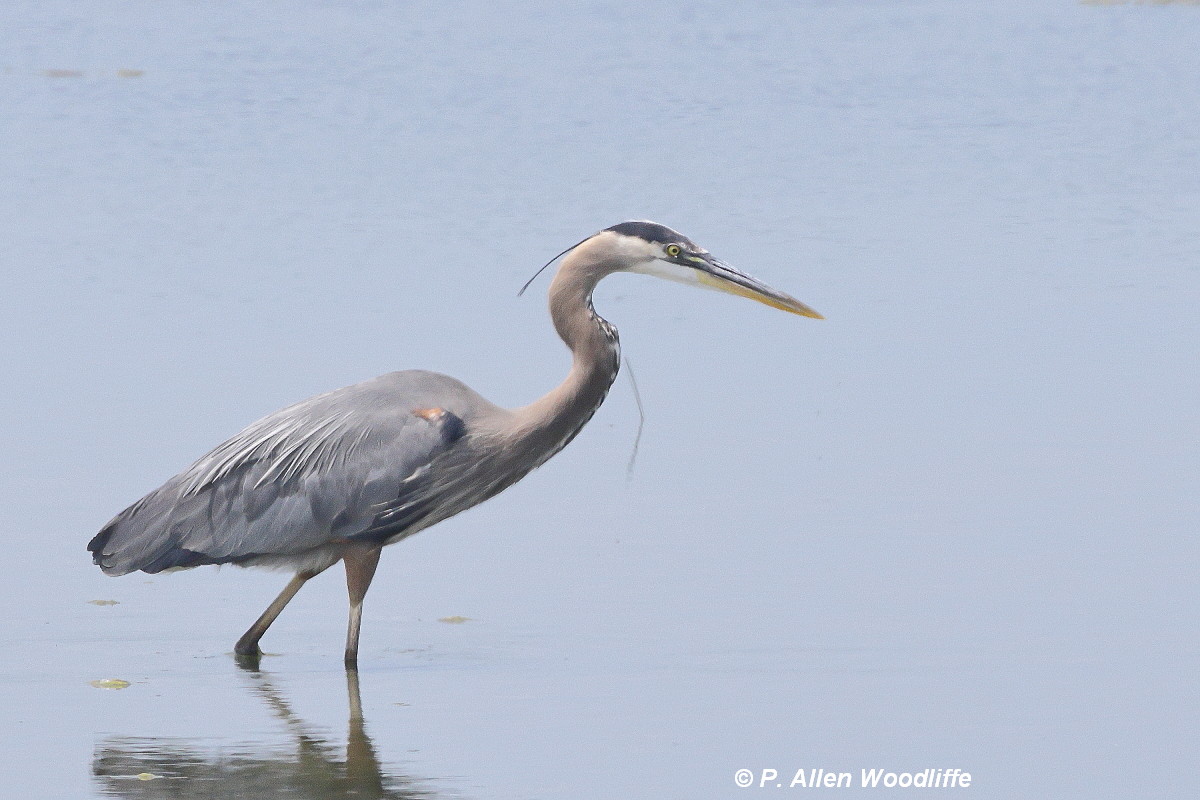
Great Blue Herons don't nest in the immediate vicinity, but at least a few are found feeding in the shallow water.
Great Egrets can be found, sometimes fairly abundantly. It isn't all that uncommon to see half a dozen to a dozen feeding, or flying by, as they nest at some of the nearby, offshore islands.
A much smaller member of the heron family is the Green Heron, usually quite elusive. This one was a long way off, and the photo is highly cropped.
The cattails harbour many, many individuals of the Marsh Wren. They are quite frequently heard, but seldom does one sit up so cooperatively.
Sandhill Cranes are more abundant these days, and a few days ago I saw this family of three wandering around in a field adjacent to SCNWA. It seemed rather early for this youngster, which had probably hatched at least two weeks earlier, but there it was.
Flyby cranes are always fun to try and get with the camera.
In the wooded areas of Rondeau, there is quite a different array of birds such as this Wood Thrush, which had a nest just off the Warbler's Way trail.
While walking along one forested trail, I was a bit startled to hear lots of thrashing going on in the thicker shrubbery right close by. It was this Turkey Vulture, which must have been feeding on something, and sat up in this tree, waiting until I left the area before it returned to continue its meal.
Rose-breasted Grosbeaks are not common, but regular.
These next two species are quite abundant, and in spite of that I always enjoy seeing them. I like the iridescence that is so well shown on the head of this Common Grackle.
Brown-headed Cowbirds are seldom the favourite of anyone, but hey....they are birds too, and I won't hesitate to aim the camera in their direction when the opportunity avails itself, (and when things are fairly quiet with not a lot of others to aim at).
Baltimore Orioles, next, are frequently heard as they are often higher up in the forest canopy, but don't often come down except to feeders.
And American Robins are abundant in many different habitats. This one was nesting on the shelf behind the sign, and was quite upset with me walking by.
Of course what is a bird themed blog in late May or early June about unless it features the iconic Prothonotary Warbler! I have had a few good encounters so far this season. On one occasion I was watching a female gathering nesting material to take to a natural cavity, and it flew in so close to me I couldn't get the entire bird in my field of view! I only got this one photo. It isn't cropped at all.
On another occasion while I was watching a male Prothonotary singing away, it actually landed on a branch right over my head, and had I a slightly longer arm, I could have reached up and touched it. However it was quite active in some of the small saplings nearby, and I got several photos, including this next one.
It doesn't get much better than that!
I will conclude this bird featured post with a highlight of a few days ago, when I encountered a flock of about 40 Whimbrel along the southeast shoreline of Rondeau.
They weren't around for long, presumably anxious to get to the breeding grounds well to the north.
If you would like to subscribe, or unsubscribe, to Nature Nuggets, send an email to: prairietramper@gmail.com