Showing posts with label Northern Cardinal. Show all posts

Monday, 9 December 2024

Late November, early December highlights

 In spite of the warmer than normal weather in late November, one doesn't expect to see swallows still around. However Cave Swallows, if they are going to show up in southwestern Ontario, have a habit of showing up after the majority of the others in that family have gone south. Such was the case when I got a text message saying that a Cave Swallow was at the Erieau pier. Since I was almost ready to head out somewhere anyway, it made the decision of where to go very easy. 

As I got to the main channel, just as I was getting parked, I saw this swallow scoot by, heading for the pier that juts out into the lake. Bingo! And as I glanced towards the base of the pier a minute or so later, I saw 4 people looking intently at something, so with camera in hand, out I went. 

And there it was, resting at the edge of the lower section of the pier, trying to keep out of the brisk wind. You can tell by its posture and fluffed up feathers it wasn't really enjoying the cool wind.

It seemed quite tolerant of us. Every few minutes it would get up and fly around, and sometimes flew by almost within arms reach, before returning to the edge of the pier.

However after awhile, it got up and flew east towards Rondeau, and we never saw it again. What a great sighting in late November! This swallow species seems to show up quite regularly in small numbers. I have had one to five of them at Erieau on at least 3 occasions, and along the east beach of Rondeau.

I've been able to find, and photograph, other species which, although they are much more common, are always a delight to see as well. Here are some of the highlights.

Bald Eagles always get ones attention, especially a fully adult bird with its distinctive white head and tail, and its fierce look if one gets a close enough look.


The above bird was in a tree right along the roadside near St. Clair NWA and it didn't seem to be concerned when I got out and aimed my camera at it. The next photo is of a bird that was well out from the trail at Keith McLean Conservation Area, and it flew off as I got within several hundred metres of it.

On one of my several visits to Rondeau, I photographed some smaller, land birds. A Hermit Thrush, not all that common this time of year but usually there is the occasional one lingering, was feeding on some berries at the side of the trail.

Its spotted upper chest area and the rusty tail are good indicators to separate this species from others in its genus.
Northern Cardinals are year-round residents, and the males really show up well with their bright red plumage.
Less brightly coloured but perhaps even more attractive with a more subtle, warm brown plumage, is the female cardinal.
Not a small bird, of course, but Wild Turkeys are regularly seen in their family groups. There were four others in this group, but I just zeroed in on this one for a full frame photo.

Elsewhere on my Rondeau travels, I photographed some Cluster Flies even though the temperature was barely above freezing...

..and I noted this White Pine seedling also along the trail. White Pines are an important element of Rondeau's vegetation, and while they are often eaten by White-tailed Deer, hopefully some will survive to maturity. This past weekend the park was closed to the public, as a deer hunt/cull was in progress. In the absence of natural predators at the park, periodic culls are important to keep the population of both the deer, and the vegetation, in a healthy condition. At one point in the mid 1980s or so, and in the absence of any kind of cull for a decade or so, the winter population of deer approached 600! The vegetation was in horrible shape, and one winter there were about 20 deer that died of starvation and severe cold. Deer biologists that specialize in herbivory determined that the population in winter should not exceed about 125 animals.

In other travels, I have often been near wetland areas which have not been iced over. Not sure how long that will last, as it isn't officially winter for a few days yet. Waterfowl are always fun to focus on. This first photo is of a female Bufflehead at the lower left, and a female Hooded Merganser on the right.


Female Hooded Merganser
As is the case with some mergansers species, the females have a tufted head, as the hoodie shows. The next photo is of a female Red-breasted Merganser which is much larger than the hoodie.
I photographed these Ruddy Ducks at Erieau, which were taking advantage of the quiet water in the harbour area. This first one is of a male...
...and next is a female.
This next one is of a female Ruddy Duck that was not resting, but quite alert.

Typically in the St. Clair NWA vicinity at this time of year, there are lots of swans. Mute Swans, shown first, are not present in large numbers, but as long as there is any open water, are present throughout the year .

But what gets more attention due to their seasonal variation, and huge numbers are Tundra Swans. It is not uncommon to see upwards of 10000 birds in scattered flocks, especially if there is an unplowed field to feed in....
....or a wetland area to take refuge in.
Small groups are frequently seen flying from one field to another, or back to the NWA.

There are still some flocks of Sandhill Cranes reluctant to leave the area. I came across over 150 only a few days ago, in two separate areas. They were quite a way off in a field, so not easy to get the kind of photos that I was hoping for, but this is what it is.


Sometimes they are on the move as well, to a quieter or better feeding area.

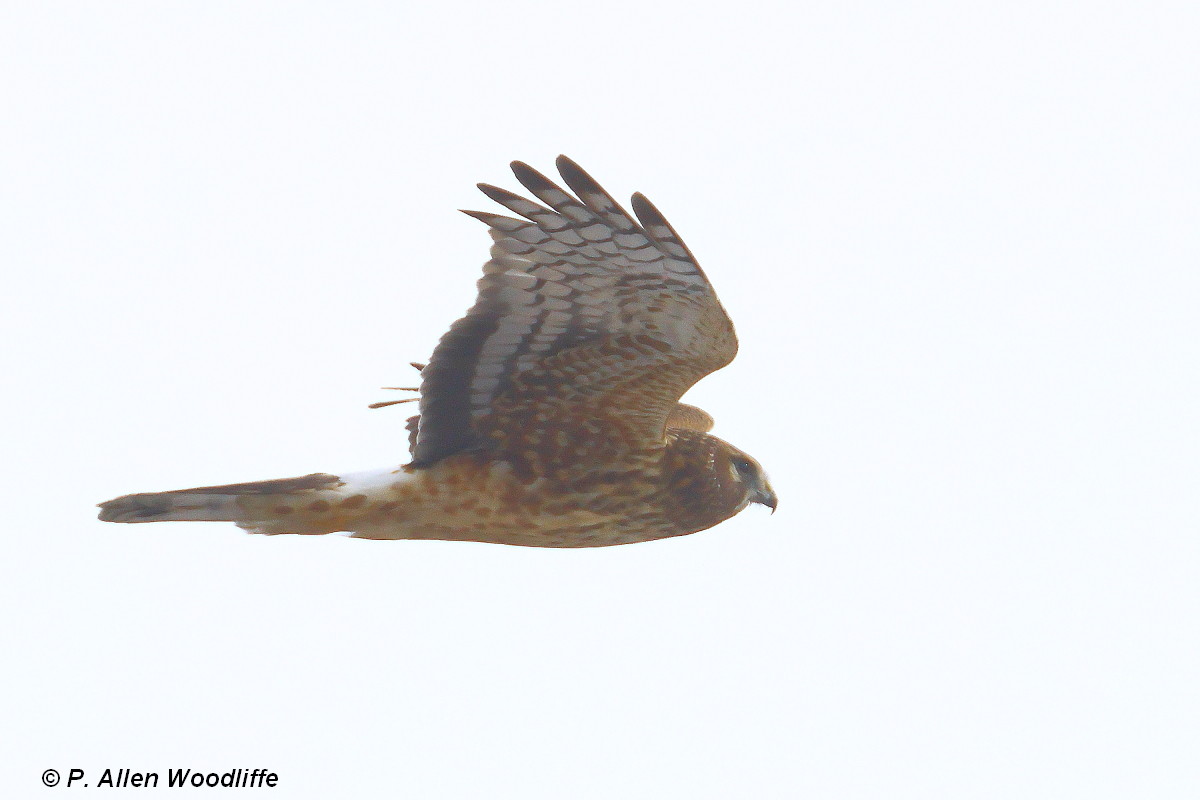
And even though the main raptor migration is over for the autumn period, some raptors will be content to stick around. I was out looking and hoping for Snowy Owls, but didn't see any. However there are a few Northern Harriers, a.k.a. Marsh Hawks, around hunting in open fields or in wetland areas.


And Red-tailed Hawks, such as this immature one, are regularly seen along woodland edges and even on power line poles.
Not the greatest shot of this bird on a power line pole, but you do what you can to capture the setting!

If you would like to subscribe, or unsubscribe, to Nature Nuggets, send an email to: prairietramper@gmail.com

Sunday, 5 February 2023

Eagles galore and a new species of squirrel confirmed for Rondeau!

 It wasn't so long ago, a mere 40 years more or less, when seeing a Bald Eagle was quite the unusual birding experience. In fact in about the mid-1970s, there was only one breeding pair of them along the north shore of Lake Erie between Long Point and the Detroit River. That was a pair at Rondeau, where even there, they did not produce young every year, and if they did, it was only a single eaglet. Historically there had been on average one nesting pair for every mile of the Lake Erie shoreline in that area. Bald Eagles were put onto the first edition of Ontario's Endangered Species Act, back in 1973. 

The resurgence of Bald Eagles is one of the good news stories of the last 40 years. In the hierarchy of rarity, it went from endangered status, to threatened status, and has for the past decade or two, been downgraded to the special concern status. New nesting pair are showing up regularly. As I have mentioned in a previous post, even about 4 years ago I knew of 26 nesting pairs in Chatham-Kent alone, with likely some others being around that I hadn't caught up with. In fact a couple of years ago I met up with an eagle enthusiast who knew of 30 nests in C-K, although I know that sometimes eagles have more than one nest that they move back and forth to, so the number of nests doesn't automatically reflect the number of nesting pairs. Regardless, they are definitely increasing and show no signs of that changing. And that is a good thing. The sight of an eagle always causes people to pause and enjoy.

It should be noted that it was 60 years ago in 1962 when Rachel Carson published her world-changing book "Silent Spring" that got people, including President John F. Kennedy, to realize what chemicals in the environment, such as DDT, were doing to birds like Bald Eagles. Of course the Bald Eagle is the USA's national bird, so that likely had something to do with any action to reduce the use of DDT. At any rate, the use of DDT declined, and eventually egg shells of eagles that had become so thin that they broke before getting to the stage of young hatching, became stronger and slowly but surely, more young were produced.

In my last post, I mentioned an eagle 'convention' of as many as 40 birds observed near or on a large private wetland area along Lake St. Clair. I went to the mouth of the Thames River and saw a few there, as expected. Since that visit to the lower reaches of the Thames River, I went out again, and there were at least 14 Bald Eagles, and this time I had some fly by giving me much better photo opportunities.

There were several adults, including the one at the top of this post. It landed in a tree right across the river from me.


There were more sub-adults than adults, mostly in the 1 or 2 year age range.

Bald Eagles have become so common that a birding site which I periodically send less common bird photos to, don't want to receive any more of eagles!

When I wasn't watching for eagles to photograph, there were at least half a dozen Great Blue Herons scattered along the river.


There were a few open spots here and there, so presumably they were finding enough to feed on, or were otherwise not energetic enough to move to someplace where there was.

A few days ago I heard about an unusual squirrel that was coming into a feeder at the north end of Rondeau. It was reported to be a Red Squirrel, which is not an expected species at all. It generally is more northern than what one should find in the Carolinian forests of southwestern Ontario. Nonetheless there have been a few observations in southwestern Ontario and closer to Rondeau, but never a confirmed one inside the park boundaries. Of course I had to check it out.

On my first attempt, it did not put in an appearance, so I moved on to other things and places to explore in the park. On my second attempt, late last week, I waited patiently for it but again, it did not show up at the feeder. The feeder area was busy with various birds, so I was able to put my photography urges in gear, and got these next three shots.

Northern Cardinals are fairly plentiful, and always nice to see. They always look their best and brightest in the later stages of winter.


Red-winged Blackbirds are not common anywhere in southern Ontario over the winter, but this one seemed to be content using what feed was available to it. It won't be long before many thousands are back.
I gave up watching this feeder area, and parked myself in my vehicle near another location not far away where it had been periodically seen. I didn't have to wait long. Within about 15  minutes, it appeared in some shrubbery and I got about three photos before another vehicle came along to dump some garbage. With that, the squirrel scampered up the trunk of a large White Oak, giving me a rear end look before disappearing. And this is, as far as I know, the first confirmed record of American Red Squirrel within the park's boundaries.

It is unknown how the squirrel arrived. It may have come along on a load of firewood, or it may have hitched a ride with a camper/trailer. Regardless, given that it is the only one of its kind in the park as far as we know, the population is not going to expand.

Yesterday I got word of a rare duck at Erieau, a male Barrow's Goldeneye. Shortly after getting the message I headed out, since I was planning to go out somewhere anyway. There were three others there when I arrived. It was very cold, at about -7C and quite windy with winds in the 30-50 k/hr range. Fortunately we had the wind at our backs, but it still made looking through the 'scope challenging with the vibration. Adding to the challenge was a bit of wave action, causing the birds to bob up and down when they weren't diving under. We eventually saw the bird out on the far bit of open water, but too far away to try for a photo. There was a much closer patch of open water we were hoping it would come to, but it didn't while we were there, so the only 'photos' we went away with were in our minds. Later in the day I heard that it did come in to the closer patch, briefly, but at least some that were there managed to get some record photos. I settled for a much more abundant species of waterfowl, which came in to the closer open patch.

There were numerous other species of waterfowl as well as a couple of Bald Eagles off in the distance.

I meandered a bit after leaving Erieau, but didn't find anything to photograph. However when I was just around the corner from home, and stopped at an intersection, this adult Bald Eagle flew almost right overhead! I got a couple of quick shots just opening the window and sticking the camera lens out. It isn't quite as crisp as I would have liked, partially because one seldom gets a crisp photo using a camera/lens that has been sitting inside a warmish vehicle and pointing it out into the frigid cold.


If you want to subscribe, or unsubscribe, to Nature Nuggets, send an email to: prairietramper@gmail.com


Tuesday, 31 January 2023

Mid-winter birding

 Birding has definitely quietened down, which is typical for the mid-winter period. There are a few lingering species, but most of what is around are fairly typical wintering species. Getting out and about does provide a few photo opportunities, however.

There is still a good number of geese and even swans around, and as long as there is a bit of open water and not too much snow on the fields, I expect that trend to continue. In checking out some of the flocks of geese and swans, one comes across an occasional less expected lingering species. Such was the case when I was checking out the waterfowl at St. Clair NWA recently. After scanning a lot of birds, I came across this Snow Goose. Fortunately it was even on the closest side of the flock making this quite clear photo relatively easy.

As expected, there was a mix of geese and swans.

A closer look at the flock had the bird in the lower right hand side of the photo get my attention. It was a little smaller than the usual Canada Geese, and the bill was a bit smaller as well. At first I was considering Cackling Goose, but it didn't look quite small enough, and the bill looked a bit too large for a typical Cackler. Also the upper chest was light coloured, rather than the darker colour of a typical Cackling Goose. There are many races and sizes in the Canada Goose complex, and I ultimately decided it could be a Richardson's Canada Goose.

There had been quite a few Bald Eagles, up to 40 individuals, reported from the same general wetland complex along Lake St. Clair. That is a notable number, but not entirely unexpected. A couple of years ago on the SCNWA Christmas Bird Count, we tallied at least 58 birds, and there could have been more. In fact there were more reported by all of the observers that day, but I suspected there was some double counting since they are a large bird that would have potentially crossed into more than one observer's territory, so downgraded the total to a mere 58. That was a record for that CBC, and almost unheard of anywhere in Ontario. However eagles migrate here to the southwest, and since there were still lots of waterfowl around to feed on, especially with the ongoing hunting season that might have resulted in crippled ducks and geese, the eagles would likely take advantage of it. And why not if the food is there for the taking.

In some years, Lake St. Clair is almost completely frozen over, and any eagles that persist this far into the winter are scattered far and wide across the ice and along the lake shore areas. With no ice to rest on, and still a fair bit of food to partake of, they are more likely to be found along the shoreline areas.

Since the large number of eagles reported were on an extensive private marsh, I didn't try and attempt to see them. However I did travel to the Jeanette's Creek boat launch area, which provides a good look upstream and downstream along the Thames River, and I have regularly seen a few eagles there. On this occasion when I checked it out, I saw at least a dozen, and since some were on the move a bit, there were likely more. Especially since a lot of the riverine habitat was upstream from where I was able to see, and certainly much closer to where the aforementioned 40 birds were reported.

I managed to get a few photos, but most were quite a distance away, and so were difficult to get good shots of without a lot of cropping of the photos. Some young birds were cavorting in the sky, practicing for when they got old enough to attract a mate or defending a territory. Or maybe they were just enjoying the wonder of flight.

Most were sub-adults, and once in awhile a bird would get a bit closer.
And sometimes this was about the only view.

When I wasn't looking for eagles, I saw and photographed some of the 5 Great Blue Herons that were scattered along the river edge.


This Northern Harrier came upon me quite suddenly, and I was unprepared with the proper camera settings, so this is the best I could do.

I have been out to Rondeau on occasion (big surprise!), primarily to go for a good walk and photograph a few things that I will deal with in a future post. The woods are fairly quiet this time of year but I still marvel at the forest complex as I walk along. I have managed to see one of the resident Eastern Screech Owls on occasion....

...and a few Northern Cardinals here and there.

Yesterday I purposely stopped by the Blenheim Sewage Lagoons, hoping to see a Ross's Goose that appears either there or in the Erieau area on occasion. There were no geese in the lagoons themselves, but a couple of Mute Swans gave a good photo opportunity. I had to photograph something to show for my time there.....:-)

...and then I realized that there were several hundred geese out on a wheat field adjacent to the lagoons, so drove around to check them out. I wasn't certain I would be able to find a small white goose if it was a long way out on a snow-covered field, but fortunately it was in one of the closer groups of geese.
It was still probably 250-300 metres from the road, so only got a distant and highly cropped shot, but good enough for identification purposes.


If you want to subscribe, or unsubscribe, to Nature Nuggets, send an email to: prairietramper@gmail.com