July 22 begins National Moth Week for 2023. I haven't been giving moths their due so far this year, but it is time! I have been out on occasion, but not as often as in the past few years. A couple of recent black lighting visits to Rondeau have been quite productive. Some of the highlights, and more colourful individuals of the approximate 100 species from those visits, are shown here.
American Idia, shown first, is pretty regular, but not always in as good a shape as this one.
 |
Arched Hooktip
|
Next, slightly worse for wear but still in pretty good shape is the Beautiful Wood-nymph.
Here is one I have rarely seen, let along photographed. It is the Black Bit Moth, and fairly large as most moths go.
I'm not entirely sure about this next one. It might be a Fragile White Carpet.
 |
Delightful Donacula
|
 |
Early Button Slug Moth
|
For moth-ers, having Sphinx moths come to the light is always a highlight. This next one is a large Sphinx moth known as an Elm Sphinx.
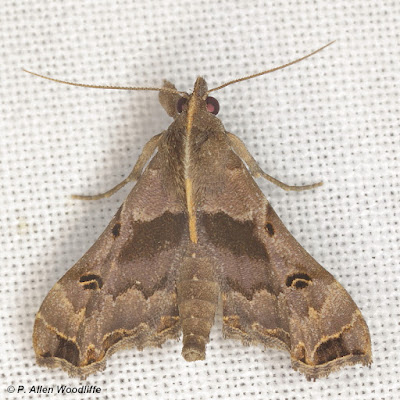
Next is one with rather limited Ontario distribution, and is on the list of rare species of Ontario. It is a Faint-spotted Palthis.
 |
Fall Webworm
|
 |
Frosted Tan Wave
|
Another highlight is this large moth, which I have only photographed a couple of times. It is a Giant Leopard Moth.
Another rare species in Ontario is this Gold-lined Melanomma.
Quite a common species, but rarely have I seen it looking so greenish, is this Green Pug.
 |
Guenee's Pearl
|
These next two are fairly regular, and quite interestingly patterned.
 |
Hickory Tussock Moth
|
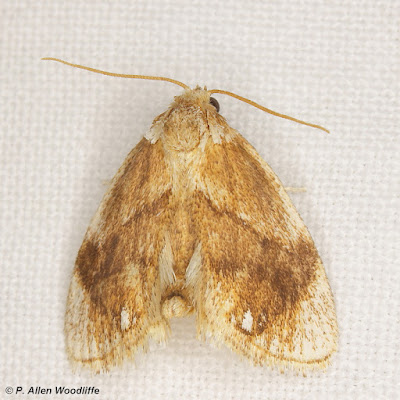 |
Jewel-tailed Slug Moth
|
This next one is extremely small, only about 5 mm long, and rarely photographed in Ontario. It is the Linden Bark Borer and is not native.
There are several Callus Borers, but only this Maple Callus Borer comes to a light. Of the Callus Borer group, it is easily told by the reddish/orange tip of its abdomen.
 |
Pale-winged Crocidophora
|
A quite colourful and vividly patterned moth is this Pink-shaded Fern Moth, shown next. I had 8" x 12" canvas prints made of these next two due to their impressive colours and patterns.
One of my all-time favourites, seen primarily in mid to late June and sometimes early July is this Rosy Maple Moth.
 |
Showy Emerald
|
This next one is new for the Rondeau checklist, and in Ontario, is only found widely scattered across the southern part of the province.
 |
| Sooty-winged Chalcoela |
|
|
|
|
Another one in the slug moth group is this Spiny Oak-slug Moth.
A larger moth looking somewhat like the sphinx moths is this Spotted Apatelodes.
 |
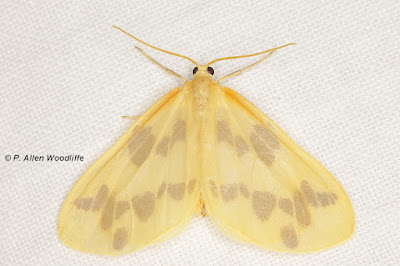
The Bad-wing
|
 |
Beggar Moth
|
This next one is rather worn and torn, but it is a rare species in Ontario. Not surprisingly it is fairly regular at Rondeau as it is a Tulip-tree Beauty, where Tulip-trees are rather common.
There are several similar looking moths, but I am fairly certain this is a Virginian Tiger Moth.
Another large Sphinx moth is this next one, the Walnut Sphinx.
At the other end of the size spectrum is another slug moth, the Yellow-collared Slug Moth.
Depending on the weather and my energy levels, I expect to be out with the black lights again on several occasions over the next few nights during National Moth Week. It is about the peak time for moths, although there will be lots more to photograph and document until October!
If you would like to subscribe, or unsubscribe, to Nature Nuggets, send an email to: prairietramper@gmail.com


