Showing posts with label Black-and-white Warbler. Show all posts

Saturday, 10 May 2025

Birds, of course!

 The month of May is exciting for many outdoor folks. Wildflowers are becoming abundant, trees are coming into leaf and flower, and of course it is prime time for large numbers of birds to arrive here in southern Ontario. And while the migration depends quite a bit on the weather, resulting in some days early in May being rather birdless, at least to the liking of most birders, some days can be fairly good for abundance and diversity. I always say that the middle two weeks of May are on average, the best two weeks for abundance and diversity, but that isn't always the case.

If one is able to get out regularly regardless of the weather, one will usually catch up to a lot of species. My last post focused on wildflowers, and I will get back to more of them soon, but this post will show a wide variety of birds I have been able to catch up to and photograph over the last few days.

This first bunch will be ones I encountered up along Mitchell's Bay or St. Clair NWA. Sandhill Cranes are always fun to see, and not always easy to photograph, but I keep trying! 


With the slightly lower water levels of Lake St. Clair, there are more mudflats than most years. This first photo shows both a Lesser Yellowlegs on the left, and a Greater on the right, illustrating a reasonable comparison of overall size and bill.
Next is a Greater Yellowlegs up a bit closer.
Great Egrets are frequently seen in these open wetland areas, and often cooperate reasonably well for the camera, as long as one has a good telephoto lens.
An anchored log just off the shoreline edge is a great spot for gulls and terns to rest. It is hard to tell from this photo, but I determined after I took this photo that these are Forster's Terns. 
And a Bald Eagle or two can often be seen passing by.

American Coots are often seen either singly or sometimes in a group.

The road on the south side of St. Clair NWA can sometimes be a great spot to see a variety of birds, depending on the wind direction and speed. On the hydro wire were a few swallows, such as this Barn Swallow.

In the shrubbery, I encountered an Eastern Kingbird....

...a Gray Catbird.....
...several Palm Warblers....

....and lots of Yellow-rumped Warblers.

Nearby were, of course, Red-winged Blackbirds.....

...and this Tree Swallow was checking out a potential nest cavity.
On another trail, there was a good number of White-crowned Sparrows....
...and a few White-throated Sparrows.

Of course Rondeau has always been one of my favourite places for a whole lot of reasons most of the year-round. However I don't like it as well in May, as it is quite crowded with birders! It seems more and more people who used to go to Pt. Pelee NP got fed up with the crowds there, and have decided Rondeau is the place to be for their spring birding. I can't say that I blame them, but.....I try and choose times when the park is a little less crowded, so I can enjoy the relative peace and quiet and still see a good variety of birds.
 
This Black-and-white Warbler was constantly on the move in its search for something tucked away in the crevices of the bark. 
 
A Blackburnian Warbler paused long enough for this photo.
This Chestnut-sided Warbler was bouncing around in some shrubbery, so the photos weren't as good as I was hoping. Maybe next time...

A Great Crested Flycatcher was trying to figure out how to consume this insect it had managed to get hold of.
Northern Flickers are fairly abundant, and can be found working on a nest cavity.
A Philadelphia Vireo stopped by for a moment. It looks a lot like a Warbling Vireo, but has a slightly more contrasty appearance, and a dark spot at the lore just in front of the eye. It also has a slight yellowish wash to it belly.
Purple Martins can be found in abundance where martin houses occur.
The number of Rose-breasted Grosbeaks are increasing, and some will remain to nest.
This pair wasn't wasting any time!!
And there were lots more Yellow-rumped Warblers.
Closer to home, at least for me, is this family of Great Horned Owls. There are two young, and they have left the nest. Often they will be found resting on a branch, in the company of one of the adults, but not always.


More birds will be coming in a future post!


If you would like to subscribe, or unsubscribe, to Nature Nuggets, send an email to: prairietramper@gmail.com


Saturday, 4 May 2019

May has arrived, and so have the songbirds!

What a difference a few days make. April was relatively slow for songbird migration, but it seems now that the first few days of May have arrived, so have the birds. There has been a very good representation of songbird migrants....not as good as it will be in a week or so, but quite rewarding to be out just the same.

The sand spits of the north shore of Lake Erie are prime places to see these avian arrivals, and Rondeau is my favourite. And there is a new trail! Well not really a new one, but a trail with a new name. It used to be referred to as the maintenance loop, as it was an unofficial walkway along the south side of the maintenance compound, with a loop that went south for a few hundred metres through an area that used to be a deer enclosure as recently as the 1960s, and when that was removed, part of it became a place to store unneeded material such as posts and parking barriers. It has been popular for a few years now for both birds and butterflies, and it is officially called Warbler's Way. You can access it from either Harrison Trail or Rondeau Road.
Warblers have been arriving in decent numbers, and I believe as of today, there have been at least 28 species recorded. I haven't been out as often as some folks, and have only seen about half that many so far, but that will change shortly. Some species are in very low numbers, as expected. I haven't caught up to some of the rarer ones, such as Louisiana Waterthrush and Golden-winged Warbler, at least not yet. Here are a few warbler species that I have caught on camera. The first three species have been fairly abundant.
Black-and-white Warbler
Black-throated Blue Warbler
Black-throated Green Warbler
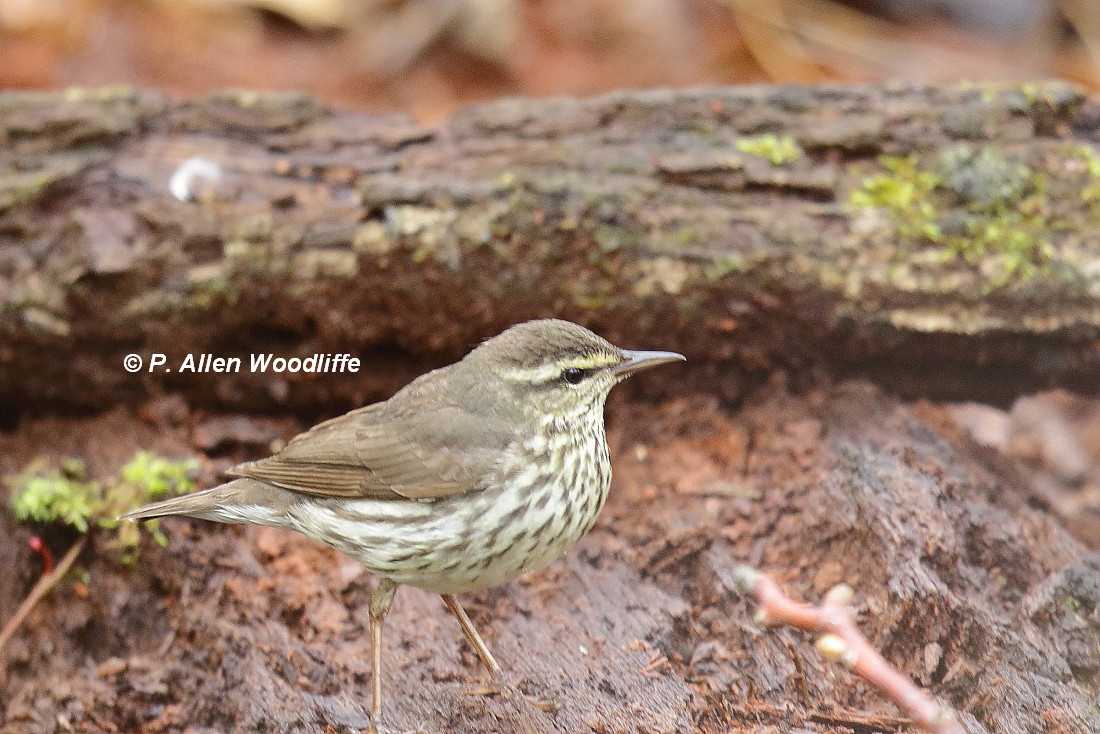
 This next one, the Northern Waterthrush, has had a few around, and I watched this one feeding and singing at the edge of a slough along Warbler's Way.
Northern Waterthrush

Ovenbird
Palm Warbler    
Of course there are lots of other members of the songbird group. Northern Cardinals are looking their most spectacular this time of year.
 Less colourful, but important in their own right are Gray Catbirds, which have just arrived in good numbers.....
 ....as are Rose-breasted Grosbeaks.
 Members of the thrush family are quite melodious. Wood Thrush is probably the most melodious of the group, at least in my opinion, and it nests at Rondeau. I have only seen a couple so far and haven't got a photo yet. The Veery is quite melodious in its own right.
Veery
 Sparrows can be hugely abundant. White-crowned Sparrows have just started to arrive...
 ....on the other hand, White-throated Sparrows are going through in massive numbers. Sometimes it seems like the forest floor is moving, they are so abundant. It is not uncommon to see several hundred in just a couple of hours. There must be thousands of them at Rondeau right now, but that can change in a hurry as they quickly head on to their more northerly breeding range.
 Brown Creepers are subtlety marked and a few of them are often seen these days.
 You never know what you might find. I came across this along the west side of the South Point Trail yesterday.
Someone is likely not happy. If you hear a youngster fussing along a trail somewhere in the park, it might be because he or she is lamenting the loss of something important.

Monday, 11 September 2017

Recent Rondeau and Erieau foray

It is amazing how time flies, and I hadn't been to either Rondeau or Erieau for awhile. A recent trip to both made up for that.

At Rondeau, I headed for the South Point Trail, where there is often a buildup of warblers and other passerines at this time of year. That was a good choice. The bushes were loaded. Unfortunately the bright sunlight, caused many shadows in the dense shrub growth, and hawks in the vicinity kept the birds low and partially hidden. So photos weren't all that rewarding. Blackpoll Warblers were by far the most common.
 I got about 15 species in all, including the occasional Black-and-white Warbler. They aren't usually this green, but being in the shade of the greenery will do that.
There were also sightings of things such as Northern Parula and Blue-gray Gnatcatcher, but no photos. No Connecticut Warbler either that I could find, although one or more has been seen by others along this trail in recent days. Seven Bald Eagles were noted overhead, including five of which were flying much higher and drifting with the winds in a southwest direction, so presumably migrants.

It wasn't that many years ago when seeing a Bald Eagle was a real highlight, but due to their rebounding population in the last couple of decades, is an expected sight.

I always keep an eye out for other things of interest, and came across a variety of pollinators on goldenrod. One that particularly caught my attention is this Feather-legged Fly (Trichopoda sp.), named because of the feathery appearance of the lower part of its hind legs. It is a little more obvious in the second photo.

I got lots of photos of other pollinators, but as yet are still working on their identification. Maybe it will be fodder for a future post.

What used to be a rare orchid but is now just considered uncommon with a restricted range, is this Great Plain's Ladies'-tresses.
A later trip to Erieau proved worthwhile. Nothing really unexpected was seen, but it is always nice to see what is around.

There was a flock of at least 50 Sanderling feeding and resting on the beach.


A Ruddy Turnstone was feeding on the pier and area.
Not a Rock Sandpiper
At the west end of McGeachy Pond is a butterfly bush next to the parking area. On this day, it was very busy, with more than a couple of dozen caught up in a feeding frenzy. There were at least 15 Monarchs and 7 Painted Ladies as well as Question Mark, Red Admiral, Silver-spotted Skipper and the usual Orange Sulphur and Cabbage White butterflies, all seen in about 20 minutes.
Monarch

Orange Sulphur

Painted Lady

Question Mark

Question Mark

Silver-spotted Skipper
A brief stop at the Campbell Line pasture on the way home did not have much bird life. Aside from the typical Turkey Vultures passing by overhead, there was a family of Eastern Kingbirds on the fence by the road.
 This immature Brown-headed Cowbird, below, was hanging out with the kingbirds, so I assume it thought it was part of the family due to it likely being raised by them. No doubt it will not make the southward migration with its 'family', but hook up with other cowbirds before long.