Showing posts with label Sinclair's Bush. Show all posts

Wednesday, 2 May 2018

Natural Areas of Chatham-Kent, Part 13 (Sinclair's Bush)

Sinclair's Bush is one of the few areas in Chatham-Kent where you can drive and have forest on both sides of the road. Not for a long way, mind you, but it is a start, and gives a hint of what driving through southwestern Ontario was like a few decades ago. It is not far from where I grew up, and I remember spending time there many years ago, exploring the natural features. It continues to be an attraction to me and others, partly because it is so accessible. Spring time is the perfect time to visit.

So where is this place? Note this first photo, showing the town of Blenheim. Towards the middle right hand side, is the letter "S", indicating Sinclair's Bush.
A closer view, also complements of Google Earth, shows the configuration of the overall woodland. Most of this almost 40 ha woodland complex is privately owned, but in the centre of the site, shown within the blue line, is the approximate boundary of the Conservation Area owned by the Lower Thames Valley Conservation Authority.
This parcel now owned by LTVCA was slated for development in the mid 1980s. It was going to be the site of a single house surrounded by woodland. In fact along the trail, the pipe where a well was dug, is still visible. However local landowners, who took pride in this larger woodland area and were not in favour of the house, joined together with conservation agencies and the Ministry of Natural Resources which had identified the overall site as part of an Area Of Natural and Scientific Interest to oppose this development. Funding from landowners, conservation groups and others as well as a significant contribution from Union Gas, allowed this site to be purchased and retained in its natural condition. It was turned over to the LTVCA.

This site is a mix of upland and lowland forest typical of southwestern Ontario. The rich, well-developed soils support a lush forest.

As mentioned above, spring is one of the best times to visit, before the leaves of the trees are out which shade the forest floor. The spring wildflower display on the CA property as well as those adjacent properties that are privately owned can be impressive! In the earliest period, the lowland forest can have some wonderful displays of Marsh Marigold.

 Dog-toothed Violet, a.k.a. Trout Lily, is in prime condition on a sunny day in early May. On cloudy days, the flowers close up.

 Cut-leaved Toothwort is plentiful.
 Starry False Solomon's-seal is scattered about.
This next one is seldom noticed, although there are good sized patches of it. Normally all one sees is the mostly round green leaves. However if you take a closer look, and move some of last year's leaves that cover the base of the plant, you may see a purplish/chocolate brown flower. It is known as Wild Ginger.
  The flower is in bloom under the leaves, since it is pollinated by ground beetles, not the flying insects that pollinate many of the other flowers you will see here.
 One of the more interesting discoveries I had here was to find the yellow form of the Red Trillium. It is not commonly seen anywhere. I know of only 4 locations for it in Chatham-Kent, although undoubtedly there are more.
 A woody plant that Sinclair's Bush is known for is Pawpaw. The flowers are fully open just as the leaves are developing. The leaves here with the flowers look like ordinary leaves, but they are still quite small.
 The flowers may develop into a greenish fruit. When it ripens fully, it can be fairly aromatic. Note the size of the leaves here.
 To get a fuller appreciation of the leaf size, see the next photo. The leaves at the top are those of Black Walnut, which are not small themselves. But the huge leaves are Pawpaw.

I found my first American Woodcock nest at Sinclair's Bush many, many years ago. This species returns to southern Ontario in late March or early April, and nesting begins shortly afterwards.
The young are able to leave the nest shortly after hatching, and blend in well with their surroundings. Do you see it in this next photo?
 How about here?
 Okay...here is a much closer view.
Red-bellied Woodpeckers are a regular feature here, as it is in many southern Ontario woodlots these days. However that wasn't always the case. In the early 1970s, it was quite a rarity in Ontario. I remember an experienced Canadian naturalist from another province camping on our lawn, since he wanted to get to Sinclair's Bush to see a Red-bellied Woodpecker which had recently been discovered there.
It is a likely place for lots of other birds in season. There are currently 85 species known for this site.

SInclair's Bush is well worth getting off the nearby paved road known as Talbot Trail (Hwy #3) and quietly driving down this rural, gravel road to experience this small remnant of what much of C-K used to look like.


Monday, 3 November 2014

Sunny and brisk on the Marsh Trail

The strong northerly winds of the last couple of days had died down. They were more out of the west, and a mere 10-15 km/h, so I decided it was time for a trek out the Marsh Trail of Rondeau. It was a non-hunting day, so the trail would not be busy with vehicles full of hunters, dogs, plastic or wooden ducks, etc going back and forth.


It is also prime time for eagle migration, especially Golden Eagles. I hoped that with the wide open skies, my chances of spotting one, and possibly even getting a photo, would be good. So off I went.

Given the beautiful day, there were very few people on the trail.....a total of 6 people and two dogs over the space of about three hours. Two people per hour was okay by me, so as to give me more of a chance to see the wildlife. Perhaps the very cool breezes off Rondeau Bay were not enticing to many folks, and the ones in the park this day stuck to more sheltered trails.

Song birds were quite few. I noted a few sparrows and juncos, including this first year White-crowned Sparrow.

A Sharp-shinned Hawk zipped by.


Golden Eagles were not to be seen, but both resident Bald Eagles were perched in one of their usual spots a few hundred metres from their nest tree.

There were lots of ducks, geese and swans on the bay or flying by, most of which were too far to bother photographing. Ruddy Ducks, Mallards, American Wigeon and Gadwall were the most abundant, with a few Green-winged Teal, Northern Shoveler, scaup and Redhead as well. I also saw my first Common Goldeneye of the fall. I'm sure they have been around for a little while....I'm sure I need to get out more :-).

A mink scampered across the trail 50 metres or so in front of me, but it was not spending any more time than necessary out in the open. I stood still and squeaked and pished, hoping to convince it that a mouse or a rabbit was injured and it would come to investigate, hoping for an easy meal and giving me an opportunity to photograph it. However this large member of the weasel family ignored my attempts, and thus I was left only with a memory of it registered in my brain cells, rather than in a series of pixels in the digital realm.

I came across an 'orange' tree! It wasn't going anywhere.

OK....we may live in the banana belt, but that doesn't mean we have southern fruit trees here. This is actually the ripening fruit of Climbing Bittersweet, a native vine that grows along forest edges. Before long, the outer orange husks will split open and reveal deep red berries, which birds enjoy.

On the return, this Northern Harrier floated by fairly quickly, and I only had time for a quick shot before it headed into even more challenging light.

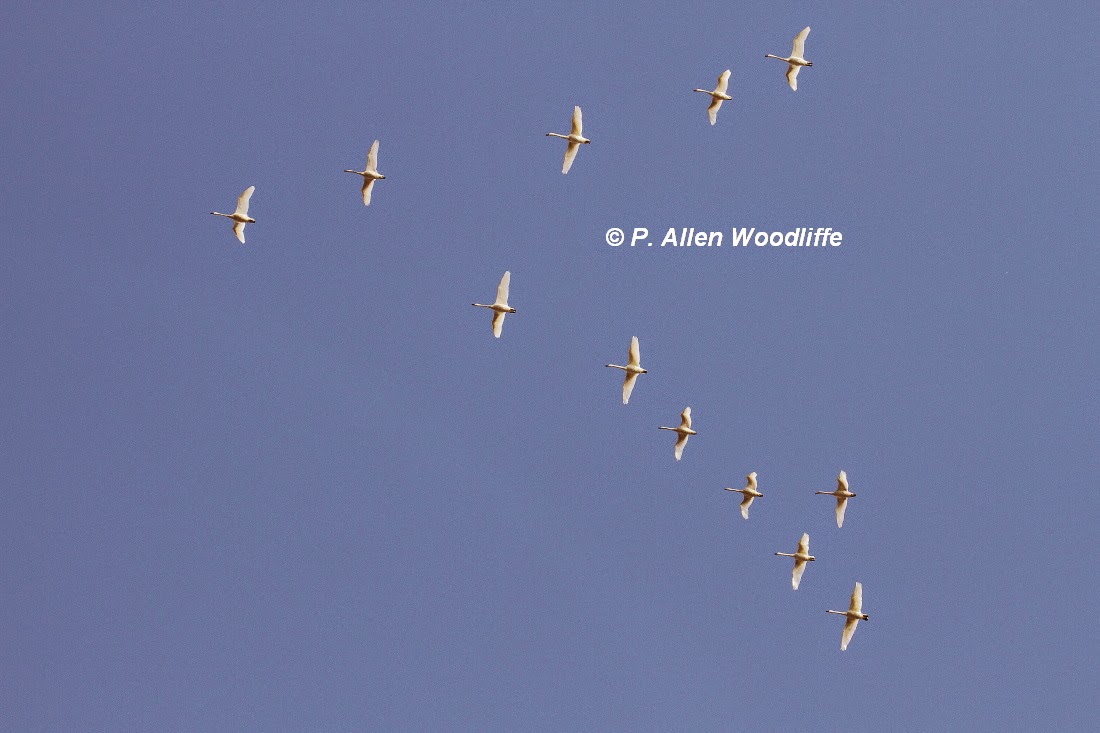
And several small flocks of Tundra Swans were winging high overhead.....and heading north! They have been building in numbers gradually over the last couple of weeks, with most of the population yet to arrive before heading southeast to spend the winter at Chesapeake Bay. Maybe they were really just heading inland to feed in recently harvested soybean or corn fields, and the wind turbulence was less problematic for them at a higher altitude.


I checked part of the campground before leaving, since there is a nice mix of shrubbery amidst the planted conifers and deciduous trees. The fruit of the Red Cedar isn't as plentiful as it was last year, but there were still birds around. Lots of robins, starlings and a few kinglets. I was hoping for Fox Sparrow but didn't find one. There were the usual Song Sparrows and juncos. I spotted at least six Yellow-rumped Warblers, a single Blue-headed Vireo and two Red-breasted Nuthatches. The vireo didn't cooperate for the camera.

American Robin

Yellow-rumped Warbler

Red-breasted Nuthatch
After leaving Rondeau, I drove through Sinclair's Bush, a provincial Area of Natural and Scientific Interest, and one of the few places in Chatham-Kent where there is a bit of forest on both sides of the road. There is still some autumn colour there.

Looking southwest
 Right behind where I took this forest scene from is a stand of Pawpaw. It is a southern large shrub/small tree species, and quite rare in Ontario and thus also rare in Canada. At one point, C-K had the greatest number of locations where Pawpaw was known from. I'm not sure that is still the case, given the recent loss of woodland. It likes rich deciduous woods, but I've seen it along roadsides adjacent to where deciduous woodland used to occur. Pawpaw is easily identified by its large, long leaves and, in the early spring, by its maroon coloured flowers that are out just as the leaves are beginning to emerge. The leaves persist longer than most other tree and shrub species in the fall.
Pawpaw
There has been a fair bit of timber harvest out of Sinclair's Bush in this last year, both large sawlogs and firewood. Firewood extraction is continuing at the moment. Of course there was a lot of ash growing in this woodlot, most of which was killed by the non-native Emerald Ash Borer, so the harvest of dead timber is a preferred option for most landowners. I anticipate that more timber will be extracted sometime in the near future, as trees in other sections of the woodlot have typical markings on them indicating they have been selected for a future harvest.