Showing posts with label Small White Lady's-slipper. Show all posts

Sunday, 28 May 2023

Rare, Threatened and Endangered Wildflowers

 A few days ago I decided to forego any serious birding activities, as this is also the time of year when some of the rarest, most threatened and endangered plants can be found, but it takes some planning.

One of the rarest plant species is an orchid, the Small White Ladies'-slipper (Cypripedium candidum). It formerly grew in small number of widely scattered places in Ontario, but currently it only occurs in an area of eastern Ontario, and on the incredible prairies of Walpole Island First Nation. Due to my working relationship with the folks at WIFN, I have been privileged to have seen them there on a number of occasions from about the mid 1980s until the early 2000s. However I had not seen them for quite awhile, so made contact with someone I have worked with over the last couple of decades or more, and made arrangements to check them out. We ventured to one of the largest and most remote prairies, and bingo, found a couple of dozen or more.


The photos above show pure examples of this endangered orchid. What is even more intriguing in some ways, is that it may hybridize with the Small Yellow Ladies'-slipper ( Cypripedium parviflorum). Finding some of the variable hybrids is always rewarding. These next photos show the variability in their colour, and are known as Andrew's Lady-slipper (Cypripedium X andrewsii). As you can see, they are not pure white or pure yellow, but may vary. Their sepals are typically more purplish than those of the Small White's as well.


There were other plants of interest on this prairie, but I didn't spend a lot of time with them. This first photo shows a small portion of this phenomenal prairie, much of which was burned this late winter or early spring, creating great conditions for tallgrass prairie. In the first photo, in the middle range, there are quite a few small yellow flowers.
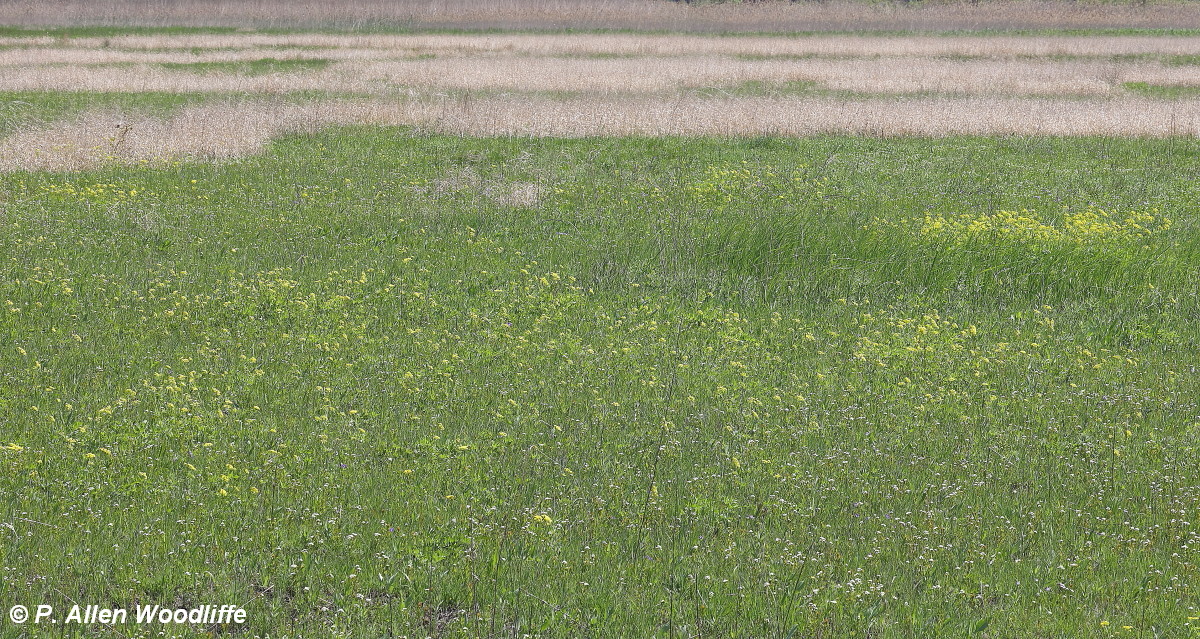
They are Golden Alexanders (Ziza aurea). It is relatively widespread in Ontario.....


 ...unlike this next one, the smallish Yellow Star Grass (Hypoxis hirsuta) which is also endangered, as it is found in less than half a dozen places in Ontario.

I had other rarities to catch up to on this day, and since I was more or less going by the Sydenham River Nature Reserve, owned by Ontario Nature, decided to stop in and see how the Virginia Bluebells (Mertensia virginica) were doing there. I had seen a fantastic display of them a week or so earlier, in Elgin County, but hadn't seen this population on the Lambton/Middlesex border for a couple of years.


They weren't quite as spectacular as in some years. Whether it was due to unusual water levels, or the way the spring unfolded as some of them seemed to show being hit with a touch of frost, or something else. I didn't get to the most impressive part of the site which is not easy to get to. However I was able to enjoy quite a few clusters and individuals throughout part of their normal range here.

They bloom prolifically for a relatively short period, but are likely 95% finished by now.

I left the SRNR and headed to my next target area, to see another endangered species. It was in  Middlesex County, in the Strathroy area, and the species to check up on was Drooping Trillium (Trillium flexipes). In Canada, it is only found in Middlesex County, with a possibility of a population in neighboring Elgin.

I hadn't seen this population for about 14 years, and wasn't certain I could find it, if it still existed. But persistence, and a reasonable memory, of its location proved to work, and I found about 15 plants. It droops more than other Trillium species....

...and a key characteristic is the very short filaments of the anthers, a closer look at these next two photos will show.

I was pleased to find that at least some individuals remained, and had I taken more time to explore, may have found others.

On the way home, I stopped at a couple of places in the Skunk's Misery and Thamesville area, where I expected to find good flowering populations of yet another endangered species, although much more widespread across southwestern Ontario than the other species featured here. It is Eastern Flowering Dogwood (Cornus florida), a largish shrub that can get to small tree size on occasion. These first two photos were taken from the roadside, so I didn't have to go far.


The flowers themselves can vary somewhat in appearance, as the next two photos show. They will have bright red berries when the fruits are ripe later in the summer.

Another endangered species is one that many years ago, was planted in a small prairie patch. It is Moss Phlox, (Phlox subulata) and likes open sandy situations, flowering right at ground level.

So there you have it: a variety of rare, threatened and endangered species that even keen botanists seldom see. These are just a small sample of the incredible diversity of rare flora here in southwestern Ontario!


If you would like to subscribe, or unsubscribe, to Nature Nuggets, send an email to: prairietramper@gmail.com


Saturday, 19 June 2021

Orchid delights

 With so much happening in spring, it is hard to keep up with everything. But it is always a highlight of the season to search for and enjoy native orchids. Some are colourful, some are not, but they are always a delight to see. They are not abundant, which makes finding them all the more rewarding.

 Some places have a good variety of orchids, such as Rondeau Provincial Park, which has had 19 species found within its boundaries. Many other woodlands in the area have never had any found.  Sandy soils seem to make a difference.

The first species to appear in flower in Rondeau, one that has been considered a species at risk but hasn't quite made it yet, is Showy Orchis, which typically flowers during the last third of May. It isn't very tall, and it can be easily missed in spite of its colourful flowers.


Here is one that likely everyone has seen, at least in photos: the Small Yellow Lady's-slipper. It is widespread in Ontario, and in places on the Bruce Peninsula, can be very abundant. At Rondeau I have seen it in three locations and likely occurs in a few more. One small population seldom flowers anymore, and the larger population is well away from any easy access, so I don't get to track it down every year.

Closely related is the Small White Lady's Slipper. It is a real rarity, and in fact is legally endangered in Ontario. There are a few spots for it on Walpole Island First Nation, but none are very accessible, and even then only with landowner's permission. I haven't been to see them for several years, so this one is from my archives. Other than being at Walpole, there is only one, or maybe two, other locations for it in all of Ontario.

Purple Twayblade, shown next, is also a legislated Species At Risk. It grows in a few scattered locations, but never seems to be very plentiful even where it is found. This one was in the Windsor area, in the greater Ojibway Prairie complex. There are all sorts of rare, threatened and endangered plant species there, which isn't surprising since the entire habitat is endangered in Canada. A population that I had known about for several decades, seemed to have disappeared, likely due to the invasion of Phragmites. However some fellow orchid enthusiasts had access to some coordinates for a single plant in another section of the complex, and after a bit of a search, Marie and I were fortunate to be able to see and photograph it. Thanks John, Peter, Jeremy and Natalya!
 

One that is visible all year round is this next one: Puttyroot. However for most of the year, only its somewhat distinctive leaves are showing, especially from November through May.

By very late May and into early June, a few flower spikes appear. However in the main population I have counted almost 60 sets of leaves in the early spring, but have never seen more than 15-20 flower spikes, and usually less than 10.
It isn't showy, but it is distinctive.

This next species may still grow at Rondeau, although I haven't seen one in flower in decades. It is Hooker's Orchid. It isn't very colourful either, so one has to look a little more intensively to find it. For getting these photos, I had to travel to a sandy site in north Lambton County where I found a few plants.


 While I was there, I took the opportunity to track down a spot nearby which usually has a few Pink Lady's-slippers, also known as Moccasin Flower.


One of my goals on this trip to north Lambton was to find a tiny, but somewhat showy orchid called Ram's Head Lady's-slipper, which I have seen here before on several occasions. However on this trip, I did not see anything but leaves, so maybe next year it will be in flower. This photo was taken in 2019. A close-up looks impressive, but in reality this whole plant was no more than about 10 cm high. This location is believed to be the most southerly in all of Canada.

The flush of orchids will taper off somewhat now, at least locally. But later in the season there are a few others that I hope to find and feature on a future post.


Monday, 7 July 2014

Early season native orchids


The topic of orchid flowers conjures up thoughts of exotic flowers from the tropics, and the ones sometimes used as a corsage on special occasions. But not too many people think about some of the plant species which naturally occur in Ontario as being orchids. The fact is, there are approximately 60 species of orchids that are native to Ontario! And some are quite colourful and exotic looking in their own right. Rondeau Provincial Park can lay claim to 19 species growing within its confines, but the orchid capital of the province are the counties of Bruce and Grey, and especially the Bruce Peninsula, where at least 44 species of orchids are known.

One of the earliest to appear in the southwest is the Showy Orchis, which grows in rich hardwood forests. In spite of its name, it is not that showy unless you get down for a closer look. It seldom gets more than 15 cm (6 ") high, and may be obscured by taller vegetation. At Rondeau, it typically begins to bloom about the third week in May.

Showy Orchis

At about the same time, and in slightly more open woods, may be found the Yellow Lady's-slipper. It occurs as a large form and a small form, which generally occupy different habitats, but there may be some overlap.

Large Yellow Lady's-slipper


The Small Yellow Lady's-slipper can sometimes be found on some of the better quality native tallgrass prairies. There it can hybridize with an extremely rare native orchid, the Small White-Lady-slipper, especially if the flowering times overlap, which they usually do. The hybrids are even rarer than the Small Whites, and can take on some unusual but attractive colour combinations that draws the attention of serious botanists and photographers.

Small White Lady's-slipper


Small White Lady's-slipper
This species is, as its name implies, small, seldom growing over 20 cm (8") high. It does occur in one or two other places in Ontario, but in somewhat different habitats. The bulk of the Ontario population occurs on the private lands of tallgrass prairie in Lambton County. It is an Endangered Species under the various provincial and federal statutes.

Another type of Lady's-slipper is the Pink Lady's-slipper a.k.a. Moccasin Flower. Depending on the latitude, it may be in flower in May but a little farther north, will still be in flower in early June. It prefers the slightly more acidic sandy soils in sand dune systems which have developed to the point of also growing coniferous trees. It also occurs at the edges of bogs, which are not found in extreme southwestern Ontario.

Moccasin Flower

Moccasin Flower


By early June, another orchid appears in flower....the Puttyroot. This occurs in rich hardwood forests, and is not nearly as colourful as the previously shown ones. But it can grow taller than the others.

Puttyroot in flower


Puttyroot flower close-up
The Puttyroot isn't visible in flower for long. One of the ways to find it, however, is to look for their distinctive leaves during a period of late autumn to early spring when there is no snow cover. It is not a really rare species, but is certainly not common in spite of its relatively widespread range in southern Ontario.

Puttyroot leaves
An uncommon orchid in southwestern Ontario, but more common in the marl wetlands and fens of the Bruce Peninsula is the beautiful Grass Pink. In the southwest it may occur in very small numbers in wet grassy areas including tallgrass prairies.

Grass Pink


Later in June, another rare orchid appears, the Eastern Prairie Fringed Orchid. In spite of its rarity, it grows in a wide variety of habitats, from high quality tallgrass prairie, to the edges of marl lakes, to fens of eastern Ontario and even along wet ditchbanks! Some type of disturbance or environmental condition to keep the vegetation open seems to be the key to survival, so at least in tallgrass prairies, the regular occurrence of fire at the right time of year is a necessity.

Eastern Prairie Fringed Orchid

Eastern Prairie Fringed Orchid
One of the interesting aspects of this latter species is that it is pollinated by night-flying moths, and specifically the Sphinx Moth types. I was monitoring a population of this orchid near the former Windsor Raceway in the 1970s and early 1980s. It eventually died out, and one of the main changes in its environment were the extensive night lights that were along the road and the raceway. Moths don't function normally under well lighted conditions, so it is possible that the population of orchids went unpollinated, stopped producing seed, and the older plants eventually died out. Interestingly since that time, another population appeared a few hundred metres away, in a well shaded environment.


More on orchids in a future post....