Showing posts with label Eastern Flowering Dogwood. Show all posts

Sunday, 8 June 2025

Late May/early June roaming at Rondeau (mostly)

 It is always inspiring to get out and roam around to see how nature is developing. Sometimes rather than focusing on any one thing in particular, it is great just to see what awaits for me. Even an overcast, somewhat rainy day, can be enjoyable. The forests look particularly green and lush in those conditions, so it is nice to have an umbrella handy and the right camera equipment for the conditions! This first one is along the South Point Trail...

...and the next one is from near the Gardiner Deer exclosure.

A couple of weeks earlier I had been out specifically looking for one of the main populations of Showy Orchis. More recently I was a little surprised to see this one still in fairly fine condition.


 There are lots of other attractive and colourful plants to aim the camera at:

Dame's Rocket, colourful but not native
While out one time exploring a part of Clear Creek Forest Prov Nature Reserve, I came across several individuals of Flowering Dogwood, an Endangered Species.


Along the grassy beach dunes of Rondeau is another Species At Risk, although not endangered, known as Hairy Puccoon.
Fairly abundant in rich woodlands is this next one, Mayapple.....
...and in more Pine-oak forest types where sandier soil is dominant, is Wild or Red Columbine, always a favourite to see in late spring.

In similar types of soils, and in this case along the Black Oak Trail, is Seneca Snakeroot.

White Baneberry

 Another species that I found for the first time a couple of years ago, and was added to the park's plant checklist for the first time, is this next one. It is Hairy Rockcress, and is considered Critically Imperiled in Canada. According to iNaturalist, it has only been recorded elsewhere in Canada on Pelee Island, at Point Pelee NP and near the north end of the Bruce Peninsula. It just goes to show that even after having explored Rondeau's trails for more than 50 years, there can be new things to discover! Which is part of the reason I keep exploring Rondeau, my 'home away from home' :-).


Something else on the Endangered species list is this next one, American Ginseng. I have been keeping an eye on this cluster for quite a few years, and is always fun to check up on.

This individual plant shows a very tiny flower cluster developing at the point where the three leaf stems separate.


 A different plant from the previous one, showing a closeup of the flower cluster. In another 2-3 weeks, the buds will open to show a few small white flowers, from which tiny red berries will eventually (hopefully) be present.


There are always a few other things to encounter along the way, such as the following in no particular order:

Black-shouldered Drone Fly

Common Five-lined, or Blue-tailed Skink

Hammer-jawed Jumping Spider

Hobomok Skipper

Hooded Dryomyza
Next is a member of the Large Crane Fly family, first a male........

...and next shows the female with it, and it looks like there is another generation of them to come!
Sometimes when trying to photograph a wildflower, there may be a tiny creature on it, such as this type of Flower Fly known as a Margined Calligrapher.
Certainly much larger is this Mourning Cloak....
...while a bit smaller is this Narrow-headed Marsh Fly.
On those days when it is slightly warmer, there are a few snakes out and about. Unfortunately some are just getting used to a bit of warmth, and are not able to escape the impact of the wheels of a bicycle or something that comes upon it quickly, such as this Northern Brown Snake, also called Dekay's Brown Snake.
They are relatively tolerant of human presence along the trail, if movements of humans are slow and calculated, allowing for close-up photos as these next two individuals demonstrate.

And finally for this post, a Silver-spotted Skipper.

 As mentioned and explained a bit in my previous post, I have started up another blog with a slightly different theme. I have called it Life Is A Journey, and if you are interested, you can check it out at this link. I plan to continue with Nature Nuggets as I have done over the past 11 years. It is now over 700 posts and almost 12000 photos, and is certainly fun to do.

 If you would like to subscribe, or unsubscribe, to Nature Nuggets, send an email to: prairietramper@gmail.com


Sunday, 28 May 2023

Rare, Threatened and Endangered Wildflowers

 A few days ago I decided to forego any serious birding activities, as this is also the time of year when some of the rarest, most threatened and endangered plants can be found, but it takes some planning.

One of the rarest plant species is an orchid, the Small White Ladies'-slipper (Cypripedium candidum). It formerly grew in small number of widely scattered places in Ontario, but currently it only occurs in an area of eastern Ontario, and on the incredible prairies of Walpole Island First Nation. Due to my working relationship with the folks at WIFN, I have been privileged to have seen them there on a number of occasions from about the mid 1980s until the early 2000s. However I had not seen them for quite awhile, so made contact with someone I have worked with over the last couple of decades or more, and made arrangements to check them out. We ventured to one of the largest and most remote prairies, and bingo, found a couple of dozen or more.


The photos above show pure examples of this endangered orchid. What is even more intriguing in some ways, is that it may hybridize with the Small Yellow Ladies'-slipper ( Cypripedium parviflorum). Finding some of the variable hybrids is always rewarding. These next photos show the variability in their colour, and are known as Andrew's Lady-slipper (Cypripedium X andrewsii). As you can see, they are not pure white or pure yellow, but may vary. Their sepals are typically more purplish than those of the Small White's as well.


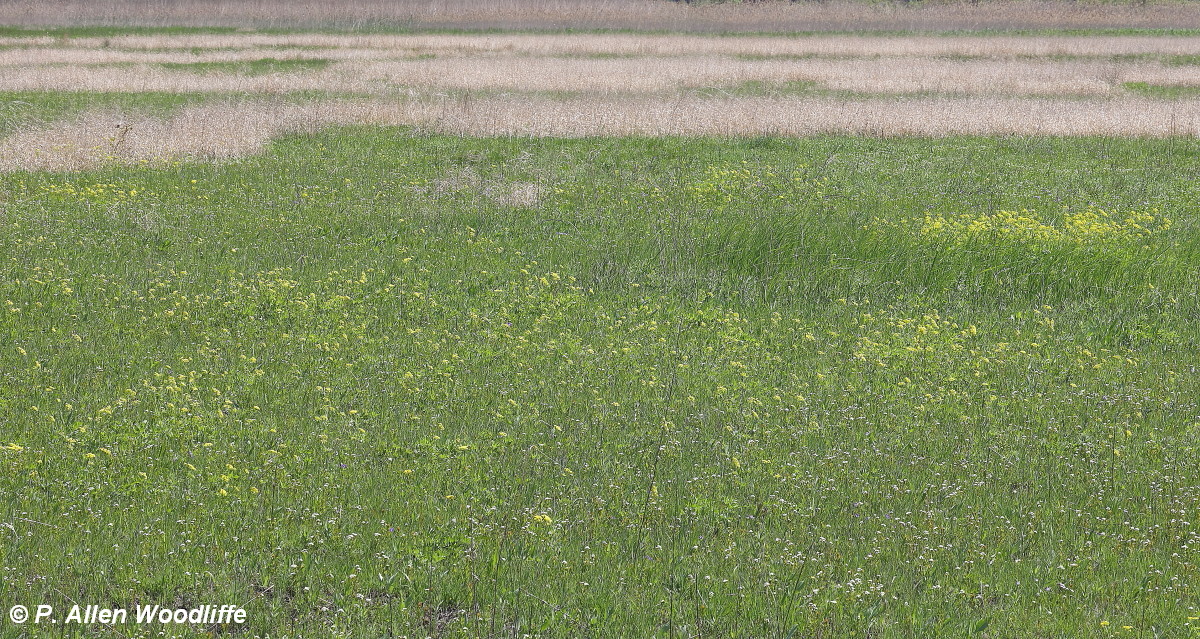
There were other plants of interest on this prairie, but I didn't spend a lot of time with them. This first photo shows a small portion of this phenomenal prairie, much of which was burned this late winter or early spring, creating great conditions for tallgrass prairie. In the first photo, in the middle range, there are quite a few small yellow flowers.

They are Golden Alexanders (Ziza aurea). It is relatively widespread in Ontario.....


 ...unlike this next one, the smallish Yellow Star Grass (Hypoxis hirsuta) which is also endangered, as it is found in less than half a dozen places in Ontario.

I had other rarities to catch up to on this day, and since I was more or less going by the Sydenham River Nature Reserve, owned by Ontario Nature, decided to stop in and see how the Virginia Bluebells (Mertensia virginica) were doing there. I had seen a fantastic display of them a week or so earlier, in Elgin County, but hadn't seen this population on the Lambton/Middlesex border for a couple of years.


They weren't quite as spectacular as in some years. Whether it was due to unusual water levels, or the way the spring unfolded as some of them seemed to show being hit with a touch of frost, or something else. I didn't get to the most impressive part of the site which is not easy to get to. However I was able to enjoy quite a few clusters and individuals throughout part of their normal range here.

They bloom prolifically for a relatively short period, but are likely 95% finished by now.

I left the SRNR and headed to my next target area, to see another endangered species. It was in  Middlesex County, in the Strathroy area, and the species to check up on was Drooping Trillium (Trillium flexipes). In Canada, it is only found in Middlesex County, with a possibility of a population in neighboring Elgin.

I hadn't seen this population for about 14 years, and wasn't certain I could find it, if it still existed. But persistence, and a reasonable memory, of its location proved to work, and I found about 15 plants. It droops more than other Trillium species....

...and a key characteristic is the very short filaments of the anthers, a closer look at these next two photos will show.

I was pleased to find that at least some individuals remained, and had I taken more time to explore, may have found others.

On the way home, I stopped at a couple of places in the Skunk's Misery and Thamesville area, where I expected to find good flowering populations of yet another endangered species, although much more widespread across southwestern Ontario than the other species featured here. It is Eastern Flowering Dogwood (Cornus florida), a largish shrub that can get to small tree size on occasion. These first two photos were taken from the roadside, so I didn't have to go far.


The flowers themselves can vary somewhat in appearance, as the next two photos show. They will have bright red berries when the fruits are ripe later in the summer.

Another endangered species is one that many years ago, was planted in a small prairie patch. It is Moss Phlox, (Phlox subulata) and likes open sandy situations, flowering right at ground level.

So there you have it: a variety of rare, threatened and endangered species that even keen botanists seldom see. These are just a small sample of the incredible diversity of rare flora here in southwestern Ontario!


If you would like to subscribe, or unsubscribe, to Nature Nuggets, send an email to: prairietramper@gmail.com