Showing posts with label winter birding. Show all posts

Wednesday, 27 February 2019

Late February Birding in southern Chatham-Kent

Hints of spring continue to tease us, but the reality is that there could be quite a bit more winter. And although some bird migration is beginning, it isn't out of the ordinary yet. On some days checking out normal bird hot spots can be downright dismal. For example yesterday I spent about 40 minutes wandering through the campground at Rondeau and did not see a single bird! But that doesn't mean some of the park inhabitants don't see you.

Elsewhere in the park it was a little more rewarding. Each trip is a little different. In fact just a few days ago, after checking the campground hoping to see the Barred Owl that has taken up residence in the park since last December, I didn't find it. Just before I left the parking lot, I got a bird alert from Garry S that the owl was at camp site 182. I had been there less than an hour earlier without seeing it, but Garry and his brother Steve had come along and watched the owl fly by and land in an oak tree. Ten minutes later, I was there enjoying the bird as well.
I'm not sure if it is just my imagination, but the number of squirrels in the campground seem to be fewer in number lately.

Northern Cardinals are sometimes quite abundant. At times it is not unusual to see 20-30 in a day. The males are at about their brightest now.
 This Bald Eagle was perched high up in a cottonwood tree along Lakeshore Road. If traffic kept moving it didn't seem to be bothered, but stop along side of the road and point a camera lens at it, and in a matter of moments it decided to move on.
Elsewhere in the park, feeders are where birds are most likely to be found, as long as the feeders have been kept filled. Photo ops are sure to be had.
Am Tree Sparrow
 Am Goldfinches are starting to show a bit more colour as they transition to their breeding plumage.

Dark-eyed Junco
White-throated Sparrow
 Okay this next one is the non-native House Sparrow. Not all that exciting, and it isn't a species that I, or likely most bird photographers, search out to photograph. But when an opportunity arises, why not?
Yesterday I took the opportunity to go on a long hike around the central block of forest in the park, and while the birds were few and far between, I came across a very cooperative Pileated Woodpecker. I heard its distinctive pecking first as it was digging in to a tree trunk in its search for invertebrates. It was on the back side of this tree, but then came around into full view.
After a few more minutes, the bird apparently wanted to get to the other side of the trail, and in doing so, flew almost right at me. It passed by at eye level not more than 4 metres from me. This next photo isn't the sharpest, but it is one of the few I have ever taken of the species in flight, and shows the wing pattern.
 The Pileated landed in a tree very close to the trail, and continued on chiselling its way into the trunk in its search for insects. This photo is not cropped very much and even with me moving around slightly to get a better angle it did not seemed bothered with my presence. A closer look at this next photo even shows 2-3 pieces of wood chips it has just dug out. After taking almost 150 photos, I continued on up the trail while the bird kept on digging.

Rondeau Bay has been frozen over for the most part, with a few openings available for wintering and newly arriving waterfowl.
Snow Geese, Greater White-fronted Geese and even a couple of Ross's Geese have been seen with the larger and much more abundant Tundra Swans and Canada Geese. Photos have been difficult, but a couple of days ago, Jim B noted that there were nine Greater White-fronted Geese on a grassy patch adjacent to the bay at Shrewsbury.
Eight of the nine
Getting a drink from the bit of standing water
 The birds were quite cooperative for me as I sat in the vehicle, getting a few photos. But then a Raccoon came along, not a normal mid-day sight. I expect that it is probably dealing with the deadly distemper disease and acting atypically.
 The critter sauntered up to the geese, causing a bit of consternation.
 A few moments later a couple of construction vehicles came along and entered the property immediately adjacent to the grassy patch and together with the presence of the Raccoon, caused the geese to move onto the open water of the bay. The Raccoon ventured out to the edge of the ice, but gave up after a few minutes and came back on land.
 The geese remained out in the water.
Nine Greater White-fronts and one Canada
 Meanwhile an adult Bald Eagle soared overhead.....
 ....which caused a great commotion amongst the several thousand ducks resting out on the bay. Most were Canvasback and Redhead, but there were Common Goldeneye, Bufflehead and scaup sp mixed in with them. The eagle kept on going and the ducks returned to the water.

I also wanted to check to see if the Great Horned Owls that are often along the Erieau Rail Trail were into nesting mode yet. On the way over I noted that the Bald Eagle nest just northwest of Shrewsbury and visible from Fargo Road, had an adult sitting on it. I've seen this on at least 3 occasions recently so it seems this pair seems to think it is time. Other nests I've checked in Chatham-Kent don't seem to be quite at that stage yet.
I got to the Rail Trail and as I approached the owl's nest tree I came across some large waterfowl that seemed like they were pairing up for their own nesting action.

I heard, and saw, the Great Horned Owls in one of their typical perches. One is fairly visible, and the other is just to the left of the main trunk and mostly obscured.
Alas, when I got to the nest tree it was clear the owls would not be using it this year. It had been severely damaged by the ice storm of a week or so ago, and the main trunk was broken and lying on the ground. I'm not sure what the owl's Plan B is, but it will be worth keeping an eye out for other possible nest sites nearby.


Wednesday, 23 January 2019

Birding in the lull between the storms

As one of our favourite bloggers would know well, the weather of the last weekend was kind of challenging for even getting out of the house, let alone birding. So the last couple of days was a relief, just before the next cold and snowy weather arrives.

The Thames River is quite iced over now, and that means it is time to check the warm water outlet of the water treatment plant, just downstream from the Keil Drive bridge at the west side of Chatham. Sure enough, there was an opening in the ice of about 10 metres by 50 metres, with lots of ducks on the ice around it, or in the water. When it is about the only open water anywhere along the river, occasionally other ducks will stop in, such as Wood Duck, any of the three mergansers, Redhead, Ring-necked Duck or Green-winged Teal. I've even had an immature Black-crowned Night-Heron there. But on this day, it was mostly Mallards, with a few Am Black Ducks, and a gaggle of geese. The only other species of waterfowl was a Northern Shoveler.
 The ducks must have been getting hungry. You don't often see Mallards going after fish, but I guess they will snack on whatever comes along. The challenge is to keep it once you catch it. This female Mallard caught it and got chased out of the water by another couple of Mallards. Once on the ice, there were several others waiting to pick up the chase. I lost track how many times this fish changed beaks before getting eaten.
 The shoveler was often partly obscured when it had the side profile I wanted.
Northern Shoveler, upper right
 Another waterbird was in the area. This female Belted Kingfisher was reluctant to leave the area of open water, not surprisingly, but never landed less than about 50 metres away from me, so this is a greatly cropped photo.
There are still a handful of ducks at Erieau, but with some construction going on where the fish tugs are, they were seldom very close.
Canvasback
All of the snow we've had lately means the plowing of roads, resulting in some nice scrapes in the grass right alongside the road. This is quite attractive to small birds. It was not unusual to see a dozen or more Dark-eyed Juncos mixed with Am Tree Sparrows and a few other species, including Song Sparrow, Fox Sparrow and quite a few Chipping Sparrows. Chippies are certainly not common winter inhabitants, and some winters it is difficult to find even a single one. The roadsides between Rondeau Prov Park and Morpeth were definitely the place to be looking for them in the last day or so. As many as 13 were seen on one occasion. I never saw any more than 6, but anytime a vehicle went by, and especially a snow plow, the birds scattered quickly and were sometimes slow to return to the road side.
Rough-legged Hawks have been few and far between for the winter so far. But this last storm has brought a few into the area. I was following one along the road for a little ways, hoping to get a good flight shot showing its telltale white banded tail and black wrist spots. I got a flight shot, but it was not worth keeping. The bird landed at the top of a White Pine, and I got this photo. It isn't all that different looking than any other large buteo type hawk in this situation and pose.
 Fortunately as it took flight, it showed the typical underwing pattern.

Not far off was this large flock of Wild Turkeys. Turkeys have been a little hard to pick out on the landscape these last few weeks, with no snow cover. This flock was about half a kilometre from the road, and without the snow, I might have missed them altogether. It totalled at least 35 birds, about half of them on one side of the wide hedgerow and half on the other, with an unknown number in the hedgerow itself.
A Ph. D. student from Trent University is using eBird data to assess the usefulness of eBird posts in determining the overall population size in Ontario. It is nice to be able to contribute a bit of data for the research.

As I was approaching Blenheim, I noticed first one, and then another, Turkey Vultures soaring. They weren't high up, but both were moving towards the southwest, probably heading to their over night roost. I got a couple of quick shots, of a black bird against a very bright grayish-white sky....certainly not the ideal conditions for photographing them.
Winter gulls are often worth looking through. There haven't been many along the lake these last few weeks, but landfills and the immediate vicinity often attracts them. The Blenheim Landfill is handy for this purpose, and a couple of days ago when I was driving by there was a good sized flock in a field nearby. They weren't all that close to the road, but I managed to scan through the myriad Herring Gulls and a surprising number of Great Black-backed Gulls to find a couple of less usual species. There was at least one Lesser Black-backed Gull, which I did not get a photo of, and at least one adult Glaucous Gull, which I was more successful at. Before I was able to check the flock more intensively something spooked the gulls and they all took to flight, landing in the same field but a lot farther back.
Glaucous Gull facing, just right of centre
Yesterday birders had several Glaucous Gulls here in the mid-day period. I swung by there about three hours later, but there was not a gull to be seen. That's the problem looking for things that have wings :-).


Tuesday, 4 December 2018

Winter Kiskadee

The Great Kiskadee adventures at Rondeau continue. This mega rarity has gone AWOL before, and had last been reported on Nov 9. In spite of local birders being on the lookout for it on regular visits to Rondeau, including at its usual haunts, the bird eluded us. That is until Dec 2, when two birders were walking down the Marsh Trail a bit before noon and saw it at the usual former canal along the north end of the trail. The discovery was reported to the staff at the Visitor Centre, which fortunately was open that day, and the word got out to others almost immediately. It was seen for a short period before going into its disappearing act once again, but this time only for a few hours. It was heard by several of us towards the end of the afternoon in the vicinity of the maintenance compound. Then it went silent, and we had no idea exactly where it went.

Bright and early the next morning, well as bright as a heavy overcast day with a hint of precipitation can be, several birders were stationed in what we thought were the most likely places it might appear at. After about two hours, we heard it, then saw it briefly as it flew north east over the maintenance compound. It continued by wing as we pursued it on foot, continuing in its northward trajectory. Then we briefly lost it, only to find it again heading into the campground. Was it looking for a vacant campsite? Probably not, but this was the first time any of us had seen it this far north in the park, even though it was only a short flight from its usual area. Is it possible that it had spent some of its time there after it disappeared in early November? Possible, but considering the amount of time that local birders had spent combing the campground in recent weeks for late migrants, or early wintering species, it would be a bit surprising. Regardless, there it was. But it was almost constantly on the move, rarely spending more than 30 seconds in one spot before moving on in what was a large circling route. We did get some distant views of the bird, and even fewer photos, also from a distance. This first one is cropped to the equivalent of about 60X, and with the bright, bland background, is nothing more than a record shot.

It eluded us for awhile longer, but we all thought that the best chance of re-finding this bird was to stake out the area immediately south of the maintenance compound. As the afternoon arrived and then wore on, there was likely a bit of uncertainty felt by the dozen or so birders who were committed to the task of waiting the bird out. And then it was heard, and seen where we had hoped. First it was down low over a slough and then it went and sat fairly high in an open deciduous tree branch facing us. The bright yellow belly was quite visible even against the bland sky, although binoculars were a necessity to truly appreciate it. At this point, it sat relatively motionless for about 30 minutes, and never made a sound.
It was apparent that being as motionless and silent as it was, and so high up, it would have been easily missed by even the most careful and observant birders. Who knows how often birders had walked by within view of it over the past several weeks when it was not reported?

After awhile, the bird flew downward and off towards the beginning of the Marsh Trail, and a few of us followed it as best we could before losing it again. It was seen briefly along Water Street feeding on berries before flying back towards the maintenance compound, presumably getting ready to enter its still unknown overnight roost.

It will be interesting to see if this bird can be found for the upcoming Rondeau/Blenheim Christmas Bird Count in less than two weeks. Given the weather that it has survived through already, and its omnivorous diet of berries, tadpoles, dragonflies, leeches and undoubtedly a few other things, we have no doubt it can survive. But will it be seen?

While on the lookout for the kiskadee on this day, a few other noteworthy birds were seen, including White-eyed Vireo, (Western) Hermit Thrush, Eastern Towhee, Baltimore Oriole, Yellow-bellied Sapsucker and Gray Catbird. Most were seen by only one or two others who happened to be at the right spot at the right time which is all so typical of birding. I was only able to catch up to the sapsucker and catbird, the latter species noted skulking amongst the dense honeysuckle shrubbery across from Lot 17240.

Friday, 9 February 2018

Early February Finds

I'll get back to the series on Natural Areas of Chatham-Kent soon, but I want to get this more timely post made.

Birding in winter can be a challenge to find much diversity. Thank goodness for feeders! Recently I wandered around part of the former Dover Township west of Chatham to see what I could find. Some Snow Buntings were around, but not close enough. Some Horned Larks were a bit more willing to stay close enough to the road. They are early migrants, singing away already.
 This next photo shows the 'horns' a little better.
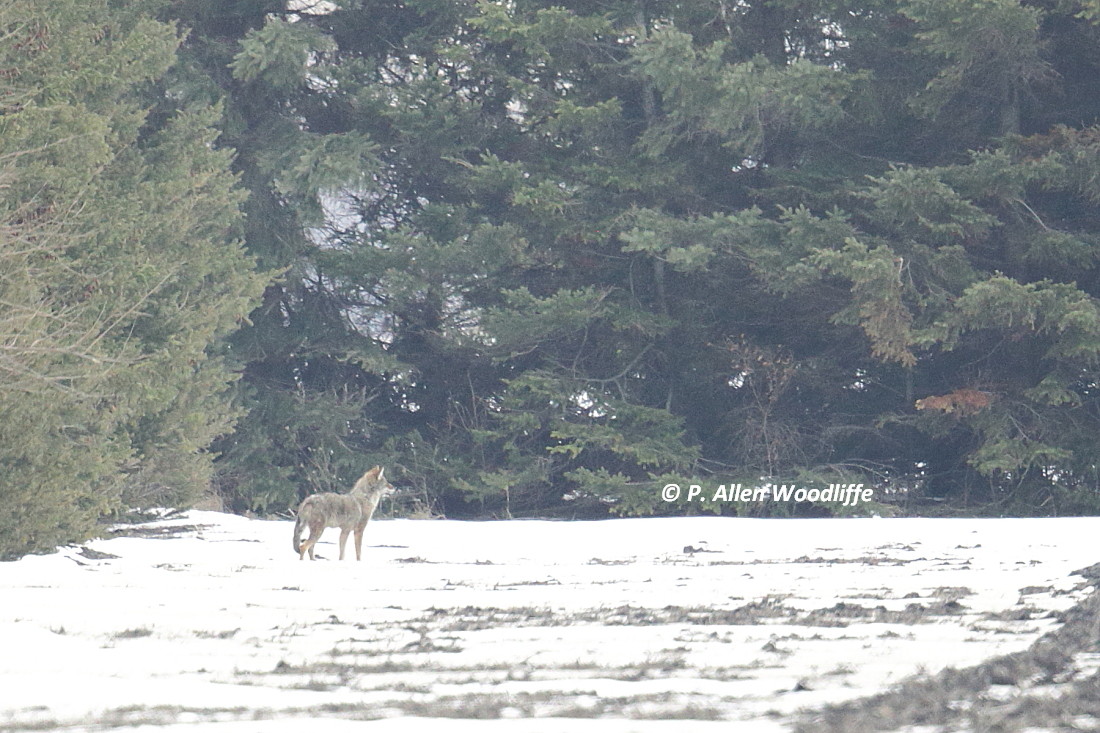
While driving slowly I noticed a canid off in the distance. It went through the end of the hedgerow, and stopped briefly due to something of interest off in the distance, and allowed me to get this photo.

The warm water outlet at the west end of Chatham had a few ducks, but of most interest was this female Belted Kingfisher.


A trip to Rondeau went well. Not surprisingly the greatest bird diversity was at the several feeders in the park. There were the usual things: Dark-eyed Juncos, Am Tree Sparrows, White-breasted Nuthatches, Blue Jays, Northern Cardinals, Red-bellied Woodpeckers, Downy Woodpeckers and such. Several Red-winged Blackbirds swooped in at one for a feed.

Downy Woodpecker


 I know....who bothers to photograph House Sparrows!

Away from the feeders there were a few things scattered about. I came across this White-throated Sparrow feeding along the side of the road.

This Hermit Thrush was the first of 2018 for me. It was hanging out in a brush pile at the pony barn.
Outside of the park I spent a fair bit of time driving back roads, hoping to come across a Northern Shrike, but it was not to be. On the way home one time, I checked for the ongoing Wilson's Snipe. It was there, but much farther back from the road, so only got a distant shot.