I mentioned in my previous post about a new series, comparing some of the birds of Chatham-Kent in the early part of the previous century, to their current status. The historic status will be based on an unpublished manuscript entitled "The Birds of Kent County, Ontario" by A. A. Wood (1948). Wood did most of his analysis between 1938-1948, but also relied to a fair extent on the writings, diaries and published articles by numerous well known southern Ontario birder/naturalists prior to that. His bibliography included 92 different sources from authorities such as W. E. Saunders, Jim Baillie, Thomas McIlwraith, George Stirrett, Ed Sandys and J. Macoun, among others. Most of his additional sources occurred around the turn of the century, although the earliest information he incorporated goes back to 1862.
Wood included information on 271 species of birds, plus at least a couple of dozen species which were considered hypothetical at the time, such as Red-throated Loon and "Little White Egret", currently known as Snowy Egret. I will present them in the order provided in Wood's manuscript, so they will not be in the current checklist order.
In going through this manuscript, I have tentatively identified about 70 species where he writes a few things of interest, or where the situation at the time is notably different from now. Clearly dealing with potentially this many species will require several installments, not just this post. So stay tuned if you are interested!
Common Loon
From Wood: this is a regular spring and fall transient, stopping for a time on large bodies of water. A few non-breeding birds remain on the lakes throughout the summer. Many are caught in the fisherman's gill nets at great depths. They have nested sparingly in some of the marshes along Lake St. Clair.
Now: not a lot has changed, although the numbers are likely lower now than they were then. I'm not sure if many are caught in gill nets these days. Nesting has not likely occurred anywhere near CK for many decades.
Red-throated Loon
From Wood: Hypothetical, although there were two reported on Lake St. Clair in the 1940s, and it was listed as a bird of the Rondeau region.
Now: certainly some significant differences. Spring-time records are not all that common in the Rondeau region, but in the last few years, they have become much more abundant than Common Loon, especially in late autumn. On some days, more than a dozen were reported flying past Rondeau's east side in just a few hours of observation. The most recent Blenheim/Rondeau Christmas Bird Count tallied a record 304 individuals on Dec 15, 2021! Time will tell if this trend continues.
Horned Grebe
From Wood: A common spring and fall transient and frequent winter visitant. Breeds abundantly at St. Clair flats.
Now: still a common, but not abundant spring and fall transient, and may be rarely seen during winters of open water. I found it interesting that it was considered an abundant breeder at the St. Clair flats. The St. Clair flats essentially include the large marshes and islands of Lake St. Clair. And that it bred there to me is not all that surprising, given that this is mainly a mid-western species commonly found in prairie type habitats and wetlands there. Since a good part of the former Dover Twp, as well as much of Walpole Island, have or at least had, strong similarities to prairies and wetlands of the mid-west, it is not surprising at all. These areas are known to attract other more western bird species as will be noted elsewhere in this series.
Here is a photo I took of a Horned Grebe nesting in a wetland in southern Saskatchewan back in 2018. It was right along a quiet back road, and I used my vehicle for a make-shift blind.
During the first Ontario Breeding Bird Atlas (1981-1985) there were two possible breeding records in southern Ontario: one in the marshes of Walpole Island and the other in the marshes of Rondeau. There were no records at any level of breeding during the second OBBA (2001-2005).
Double-crested Cormorant
An interesting species that has undergone significant changes in its abundance over the decades.
From Wood: A regular spring and fall transient along the Great Lakes.
Now: interesting that Wood does not mention anything regarding breeding or abundance. Certainly at one point early last century, it was fairly abundant, and since it was believed to be a significant predator of the desirable fish species by both commercial and sport fishermen, it was persecuted heavily. By the middle of last century and into the 1970s, it was quite rare, and in fact was being considered as a candidate for the newly enacted Endangered Species Act of Ontario! I posted a blog about that in more detail, which you can see here. Certainly things have changed a lot since the 1970s. The species did not make it on to the ESA, as shortly after that consideration, the numbers began increasing, slowly at first and then quite rapidly. It is now a major, even problematic, breeding species in many, many corners of the Great Lakes and beyond, and is present here in the south throughout the time of year where there is open water.
Great Egret
From Wood: this beautiful bird, from the far south, visits the area regularly in the fall but is very rare in the spring. Occasionally a straggler stays until the middle of October.
Now: It is not uncommon in the spring, and in fact nests in various places in Ontario. There is a sizeable breeding colony at Walpole Island, with other colonies up as far as Georgian Bay. Numbers can build up in the autumn, due to post-breeding birds and their progeny. They can gather in large numbers at times. Here is a photo of an overnight roost of them at St. Clair NWA, when low water appealed to them. I took this just before daybreak at the very end of September, 2012. There was upward of 100 birds here.

I suspect that a few weeks before this date, the egrets would roost over night in various other wetland areas, but as the waterfowl hunting season got underway, they would have chosen less disturbed areas. The water levels have not been low enough at the NWA since to allow for them to gather like this. If the autumn and even early winter is relatively mild, with open water, egrets will stay much longer. One or more have been recorded at or near the mouth of the Thames River in January twice in the last 5 years. This next photo shows two of three birds photographed there on Jan 23, 2021.
Black-crowned Night-Heron
From Wood: Considered a common summer resident in localized areas, with the only mentioned breeding colony in an artificially constructed wetland at Bradley's marsh at the mouth of the Thames River.
Now: this species is certainly not common, and in fact may not be nesting anywhere within Chatham-Kent. The closest confirmed nesting colony that I am aware of is at Walpole Island, although there may be some nesting going on at some of the cattail dominated islands in Lake St. Clair off of Mitchell's Bay. It is a little more likely to be seen at some of the larger wetlands along Lake St. Clair later in the season as birds disperse from their nesting colonies.
Some may persist well into a mild winter, as this next photo suggests. It was taken on January 21, 2012 near Erieau. One or more have been recorded on the early January SCNWA Christmas Bird Count on three occasions.
Tundra Swan
From Wood: the 'Whistling Swan' is a plentiful transient, with a few dozen to a few hundred seen and on occasion, up to 1100 have been observed in the spring.
Now: it is interesting that Wood does not mention anything much about them being present in the autumn, and even in the spring, 1000 birds or so was notable. Now, it is quite an abundant species in both spring and autumn. Perhaps it is due to the change in agriculture resulting in extensive corn stubble and winter wheat fields available. At any rate, seeing several hundred to several thousand in a day is not uncommon during either season, and at times there are well over 10,000 birds present at some localities in CK. The peak of the autumn migration would be in late November and early December, but there has been almost 11000 swans counted on one of the early January SCNWA Christmas Bird Counts. Over the last 4 years, there has been an average of more than 9250 swans seen on each of the Blenheim/Rondeau CBCs in the latter half of December.
American Black Duck
From Wood: The Black Duck is a common summer resident; the most abundant breeding duck in our area. Some years several thousand spend the winter in marshes, associating with Mallards.
Now: it is anything but common as a breeding species in Chatham-Kent. Historically it was as it occurred in forested wetlands and adjacent areas. With the opening up of forested areas and converting them to farmlands, etc., Mallard quickly took over as it was a species that thrived on the more open mid-western type habitats. There are a few recent breeding records of the Am Black Duck in CK and in general, in southwestern Ontario. However Mallards continue to be by far the most abundant duck species. In winter, the ratio of Mallards to Am Black Duck is much closer, although still leaning heavily towards Mallard. On a couple of occasions on the SCNWA CBC, we have had approximately 45000 Mallards, but the greatest number of Am Black Ducks on that count is about 7600.
Redhead
From Wood: A regular spring and fall transient, where rafts of one to two hundred may be identified. Nests were located on rare occasion near Mitchell's Bay.
Now: much the same as from Wood, although it is likely that up until recently, it was more often found as a breeding species in the vicinity of the Lake St. Clair marshes. During the second OBBA, there were 7 atlas squares in that area with breeding evidence. However there are likely fewer now, as the highly invasive and non-native Common Reed (Phragmites australis) has dominated much of the suitable habitat along the main channels. There are several channels passing through the bird's-foot delta that makes up Walpole Island First Nation. As mentioned, there used to be a lot of excellent nesting habitat for various species of waterfowl including Redhead. But now, with the spread of Common Reed, this is what most channel edges look like, and are virtually useless for many of those species.
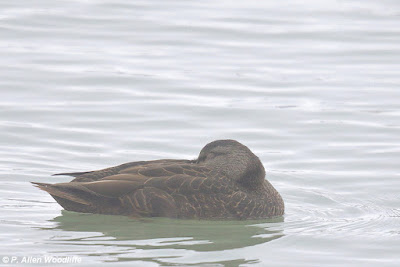
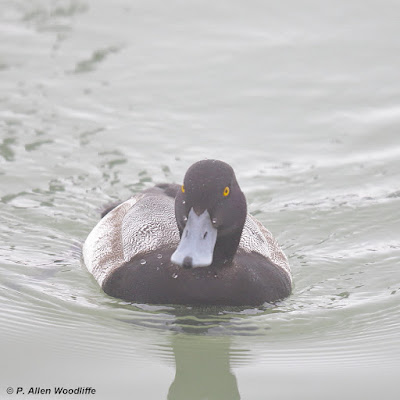
Lesser Scaup
From Wood: considered an abundant spring and fall transient and rarely remains to breed, with at least a couple of nesting records mentioned from the Lake St. Clair area.
Now: still considered fairly abundant at times, both spring and fall. There are a few breeding records from the second OBBA atlas squares adjacent to Lake St. Clair. However as is the case described for Redhead, the most suitable habitat along the main channels have deteriorated greatly, so it will be interesting to see if the third OBBA, just beginning the second of five years of data collection, will show any change.
Bufflehead
From Wood: a rather common spring and fall transient, with reference by some of his sources indicating that there are a few breeding at St. Clair flats.
Now: not much change as it is a rather common spring and fall transient. However there has been no evidence in recent decades of this species breeding anywhere within the marshes around Lake St. Clair, and that is consistent with both the first and second OBBAs.
Oldsquaw (now known as the Long-tailed Duck)
From Wood: considered to be a rather common spring and fall transient, and winter visitant. However a somewhat disturbing series of events a few decades earlier was included in the description. Every year fishermen catch dozens or hundreds in their nets. One source reported that in 1917, there were 12 tons of the birds (~1500 ducks to the ton) conveyed to a fertilizer factory.
Now: while Long-tailed Ducks are seen fairly regularly off of the lakeshore of the Great Lakes, by no means are they considered a common species at any time of year. For the Blenheim/Rondeau CBC which began in 1939, the maximum number of birds recorded on the day of the count was 80 birds, back in 1958. Some years it is not recorded at all, and over the last 15 years has averaged only 13 birds. For the SCNWA CBC, it has only been recorded twice since that count began in 1981.
Ruddy Duck
From Wood: A regular but not abundant spring and fall transient, but also includes a reference to an 1882 publication indicating that a few breed in the marshes.
Now: it is definitely a regular spring and fall transient, with fairly high numbers at times. On occasion well over 100 birds can be seen in one or more rafts off the shores of Rondeau. On other occasions, sometimes several hundred can be seen congregating in some of the larger sewage lagoons in CK. Both of the first and second OBBAs had several atlas squares with breeding evidence for this species, although mostly at the Probable level and very few at the Confirmed level.
This next photo shows a fairly typical number of Ruddies at a local sewage lagoon. On occasion there can be several times the thirty-five shown as present.
This concludes Part I of this series. Part II will not be far off.
If you would like to subscribe, or unsubscribe, to Nature Nuggets, send an email to: prairietramper@gmail.com