Showing posts with label spring wildflowers. Show all posts

Saturday, 13 May 2023

Wildflower parade continues; Virginia Bluebells are a highlight

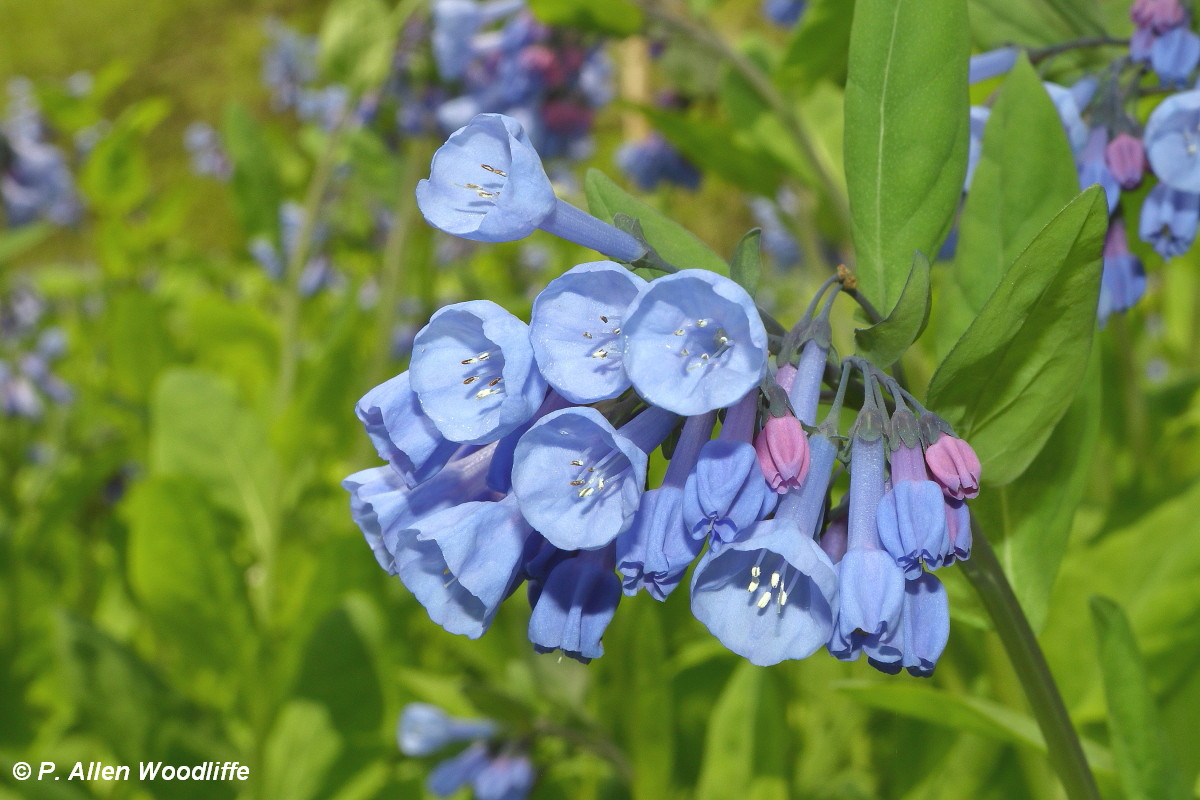
 There are lots of birds around these days, but wildflowers often get less attention. Therefore this will be another post which features the magnificence of many landscapes that birders frequent, but may not always pay as much attention to. That being said, I want to start off with a species of wildflower that is overall quite uncommon, but where it occurs, can be overwhelmingly dominant. I am referring to Virginia Bluebells (Mertensia virginica).

It is not a species that occurs in Chatham-Kent as far as I know, at least not naturally. It will be in an occasional private garden. But the populations I know of and have immersed myself in over the last decade or so are in two places in Elgin Co, and another in a nature reserve that borders Lambton and Middlesex.

These wonderful plants are relatively short-lived, but are dominant when in full bloom. The photo above was actually taken a few years ago at the Sydenham River Nature Reserve. The ones that follow were taken along a hiking trail in Elgin Co, where my sister and her husband invited me to join them a few days ago on their annual trek to see these beauties. It took the better part of an hour along the trail to get to the first of three patches, including a few ups and downs along the trail, so definitely not in the relative flatlands of Chatham-Kent! It covered several acres along Dodd Creek. Most were in full flower, with a few pink undeveloped ones yet to appear.

As in many populations of plants, there can be some anomalies, such as this next one which is fully open but has retained its pink colour.
It was a beautiful day and we had the place to ourselves. Sunny, mild with hardly any wind, and the only sounds were a few Baltimore Orioles vying for territory in the trees above, as well as the babbling creek nearby. (Thanks Susan and John!)


All in all it was a wonderful few hours enjoying this piece of creation.


Closer to home, I continue to be on the search for wildflowers while out birding or whatever. This first one is Blue Cohosh, the later blooming species compared to the one I featured a couple of blogs ago. The flowers are noticeably yellowish, not purplish.

Violets continue to be abundant, with this Downy Yellow Violet one of the most common.....
...a far less common species is this aptly named Long-spurred Violet, which grows in small scattered groups rather than being as widespread as either the yellow or blues ones.
Large-flowered Bellwort appears in clusters here and there.

There are still some Red Trilliums, and I have a hard time resisting them.
Skunk Cabbage was in its prime a few weeks ago, but I missed them at that time. It is not common in most places that I travel.
It is mostly visible by its leaves, rather than flowers these days.
A wildflower soon to be out is Canada Mayflower. The leaves, as shown next, are fairly widespread, and I suspect there may be a few out in flower that I haven't caught up to.

White Trillium continues to show well....

...as in this scene from Clear Creek Forest Prov Park.
Wild Blue Phlox is scattered here and there along roadsides and trails at Rondeau.
Wild Geranium is becoming more plentiful, and the flowers can vary a little in appearance.

Wood Anemone is relatively diminutive, but always pleasing to see if you get down close to it.
...and the sloughs of Rondeau, while dropping in water levels slightly due to the lack of precipitation over the last few days, continues to support members of the Yellow Water Crowfoot.

There will be a steady, but slightly decreasing stream of wildflowers appearing in the next few weeks due to the closing of the forest canopy. Some will likely appear in a future post.


If you would like to subscribe, or unsubscribe, to Nature Nuggets, send an email to: prairietramper@gmail.com


Tuesday, 5 May 2020

Happy Birthday Rondeau!

Today marks the 126th birthday of Rondeau Provincial Park. A year ago we had a nice celebration of former and current park staff, as well as numerous visitors. This year, with the park being closed, there is no on-site celebration, and in fact most people won't even be aware of this milestone at all, unless you are reading about it here. So consider yourself one of the knowledgeable few.

All of the parks in the provincial park system, including Rondeau, have been closed since March 19. No one is allowed in at Rondeau, other than cottagers, although I have heard that some folks are ignoring the closed signs and status. They do so at their own risk, since the potential fines can be substantial.

I was last in the park on March 18, the day before it was closed as it turned out, so I can only imagine what might be happening over the last few weeks. With the spring bird migration normally in full swing right now, one can only wonder what might be arriving without being seen. Perhaps there would be some new species for the park checklist, and no one is there to document the event! In the meantime, I will dig into my photo files and provide some idea of what may have occurred.

The first two photos were taken earlier this year, just before the park was closed. The mood even then was sombre, perhaps a foreboding of the future closure, with the foggy light filtering through the still mostly dormant forest.


 Wood Ducks had appeared.
 The leaves of an uncommon orchid, Puttyroot, were still visible late in the winter. They will then dry up and disappear as the flowering spike then develops to be in flower in early June.
But as the spring slowly unfurled, here are a few things that have likely occurred, or arrived. Blue Jays were fairly common this winter. Some will have moved back north.
 American Robins have arrived in numbers outside the park, so one can only expect that there are many of them inside, busily carrying on with their usual routines.
 Eastern Towhees have arrived.
 Spring wildflowers are emerging, such as Bloodroot, one of the earliest.
 Sharp-lobed Hepatica, as defined by the pointed leaf structure, will have undoubtedly almost finished by now.
 Spicebush is an abundant shrub, thriving in the damp soils that are so common at Rondeau. There is often a yellow hue to the forest understorey about now, indicating the abundance of this fragrant shrub.
 Dutchman's Breeches are common on the higher, drier parts of the forested ridges.
 A somewhat rare plant, Wood Violet, should be in flower in the next few days. It only occurs in a few small spots in the more northerly parts of Rondeau. Will anyone be able to enjoy it this year?
 ....or that of the diminutive False Mitrewort, the delicate flowers of which are barely half a centimetre in diameter?
 Red Trillium is not nearly as common as its white, provincial counterpart, but is widespread and as their average first flowering date is about May 4, should be in flower right now.
 Sometimes there are unusual forms of the Red Trillium to be found, such as this next one which I have seen on several occasions along the Spicebush Trail. Will it be there again in 2020, or has it completed its life cycle never to be seen again?
In another couple of weeks, this declining orchid will be in flower. Although its name is Showy Orchid, it is small and anything but showy unless one gets down to its level for a close-up view.
Of course birds are one of the things that many people look forward to at hotspots like Rondeau right about now. Undoubtedly they will arrive as usual, but will they notice the lack of birders with binoculars pointed in their direction? Probably not, I'm thinking. These first two species are some of the almost 40 species of warbler recorded at Rondeau, and are pretty common any year.
Chestnut-sided Warbler

Black-throated Green Warbler
 And then there are the less common ones, that always get a little more attention when they are found, such as Hooded Warbler....
 ....and including, of course, the unofficial bird of Rondeau, the Prothonotary Warbler. Rondeau remains the provincial, indeed the national, stronghold for this dazzling warbler.

 Common Nighthawks aren't so common any more, and to find one cooperatively resting on a visible branch along a trail is always a treat.
 The Red-headed Woodpecker, which used to be fairly common, is now far less often seen anywhere in Ontario, although in any given year there may be one or two pairs of them still nesting at Rondeau.
 The White-winged Dove has been back for a few weeks now so I am told. If its past behaviour is any indication, it will still be easily found by the time the park (hopefully!) opens up again.
As May continues, there will be other highlights, including an array of colourful butterflies flitting along the trails.
Eastern Tiger Swallowtail
 So regardless of the current closure of the fabulous natural areas that we tend to enjoy, and to some extent take for granted in both the Provincial and National park system, it is some consolation to know that nature will likely thrive nonetheless. In fact it is almost certain that there will be far fewer road killed critters adorning the roadways!

The sun will rise again and it is just a matter of time before we can enjoy these special places.
In the meantime, stay safe, and

Happy Birthday Rondeau!


Sunday, 13 May 2018

Natural Areas of Chatham-Kent, Part 14 (Clear Creek Forest)

Clear Creek Forest is one of the most recent additions to the provincial park system. It has an interesting recent history, being privately owned up until a few years ago. I first encountered this impressive woodland in the early 1980s, when I was the regional coordinator for the first Ontario Breeding Bird Atlas. I had been roaming around looking for places to find breeding birds, and came across this site, which had an unofficial trail into it. I wandered along the trail and was immediately impressed with the condition of the forest. It was relatively untouched and had an assortment of impressively large trees, especially along the trail which followed along the top of the bank overlooking a creek and floodplain.
There was a project called Significant Natural Areas of Kent County underway at the time. We added this site to the project, and gradually its importance became better known. It was part of a much larger natural area of varying vegetation types and conditions, stretching all the way to Lake Erie. This length of an area, complete with one of the better examples of what was considered a cold water stream, was unusual in C-K.

Eventually the owner of the property, who lived in Michigan, passed away, and the executors of the estate were trying to decide what to do with it. There was an interest by local environmental groups and individuals to see it retained in its natural condition and together with the Nature Conservancy of Canada and Ontario Ministry of Natural Resources, managed to acquire this site. It became regulated as a provincial park in 2014, classified as a Nature Reserve. Some signs like the following identify its provincial park status. There are no staff on site; however it is under the administration of Rondeau Provincial Park.

The most accessible area is the part north of Hwy 3/Talbot Trail, near the corner of Duart Road and Cochrane Line. There is a small parking area marked on the next photo by an 'X' along the roadside across from the entrance to the trail, which is shown as the blue line.
As mentioned, there are some impressive trees in part of this site. Most of them are species typical of the hardwood forests of southwestern Ontario, and include American Beech, Sugar Maple, Black Cherry, Basswood, Bitternut Hickory, White Ash and several oak species, although the ash trees have been almost obliterated due to the invasive Emerald Ash Borer.
One of the largest American Beech trees in Ontario is here. It is close to a metre in diameter.
The forest floor is rich with spring wildflowers.
Dutchman's Breeches
Large-flowered Bellwort
Wild Blue Phlox
Mayapple
Skunk's Cabbage...not common but present in the early part of the season
Wild Geranium
There are birds, of course, both migrants and breeding species. It has not been birded heavily, but even so there are at least 117 species of birds known for the site to date. Warblers are a highlight in the spring, most of which are migrants.
Black-throated Blue Warbler


A possibly breeding warbler is this next one.
Ovenbird
Baltimore Orioles are well represented.
Eastern Towhee is certainly present in various parts of the park.
Pileated Woodpeckers are present in small numbers. A pair had a nest right beside the trail a year ago.
 Ruby-throated Hummingbirds are seldom seen, but it is prime habitat for them.
The more extensive woodland area is sought after by Wood Thrush, a declining species and officially at risk.
Blue-spotted Salamanders, and their Red-backed Salamander relatives, are found throughout the higher quality forest but seldom seen as they spend the majority of their time underground or under logs.
On the north side of Cochrane Line is a very different part of the park. It is an old gravel pit complex, and there are several ponds, some of which have been there for several decades. I remember swimming in one as a teenager back in the 1960s. This next photo is of one of the largest ponds.
At the upper level of the site is another pond, which has more trees and shrubs around it.
There have been a couple of new ponds constructed in the area, which will gradually develop into something more valuable for wildlife.

With so much water present, it is a great spot for dragonflies. This first one is a Halloween Pennant.
 This next one is a White-faced Meadowhawk, which is chowing down on a midge type of insect.
The open areas have many later season flowering plants, and are popular with butterflies.
Common Ringlet on Black-eyed Susan
Hickory Hairstreak
Clear Creek Forest is a valuable addition to the provincial park system, and a worthwhile site to explore in Chatham-Kent at any time of the year!


This concludes the Natural Areas of Chatham-Kent series as per my presentation earlier this year at the Chatham Public Library. However there are other natural areas which were not covered at that time, and I hope to expand this theme to include some of them in the future.