Showing posts with label winter. Show all posts

Monday, 17 January 2022

Early New Year Outings, Before the Snow and Cold

 Since the Christmas Bird Count season is well past, I have altered my outings a bit. Certainly a few visits to places like Rondeau Prov Park have been in order, but as the winter progresses, birds have become fewer. However there are still great reasons for getting out! I have spent some of the time just going for long walks through the forest roads and trails. Much of the time it seems I have the place to myself, which I don't mind.

I quite enjoy the incredible diversity in the shades of gray and green in winter, which can vary quite a bit depending on the direction and intensity of light. As Rondeau is an example of old growth forest, it shows how tree trunks are not always perfectly straight, as you typically see in a plantation.

Yellow Birch root systems are often interesting. The seeds sprout on things like a fallen tree trunk or other root system. As they grow, they can show curious forms such as this one.
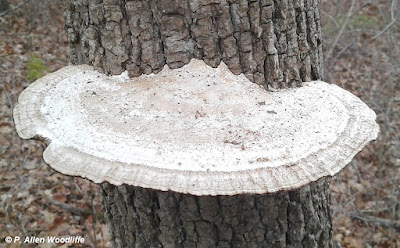
Fungi are still visible, at least the hardier ones like the bracket type of fungus shown next.

Northern Cardinals can be fairly abundant, and the males really stand out. In spite of their relative abundance now, it was just a little more than a century ago when they were first recorded breeding in Ontario, and only in the extreme southwest at Point Pelee. They certainly have expanded their range, as birds do. Now they are seen somewhat regularly well into Northern Ontario, even as far as Moosonee.

One day in my travels, I was out checking to see if a Wilson's Snipe had shown up at its usual wintering spot, in a spring fed stream southeast of Blenheim. As far as I know, it hasn't been seen by anyone there yet, but once the more intense cold arrives, along with a bit of snow, it will likely appear.

Snipe from a previous year

I did see this Red-tailed Hawk comfortably perched on a road-side snag, looking over a few juncos and tree sparrows beneath it. 

However its nervousness regarding my camera sticking out the window overcame its comfort, and off it went.

I had been out to Lighthouse Cove at the mouth of the Thames River, as well as points farther west a few days ago, to cover my area for the mid-winter waterfowl survey. It was just after a recent cold snap, and the ice kept most waterfowl beyond view. In an open spot at the river mouth, I did see a few Double-crested Cormorants....

...and a Hooded Merganser.
An adult Bald Eagle was perched in a tree right along the road, seemingly not bothered by traffic frequently passing almost right below. I managed a couple of photos.....
.....but as with the Red-tail, a stopped vehicle and a camera made it decide to move on.
At Jeannette's Creek where it meets the Thames River, there were about a dozen Great Blue Herons looking a little out of place.

A couple of days ago I went back out to see what was at the river's mouth. The ice had taken over almost completely, and there was only a small opening about half the size of a vehicle, where there were about 8 birds crowded in: two Canada Geese, two Common Mergansers, and four domesticated Mallard types.

I also stopped a bit upstream of the river's mouth, as there was an opening with several hundred geese. Included were 12 Snow Geese, including at least 4 blue phase.....

...and eight Greater White-fronted Geese. We had 5 on the SCNWA CBC, and it is quite likely that they were part of this group. Most were tucked in to the larger group of geese, and difficult to photograph, but one or two were more or less out on their own.

Yesterday I was back at this spot, hoping to get some slightly crisper and overall better photos since the light on the previous trip was quite intensive, but alas, they had been seen leaving this spot a couple of hours earlier. There are still lots of geese hanging around the Chatham area and points downstream, so maybe they will turn up again.


If you would like to subscribe, or unsubscribe, to Nature Nuggets, send an email to: prairietramper@gmail.com


Friday, 13 February 2015

The depths of winter at Rondeau

I don't need to post any reminders that it is still winter. And it looks like the ground-hog prognosticator that foretold of a few more weeks of winter is likely correct. It is expected to remain below normal temperatures for at least the rest of February.

Having said that, it is still nice to get out and look for whatever is around. So a day or two ago, I headed south to get my Rondeau fix.

The weather was snowy, and the park was quiet. During the several hours I was there, I only saw two people who were not park employees.

The forest was still, other than zillions of small flakes drifting downwards to add to the already considerable blanket, and giving a hazy appearance to the landscape. The above photo is of a slough along Bennett Ave. Hard to believe that in less than three months, Prothonotary Warblers will (hopefully) be back nesting in this slough again. At least with all the precipitation, it appears that the sloughs will have lots of water this year, so there will be no shortage of Prothonotary habitat.

Even though there wasn't much overt action in the woods, one could see where wildlife had been active. This next photo is of a very freshly worked trunk of Sassafrass, where one of the resident Pileated Woodpeckers had been digging for a meal.


An Eastern Cottontail was hunkered down under a bush.


Bird feeders are where some wildlife action is virtually guaranteed, so a stop at the Visitor Centre was in order. At first it was quiet, but the 'locals' arrived all in good time. With the snow falling steadily, the continuous movement made the auto focus of the camera challenging.

American Tree Sparrow and Northern Cardinal

Song Sparrow

White-crowned Sparrow
 Note the extra white spots on the sparrow above....complements of the falling snow!
Red-winged Blackbird
There aren't many Red-wings around this time of year, and I was a little surprised to see this one come in. There were lots of Brown-headed Cowbirds, and the usual juncos, goldfinches, nuthatches, red-bellies, etc.

The male Eastern Towhee made an appearance in the background, but I never saw it come right in to the feeder while I was there. This shot is from a few days ago.


Winter can be tough on wildlife, as you know. My previous post discussed some of the ways they cope to survive.

But I wondered about another 'resident'.......I'm not sure how many of you have heard of the legend/story/myth of Bruno? There was a work camp at Rondeau in the first part of the last century, where men were employed to build facilities, clean up fallen trees and such. One time a worker of German descent was injured out in the bush. His co-workers went for help, but when they came back, he was gone. And he was never seen again. But rumours persisted that he was still roaming the wilds of Rondeau, and someone even found where his camp was!

So you can ponder the validity of this story, as well as how he might have survived without ever being seen.

Please note: this is a long weekend, beginning tomorrow, as Family Day is on Monday, February 16. The Rondeau Visitor Centre is open Saturday, Sunday and Monday, from 10 a.m.- 4 p.m. There are special programs planned, so if you are looking for an excuse to get out to enjoy winter at Rondeau, this is the perfect weekend to do it! Check out this web site link for more details:
http://www.rondeauprovincialpark.ca/2015/02/hear-ye-hear-ye-family-day-weekend-is-fast-approaching/

On the 'this and that' front, earlier this week I was out east of Thamesville. I had noted a Bald Eagle nest here quite awhile ago, and it is quite visible from Longwoods Road especially when the leaves are off. It is exactly 5.8 kilometres east of the railway tracks at the east edge of Thamesville.

 At first I thought it was right along the river, but upon closer examination, it is at the edge of an old oxbow of the river. This particular day I just had my point and shoot with me, but I managed to get a photo of the nest while an adult perched in a tree nearby. The local Bald Eagles are strengthening their pair bonding right about now, and it won't be long before an adult will be on this nest incubating eggs.

And an update on the Pine Warbler which was coming into a feeder at the south side of Chatham. The bird initially survived the storm of the Super Bowl weekend, but was last seen on the Monday afternoon following. Hopefully it has found a place to survive!

Pine Warbler


Friday, 14 November 2014

It's beginning to look a lot like....

....wait a minute....we shouldn't be singing that jingle for at least another month (although Christmas songs are now being heard on the radio from time to time).

But yesterday morning, it was looking like this for Chathamites: a fresh blanket of snow with autumn leaves still falling.

And to think just two short days before, we were enjoying Indian summer like weather, with temperatures reaching as high as 17C!

Weather changes can affect wildlife, especially migrating birds. Given the as yet not severe late fall/early winter weather, some birds have not taken the next leg of their southern migration journey. I got a message from Jim Burk yesterday morning that he had seen a Semipalmated Plover fly over at Erieau, and also a quick glimpse of a Spotted Sandpiper which had been seen a few days ago and I reported on a previous post. Both of these species should be much farther south by now. So I headed to Erieau in the hopes of finding one or the other of these birds, or something else equally as interesting.

As expected, the closer I got to the lake, the less snow there was, and by the time I got to Erieau there were only tiny bits of snow remaining in some sheltered areas. It is the lake effect, which is the reverse in the spring when inland temperatures can be quite warm, but breezes off the water can make being at the lakeshore very cool.

The water is still completely open, since it hasn't been below freezing long enough to produce ice. And there were birds. The most notable bird species and numbers were: Horned Grebe (125), Ruddy Duck (35), Double-crested Cormorant (22+) and Bald Eagle (2). Actually one of the eagles was so far off it was difficult to call it a Bald for sure.....Goldens are migrating through right now, and it appeared very dark all over, so it might have been the latter species. Of course there were other species, including good numbers of Common Goldeneye, Bufflehead, scaup, Red-breasted Mergansers and the usual mix of gulls, some of which were quite close in the main slip. Most were quite a way off, and not worth attempting a photo of, but for those that swam by close enough, I tried to oblige with the camera.

Double-crested Cormorant


Horned Grebes

Red-breasted Merganser
But no shorebirds that I saw.

Leaving Erieau and returning inland, I noted lots of gulls feeding in the fields, along with huge flocks of starlings. Horned Larks are also around in increasing numbers.

I decided to stop in at the Blenheim Sewage Lagoons, as I hadn't been there for awhile, and one never knows what lingering shorebirds there might be. It turned out to be a worthwhile decision, even though the sun was getting lower. There were lots of ducks, and a good mix of species. Most notable were: Ruddy Duck (260+), Northern Pintail (4), Northern Shoveler (175+), Hooded Merganser (5), Green-winged Teal (6) and Horned Grebe (5) (although the latter species is not technically a duck). Other waterfowl included Mallard, Black, Bufflehead Canada Goose and Greater Scaup. There were lots of gulls as well, mostly Bonaparte's, in a feeding frenzy. I'm not sure what they were finding, as I never saw them with anything in their beaks, but they were sure trying hard!


Bonaparte's Gulls

Bonaparte's with Northern Shoveler and Greater Scaup

Northern Shoveler

Ruddy Duck
The sprinkler cells had quite a bit of water in them, at various levels, providing optimal conditions for a variety of species. The most northerly cells were quite full, and had lots of the Northern Shovelers. Fortunately the closer two cells had a bit of water more suited to shorebirds, and it was there that I found the shorebirds. I counted at least 82 Dunlin as well as a single Pectoral (with one leg) and also had a single Killdeer fly over.

Dunlin

Dunlin
 The sun was very bright but getting fairly low by this time, giving everything a golden glow, so the colour of these Dunlin look more golden than they might under different conditions.
Pectoral Sandpiper
The Pec had a bit of trouble hopping around and feeding, but in flight it had no apparent problem at all.

There were also quite a few American Pipits scattered around.

American Pipit
As the sun began to go behind the clouds near the horizon, it resulted in a brilliant sundog. Having only a lens combination with the equivalent of 640mm at hand, I couldn't back up far enough to get more of the sky.